Showing posts with label programmes for schools and colleges. Show all posts
Can’t Help Thinking About Christmas
Can’t Help Thinking About Christmas is a special stocking-filling companion to the year’s best-selling book about obscure radio shows and films nobody remembers Can’t Help Thinking About Me, and includes the following seasonal trimmings:
– A collection of reviews of some of the worst sitcom Christmas Specials ever made (and a couple of good ones too!)
– A Christmas Party Medley of nonsense about carol services, BBC Records And Tapes, mind-hurtingly strange Christmas Films, and when some Brookdale kids tried to steal ‘the disco’ in Grange Hill
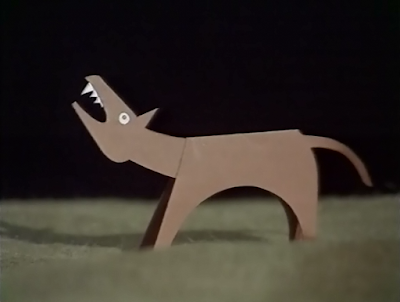
– The story behind BBC Schools programme Music Time‘s adaptation of Lieutenant Kije
– Features on Saint Etienne Presents Songs For A London Winter and Santa Claus Is On The Dole by Spitting Image
– The ultimate guide to Denys Fisher’s TV tie-in board games
– And a brand new feature on the little-seen Rising Damp Christmas Special!
All of the previously-seen pieces are updated with new footnotes, introductions and extra detail – yes, we finally know who wrote the theme to George And The Dragon! – and there are a couple of extra Yuletide surprises too. It’s probably only going to be available during December, so grab your copy now!
Can’t Help Thinking About Christmas is available in paperback here or from the Kindle store here.
And if you still haven't got it, Can't Help Thinking About Me is available in paperback here or from the Kindle store here.
Peep-Peep, Pandit And Papers: Richard Carpenter's Look And Read Serials
This feature on the three memorable yet often overlooked serials written for the BBC schools programme Look And Read by Richard Carpenter - more widely recognised as the creator of Robin Of Sherwood, Catweazle and The Ghosts Of Motley Hall - was originally written for the television review site Off The Telly. Later, with a bit of reworking, it found its way into a special issue of the fanzine This Way Up devoted to Richard Carpenter, which is well worth tracking down if you can find a copy as there was a lot of very good material in it. This was basically written as a reaction to the manner in which 'genre' magazines would tend to dispense with Look And Read in little more than half a sentence when talking about his 'proper' shows; this was very much at odds with how fondly The Boy From Space in particular is remembered by those who actually watched it at school, or indeed chanced upon it as a bit of 'extra' sci-fi on a day off. You had to make your own entertainment in those days. Incidentally the title was intended to appear as Peep-Peep, Pandit And Papers, to reflect the technique used in Look And Read's animated interstitials, but nobody could ever find a way of making that work properly - including right now - so it always just looked a bit bland. Anyway, the piece itself is anything but bland, though I've had to trim it slightly to remove a couple of inaccuracies and a lot of waffle. Wordy would be proud.
What did Richard Carpenter once describe as “the most difficult thing I’ve ever written in my life”? His first ever television commission? Three series about a small cast limited to a single set? Trying to make The Adventures of Black Beauty in any way watchable?
No, it was The Boy from Space, a ten-part serial he penned for the long-running BBC Schools' programme Look And Read in 1971. Aimed at a primary school audience, Look And Read featured a combination of dramatised story segments, animated musical inserts and studio links with a presenter, and sought to reinforce reading and writing skills. A rare example of genuine 'entertainment' in education, the various Look And Read serials are inevitably fondly recalled by those who watched them at school, and many of the most well-remembered were written by Richard Carpenter.
Developing out of the similarly long-running Merry-Go-Round, Look And Read had made its debut in 1967 with the straightforward light-hearted crime caper Bob And Carol Look For Treasure. The somewhat grittier Len And The River Mob followed in 1968, which introduced the concept of the filmed drama segments being linked by one of the cast in character, in this instance George Layton as Len. Feeling that the programme needed to explore a fresh genre and direction, producer Claire Chovil then contacted a relatively new television writer to develop an idea for a science fiction-themed serial.
Previously an actor, Richard Carpenter had developed the idea for Catweazle, a comedy-drama about a medieval sorcerer who finds himself transported forward in time, in 1969. Quickly commissioned by London Weekend Television for broadcast the following year, Catweazle was an instant hit with viewers and critics alike, inspiring a best-selling tie-in novel and winning numerous industry awards. Impressed by his ability to relate advanced concepts to a younger audience through careful use of language, Chovil commissioned Carpenter to write a new serial limited to using, as he would later put it to TV Zone, "the first two hundred words of the English language, plus a few words like ‘telescope’ and ‘telephone’ and ‘television'". And unlike Catweazle, he couldn't make up his own new words and phrases to cover them either.
First transmitted in September 1971, The Boy From Space tells the story of Helen (Sylvestra Le Touzel) and Dan (Stephen Garlick), two astronimically-obsessed youngsters who come to the aid of a stranded alien boy who they nickname Peep-Peep after his garbled bleeping speech, and shield him from a sinister 'Thin Man' intent on extracting information from him. Although limited by its educative purpose and short episodic structure, The Boy From Space is more tense and enjoyable than might normally have been expected from a programme of this nature. Much of this is down to the skilful and economical direction by former BBC Radiophonic Workshop musician Maddalena Fagandini, though at its absolute foundation is Carpenter’s script, which managed to turn the small cast and equally limited number of locations to its advantage.
Although the BBC had nominally moved to colour broadcasting in 1970, some lower priority departments were still making programmes in black and white into the early seventies, and The Boy From Space was both taped and transmitted in monochrome; although the filmed segments were actually made in colour, with a view to later repeating them in 'movie' format. The serial was repeated up to the Autumn of 1973, after which the original tapes were erased. Little is known about the studio segments, other than that they were presented by actor Charles Collingwood and apparently from an observatory set, and all that remains of this original version are the standard Look And Read classroom workbook, featuring a simplified novelisation with illustrations and exercises based on the teaching segments, and an abridged version of the story soundtrack released by BBC Records And Tapes (RESR30). And the filmed inserts, of course, but more about them later.
First seen in Spring 1973, Joe And The Sheep Rustlers by Leonard Kingston was the first Look And Read serial to be made in colour, and took an entirely different direction yet again with its straightforward story of livestock pilfering. The following year, it was back to sci-fi as Richard Carpenter returned with Cloud Burst. Possibly inspired by the BBC's primetime 'sci-fact' serial Doomwatch, Cloud Burst brought the excitement thoroughly down to Earth with the tale of stolen plans for a 'Rain Gun' that could potentially eradicate drought and famine. Slightly less convincingly than their counterparts in The Boy From Space, youngsters Tim (Nigel Rathbone) and Jenny (Tina Heath) have an obsessive interest in atmospheric conditions, apparently on account of their father being a lock-keeper. This brings them into contact with scientist Ram Pandit (Renu Setna), who is developing the 'Rain Gun' in his laboratory; his twin brother Ravi is determined to steal his research and use it to make money rather than save lives, and what's more has a handy 'Gas Gun' at his disposal.
Unnervingly closer to a Cold War thriller than clean-cut childrens' adventure, and benefitting greatly from Carpenter's insistence that, with advancing technology in mind, Pandit's laboratory should have a 'home-made' feel to offset the computers looking outdated, Cloud Burst is a skilfully made serial with an unexpected 'lo-tech' twist at the climax. It also boasted an arresting opening sequence, with an ominious instrumental by the BBC Radiophonic Workshop's Roger Limb, complete with a perfectly-timed thunderclap, played out over time-lapse photography of blooming deserts. It was the first of many Look And Read serials to be re-edited in sound only for BBC Schools Radio, and to feature the celebrated 'darting eyes' opening animation, but it also brought with it a slightly more contentious innovation.
Incoming producer Sue Weeks was keen for Look And Read to introduce a regular puppet character that could interact with the human presenter, in much the same manner as other BBC Schools shows like Words And Pictures and You And Me. The result of this was Mr Watchword, or 'Wordy' as he was informally known - a huge orange electric typewriter print head with a face and arms and voiced by Charles Collingwood, who would smugly interject with know-all observations on how much better he was at using language than the rest of us 'Word-Watchers'. Wordy would remain with Look And Read until 1992, but was clearly a source of much irritation even at this early stage. The studio segments for Cloud Burst were presented by Richard Carpenter himself, in the postmodern guise of the story's writer, who would take great delight in pointing out to Wordy that he actually knew what would happen next.
Carpenter was the strictly off-screen writer of 1977's The King's Dragon, which kept up the postmodern pretence by featuring Kenneth Watson as Hasting Times editor Jack Dunbar, puzzling over how to paste up a story about the central archaeological mystery in the face of constant interruptions from Wordy. Indeed, there was a further experiment with encouraging the audience to produce their own classroom newsletter about the unfolding events, which was somewhat undermined by the relatively unspectacular nature of the serial itself.
Contrary to the sword and sorcery that the title might suggest, The King's Dragon is simply a historical artefact that has been stolen from a museum in a small Hastings village. Hot on the thieves' trail are Billy West (Sean Flanagan, also starring in Carpenter's The Ghosts Of Motley Hall at the time), a local youngster who has worked out their secret code for communicating via personal ads and newspaper headlines, and Ann Mills (Frankie Jordan), a Hastings Times reporter assigned to cover an archaeological dig. They soon find out that there are in fact two King's Dragons, and nothing about the theft is quite what it seems.
There is nothing wrong with The King's Dragon in itself - it's a taut escapade in the manner of Carpenter's more straightforward historical adventure serials such as Dick Turpin and Smuggler - but it had little to offer those who had thrilled to the decidedly atypical-for-the-classroom The Boy From Space and Cloud Burst. It inevitably came across as something of a comedown, not to mention a lot close to traditional classroom exercises, and - perhaps unfairly - it is widely regarded as the lesser of the three serials.
Unfortunately it was also Richard Carpenter's last new serial for Look And Read, although it did not actually mark his final contribution to the series. Following Leonard Kingston's Sky Hunter in 1978 - coincidentally featuring Catweazle star Geoffrey Bayldon amongst the cast - the production team were keen that their next project should be a cheaper book-balancing effort. The original filmed inserts for The Boy From Space were duly located, new animated inserts were commissioned, and studio dates were booked to tape Wordy and his technician Cosmo (Phil Cheney) aboard the space station Wordlab 1, which some may well have felt was the best place for them. However, it soon transpired that the film sequences required some restoration work and new editing, and also some new music and sound effects to bring them more in line with the current Look And Read house style. At a late stage of production, the decision was taken to film a brief new introductory sequence featuring Helen and Dan - played by the now adult Sylvestra Le Touzel and Stephen Garlick - returning to the observatory to reminisce; presumably, this was added to excuse some of the by then outmoded fashions and hairstyles on display. Needless to say, this did not exactly result in as much book-balancing as had been hoped for.
Nonetheless, this unexpected expense was arguably worth it for the BBC Radiophonic Workshop's Paddy Kingsland's musical contributions alone. Replacing the original contributions by his colleague John Baker, Kingsland added a more suitably post-Vangelis/Jean Michel Jarre style of 'space' music to the existing films and the new segments, and most memorably to the opening and closing titles. To the accompaniment of swooping portamento synth lines, Look And Read's regular singer Derek Griffiths plaintively asks "Out there in space, shall we find friends? Is there a place where the Universe Ends? When shall we find it? Never. Never. Space goes on forever...", echoing into the infinite distance as the closing credits roll. Lonely, haunting and dispassionate, it's likely that this song is what is most well remembered about The Boy From Space.
Although Cloud Burst and The King's Dragon have yet to put in an appearance, The Boy From Space is now available on DVD, complete with chapter points that make it easy to skip past the studio links when you've had quite enough of them. Space may well indeed go on forever, but thankfully Wordy does not have to.
There will be more about the BBC Records And Tapes LP version of The Boy From Space soon. In the meantime, you can get Top Of The Box - The Complete Guide To BBC Records And Tapes Singles from here.
What did Richard Carpenter once describe as “the most difficult thing I’ve ever written in my life”? His first ever television commission? Three series about a small cast limited to a single set? Trying to make The Adventures of Black Beauty in any way watchable?
No, it was The Boy from Space, a ten-part serial he penned for the long-running BBC Schools' programme Look And Read in 1971. Aimed at a primary school audience, Look And Read featured a combination of dramatised story segments, animated musical inserts and studio links with a presenter, and sought to reinforce reading and writing skills. A rare example of genuine 'entertainment' in education, the various Look And Read serials are inevitably fondly recalled by those who watched them at school, and many of the most well-remembered were written by Richard Carpenter.
Developing out of the similarly long-running Merry-Go-Round, Look And Read had made its debut in 1967 with the straightforward light-hearted crime caper Bob And Carol Look For Treasure. The somewhat grittier Len And The River Mob followed in 1968, which introduced the concept of the filmed drama segments being linked by one of the cast in character, in this instance George Layton as Len. Feeling that the programme needed to explore a fresh genre and direction, producer Claire Chovil then contacted a relatively new television writer to develop an idea for a science fiction-themed serial.
Previously an actor, Richard Carpenter had developed the idea for Catweazle, a comedy-drama about a medieval sorcerer who finds himself transported forward in time, in 1969. Quickly commissioned by London Weekend Television for broadcast the following year, Catweazle was an instant hit with viewers and critics alike, inspiring a best-selling tie-in novel and winning numerous industry awards. Impressed by his ability to relate advanced concepts to a younger audience through careful use of language, Chovil commissioned Carpenter to write a new serial limited to using, as he would later put it to TV Zone, "the first two hundred words of the English language, plus a few words like ‘telescope’ and ‘telephone’ and ‘television'". And unlike Catweazle, he couldn't make up his own new words and phrases to cover them either.
First transmitted in September 1971, The Boy From Space tells the story of Helen (Sylvestra Le Touzel) and Dan (Stephen Garlick), two astronimically-obsessed youngsters who come to the aid of a stranded alien boy who they nickname Peep-Peep after his garbled bleeping speech, and shield him from a sinister 'Thin Man' intent on extracting information from him. Although limited by its educative purpose and short episodic structure, The Boy From Space is more tense and enjoyable than might normally have been expected from a programme of this nature. Much of this is down to the skilful and economical direction by former BBC Radiophonic Workshop musician Maddalena Fagandini, though at its absolute foundation is Carpenter’s script, which managed to turn the small cast and equally limited number of locations to its advantage.
Although the BBC had nominally moved to colour broadcasting in 1970, some lower priority departments were still making programmes in black and white into the early seventies, and The Boy From Space was both taped and transmitted in monochrome; although the filmed segments were actually made in colour, with a view to later repeating them in 'movie' format. The serial was repeated up to the Autumn of 1973, after which the original tapes were erased. Little is known about the studio segments, other than that they were presented by actor Charles Collingwood and apparently from an observatory set, and all that remains of this original version are the standard Look And Read classroom workbook, featuring a simplified novelisation with illustrations and exercises based on the teaching segments, and an abridged version of the story soundtrack released by BBC Records And Tapes (RESR30). And the filmed inserts, of course, but more about them later.
First seen in Spring 1973, Joe And The Sheep Rustlers by Leonard Kingston was the first Look And Read serial to be made in colour, and took an entirely different direction yet again with its straightforward story of livestock pilfering. The following year, it was back to sci-fi as Richard Carpenter returned with Cloud Burst. Possibly inspired by the BBC's primetime 'sci-fact' serial Doomwatch, Cloud Burst brought the excitement thoroughly down to Earth with the tale of stolen plans for a 'Rain Gun' that could potentially eradicate drought and famine. Slightly less convincingly than their counterparts in The Boy From Space, youngsters Tim (Nigel Rathbone) and Jenny (Tina Heath) have an obsessive interest in atmospheric conditions, apparently on account of their father being a lock-keeper. This brings them into contact with scientist Ram Pandit (Renu Setna), who is developing the 'Rain Gun' in his laboratory; his twin brother Ravi is determined to steal his research and use it to make money rather than save lives, and what's more has a handy 'Gas Gun' at his disposal.
Unnervingly closer to a Cold War thriller than clean-cut childrens' adventure, and benefitting greatly from Carpenter's insistence that, with advancing technology in mind, Pandit's laboratory should have a 'home-made' feel to offset the computers looking outdated, Cloud Burst is a skilfully made serial with an unexpected 'lo-tech' twist at the climax. It also boasted an arresting opening sequence, with an ominious instrumental by the BBC Radiophonic Workshop's Roger Limb, complete with a perfectly-timed thunderclap, played out over time-lapse photography of blooming deserts. It was the first of many Look And Read serials to be re-edited in sound only for BBC Schools Radio, and to feature the celebrated 'darting eyes' opening animation, but it also brought with it a slightly more contentious innovation.
Incoming producer Sue Weeks was keen for Look And Read to introduce a regular puppet character that could interact with the human presenter, in much the same manner as other BBC Schools shows like Words And Pictures and You And Me. The result of this was Mr Watchword, or 'Wordy' as he was informally known - a huge orange electric typewriter print head with a face and arms and voiced by Charles Collingwood, who would smugly interject with know-all observations on how much better he was at using language than the rest of us 'Word-Watchers'. Wordy would remain with Look And Read until 1992, but was clearly a source of much irritation even at this early stage. The studio segments for Cloud Burst were presented by Richard Carpenter himself, in the postmodern guise of the story's writer, who would take great delight in pointing out to Wordy that he actually knew what would happen next.
Carpenter was the strictly off-screen writer of 1977's The King's Dragon, which kept up the postmodern pretence by featuring Kenneth Watson as Hasting Times editor Jack Dunbar, puzzling over how to paste up a story about the central archaeological mystery in the face of constant interruptions from Wordy. Indeed, there was a further experiment with encouraging the audience to produce their own classroom newsletter about the unfolding events, which was somewhat undermined by the relatively unspectacular nature of the serial itself.
Contrary to the sword and sorcery that the title might suggest, The King's Dragon is simply a historical artefact that has been stolen from a museum in a small Hastings village. Hot on the thieves' trail are Billy West (Sean Flanagan, also starring in Carpenter's The Ghosts Of Motley Hall at the time), a local youngster who has worked out their secret code for communicating via personal ads and newspaper headlines, and Ann Mills (Frankie Jordan), a Hastings Times reporter assigned to cover an archaeological dig. They soon find out that there are in fact two King's Dragons, and nothing about the theft is quite what it seems.
There is nothing wrong with The King's Dragon in itself - it's a taut escapade in the manner of Carpenter's more straightforward historical adventure serials such as Dick Turpin and Smuggler - but it had little to offer those who had thrilled to the decidedly atypical-for-the-classroom The Boy From Space and Cloud Burst. It inevitably came across as something of a comedown, not to mention a lot close to traditional classroom exercises, and - perhaps unfairly - it is widely regarded as the lesser of the three serials.
Unfortunately it was also Richard Carpenter's last new serial for Look And Read, although it did not actually mark his final contribution to the series. Following Leonard Kingston's Sky Hunter in 1978 - coincidentally featuring Catweazle star Geoffrey Bayldon amongst the cast - the production team were keen that their next project should be a cheaper book-balancing effort. The original filmed inserts for The Boy From Space were duly located, new animated inserts were commissioned, and studio dates were booked to tape Wordy and his technician Cosmo (Phil Cheney) aboard the space station Wordlab 1, which some may well have felt was the best place for them. However, it soon transpired that the film sequences required some restoration work and new editing, and also some new music and sound effects to bring them more in line with the current Look And Read house style. At a late stage of production, the decision was taken to film a brief new introductory sequence featuring Helen and Dan - played by the now adult Sylvestra Le Touzel and Stephen Garlick - returning to the observatory to reminisce; presumably, this was added to excuse some of the by then outmoded fashions and hairstyles on display. Needless to say, this did not exactly result in as much book-balancing as had been hoped for.
Nonetheless, this unexpected expense was arguably worth it for the BBC Radiophonic Workshop's Paddy Kingsland's musical contributions alone. Replacing the original contributions by his colleague John Baker, Kingsland added a more suitably post-Vangelis/Jean Michel Jarre style of 'space' music to the existing films and the new segments, and most memorably to the opening and closing titles. To the accompaniment of swooping portamento synth lines, Look And Read's regular singer Derek Griffiths plaintively asks "Out there in space, shall we find friends? Is there a place where the Universe Ends? When shall we find it? Never. Never. Space goes on forever...", echoing into the infinite distance as the closing credits roll. Lonely, haunting and dispassionate, it's likely that this song is what is most well remembered about The Boy From Space.
Although Cloud Burst and The King's Dragon have yet to put in an appearance, The Boy From Space is now available on DVD, complete with chapter points that make it easy to skip past the studio links when you've had quite enough of them. Space may well indeed go on forever, but thankfully Wordy does not have to.
There will be more about the BBC Records And Tapes LP version of The Boy From Space soon. In the meantime, you can get Top Of The Box - The Complete Guide To BBC Records And Tapes Singles from here.
Christmas With Children's BBC: Watch - The Nativity
Watching TV in school was a week-brightening treat at any time of the year, but especially so in the run-up to Christmas. While in those days the gap between the first week of September and the last week of December could seem to stretch on into infinity, whenever the Schools' TV shows went into their oft-repeated Festive modules, you at least knew that it was now only a matter of weeks until you were able to spend your mornings watching The Red Hand Gang and finding that all of the Matchmakers had been eaten before you'd even got near them. And - more importantly - not having to go to school.
Although Music Time's lavish stop motion-animated adaptations of The Nutcracker and Lieutenant Kije probably make it a close run thing, it's a fair bet that the most fondly remembered of these Festive diversions is the two-part retelling of The Nativity by Watch. First seen on BBC1 in 1977, and repeated many times up to the early nineties - sometimes in a standalone omnibus format on or around Christmas Day itself - it's perhaps not surprising that so many erstwhile schoolchildren should look back on it with such affection. As well as tying in with memories of sitting cross-legged in front of those funny big televisions with shutters on them, it's also redolent - much like Blue Peter's more widely celebrated Advent Crown - of a time when cheap home-made decorations were not just tolerated but actively encouraged, and of a long-lost simpler and more exuberant way of making and indeed watching television. And of course with realising that the Christmas Holidays were only a matter of weeks away. It probably wouldn't do to understate that one.
So, in the first of a series of articles looking back to that simpler and more exuberant time in BBC Children's Television in particular (although, yes, this one was technically a BBC Schools production), today we're going to be taking a look at those two episodes of Watch and trying to work out what made them just so immovably lodged in the collective memory of a generation or two in a way that the Christmas modules of Going To Work or Mathshow sure never managed to. If indeed either of them ever actually had Christmas modules, and the fact that nobody's quite sure whether they did or not says a lot really. Anyway, it's time to watch Watch. A time of celebration. A time to clap your hands and be cheery...
The first episode of the Watch Nativity opens with that instantly familiar combination of jaunty jazzy flute theme music (as later shamelessly purloined by The Wonder Stuff for Welcome To The Cheap Seats) and shapeshifting title-spelling blobs of multicoloured modelling clay, which on this occasion set out their, erm, stall by morphing into a rough approximation of a crib. Instead of cutting straight to the studio, though, there's a dissolve into expensive-looking location footage of presenter Louise Hall-Taylor and her alarmingly expansive layered hairstyle sitting on a hillside in Jerusalem. Although Watch had been running since 1967, initially under the stewardship of the somewhat less with-it Rosanne Harvey, the former anchor of ITV lunchtime show Hickory House had come on board in 1976 as part of a more assertive relaunch of the well-established documentary strand to incorporate more interactivity and humour. Although Louise was also present for pretty much all of the other well-remembered Watch interludes, including the modules on Robinson Crusoe, David And Goliath, evolution and, erm, pancakes, this remains her definitive small-screen moment, and when you witness that opening shot it's not difficult to see why.
Pre-adolescent hearts might well have been a-flutter, but Watch is ostensibly here to engage their minds, and that's why Louise is keen to tell us her reason for lounging around on some rocks in a natty white dress and necktie - she's listening to some bells sounding from "not a very big town... but one of the most famous towns in the world". After some pretty impressive shots of Bethlehem and indeed those notably sonorous bells, she tells us that over the next two weeks they're going to be telling us a story, although it's actually going to be started off back in 'the studio' by her co-presenter James Earl Adair. If you'd been thinking that this was all starting to look impressively expensive for a schools television production, then the book-balancing is about to begin in earnest.
Although the donkey and its charges soon trot out of shot, we stay on location for the moment as Louise reiterates just how much Bethlehem has changed since Biblical times, the most significant manifestation of this apparently being that the rooves are now covered in television aerials. Thankfully, there's a somewhat less technologically advanced village nearby where she can give us some pointers towards what life and architecture might have been like in the days before houses were kitted out to facilitate easy viewing of Horses Galore. Bang on cue, we then see the stand-in live action Mary, Joseph and Donkey 'arriving', only to meet with an overlong and overstated montage of all-too-literal representations of doors being slammed in their faces.
And, taking care to remind us that "these houses aren't made of stone, they're made of old shoeboxes", James is about to make more or less the exact same point back at the studio. Guiding his own Mary and Joseph between said repurposed discarded cardboard, he treats us to his rendition of You Can't Come In, a haunting proggy number about their dejected trudging around the biblical streets; like all of the musical numbers in the Watch Nativity, this song originates from Follow The Star, a hit mid-seventies stage musical which the BBC would go on to present their own television version of - starring the once-ubiquitous Christopher Lillicrap - in 1979. Doctor Who fans might like to note that Follow The Star was written by Wally K. Daly, who is of course best known as the creator of TV 'Dwarf Mordant'. Anyway, perhaps betraying its external origins slightly, You Can't Come In is a surprisingly credible and effective number for a Schools Television production, particularly on the hushed repetition of the chorus. It's also accompanied by footage of the paper couple heading towards a suspiciously cave-resembling 'stable' and celebrating the arrival of Jesus (in the exact same crib as in the opening titles), which you can't help but notice is actually presented on rather blurry and scratchy film; an odd and jarring juxtaposition of visuals to rank with the occasions when Gabriel The Toad was a real hand puppet or Windy Miller appeared stock still whilst spraying some bees with smoke. Yes these things did happen. They weren't just hallucinations provoked by juvenile overexposure. No.
Louise isn't about to start explaining the technical whys and wherefores of this production decision - probably a wise idea given that she's only on marginally better film stock herself - but she is on hand to point out that back in Biblical times, 'stables' were indeed only glorified caves (and that's a pretty tenuous definition of 'glorified' there). Inside one such glorified cave, she meets a donkey and some fairly agressive sheep, and then there's some overlong and unneccesarily technically detailed film demonstrating how a baby is 'swaddled'. Thankfully this is just a temporary interruption to the business with the spectacularly arsey sheep, who we then see in tandem with their rather resigned-looking shepherd. There will be no prizes for guessing which part of the story we're about to move on to.
Yes, surprisingly enough, James is busy making his own sheep and shepherds - a process that appears to take twice as long as swaddling a newborn - along with a possibly non-canon and very alarming-looking wolf. Thankfully, some stock footage from Horizon startles the lupine interloper, who sidles off-screen in head-hung celestial chastisement, and the shepherds get their heavenly message delivered through the medium of another extract from Follow The Star. Arriving at the manger in glorious manky film stock-o-vision, they elect to spread the good news around the cardboard boxes, knocking on doors, opening windows and generally greeting fellow puppets to the accompaniment of There Must Be Room, a jubilant funked-up gospel-inflected variant of You Can't Come In exhorting all and sundry to 'clap your hands and be cheery'. This was, famously, the cause of much teacher-disconcerting classroom hilarity, when the line "there must be room" was accompanied by the sight of one shepherd attempting to enter a doorway he was a good inch too tall to get through...
"And that's how Jesus was born!" beams James. "But our Nativity story isn't over yet" adds Louise in quick-cut succession. Which is somewhat convenient, as we're about to move on to Part Two...
Suggesting that the BBC Schools department had scant concern about potential 'spoilers', the second part opens with the modelling clay turning into three camel-bound individuals bearing gifts. Back in Bethlehem, Louise duly gives us a quick recap of what was apparently "only half the story" - a little too convenient, given that they've split it into two - before moving straight on to introducing the Three Wise Men. And lo and behold, they (or at least close approximations thereof) actually appear in her field of vision, subtly accompanied both by an off-screen James singing the title number from Follow The Star and by a very poorly patched in, erm, 'star'.
Partway through, the three dimensional three wise men dissolve into their cardboard counterparts, and as James has only just been singing "gold for a crown, frankinsence fair, for the baby I shall take myrrh", it's only right and proper that he should take the time to explain what those oft-namechecked gifts actually were. After he's spent a ridiculous amount of time detailing how to make your own camels and attempting some kind of academically accurate introduction of Kaspar, Melchior and Balthazar (of whom he gamely admits "we don't really know very much about", whilst also conceding "strange names, aren't they?"), that is. 'Gold' of course needs little introduction, but some 'frankinsence' is brought on in a bowl and explained as coming from "the inside of trees" and "something that you burn to make the air smell nice", with James doing a somewhat suspicious blissed-out face as he inhales some suitably nice-smelling air, while myrrh - which "also comes from trees" - is shown in both its raw and medicinal state and its apparent usefulness for teething babies is spelt out in no uncertain terms. And then Melchior falls off his camel for accidental comic effect.
As they trot off past paper palm trees to the accompaniment of yet another rendition of Follow The Star, it's over to Louise to show us the kind of real life desert that they might well have traversed, and offer some scientific facts about camels and how this combination of land and transport might actually have hampered the voyage of the Magi. This she then proceeds to illustrate by taking a ride on a camel called Leilla, looking somewhat green about the gills as she does so. Still, she manages to deliver her narration to camera without throwing up into the lens, although you do have to wonder how many takes were required. There's then a quick look at present day Bethlehem and its social and architectural parallels with ancient history, before James picks up the story with the Three Wise Men's decidedly unwise detour to the palace of King Herod.
In something approaching a dramatised section we get an inkling of Herod's intentions towards the metaphorical pretender to his throne - albeit without a song to rank with "that man David, he's a threat, catch him catch him in your net" - but the story judiciously moves straight on to the Wise Men's arrival at the stable and the timely Angel-issued alert about Herod's intentions, mercifully stopping short of a puppet depiction of The Slaughter Of The Innocents. Instead, as Louise advises, if you want to know what became of them all, "you'll have to ask your teacher about the rest of the story"; a comment that was doubtless greeted by a mass outbreak of frowns and folded arms. There is still room, however, for a closing comment from James about how Mary and Joseph "like all new parents, felt sure that their baby was the best baby in the world". A remark that was presumably not at all pointed in any what whatsoever.
Sidestepping the rather more complicated issue of whether an educational programme with such a singularly religious slant would even be made today - something that is complicated further by the fact that Watch more normally traded in cold hard scientific and historical fact and preferred to tackle such vexing questions as how post reaches the right address - it is still true to say that the two Nativity episodes belong to another age of television, when the presenters and producers weren't afraid to, appropriately enough for a Schools programme, show their working. And it was probably precisely that mismatched ramshackle charm that caught the attention and imagination of its intended audience at the time; well, that and the endless repeats. And the truncated version of the Nativity on the Watch album. It was also possibly the closest that Children's Television around this time got to recognising the 'real meaning' of Christmas, even if it did subject it to some degree of veracity-testing analytical rigour, which quite possibly helped it to stand out all the more. With most other shows, though, it was Yuletide entertainment all the way...
For a spot of pantomime with the Rentaghost cast, head here.
Subscribe to:
Posts (Atom)


![[GRAMS: THOSE NOTES FROM THE END OF THE BLAKE'S 7 THEME]](https://blogger.googleusercontent.com/img/b/R29vZ2xl/AVvXsEj8GHbLsCzbXWCyz-Zq_FWLgLeE7oN3xpSyeqWy6zrZeBtyNerOe48FnxEMNUvwBItRuFv75u7mH0sAqb8kNvy1yd4gx9SvjNPFcCKWQKSJftZrekHG_NB6UB_GV2ZZSmsKNDy_lmdMBej6/s400/watch28.png)