Showing posts with label spangles. Show all posts
There's So Much More In TV Times Part 6: I Want REAL Spam Mam!
If you've read the previous instalment of this look back at distasteful, off-colour or just plain baffling space-filling nonsense from the TV Times archive, you'll be aware - or, if you'd rather, forewarned - that there was even more in the way of dubiously chirpy junk food adverts to come. And, well, here are the leftovers, so let's get straight on with them before Bruce Forsyth puts on his oversized comedy chef's hat and tries to fashion them into a recipe...
Before we go any further, remember that Mars advert with Bob Monkhouse pulling a worryingly frenzied face and indulging in way too many words beginning with 'm'? Well, it turns out that none other than Jon Pertwee also contributed to the campaign, though he seems to have swerved the effects that the combination of Milk Chocolate, Buttery Caramel and Chocolate Malted Milk had on poor old Bob, and appears here with an expression that merely suggests he is about to embark on one of his 'million voices' that all sounded the same. Meanwhile, note how careful the advert is to reiterate that the eating of Mars should take place in the mouth.
Speaking of all things bouche-amusing, here Wrigley's give their antisocial wares a plug with the assistance of some sub-Beverley Sisters clean-cut presentable young ladies, taking care to emphasise the somewhat debatable alleged dental care-friendly properties of chewing gum. This is cunningly rendered plausible through the diversionary mention of the even more spurious 'Birchmint' variant, a supposed flavour of which the World Wide Web throws up absolutely no corroborating evidence whatsoever. Note also how the one who was given 'Standard' flavour appears decidedly less happy about this turn of events than the others.
Opinion seems to be divided on whether the average mid-sixties football fan was a rattle-waving toff in an Uncle Sam hat or the 'I Shot J.R.' bloke from Father Ted overstating his Caledonian heritage, but there's one thing we can all be certain of - they never went to a match without an impractically-sized tin of Nuttall's Mintoes to hand. There's also a promise of 'five minutes of extra time' attached to them, which presumably meant something at the time but now just leaves you wondering if said mints could somehow extend the match either spatio-temporally or literally.
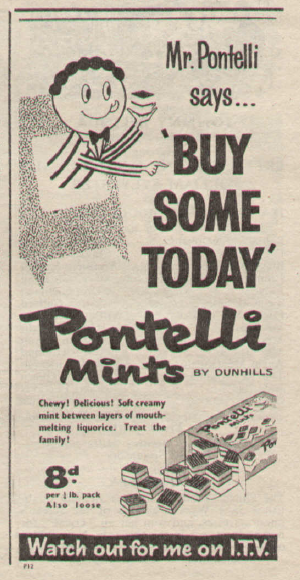
In possibly the most direct and to-the-point advertising campaign ever, the not exactly unmurderous-looking 'Mr Pontelli' plugs the mints that share his name simply by demanding 'BUY SOME TODAY'. A gambit that clearly paid off as we're all always racing off down the corner shop to stock up on Pontelli Mints even today. Mr. Pontelli also advises us to 'Watch out for me on ITV', presumably in reference to his continually making random unscheduled appearances in Saturday Night At The London Palladium and Gideon's Way.
On a slightly less minty theme, this giant talking joint at least has the decency simply to ask us to 'enjoy' Bensons Oranges & Lemons. Wonder which one of them made you larger and which one made you small?
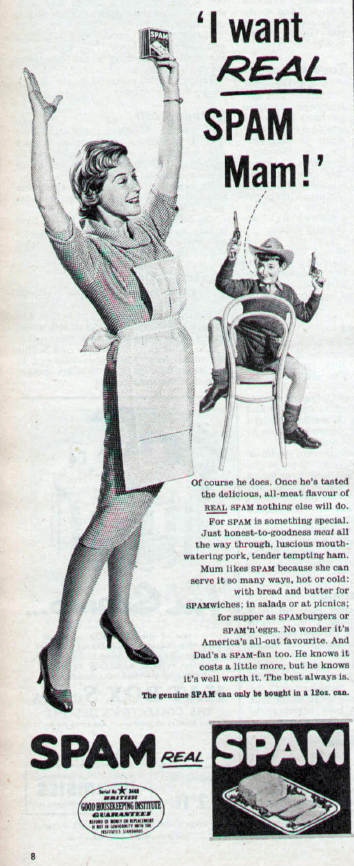
Meanwhile, the ones that mother gave you didn't do anything at all, which is presumably why this inexplicably Wild West-fixated youngster is demanding real Spam from his mam, as opposed to all that fake Spam they're always trying to palm off on us. In fact it goes as far as to confirm that genuine Spam can only be bought in a 12oz can, so keep an eye out for those crafty imitators. Meanwhile, quite why his mother is standing in the exact same pose as a Subbuteo goalkeeper is not specified.
Afterwards, why not wash your genuine Spam down with a nice bowl of Wall's Strawberry Fayre, a Battenberg-esque ice cream treat that is essentially just Neapolitan without the cumbersome inconvenience of chocolate. To be, boom boom, 'fayre', it does actually look quite nice, and the 'New as square strawberries' tagline is one that holds up as true even now. Though 'Not invented yet and never likely to be' would be more technically accurate.
Parents should also apparently take note that not only do children 'love' Weetabix (no, they really do), but it's also 'wholewheatedly' good for them, and 'packed with goodness from end to end right to the very end' - assurances that make it sound like a nice healthy alternative and, crucially, do not stand up to any kind of actionable legal scrutiny whatsoever. Steve Davis seems perfectly happy to endorse this standpoint, mind.
Years before somehow inexplicably managing to become the preferred option to Fanta, Tango offer an all expenses paid round-the-world trip to anyone who can identify which countries these none-more-sixties illustrations are sporting the patronisingly stereotypical national clobber of, and - more importantly - buy some more cans of Tango. The genius of that ad campaign was clearly still some distance from their grasp. No, not the one you're thinking of. The one just before that with the two kids in Miami Vice-inspired getup with Felix Howard haircuts playing pinball to the sound of Apache. Because that was better. Yes it was. Shut up. You should bloody well know when you've been Tangoed.
It's surprising that it's taken us this long to get round to a mention of Spangles, the much-'remembered' multi-flavoured boiled sweet that was frankly nice enough to warrant all that nostalgising and yah boo sucks to anyone who used to leave them until last in their Selection Box. First up is an actual entry form for the competition based on the question-mark denoted 'mystery' flavour, the identity of which was apparently never actually revealed, though that didn't stop, erm, someone from co-opting the iconography into the logo for a certain podcast. This is followed by some witty inter-Mod japesmithery on the subject of whether the pixie-cutted pillion passenger has neglected to stock up on something that, if not a suitable all-night-dance-facilitating legal stand-in for Purple Hearts, is apparently even more essential to the smooth operation of a moped than petrol. In fact, you could almost say she's forgotten to remember Spangles. As you were.
And finally, here's Zing, the bar that has 'everything'. Presumably on a planet composed entirely of chocolate and biscuit and nothing else.
Not that she has anything to do with any of the above either, but it would take too long to explain exactly why Diana Dors was being disclaimered as having 'nothing to do with geography', though doubtless the pre-Alternative Comedy funnymen could have come up with a billion hilarious 'reasons' within seconds. Anyway, join us again next time, when we'll be taking a look at some of the ways in which ITV conspired to convince viewers that they weren't watching enough television...
If you've enjoyed this article, you can find lots more about stuff you just don't see on television any more in Not On Your Telly, which is available in paperback here or from the Kindle Store here.
All The Fun Of The Flares
If there ever was a happy medium between the ha ha ha ha look at the big telly like they used to have in school shhhhhhhh fingers on lips!! work night out lol abba are so retro banality of I Love The Seventies, and the WOOOOOOOOO MURDERS SCARECROW GIVES EXPERIMENTAL HALLUCINOGENS TO SOUTHERN TV TRANSMITTER INFORMATION CONTINUITY SLIDE tediousness of so-called 'hauntology', then it was a happy medium that fell squarely into mainstream TV sitcom-land in the late nineties.
Some time around 1991, the law that forcibly ringfenced all 'remembering' outside of wartime nostalgia to the fifties and sixties was finally overturned, and the all-pervading mish-mash of Andy Pandy, Miniskirts, 'Flower Power' and that thing where they shouted "OPEN THE BOXXXXXX!" or something gave way to an all-pervading mish-mash of Colour Andy Pandy, Hotpants, 'Punk Rockers' and that thing where they shouted "THE MONEY PROGRAMMMMMMMME" or something. It was a long and slow process getting from there to the point where seemingly every single advert for about three years used the Gallery music from Vision On, but nonetheless there were still some splendid scattered-yet-spangly platform-stomped rumblings earlier in the decade, from Denim's wittily personal debut album Back In Denim to Channel 4's hilarious Richard Allen-tastic one-off play The Token King, not to mention Richard Linklater's stoner-skewed hall pass slackery masterpiece Dazed And Confused wafting across the Atlantic on a cloud of suspicious-smelling smoke, all of which succeeded by virtue of treating the outdated reference points as something that informed the lives of real and believable characters rather than just as things held up to smirk at without even any actual tangible joke attached. It wasn't until the latter half of the decade, though, that seemingly everyone wanted to do The Hustle onto this Aztec Bar-fuelled Chopper Bike-shaped bandwagon.
When this wave of Patrick Mowermania finally took full hold, it gave rise to three very similar sitcoms making their debut at very similar times - That '70s Show, Days Like These and, of course, The Grimleys. Despite being wildly varied in terms of actual entertainment value, they all employed a markedly similar premise and indeed had suspiciously similar opening episodes. Well, not that suspicious when you consider that one was actually a direct remake of one of the others, but we have to get your attention somehow, and preferably without resorting to calling Bill Grundy 'an A Good Read goofball'. But which was best? Well, short of letting the respective lead characters battle it out with sharpened spacehoppers - which would be futile as Darren Grimley would inevitably emerge victorious - the best way is just to watch those opening episodes and compare them. So, crack open a bottle of Cresta, put down that copy of Shiver And Shake, and let's take a trip back in time...
...all the way back to 23rd August 1998, which was when That '70s Pilot, the all-too-obviously named opening episode of That '70s Show, made its first appearance on Fox. True, we would in fact have to wait a further two years to see it in the UK, but more on that in a moment. Made by sitcom heavyweights Carsey-Werner and created by 3rd Rock From The Sun maestros Bonnie and Terry Turner, if there's one thing that you can say about this pilot episode, it's that it doesn't mess about. There's a revving engine, a rattle of drums, a zooming retro logo, a caption placing us in Point Place Wisconsin on May 17 1976 (at 8:47pm, to be precise), and a belting opening scene set in Eric Forman's Basement, a den of guitars, speakers, discarded old board games and 'naughty' magazines wherein the straight-laced aforementioned Eric and his somewhat less upstanding teenage associates - wild-haired stoner conspiracy theorist Steven Hyde, gangling slacker Michael Kelso, and girl-next-door turned rad-fem Donna Pinciotti - concoct a wild scheme to 'liberate' some beer from Eric's parents' party, which is in full Captain And Tennille-soundtracked swing directly above them. Various quick-cut attempts at grabbing cans whilst avoiding vigilant parents ("Eric - don't use the 'ass' word!"), dodgy perms and predatory older female neighbours follow, before the hapless would-be beer thief is simply asked to take some surplus cans to the basement. In three minutes flat, we've been introduced to four distinctive yet likeable leads, had quick glimpses of their various parents, and enjoyed some tremendous gags about a fairly universal teenage experience. THAT's how you kick off a TV series.
You can see from those same three minutes just how and why That '70s Show captured America's imagination so quickly and decisively, and indeed how and why someone at ITV thought it would be a good idea to do an Anglicised remake rather than just buy the rights to show the original. Yes, the first that UK viewers would get to see of Eric and company was courtesy of Days Like These, an 'adaptation' that would become a notorious part of a long and inglorious tradition of transatlantic sitcom transfers, where for every All In The Family or The Upper Hand there was a Payne, a Brighton Belles, a Dear John USA, a Stand By Your Man, a Reggie, a You Again?, a What A Country!, a DC Follies, a My Guide To Becoming A Rock Star, a Married For Life, a wince-inducing Red Dwarf remount where the only good line goes to the imported Kryten, a sanity-flattening attempt at doing Dad's Army in the middle of America complete with the classic scene where Captain Rosatti says "don't tell him Henderson!", and most odiously of all, Bill Cosby playing fast and loose with the near-perfect scripts for One Foot In The Grave and replacing all the proper jokes with tedious wank about how while the women are doing the talking he will eat the cookies but the women, they have eaten all of the cookies. In fairness, rather than an outright airlift of the concept and format, Days Like These was at least co-produced by Carsey-Werner, and they had the good sense to bring in sitcom veteran Bob Spiers (whose credits, for the uninitiated, range from Fawlty Towers to Absolutely Fabulous and Press Gang) to try and make some sense of the ambitious venture, but it was a co-production with Carlton Television, which must already be setting off alarm bells for many readers, and while it probably wasn't where the problems started, it's almost certainly where the problems cemented themselves as problems. Sadly, it's also a co-production from after David Cameron's tenure at Carlton, which denies us the opportunity for a great deal of invective later on.
Batteries Not Included, the first episode of Days Like These which was originally broadcast on 12th February 1999, doesn't exactly start off in fine style, opening with an animated Spacehopper (complete with a non-copyright generic smiley in place of the usual Spacehopper 'face'), a burst of music that sounds more like Metallica than anything from the seventies, and a logo straight out of a late seventies Sunday Morning BBC children's religious show. It's still 17th May 1976, and indeed still 8.47pm, but this time we're in Luton and Eric Forman's Garage. We then see something that looks for all the world like a rubbish sketch show parody of That '70s Show, complete with an 'adapted by' credit for Jesse Armstrong and Sam Bain (who have kept THAT well hidden from their CVs), with the four badly-wigged leads sort of reacting-ish to 'McGuire' (read 'Kelso') boinging out a tune on that most seventies of instruments, the Jew's Harp. While one of those rotatey circle executive toys enjoys some wince-inducingly prominent positioning, there's a stilted word-for-word replay of that zingy opening scene, only with some awful added business about 'shandy makes me randy' or something. Once he ventures upstairs, again it's much the same only far more forced, and with substitutions for the more 'esoteric' reference points such as pizza sticks becoming a 'pineapple and cheese hedgehog' (not to mention "Eric, don't say the 'arse' word"). Presumably, this mild Transatlantic discrepancy between shared memories of the seventies was the primary reason that a remake was considered necessary in the first place - not that That '70s Show was exactly overflowing with references to S.W.A.T. or The Raspberries - and this imperative is somewhat undermined when you notice that the party still has The Captain And Tennille playing in the background. Also you do have to question whether whoever it was that crowbarred in that reference to The Wurzels had ever been to any actual parties ever.
Back over at That '70s Show, this is the point at which we get the opening titles. And what opening titles they are, featuring the gang (including two whom we haven't actually met yet) cruising around in Eric's Oldsmobile Vista Cruiser and singing along to Big Star's In The Street, an inspired choice that both reflects what these characters might actually have been listening to, and underlines that the production team weren't just reaching for the nearest available bit of retro iconography. Days Like These, meanwhile, has them all cramped into a noticeably less sleek Ford Zephyr and singing an awful song about how 'days like these/I feel like I can change the world'. And where That '70s Show then runs into a witty bit of group commentary about an episode of The Brady Bunch - a show that, let's be honest about this, the real life equivalents of these characters doubtless resented for its patronising view of life as a 'teen' - Days Like These replaces it with some sneery and historically off-beam wank about Doctor Who (complete with a baffling reference to Sarah Jane 'jiggling up and down in a jumpsuit'). Already this is looking like it's going to be barely watchable, devoid of even the compelling 'awful sitcom' charm of something like Believe Nothing or High Stakes, and there's about eighteen more minutes of it to get through yet. So let's head back over to Wisconsin with immediate effect.
This is the point at which we meet Jackie, the hard-of-thinking rich kid who has somehow got mixed up with this dubious shower, and she invites herself along to the Todd Rundgren concert that the others are planning to attend (over at Days Like These, they're opting for Steve Harley And Cockney Rebel, which at least gets them some grudging realisticness points). Eric still needs parental permission to take the car, and there's also the first mention of 'Fez', about whom more very soon indeed. Jackie and Kelso head off, and there's some brilliantly played sexual tension between Eric and Donna, which their British counterparts replace with some arms-folded standoffishness that immediately loses them any points that they may have recently attained. Then the same 'fizzing daisy' animated interstitial shows up in both shows, and the action moves to Eric declaring his undying love for what the audience thinks is Donna, but which turns out to be the car; a joke that, you guessed it, is appallingly handled in the UK version, as are the amusements about Donna's father's perm, and then then Days Like These opts to replace a shot of a singing Farrah Fawcett with some more animated daisies playing pinball. And you know what, it's really going to be much the same from this point on, with Days Like These continually taking good and well-performed gags and ramming them into the ground like a broken bottle in a Public Information Film.
Although there's one area where they could - that's could - turn the tables a bit. The next scene of That '70s Show takes place in a hip arcade game-festooned hangout and introduces us to 'Fez', an exchange student from an unidentified subcontinent who is, at least at this early stage of the show's existence, played for some very dubious Del-and-Rodney-find-an-illegal-immigrant-style laughs. Not explicitly offensive, it should be stressed, but based on notions of language barriers and lack of cultural awareness that should really have been let go of by the nudging edge of the twenty first century. Surely, you will be thinking, surely Days Like These has to have taken the opportunity to do something a bit more enlightening? Well, this is where we meet Torbjorn, from an unidentified bit of Europe, who gets exactly the same semi-offensive gags at his own expense, which in this context somehow seem a little more acceptable but only a little. And indeed you'll still see stuff like this on TV all the time, which makes it all the more galling when people insist on having a go at sodding Rising Damp. Still, a little better is a little better, and we do get both a half-decent extra scene with Donna and Jackie doing 'girls talk' in the bathroom about their views of each other and respective interest in Eric, and the seriously on-the-money sound of The Sutherland Brothers in the background, so Days Like These isn't doing quite as badly as expected. Though it almost is.
After a smirk-friendly interstitial featuring Eric, Hyde and Kelso inhaling helium and harmonising Hooked On A Feeling (though Eric, Jones and McGuire give us You Should Be Dancing), the gang are depicted very unflinchingly post-joint and in an impressively restrained fashion, with Eric's updates on the car situation diverting into stoner paranoia about the oil shortages being faked and top secret car 'they' are supressing that runs on water, before a still-out-of-it Eric has to have a serious chat with his parents about his responsibilities as a driver whilst they subtly sway in and out of frame before his bleary eyes. As you can probably guess, Days Like These's giggle-heavy reinterpretation of this scene is straight out of the average newspaper cartoonist's view of 'drugs' and can, in short, fuck off. As can the replacement of Eric's parent-irking 'bitching!' on recieving the car keys with a much more blunt and unfunny go-on-Days-Like-These-you've-got-eight-minutes-say-something-outrageous 'shit'.
The next major scene in That '70s Show deals with the gang squabbling over who gets to sit where in the car and Eric's father issuing a concert-threatening instruction that he's not to drive it out of town, and follows much the same in its ITV translation only with less 'accomplished' acting, changed place names, and the driver on the other side; though when the car breaks down shortly afterwards, Days Like These at least has the good sense to insert a couple of lines to suggest Donna is more knowledgeable about motor vehicle maintenance than her more smug and self-assured male travelling companions. After they replace the battery and end up taking the mechanic and his non-played-for-laughs gay partner to the venue with them, Fez and Torbjorn both get the same smooth-lines-and-boogieing interstitial, before That '70s Show weighs in with an impressively realised Todd Rundgren gig complete with an actual live version of I Saw The Light threatening to drown out the dialogue. Days Like These on the other hand belches up a couple of extras in front of a blue light, two blokes in leather caps and bondage gear, and Make Me Smile (Come Up And See Me), performed apparently by neither Steve Harley nor Cockney Rebel quietly in the background, and it's at this point that you want to start punching the show very hard in the DigiBeta. Thankfully there's only a couple of minutes left, yet even in that short time they manage to do unspeakable things to a sweet scene between Jackie and Kelso and to Eric and Donna's show-closing car-bonnet couple-of-inches-away-from-getting-it-on stargazing. Mercifully, That '70s Show gives us an under-the-credits glimpse of the exhausted revellers returning from the concert singing Hello It's Me, so at least we've got a halfway decent note to end on.
That '70s Show would go on to run for eight highly successful seasons up to 2006. Days Like These, on the other hand, was being shunted around the schedules within weeks ("to give the other programmes a chance", as Lee and Herring gleefully noted), and eventually Spacehopped its way offscreen with three of its thirteen episodes remaining unshown. And we can't even blame David Cameron for its failure. Shortly afterwards, Channel 5 picked up the rights to That '70s Show itself, and the attempt at remaking it for the benefit of audiences who had never so much as scoffed a Twinkie was quietly forgotten.
When it comes down to it, the biggest problem with Days Like These was that it was neither one thing nor the other. A pointedly American script nastily mangled for a British audience, gags from established old hands rewritten by up and coming highly talented youngsters, an attempt to force one strand of nostalgia into another in a manner that called to mind a seventies toddler trying to bash the wrong piece into the wrong slot of a Fisher Price shape sorter. It had no idea whether it wanted to be cosy past-remembering fun for all the family or an edgy must-see for teenagers able to relate to its timeless themes. What it definitely wasn't was That '70s Show. Or, more to the point, The Grimleys. What's that? We didn't even mention The Grimleys? Well, maybe that's yet to come...
Strikes! Silver Jubilees! Barnaby!
This bit of pop-cultural political posturing from back in 2007 got one of the angriest responses to anything I've ever written, leading to me quickly pulling the post and deciding there and then that I was going to pursue a less GRR GRR-friendly creative path in future ("What are they on about? You like Ugly Betty, for fuck's sake" - Ben Baker). It's sort of worked, though I do still sometimes find my name mentioned in connection with some pointless campaign to bring back 1976-standard ad break lengths while I'm walking into Starbucks listening to the Glee soundtrack. Not everyone's behind your campaigns just because they like old stuff, people. Anyway, here it is again, hopefully appearing to a more positive reception this time around...
Spangles. Bagpuss. Spacehoppers. Slade. Rainbow. That episode of Grange Hill where Tucker did something. All of these things, and so much more more besides, once seemed so nostalgically evocative, even as early as the mid-eighties (when 'nostalgia' supposedly began and ended with Jonathan Ross saying "cor them toy space rockets eh?"), but more recently have become like popular cultural Kryptonite.
On the one hand, there was the endless parade of clip show talking heads who thought that simply 'remembering' such things was enough to provoke a proustian rush of nostalgia for the days of Sam Tyler arguing with the BBC Schools Diamond, and those ringtone-toting Abba-endorsing ha-ha-Zippy-was-on-teh-drugs retrololz jerks who insist on turning everything into an unfunny 'lewd' observational joke, which was enough to make even the most tolerant and good-humoured enthusiast for all things vaguely Phantom Flan-Flinger-tinged start to think that Noddy Holder was becoming ever so slightly tedious a reference point.
But on the other hand, when some of said enthusiasts started to wave a healthily tongue-in-cheek two fingers in the direction of Space Dust and its ilk, some others took the George Best-autographed ball and ran with it, adopting a militant stance that basically dictated that nobody was allowed to show affection for anything from the past unless they had obtained written permission and had refused to watch a South Bank Show on two people that they weren't interested in discussing a subject that they didn't understand but still got angry about it anyway.
And so everything fell into a kind of limbo, with poor old Bungle going undiscussed for fear of sparking off a wave of stupidity in both directions... and it's time that we took them back. Reject those false prophets, and reject those false blokes-with-big-sunglasses-on-office-nights-out - let's put lazy uncritical nostalgia back in centre stage, and indeed 'Denim', where it belongs. Starting today, Out On Blue Six officially launches The Humphrey Cushion 'Remember Supermousse' Campaign For Being Allowed To Talk About Spangles Again - watch this space for further developments, and for celebrity endorsements by the likes of Bawrence, Darren Grimley and TV Andrew Collins!
Tonight Matthew, I'm Going To Be... Eli Culbertson?
In the early nineties, the mysterious 'Watershed Pictures' put out a triple whammy of video-only spectaculars under the banner title The Best Children's TV Of The Decade. Presented by Phillip Schofield from in front of a wall graffitied with just about copyright-averting approximations of well-worn childrens TV iconography, there was one each to cover the sixties, the seventies and the eighties, and despite the occasionally questionable approach to chronological accuracy - the eighties one infamously included Joe 90 alongside the ramping-up-latterday-eBay-value likes of Jigsaw, Lift Off With Coppers & Co., Tucker's Luck and some vintage Gonch-driven scammery from Grange Hill - they were actually pretty good selections of what was then pretty rare stuff.
On the seventies volume, alongside extracts from the likes of Ace Of Wands, The Tomorrow People, Tiswas, Worzel Gummidge, How, Magpie, Swap Shop, Play Away, Pardon My Genie and a colour bit of Timeslip that momentarily got archive TV types a bit hot under the collar as nobody had realised that any of it actually did exist in colour, there was a section covering pop music on children's TV, bookended by Schofield stomping about in an unfeasible pair of stack heels and offering some perplexing words of caution about how built-up shoes could hamper childbirth or something. The accompanying clips were all drawn - presumably in some sort of licensing job lot - from Glam-heavy Granada teatime offerings Shang A Lang and Lift Off With Ayshea, and featured brief glimpses The Bay City Rollers plodding unexcitedly through All Of Me Loves All Of You, Lieutenant Pigeon rattling through what sounded like a Moudly Old Dough-ed up take on I'll Take You Home Again Kathleen, and some character in an overexaggerated approximation of Vegas-era Elvis getup, singing an overexaggerated approximated cover of Vegas-era Elvis favourite I Need Your Love Tonight with added Glitter Band-style drums and guitars, going by the unlikely name of Eli Culbertson.
For someone who had only recently purchased the genre-defining K-Tel double compilation Glam Slam, and whose copy of which still has a handwritten A4 list of 'Glam Rockers' tucked inside the sleeve (which included the explanation-challenging likes of Mungo Jerry, Marmalade, The Wombles and The Goodies), this was a mystery that needed to be solved. Who was this mysterious presumably randomly-selected musical interloper, and why wasn't he mentioned in any rock history books nor indeed featured on any compilation albums? What happened beyond the twenty seconds or so featured in the clip, which tantalisingly end with a change of tempo and some proto-Jarvis Cocker finger-waggling? Was that really a name that anyone expected to have a hit single with? And yet no answers ever seemed to be forthcoming. Even the exhaustive bible of UK beat, psych, folk, prog and glam The Tapestry Of Delights couldn't find space for Mr. Culbertson, despite boasting entries for everyone from kazoo-wielding proto-Wurzels The Piggleswick Folk to Marty-Wilde-in-American-Football-helmet Glam cash-in nonsense Zappo.
Though the rise of the internet would reveal more people who were similarly fascinated by this shadowy Culbertson character, not least TV Cream founder Phil Norman, it didn't seem to be quite so keen on providing any answers. It was some years before it was even possible to find out that the single I Need Your Love Tonight, backed by the no less intriguing-sounding Boogie Queen, was released by EMI in September 1974, and beyond that it was - and remains - a total and utter case of blank-drawing. The single did eventually show up on a few music blogs, often accompanied by bizarre claims that the whole venture was somehow linked to the 'Elvis Is Still Alive' rumour mill; chances are, though, that none of these stories were started by anyone who'd sat through the interminable clip from The Forest Rangers on that Schofield-fronted video.
Of course, The Best Children's TV Of The Decade - The Seventies did pose a further conundrum, in that the footage from an early edition of Rainbow featured an unidentified two-man-one-woman singing trio who were demonstrably neither early musical act Telltale nor their better remembered latterday counterparts Rod Jane & Freddy, nor indeed Rod Jane & Roger or even Rod Jane & Matt, but that was another story. And it involved Crow & Alice...
If you've enjoyed this, you can find more articles about popular culture from the deepest early seventies in my book The Camberwick Green Procrastination Society, available in paperback here, from the Kindle Store here, and as a full-colour eBook here.
Subscribe to:
Posts (Atom)