For all that they might have gone on about their collective fear of typecasting, the various 'classic' Doctor Who lead actors didn't half jump at the chance of an in-character tie-in appearance. Whether it was Jon Pertwee tussling with Aggedor at Glorious Goodwood, Tom Baker dispensing pseudo-scientific facts about his favourite best aliens on Animal Magic, or Colin Baker going on a ride at Blackpool Pleasure Beach for some reason, costumed-up 'canon'-taxing guest spots were a regular and recurring feature of Doctor Who in its original incarnation. Even Richard Hurndall got to do his "and greetings to you from The Time Lords!" gibberish on a couple of occasions, though nobody has ever been quite sure about what character he was actually 'in'. On rare occasions the companions got in on the act as well, particularly on Crackerjack (don't) for some reason, and that's not even getting started on Celation from The Daleks' Master Plan guest-presenting Points Of View.
Sadly, Celation's little chat - if ever a chat as was - with Robert Robinson no longer exists, but at least it was actually recorded and televised in the first place. During the sixties, before anyone really had the means or indeed the inclination to preserve them in any form, there were literally hundreds of tie-in appearances - particularly at the height of 'Dalekmania' - that came and went and faded into hazy memory with only the odd press cutting to prove they happened, from stage plays to charity events to pop single-plugging to visitors at a Daily Mail-sponsored exhibition being ferried past a collection of Doctor Who aliens in a 'Brainy Train', whatever one of those was exactly. And then there was William Hartnell's disconcerting enthusiasm for making appearances at airfields.
Presumably as an adjunct of his previous starring role in long-running ITV sitcom The Army Game, Hartnell appears to have been invited along to air shows and open days roughly every three minutes, and he also appears to have never turned any of them down. Quite often he would show up in character and costume as The Doctor, sometimes with Daleks in tow, and there was even a vague accompanying 'mini-adventure' narrative of sorts; after his speech is interrupted by an 'Anti-Magnetic Device', The Doctor discovers that the
Daleks have constructed a 'fort' on the airstrip, and dashes off to alert his good friends at the RAF who promptly unleash a couple
of torpedoes and blow the malevolent interlopers sky high. Terry Nation's feelings on this somewhat off-agenda use of his creations are sadly not recorded, although the escapade did usually involve the nobody-would-ever-suspect-a-thing deployment of a 'double' for Hartnell during the more action-packed moments, which was at least in keeping with the usual mode of practice for his actual television adventures.
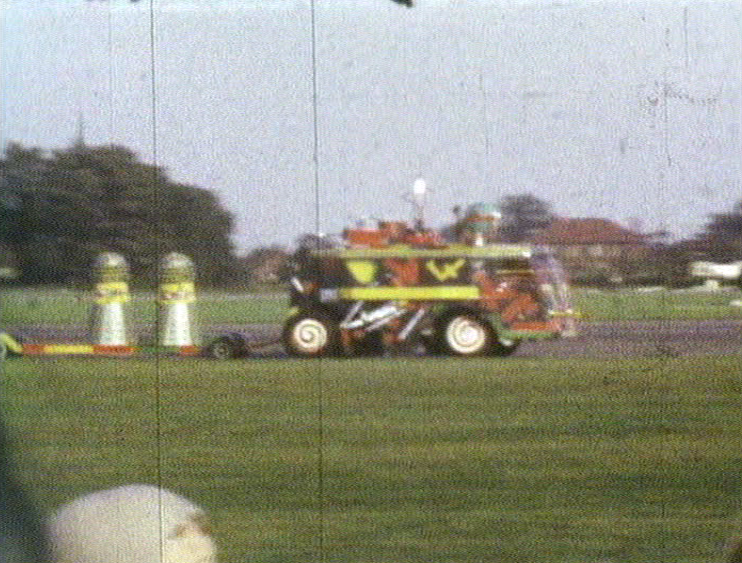
Needless to say, very little evidence of any of these events now remains, apart from - staggeringly - some full colour cine camera footage of one of them. On Saturday 18th September 1965 – the same day that Trap Of Steel, the long-lost second episode of the decidedly Dalek-free Galaxy 4 was transmitted by BBC1 – TV’s Doctor Who William Hartnell took part in an RAF Finningley air show along with some Daleks. Well, we say ‘Daleks’, but that's a very loose interpretation of the term. Anyway, we may not have the sights and sounds of that thrill-packed day, but the few existing seconds of moving footage give us a good idea of... well... not very much at all really.
In an unexpected new twist to the big news story of 1963, William Hartnell arrives at Dealey Plaza; controversy and debate will subsequently rage over whether The Thin White Crochety Old Man was giving an 'inappropriate' salute or simply waving to a fan.
Dangling from a helicopter due to some unspecified 'mini-adventure' plot detail, Hartnell's stunt double puts in an unconvincing bid to secure the role of the next Milk Tray Man. Meanwhile, down on the ground, you can just about make out one of the 'Daleks'. Looks pretty convincing from this distance, doesn't it? Well, just you wait.
With full strength undiluted 'Dalekmania' taking full effect, the crowds are clearly enthralled by the unfolding spectacle. So much so, in fact, that they haven't noticed The Queen arriving to take a look. She preferred The Voord anyway.
After someone realises that the audience would probably feel a bit short-changed without one, some sort of cage box thingy that we're probably best off not knowing the real purpose of is hastily redecorated as a vague approximation of a 'Tardis', which some high-spirited youngsters promptly attempt to upend. Clayton Hickman is reportedly 'concerned' by this turn of events.
As everyone knows, Daleks should only be demonstrated to youngsters by qualified experts in lab coats, and the organisers of the air show have gone one better and added to an already star-studded bill by persuading The Prof from Vision On to do the honours. Here he is also introducing some young attendees to a haphazardly repainted diving bell with random number labelling and some kind of lurid red jagged symbol on top. Meanwhile if anyone can identify that crater-festooned planet, please get in touch.
"But how did the Daleks get up stairs? Eh? Eh? The stairs? How did they get up them? Eh?". By walking on their feet. A fact so widely known and recognised that these two youngers cannot even be bothered turning their heads to have a look.
The most convincing Dalek yet achieves speeds in excess of 234.9mph, before breaking off and heading for Brand's Hatch, where it effortlessly beat Lorenzo Bandini and Graham Hill into second and third place.
In a neat bit of cross-promotion, The Mystery Machine tows two reconfigured shuttlecocks past the awestruck crowds. How this fitted into the 'story' is anyone's guess, frankly.
And finally, the fun family day out concludes with a precision-targeted explosion in which everyone's favourite TV villains are seared from existence in a torrent of smoke and flame. In fairness, it's amazing to think that any visual record of an event of this kind exists at all, let alone in colour. In equal fairness, it's also amazing to think that this and many, many, many other examples of harmless yet decidedly off-message ridiculousness were signed off, approved and authorised where nowadays they would be sent packing at the very first hint of a Brand Awareness meeting. Honestly, providing a bit of cheap and cheerful extra-curricular entertainment for average everyday mainstream viewers of a popular television show - what a thought. It's almost worth writing to Points Of View about.
You can read more about Doctor Who's early extra-curricular activities, including a little-known radio appearance by the Daleks, in Not On Your Telly.
Doctor Who's third series in 1965-1966 is in many ways its most interesting. It's also - frustratingly - the least represented in the archives, at least in terms of key visual material. Bold if aimless changes of direction, struggles to maintain a strong regular cast, desperation to cling on to the remnants of 'Dalekmania', and reputed behind-the-scenes high level clashes would all play their part in shaping this often overlooked set of episodes, but many of their most glaring manifestations were wiped before the sixties were even over and have never surfaced again. Unless they're in that tedious proverb-dispenser's coal scuttle, of course.
As it stands, we have no concrete idea of what some key scenes and costumes actually looked like, or even what some characters were actually called, but you can rest assured there'll be plenty more about that later. It also means that there's comparatively little of the series actually available to watch, and while the surviving audio recordings have really come into their own at this point, it's still going to make this instalment something of a challenge to write. And so, if you will, The Nightmare Begins...
The Drahvins Would Have Loved Twitter
Series Three's opening story Galaxy 4, one of the most overtly politicised Doctor Who stories ever, saw the Tardis crew caught up in a struggle between spaceshipwrecked factions of glam glittery-eyed statuesque blonde female-dominated race The Drahvins, and reclusive walrus-like scary-voiced bug eyed monsters The Rills, of whom every photo ever printed is apparently 'rare'. You can guess who turned out to be the real 'monsters' of the piece. Along the way, there is a good deal of strident-for-the-time debate about the pros and cons of a female-led society (not all of them entirely endorsed by Vicki), the effects of cloning on human behaviour, and the point at which equality becomes inequality - alongside, to be fair, mass frowning at the wishy-washy passive pacifism that The Rills claim makes them 'superior' - and the moral and ethical ramifications that these beliefs and values hold for The Drahvins' plan to get away from the unnamed planet. As their plan more or less involved slapping a Trigger Warning on the poor old Rills before setting up a Safe Space and then No-Platforming them into the middle of an exploding planet, they'd no doubt have jumped at the opportunity to indulge in a hashtag-fuelled argument about which of them was the best at having the plan. Meanwhile, it's probably best not to speculate on what Maaga's oft-referenced 'special things' might have been.
"Then There Was A Galaxy Accident"
Let's be honest about this, the entire history of Doctor Who right up to the present day is awash with jaw-droppingly jarring examples of simultaneously unscientific and ungrammatical dialogue. And it's not really the purpose of this series-by-series overview to point and laugh at deficiencies (unless it's The Anti-Matter Monster), but there's some that you just can't let pass. The Ark is not exactly a story known for its understated and naturalistic script exchanges - in fact, that bizarre bit with a Monoid smashing a vase threateningly, then throwing the flowers that were in it to the floor as if 'underlining' his point almost made this list in its own right - but one particular line elevates all of this to a virtual art form. It's all going swimmingly when The Doctor starts quizzing a friendly Refusian about why their planet is so keen to accept the incoming colonists, Human and Monoids alike, until he asks how the Refusians came to be invisible. This was, we are informed, due to a 'Galaxy Accident'. Oh, right, thanks. You can't help feeling that there were probably better explanations in Space School (BBC, 1956). The Ark was ostensibly written by Paul Erickson and Lesley Scott, although Erickson later alleged that Scott was simply credited out of courtesy and did not have any hands-on involvement in the scripts. Evidently not, as she might well have crossed that line out.
Katarina Could Actually Have Been Quite Good
Let's get this series' first major Elephant In The Room out of the way then. And not the actual elephant in The Ark. Given that even proper hardcore fan researchers are at stern-faced loggerheads over it, it's likely that the debate over whether short-stay regular cast members Sara and Katarina constitute proper 'companions' (or, as they were more accurately known at the time, 'assistants') will rage on for ever more. While I do have my own opinion on the matter based on the wider context of television at the time, I have no intention of turning this into a free-for-all scoff-festival, and so shall leave it there. Other than to say that certain magazines who snort at the idea of including them probably shouldn't pass out with excitement over someone who was in about two and a half recent episodes a couple of pages later. Anyway, the main argument made against poor old Katarina as a character - who for many years was only represented by less than a minute's worth of footage in which she essentially had no dialogue - was that she slowed down proceedings too much. Hailing from Ancient Troy, she was forever having to have anything and everything and indeed everyone explained to her, which quickly got on the production team's nerves, to the extent that Terry Nation simply noted her final scene in the script as 'SPEECH HERE TO COVER THE DEATH OF THE GIRL'. Then an episode featuring Katarina turned up, but everyone was too busy trying to work out which Delegate was which to notice that she actually seemed to have a lot more potential than anyone had quite reasonably assumed. Adrienne Hill gives a solid performance combining superstition and pre-scientific intellect with a combative nature and a reverential trust in The Doctor - almost like a faint evolutionary echo of Leela - and while she isn't used particularly well in that particular episode, it's easy to see how with a bit of time and work, that could have slotted into the show's dynamic to good and potentially comic effect. She'd certainly have ended up with a bit more to do than just twisting her ankle. Speaking of which, Sara was a properly badass independent woman who'd made her name in a man's world and showed more bravery and level-headedness in facing off against an entire Dalek army than The Doctor and Steven combined, so maybe she's worth 'allowing' on that basis alone? I mean, it's not like the vast majority of Doctor Who fans are huffy chauvinist blowhards or anything. And while we're on the subject of uppity female regular characters...
Are Dodo's Outfits Really That Ludicrous?
Gobby Mod Girl Dodo Chaplet joined the Tardis crew halfway through Series Three, but never really endeared herself to the viewers and was quietly written out at the end of the run. Since then, she hasn't exactly endeared herself to fans either, and comes in for a good deal of flak on account of her inconsistent accent, chipper street-smart attitude, ludicrously contrived backstory and somewhat 'of their time' fashion choices. In fairness she wasn't the best conceived or realised regular character in Doctor Who history, and there is probably something in all of these criticisms. Apart from the last one. Dodo, so we're told, was the ultimate Doctor Who fashion victim, sporting ludicrous getup that made Capable Caroline from Here We Go Round The Mulberry Bush look underdressed, and bore no relation to anything that anyone in the real world would ever have been spotted wearing. In the context of the High Street Fashion of the day (as opposed to everyday clothing), though, she wasn't too far off the mark. And in terms of the sort of Swinging London style explosion she was supposed to represent, absolutely bang on Mod Target. That pop art two-tone 'Crusader' tabard that she wears to much snigger-provokement in The Ark? Keep an eye on Roy Wood the next time BBC4 repeat that clip of The Move doing Fire Brigade on Top Of The Pops. The miniskirt, vest and cap combo covered in psychedelic circles in The Celestial Toymaker? Try finding a mid-sixties magazine shoot where a model isn't wearing something similar. Nehru Jacket/Plastic Mac hybrid in The Savages? Seriously, talk of the UFO Club right there. It probably would have gone down well in a similar if fictional club Dodo once visited, too. Other than that...
There Is A Distinct Lack Of 'Mods' In The Inferno Club
Right at the end of Series Three, there was a conscious attempt by incoming producer Innes Lloyd to 'reinvent' Doctor Who by shaking off the lingering air of Improving Children's Literature and give it a more contemporary and action-packed edge. This he managed in no uncertain terms with The War Machines, a story that combined cutting edge mass communication-related scientific concerns with getting out and about in 'Swinging London', a large part of which actually takes place within the Capital's hippest and most happening nightspot, The Inferno. Yet while it looks convincingly close to the sort of place that Georgie and her mates would have hung out at in Adam Adamant Lives!, and had the post-Georgie Fame pre-Syd's Floyd Hammond-Jazz grooves and trendy lingo spot on (though it's best not to dwell on that reveller that tells The Doctor "you look like that Disc Jockey!"), the actual clientele have somewhat less of an air of authenticity. Aside from the Op-Art patterns sported by new assistant Polly and Sharon Tandy-esque club hostess Kitty, and one alarmingly frugging extra with a dandy suit and Jeff Beck hairstyle, everyone else just looks as though they're sporting their Sunday Best and dancing at a Church Hall 'hop'. In effect, they look exactly like how you'd get one cool person in amongst a load of clean-cut youngsters with am-I-doing-this-right? expressions in the average sixties Top Of The Pops audience, which is 'authenticity' of a sort but almost certainly not what they were aiming for. Still, given recent revelations, it's a good job none of that mid-late sixties Top Of The Pops footage exists or anything...
Hey! That's The Name Of The Series!
Sorry, where were we? Oh right, yes... The War Machines is also notorious for a sequence in which snazzy big WAP-enabled computer WOTAN appears to suggest that The Doctor also goes by the somewhat more contentious monicker of 'Doctor Who'. This one throwaway line has caused more in the way of consternation, hair-splitting and 'thinkpieces' than pretty much any other in old-skool Doctor Who's entire twenty six year history. There are those who argue that it proves this is his full name after all, those who try and invent ludicrous He's Free Is Nelson Mandela-style conceits in order to posit that it's some form of mishearing of '(it is The) Doctor who is required' or similar, and at the most ridiculous extreme the ones that furiously declare that it means The War Machines isn't 'canon'. And this is one of those moments where you have to look at Doctor Who as Just Another TV Series. Nobody involved in The War Machines had any idea that anyone would even care about it after what they expected to be its one and only showing, they'd never exactly been averse to playing around with this before then ("Eh? Doctor Who? What's he talking about?"), and with several new people coming in on the production side it's hardly surprising that something like this should have slipped in under the radar. Honestly, you do have to wonder about the sort of person who gets exercised about what was 'meant' by something that probably predated even the merest suggestion that it might in fact 'mean' anything at all.
D/C? Or Not D/C? That Is The Question
So many question marks over the lost visuals of the last ten minutes of The Massacre alone. No way of knowing for certain which of The Delegates was which and precisely how many episodes each of them appeared in. Impossible to reliably determine whether those two cricket commentators actually appeared on screen or not. And yet there's nothing about those long-lost Series Three stories that provokes more in the way of humourless debate than the conflicting accounts of what one of them might actually have been called. Actually, yes there is - the same story's production code. Mission To The Unknown, a one-episode story made without the regular cast and as more or less a 'trailer' for the forthcoming twelve part The Daleks' Master Plan, was recorded in tandem with Galaxy 4, or in internal document-ese 'Story T', and was duly assigned the story code 'T/A'. At least that's what we all thought, until someone went poking around those selfsame internal documents and found that it was occasionally referred to as Dalek Cutaway, and that - shock horror - the production code had been occasionally scribbled as 'D/C'. Even to the untrained eye it should be obvious that these are a description and a bit of shorthand respectively, and as such could only be counted as the genuine article in a universe where Strange Matter, The Destructors, Enemy Within, Oh Y'Know That One With Chellak and The Final Three Part Story Does Not Have A Title As Yet are also considered official story titles. More to the point, Mission To The Unknown was explicitly stated as the story title by Radio Times, and T/A was used somewhat more soberingly on the release form for wiping the episode in the early seventies. And anyway, Dalek Cutaway sounds stupid. And now, if you'll excuse me, I really must get out more.
The Gunfighters Is Actually Really Good
Although 'conventional', 'fan' and 'wisdom' are not really words that have any meaning when placed next to each other, conventional fan wisdom has it that The Gunfighters is one of the single worst Doctor Who stories ever. It is, apparently, a hammily overplayed comedy short on actual laughs, woefully historically inaccurate, crammed full of time-filling ear-assaulting musical performances, and all in all the main reason why the production team stopped doing those 'pure' historical stories (as apparently it's a legal requirement to refer to them as) altogether. Except that when you actually watch the story, it turns out to be a rather fun stage farce-like bit of Wild West hokum, where the reluctant and dreadful musical turns are actually part of the storyline, the cast get the chance to play for laughs and seem to enjoy it, and there are subtle but effective hints of 'adult' behaviour thrown in for good measure (Dodo seems disconcertingly - if realistically - taken with drinking and gambling), and anyway, who cares about getting minor bits of Frontier Days folklore wrong in the series that gave us The Megabyte Modem? True, The Ballad Of The Last Chance Saloon does get a bit wearing after a while... but you can read more of my thoughts about The Gunfighters, and all of the other historicals too, in Well At Least It's Free.
The Feast Of Steven Is Also Actually (Possibly) Really Good
Conventional fan wisdom also has it that the episode that went out on 25th December 1965, featuring the regular cast sprinting through a series of panto runarounds in the middle of a grimly serious twelve part Dalek epic set in the far future, isn't actually the sort of thing that most BBC shows did for Christmas around that time but the product of some sort of momentary lapse of sanity and basically a Fourth Wall-breaking aberration that should not be considered alongside the 'proper' series. Although it's difficult to say for certain unless The Eleventh Day Of Christmas brings us Eleven Philip Morrises A-Film Can Waving, chances are that for much the same reasons as above, it was actually an enjoyable Fourth Wall-breaking bit of silliness; it certainly seems that way from the existing audio recording (although it would be a stretch to say it looks that way from the few surviving off-air photos). After all, it was written by Terry Nation, who'd had years of experience in radio comedy, and starred William Hartnell, who was in a number of top-rated TV and film comedies before he started going 'eh?' a lot, and why get so stony-faced about The Doctor addressing the audience directly? It's almost like it might just be, you know, a bit of entertainment or something. And again, you can find more of my thoughts about this episode and The Daleks' Master Plan in general in Well At Least It's Free. And I'll go on plugging it until we get all those episodes back.
Did The Savages Actually Exist?
There are plenty of Doctor Who stories that everyone forgets about - try recounting all of the post-2005 adventures in order if you don't believe me - but at least there's still some tangible evidence that they were actually made and broadcast. Poor old The Savages, however, is somewhat lacking in that area. Broadcast once between two stories that were at least memorable, albeit for wildly differing reasons, and wiped not long afterwards, The Savages had little about it that would have imprinted itself in anyone's memory. Nowadays it's only represented by some unremarkable Telesnaps that could have come from any story, a couple of seconds of blurry off-air cine film of Frederick Jaeger that could frankly just be from any old film he was in, and audio recordings that even people who have listened to them within the previous forty eight hours would struggle to tell you very much about. In fact, not only did I find I had nothing to say about it when preparing for this feature, I'd actually unknowingly left it off the original list of notes. Even some prominent and authoritative episode guides list various crew members as 'Unknown', and it's hard to shake the suspicion that it might actually just be a massive hoax, slipped into a list of sixties stories by some jolly prankster so long ago that everyone's just come to believe that they always knew it existed. Still, being unremarkable to the point of nothingness is still better than being Rings Of Akhaten. Oh hang on, we haven't had any of that They Like Big Butts And They Cannot Lie stuff this time, have we...?
Anyway, join us again next time for 'Can You Sew Cushions?', Krail and Krang singing Reet Petite, and whatever NXOZ might actually mean...
In between the second series of Doctor Who and its baffling obsession with ants, and the third series with its deployment of 'Mods' in all the wrong places, The Doctor and company made a slight detour onto the big screen. Or, to be more accurate, The Daleks did.
Although 'Dr. Who', Ian, Susan and Barbara (or, if raining, 'Louise') did
nominally occupy the lead roles, recast and in canon-confounding
slightly rewritten incarnations to boot, they took a back seat
to The Daleks when it came to promotion. This was, after all, the height of 'Dalekmania', and Amicus Productions head honcho Milton Subotsky probably wasn't exactly thinking of the thrills and spills of The Sensorites when he snapped up the movie rights to Doctor Who.
'From the B.B.C. TV Serial by Terry Nation' - the cause of a million glib misattributions in 'sci-fi fantasy movie guides' written by clueless Americans - Dr. Who & The Daleks and Daleks - Invasion Earth: 2150 A.D. have traditionally been written off by fans as somewhere between an of-their-time curio and an embarrassing cash-in. Well, enough of that nonsense. The Dalek Films are brash, loud, colourful, action-packed, and more deserving of the average Doctor Who fan's attention than a good deal of Doctor Who itself. If your primary concern is where they fit into 'canon', then you should probably just fire yourself out of one.
That doesn't necessarily mean that everything about them was quite so spectacular, though...
They Could Have Spent A Bit More On The Opening Titles
It's scarcely worth pointing this out, but the big-screen Dalek adaptations had a great deal more money, bigger and better sets, more spectacular effects, and more colour in general to play with than their small-screen counterparts. Though you really, really wouldn't know this from their opening titles. Underneath a credit font that might as well just say 'HOORAY FOR BRITISH FILMS' over and over again, the first movie merely relies on a couple of blurry sweet wrapper-esque coloured lights pitched somewhere between the burbly mind transference effects in superlative cheapo Brit sci-fi-horror The Sorcerers and the end credits of decidedly non-superlative cheapo make-learning-fun imported animation The Wonderful Stories Of Professor Kitzel. The second, if anything, looks even worse, simply relying on a procession of slow moving vaguely tinted whirlpool-stroke-plughole effects that might actually literally be footage of paint drying. Meanwhile, the small-screen Doctor Who opening titles of the time were famously visually arresting, and had been made for virtually no money whatsoever. In fairness, the massive orchestral themes playing out over the inexcusably dull titles are somewhat on the thrilling side, but on the other hand...
What Was Going On With Those Soundtrack Singles?
Nowadays, thanks to the sterling efforts of Mark Ayres and Silva Screen, we can enjoy the splendid soundtracks to both Dalek movies in full. Back when the films were first released, though, all that music-crazed moviegoers had to remind them of the Skaro-friendly score were a handful of tie-in singles. And what peculiar tie-in singles they were. Possibly 'inspired' by John Barry's bongo-tastic break-festooned A Man Alone, Part 2 from The Ipcress File, composer Malcolm Lockyer sped up the main title theme and the Thal Ambush bit of Dr. Who & The Daleks into beat-crazy guitar'n'brass instrumental stompers, under the misleadingly sedate titles of The Eccentric Dr. Who and Daleks And Thals respectively. Less explicably still, Daleks - Invasion Earth: 2150 A.D. soundtrack-provider Bill McGuffie took the Bach-inspired piano hammering from the Cribbins-outwitted-by-jewel-thieves opening scene and fashioned it into a decidedly chart-unfriendly spot of classical/free jazz crossover called Fugue For Thought. As an impulse buy in the foyer they must have fitted the bill, but as straightforward Hit Parade contenders - which, let's be honest about it, most singles released back then very much were - they made little sense at all. However, both of these pale into rationality next to the in-character single released by Big Screen Susan Roberta Tovey. Recorded under the musical direction of Malcolm Lockyer, the Movie Doctor-eulogising a-side Who's Who? is bad enough, with its unfortunate combination of a perfectly acceptable sixties throwaway pop melody and arrangement with cloying and debatable vocal talents and peculiar lyrics about how The Doctor is "quite at home on a big spaceship/or sitting on top of a horse". Meanwhile the b-side Not So Old was doubtless written and recorded in all innocence back then, but nowadays an adolescent girl asking a fully grown man to 'wait' for her on the proviso that he doesn't tell her mother just sounds downright wrong. A pity, because it's actually not a bad tune at all. Incidentally, if you want to know more about the little-known radio spinoff from the movie, there's a huge feature on it my book Not On Your Telly. But while we're on a certain subject...
Roberta Tovey Is Actually Quite Good
If you read pretty much any article ever written about the Dalek films, whether favourable or not, you'll come away with the distinct impression that their most substantial problem is Roberta Tovey. Repositioned as a Top Juniors smartypants rather than an enigmatic otherworldly teenybopper, Movie Susan, so the literal armchair critics would have us believe, spoils everything with her shrill stage-school performance and precocious mannerisms. From this we can only deduce - as is so often the case - that they have no frame of reference outside of Doctor Who. It was pretty much an unwritten law that any British Film of the era had to have at least one chirpy, polite and adventure-happy child character hovering around the eleven-years-old mark - it wasn't as though TV Susan Carole Ann Ford hadn't occupied that role a couple of times herself, in fact - and as they tend to go, Roberta Tovey is a lot more restrained, likeable, expressive, and capable of delivering dialogue in a manner that suggests she may even have read something aloud at some point in the past. Alright, so she's hardly exactly operating on a Whistle Down The Wind level, but nor is she worthy of swelling the cast of Our Mother's House either. And while we're taking down the main points of scoffing-fuelled attack on the movies...
The Dalek Smoke Guns Are Also Actually Quite Good
Whether the original plan for them to be armed with flamethrowers was vetoed on health and safety grounds, or because it would risk terrifying the juvenile audience (which seems a bit incongruous given that the TV Daleks were OP-ER-A-TING-PYRO-FLAMES left, right and centre), the Movie Daleks ended up spraying Peter Cushing and company with huge blasts of exterminating steam courtesy of their controversial 'fire extinguisher' attachment. Conventional fan wisdom would have you believe that this was a cheap and nasty compromise, which looked little short of embarrassing next to the simple but effective negative image gambit deployed on the small screen. Once again, if you consider the movies in their proper context as standalone sixties British Films, as opposed to charging at them with your Doctor Who gloves on and waving a copy of The Unfolding Text, it all starts to seem a lot more favourable. Cinema audiences needed a big sound and a very visible effect to go with it, and the skilful direction actually gives the off-the-cuff replacement for a familiar effect the illusion of a dangerous weapon. They may fire vapour rather than concentrated light as a needs must measure, but it actually adds a distinct atmosphere to the bigger, bolder and brighter Dalek films. Of course, though, not everything seen in the films was quite so different from their television counterparts...
They Like Big Butts And They Cannot Lie - Now On The Big Screen In Colour!
We've already looked at how, presumably courtesy of cameramen angling to hook themselves a gig on Top Of The Pops, mid-late sixties Doctor Who had a disconcerting habit of zooming in on female cast members with sizeable backsides. And rest assured that there is plenty more - and plenty worse - to come. Needless to say, the films did not let the side down in this, erm, area, notably with poor old Film Barbara Jennie Linden being forced to squeeze herself into a circulation-threateningly tight pair of pink trousers, and directed to continually thrust her arse in the direction of the all-too-eager cameramen, almost as if it had been specified in the script. Not to be outdone, her Daleks - Invasion Earth: 2150 A.D. replacement Jill Curzon opted to capitalise on her new-found fame by stripping down to her bra and pants and draping herself all over a Dalek in a somewhat racy-for-the-time photo session. Terry Nation's thoughts on this blatant misuse of his creations are sadly unrecorded.
And, funnily enough, that's not the only dubious production detail of the television version to find its way into the films...
The Stock Footage Invariably Looks Awful
Alright, this is a bit of a misleading heading, as there's only really one piece of stock footage between the two movies. But what a glorious mismatch of film stock it is. Right at the end of the first film, Ian opens the Tardis door onto an off-screen adventure that will probably have 'canon' obsessed fans... well, they never are going to give up and go home, are they? Anyway, he opens the door onto bought-in film of advancing Roman Centurions, apparently giant-sized and abiding by an entirely different colour spectrum, who march straight through the Tardis exterior without even drawing breath. It's a fun way to end the on-screen action, but even to audiences back then it must have looked every bit as jarring as every last second of muddy and battered film of clouds that they could get to see in black and white and for free at home. And although it's not quite the same thing, a special mention here for the sore thumb-like use of toy Daleks in the second movie's climactic explosions.
In case you hadn't worked out from the above, Movie Ian is a lot less rational and practical and a lot more comical than his small-screen counterpart, and sometimes they take that a bit too far...
What Box Of Chocolates Ever Made A Noise Like That?
During Ian's zanily clumsy on-screen introduction, there's a scene in which Roy Castle is called upon to accidentally sit down on the box of chocolates he had brought as a gift for Barbara, while Dr. Who and Susan look on in bemused despair. There's nothing wrong with this scene in itself, not least because it's played with decent comic timing from all concerned, but the real issue is with the sound effect used to denote the chocolates being crushed; a loud splintery crash. This is all the more ill-fitting given that the assembled company have only just made a bewilderingly big deal of the fact that they are in fact SOFT centres ('Barbara's Favourite', apparently). Unless Terry's were planning to introduce their hastily-cancelled Balsa Wood Assortment as a tie-in with the film, we'll just have to chalk this up to the exuberance of sixties filmmaking. Speaking of which, despite what the others keep saying, it's not actually Ian's fault that the Tardis accidentally takes off and ends on Skaro - he's knocked over by an over-affectionate Barbara, who keeps conveniently quiet once blame starts being apportioned. And while we're on the subject of things being broken by Ian...
The Other 'Monsters' Look Rubbish Compared To Their TV Versions
In-house BBC staff designer Ray Cusick may have infamously lost out on his chance to share in the Dalekmania Millions due to tedious contractual reasons, but he was clearly able to prevent Subotksy and company from using certain other of his designs. How else would you explain the fact that The Magnedon, the creepy, spindly fossilised metal reptile that the Tardis crew find on first venturing out into the petrified forest, here becomes a sort of multicoloured dog with a ruff on. Or that the creature in the Lake Of Mutations - never exactly the best realised of alien menaces in the first place - is barely even visible at all. Still, what can you expect when the planet's dominant life form simply pops down to their local Habitat for their hi-tech scientific equipment...
Why Do The Daleks Have So Many Lava Lamps?
On the whole, the Dalek city and flying saucer sets in the two films are pretty impressive. The eye-cameras mounted on the walls look sinister and oppressive, the automatic doors open and close convincingly (even if Ian does decide to mount a low-budget recreation of the video for Glory Of Love with them for some reason), and even the signs saying 'WASTE DISPOSAL' make sense if you interpret them as being there for the benefit of the Robomen. The only jarring note is that the Dalek labs are positively groaning under the weight of Lava Lamps. And not incorporated into the design either, just free-standing on any available bare-looking surface. Given that Lava Lamps had been commercially available for over two years by that point, they can't even be explained away as having been 'new' at the time, and frankly it just smacks of cheapness in an impressively expensive-looking franchise. Then again, The Daleks did appear to be using those static lightning plasma globes as a key piece of equipment in 1988's Remembrance Of The Daleks, so novelty ornament gadgets were clearly of enormous technological importance to them. Don't be surprised if when The Power Of The Daleks finally turns up, there's a scene featuring them playing with those spidery octopus things that rolled down windows.
There's Never A Postmodern Policeman Around When You Need One
Mention Daleks, the mid-sixties and the so-called 'fourth wall' to the average Doctor Who fan, and chances are that the first thing they think of will be William Hartnell's bafflingly contentious toast to the viewers at home on Christmas Day 1965. A more alarming and incongruous travel in hyperreality occurs, however, immediately prior to the opening titles of Daleks - Invasion Earth: 2150 A.D.. Keen to report the 'smash and grab' to the local bobby, a cheerful down-to-earth honest-to-goodness-guvnor geezer in a flat cap and mac hurls himself bodily at the nearest Police Box, only to find himself falling right through the dematerialising Tardis. Apparently used to this sort of thing happening, he turns to the camera and looks straight at the audience with a shrug and a comically exasperated expression. Quite where that now places the films in accepted Doctor Who 'canon' is anyone's guess...
...but next time, we're back to the series itself, so join us then for a 'Galaxy Accident', a Twitter War with @maaga_, and Dodo swapping fashion tips with Roy Wood...
You can find an in-depth article on a little-know BBC Radio version of Daleks - Invasion Earth: 2150 A.D. in Not On Your Telly, available in paperback here or from the Kindle Store here.
In our look at the first series of Doctor Who, we saw how the show went virtually overnight from being a well-made but undistinguished making-learning-fun history-fest to the ratings-topping eye of a money-spinning storm flinging around the word 'Dalekmania' in those funny triangular letters. And also how there were too many fucking rope bridges.
After a short break over the summer of 1964, Doctor Who returned in the Autumn with a concerted effort to capitalise on this success in all senses of the word. Along the way, the production team would have to wrestle both with significant changes to the regular cast, and with their own apparent self-defeating wheel-reinventing determination to find the 'new' Daleks while the originals were still pretty much the second biggest phenomenon on the planet. Although the contenders for this honour most definitely did not include...
That Darn Cat!
You may recall that, back in the first series overview, there were a few subtle and restrained comments about the manky bulk-bought stock footage that the Doctor Who production team were prone to using around this time in lieu of having to film resource-challenging things like sweeping landscapes and extreme weather conditions. It's only when you witness one of their attempts at filming a complicated live action sequence for themselves that you realise just why they were so keen to reach for the crumbly bits of cloudy 16mm snipped out of dismal old films nobody liked. A significant proportion of the final episode of Planet Of Giants involves the inconveniently miniaturised Tardis crew being unconvincingly menaced by a particularly disinterested-looking normal-sized cat, determined to inadvertently thwart their attempts to prevent unscrupulous scientist Forester from getting his hands on decidedly eco-unfriendly compound DN6. This in itself is visually problematic enough, but if you watch closely you can't help but notice that the cat itself subtly but very definitely changes between shots, from a tortoiseshell with a straight-down-the-middle light/dark facial fur divide like some lost extra from the video for Passengers by Elton John, to another with a more subtle blend of mug-upholstery, and back again. Of course, this might have been down to the fact that episode three was actually edited down from two episodes' worth of material, and there may well have been some proto-Eurocrats In Brussels regulations about how many consecutive hours an individual cat could spend in Lime Grove, and as such the animal handlers might actually have brought along two mogsters for the recording blocks. But let's not weigh this down with reason and logic, shall we? Incidentally, it's also worth noting that for a swotty know-all science teacher whose primary purpose was to convey educational facts to the young audience, Ian really does come across as a bit dense in this story.
The Dalek Invasion Of Earth Is Astonishingly Well Made
You probably won't be too surprised to learn that The Cat did not manage to inspire a deluge of tie-in merchandise. Nor indeed did it cause Raymond Cusick to bitterly reflect on not getting his share of the rights to it every time a camera was plonked in front of him. In late 1964, though, The Daleks were everywhere, and you could scarcely walk past a shop without being submerged by a landslide of Dalek Fish Slices whilst a shopkeeper with a top hat and monocle counted a wad of guineas and grinningly reflected on the commercial boom of 'Dalekmania'. The BBC and Terry Nation both knew that they'd have to bring them back in a big way, and The Dalek Invasion Of Earth got this exactly right; ambitious, imaginative, action-packed, Daleks every three seconds, and - crucially - an entirely different story to their debut in almost every regard. From this distance, it would be easy to write The Dalek Invasion Of Earth off as a story elevated to 'classic' status by circumstance and hype (and there was a lot of hype - how many ITV shows at the time had trailers that expensive and prominent, let alone BBC offerings?), except for the fact that even now it still looks amazing. Sidestepping that never-explainable cliffhanger with a Dalek rising out of the Thames, Terry Nation's script is a clear attempt at playing with the big-screen big boys, and director Richard Martin rises to the challenge admirably with dynamic pacing, some very fast editing for the time (including lots of cutaways to Daleks, a joke that will be lost on approximately 93% of the audience), a skilful combination of imaginative location work and convincing studio sets, and just generally making everything look and feel 'bigger'. In fact, it's not really that far away from the later big screen adaptation of the story... but we'll come to that in due course. Meanwhile, if anyone has any idea of that business with the two mysterious figures caught measuring Robomen on set was all about... actually, on second thoughts, keep it to yourself will you?
Other Stories Were Less Astonishingly Well Made
OK, so we can point towards the Daleks haring across Tower Bridge, chasing Barbara past the Albert Memorial, and getting a bit soggy at Queen's Wharf, and rebut some of that insistent journalistic twaddle about cardboard monsters made of rubber or whatever it is. And yes, there are other superb effects dotted throughout this second series, from the model spaceship that doesn't look like a model at all in The Rescue to the flamethrower-strewn smackdown between The Daleks and The Mechonoids/Mechanoids/whichever spelling we're taking as authoritative today. Even those giant-sized props in the first story mostly look pretty convincing. When they don't quite pull it out of the bag, though... they really don't pull it out of the bag. In fact you sometimes have to wonder if they'd even known where the bag was in the first place. You'll all have seen that Zarbi walking head first into the camera - possibly even without Pappy's Fun Club shrieking over the top - but there are so many other effect and design slip-ups more worthy of chortling disdain than poor old star-seeing John Scott-Martin. There's Vicki apparently doing her Wii Balance Board exercises to indicate that the Tardis is being forcibly moved, the hilariously unmenacing impracticality of the Mire Beast, the Optera's side-letting-down Ragdoll Productions-esque appearance, and let's not even get started on the somewhat less than advisable 'blacking up' in The Crusade, which is frankly too shoddily rendered even to be offensive. And all of this might well be linked in some roundabout way to...
What's That Coming Over The Hill, Is It A Fungoid?
One of the strengths of the first series of Doctor Who was that even the supporting characters were incredibly well-defined. Alright, so One-Line Wonder The Man From Lop brought down the average a bit, but on the whole they were believable characters with at least serviceable back stories, and were quite often given well-written 'star moment' scenes to explore their philosophies and motivation. On top of that, the production team very clearly spent a long time working on the regular characters, ensuring that their interactions, attitudes and propensity for twisting ankles were always consistent and easy for the viewer to identify with. Most impressively of all, some considerable thought went into making the female characters as strong and independent as was practical at the time, and they even had some dialogue on that very subject. By the time of the second series, though, this has all changed - The Doctor, Ian and particularly Barbara ("Oh boy... THAT was a mistake!") just about manage to cling on to their established personas, and there are a couple of exceptions amongst the rag-taggle of Dalek-fighting civilians, but just about everyone else ends up as little better than a one-dimensional cipher, all the way from the jovial village 'bobby' and the hilariously purpose-free Morok Messenger to new companion Vicki, who is likeable enough and has a good rapport with The Doctor, but never seems to actually 'do' anything as such. This is presumably because the bulk of everyone's creative energies was being given over to the newly-found 'So you like aliens, eh?' imperative, which would be all very well and good if it wasn't for the fact that Malsan The Aridian and company had about as much chance of dethroning The Daleks as Ian And The Zodiacs did The Beatles. And yes, this does include The Zarbi, no matter what volume of 'Plastoid' badges they may have inspired. Of course, this did change towards the end of the series... but more about that later. Meanwhile, on a similar note...
There Are Too Many Stories With A Good First Episode
Admittedly this was a problem that would continue to plague Doctor Who for many years (and still does, if you count the ones that have a good first seven minutes), and arguably actually began with The Sensorites in the previous series, but this was where the phenomenon first took hold. There are few greater disappointments than a creepy, atmospheric and tightly-plotted opening episode followed by three to five of just wandering about going 'erm', and you'll find more than anyone's fair share of them here. Take, as a completely random and not at all obvious example, The Space Museum, which opens in fine style with imaginatively realised spooky stuff about the 'ghost' Tardis and the Food Machine acting the goat, Hartnell's Dalek-impersonating interlude, and a genuinely shocking cliffhanger, and then follows it up with seventy five minutes of meandering along corridors and re-enacting the Tony and 'Control' sketches from A Bit Of Fry And Laurie. Then there's The Web Planet, in which a visually arresting opening episode with the cast wandering around Vortis in their Bespin Fatigues gives way to more or less nothing whatsoever, and adds insult to injury by at least making an effort with all that Top Of The Pops Studio Lights/Jackanory Kaleidoscope mayhem in the final episode, by which time most people had probably stopped watching. Quite how so many writers managed or indeed were allowed to put so much effort into their first script and yet follow it up week upon week with the first thing that sort of half came into their head-ish is something that no amount of production documentation can ever really adequately explain.
They Like Big Butts And They Cannot Lie
Quite
what changed in the couple of weeks between production blocks is
something that may never be known, but the evidence is there for all to
see. And boy, is there evidence. In the second series of Doctor Who,
the fun and improving show for all the family, there is a sudden and
marked emphasis on casting ladies with oversized backsides, and what's
more the cameramen go out of their way to draw attention to this,
anchoring their shots on the back-gotters and lingering thereon until
William Hartnell deigns to start speaking and they reluctantly have to turn to him. Even allowing for the
'outrageous' ((C) Polly Toynbee) vagaries of sixties fashion, this still
seems a bit jarring and, well, over-abundant. This reaches its dubious
highpoint - or possibly nadir - when an extra of Kardashian proportions
takes a stroll around the top of the Empire State Building, attracting
the intent attention of not only comedy Good Ol' Boy Morton Dill but
also a suspiciously modern-looking extra, whose reaction was almost
certainly authentic. And while we're in that general area, later on in
the story there's the inadvertent exposure of Barbara's pants...
Seriously, What's With All The Ants?
In Planet Of Giants, the miniaturised Tardis crew encounter a DN6-immobilised Giant Ant. This is, it has to be admitted, an acceptable and probably even predictable plot device for this kind of story. What is somewhat less acceptable, and certainly less predictable, is the heavy recurrence of ants as a motif in the remainder of the run. Not only is Ian tortured in The Crusade by Ibrahim The Bandit dabbing a trail of date honey to his wrists and inviting his 'little friends' to sample the 'great delicacy' ("such ecstasy!"), there's also the not inconsiderable matter of the elephant-sized ants in the room in the cumbersome shape of The Zarbi. In the second series of Doctor Who, the Stewart Lee's True Fables-esque struggle between man and ant is as all-pervading a feature as the much more widely remarked-upon Mercury and Static Electricity. But why the sudden fear of our eusocial chums? Did David Whittaker live in constant fear of a six-legged army hightailing it out of his kitchen carrying entire slices of cake and joints of ham? Sadly, unless there are any long-lost internal memos headed 'Thirty Two Points Of Worry (Over Ants)' knocking about, we may never know.
Why Are There Only Eight Planets On The Time Space Visualiser?
The closest planet in the Solar System to The Sun, metal and silicate-based terrestrial body Mercury was first definitively observed as far back as the Fourteenth Century. Remotely mapped several times from the 1800s onwards, it was finally subjected to modern scientific analysis when a team of Russian scientists successfully bounced a radar signal off its surface in June 1962. However, news of this clearly had not filtered through to whoever made the Time Space Visualiser that The Doctor 'borrowed' from The Space Museum. Although ostensibly allowing visual access to any moment in space and time within the solar system, it actually only features labelled controls for eight planets (including Pluto - the International Astronomical Union hadn't started saying 'aaaaaaaahhhhh' yet), with poor old Mercury missed out altogether. We can only presume that its close proximity to the sun and negligible atmosphere renders it beyond the technological reach of the TSV. Either that, or whoever designed it wasn't really taken with that Kurt Vonnegut Jr book where those splodgy things hang on the cave walls or something. And while we're on the subject...
The Beatles Were As Clumsily Crowbarred In As Any New Series 'Reference'
OK, let's not set about rewriting history - not one line - as there's no escaping the fact that even by the Summer of 1965, The Beatles were ever so slightly huge. They were already an almost unprecedented two and a half years into a chart-topping career, and Ticket To Ride was not only their ninth hit, it was also their seventh consecutive number one. It was also, it should be added, taken from the soundtrack of their second box office-walloping feature film. That said, however, there's similarly no getting away from the fact that a large part of the potential audience of Doctor Who couldn't stand the sight of John, Paul, George or indeed Ringo, regarding them as an annoyingly ubiquitous and over-lauded passing fad who weren't really distinguishable from Heinz or The Swinging Blue Jeans. At that time there was simply no suggestion that they would make such a dramatic artistic leap forwards only a couple of months later, never mind go on to change the sociocultural face of the entire world and leave a legacy that shows no signs of abating even now, and there were plenty of people out there who were heartily sick of the merest mention of the Fab Four. So when they showed up on the Time Space Visualiser in the first episode of The Chase, was it really any better - for a large proportion of the audience at least - than when the All-Singing All-Dancing 'New' Series gratuitously crowbars in an appearance by a reality TV star or reference to some pop favourite du jour? No, it's not. And it could so easily have been Herman's Hermits...
Was This The First Ever 'Reboot'?
As exciting as The Dalek Invasion Of Earth is, as amusing as The Romans is, as good as William Hartnell continues to be, as much as any given villain might make thinly veiled statements of S&M-tinged intent towards Barbara, even the most ardent adherent of the black and white era would have to admit that in the second series of Doctor Who, there's an overall feeling that they were coasting on their success a bit. Except that, right at the end of the series, something very odd happens. Terry Nation's The Chase, another set of scripts well above the batting average, combines thrills, action and self-contained comic setpieces with a deftness that would have had the average adult series later in the Saturday schedules seething with envy. It also waves goodbye to Ian and Barbara with a beautifully light-hearted and surprisingly 'modern' montage of them pissing about in Central London, introduces new companion Steven as a much-needed mouthy know-all, and most significantly unveils The Mechonoids, the closest thing to a rival to The Daleks until The Cybermen came along, and hurls them into a literal guns-blazing battle with said rivals in a sequence that must have left the average 1965 youngster reeling, or at the very least rushing straight out into the street to 'play' Mechanus. Then the final story, The Time Meddler, not only introduces us to the first ever fellow renegade member of The Doctor's race in the form of Peter Butterworth as The Monk, but is also carried along on a wit and verve that has seldom if ever been witnessed before now. Even the stock footage of longships looks quite convincing, though that shot of a fox appears to hail from another somewhat grainier universe. Frankly there is too much of it going on to arrive at any other conclusion than that the production team had decided to up their game and get more in step with whatever else was grabbing the family audience at that time. Which was... um... well ITV were scheduling Thank Your Lucky Stars against Doctor Who so... erm... had Quick Before They Catch Us started yet? Anyway, whoever and whatever had managed to convince them to dial things up a notch, the fact of the matter is that they did, and when Doctor Who returned after a short break, all manner of mayhem was about to break loose...
...but we've got a slight detour to take first. So join us again next time for A Postmodern Tramp, More Base Voyeurism, Ian Singing The Glory Of Love, and Something About Professor Kitzel Falling Down A Plughole...
And if you want to read a more detailed piece on The Romans, The Crusade, The Time Meddler and all of the other sixties historical stories, you can find one in my book Well At Least It's Free, available in paperback here or from the Kindle Store here.