Showing posts with label daleks. Show all posts

A Fast Exciting All Action Game

War Of The Daleks

Entrepreneur, engineer and inventor of the Spirograph, Denys Fisher was the creative driving force behind an enduring and very very 'British' toys and games company. No, seriously. You really don't have any idea of just how idiosyncratically regionally niche-targeted their output was. Despite being at least partly bankrolled by the vastly more internationally aware Palitoy - which in turn was at least partly bankrolled by American-as-they-come toy and game conglomerate Hasbro - Denys Fisher Toys specialised in securing the rights to what were in the main the most localised and parochial of cultural phenomena imaginable and creating toys and games around them. Famously this included the first ever range of Doctor Who action figures, less famously the official Roger De Courcey's Nookie Bear Ventriloquist Doll, and a staggering quantity of board games.

From sportsmen to disc jockeys, from disruptive puppets to inevitable gift books from well-meaning relatives, if a single child so much as recognised it in passing then Denys Fisher would rush out a board game based on it, and the less chance that the concept had of inspiring international licensing deals the better. Some of these, it has to be said, were of remarkably high quality and equally high concept. Others were very much not. Here then are some of the good, the bad, and the based around a scrawny old bastard...


On The Buses (1973)

On The Buses

It's easy to forget just how popular On The Buses really was in its day. Mainly because of its wince-inducing attitude towards women and minorities and the fact that it appeared to have left all of its jokes back at the depot, but even so, it's worth pointing out that it inspired no less than three hit feature films and - more importantly - a board game. Which, to be honest, is actually quite fun, involving little more than successfully collecting and dropping off three passengers without being interrupted by Blakey by means of dice, cards, a zany road map, and chunky plastic buses and punters. Denys Fisher specialised in making simple gameplay concepts into visually and often mechanically elaborate affairs, and you'd be hard pushed to find a better example of the phenomenon than this. Yes, that was me being nice about On The Buses. I 'ate you, Butler.


Harvey Smith's Show Jumping (1974)

Harvey Smith's Show Jumping

1972 Olympic Equestrian Hero and tabloid-infuriating flicker-of-'V's'-at-judges lends his name to this curious gameplay mish-mash involving dice, cards and good old fashioned chucking plastic horses around a board in an attempt to attain the perfect Descending Oxer. "You can't get nearer to the real thing without taking part", says Harvey, which as non-committal aversions of endorsement go is right up there with "With Richard Hurndall you got a complete character".


Dad's Army (1974)

Dad's Army

Cartoonish counters depicting the entire regular cast make their way across a military map of Walmington-On-Sea, upending Nazi insignias and replacing them with the good old British Union Flag. Yes, you did read that right, and owing to this uneasy combination of cuddly bumbling loveableness and blood-chilling verboten symbolism it's now almost impossible to buy or sell a copy of this game on leading auction sites. Honestly, it's almost as though someone was erring on the side of caution when it came to facilitating the dissemination of potentially and widely-acceptedly offensive and upsetting material and wanted to make sure they were doing the right thing by the overwhelming majority of their customers. What will Plastic Bertrand and those Eurocrats in Brussels think of next?!


It's A Knockout! (1974)
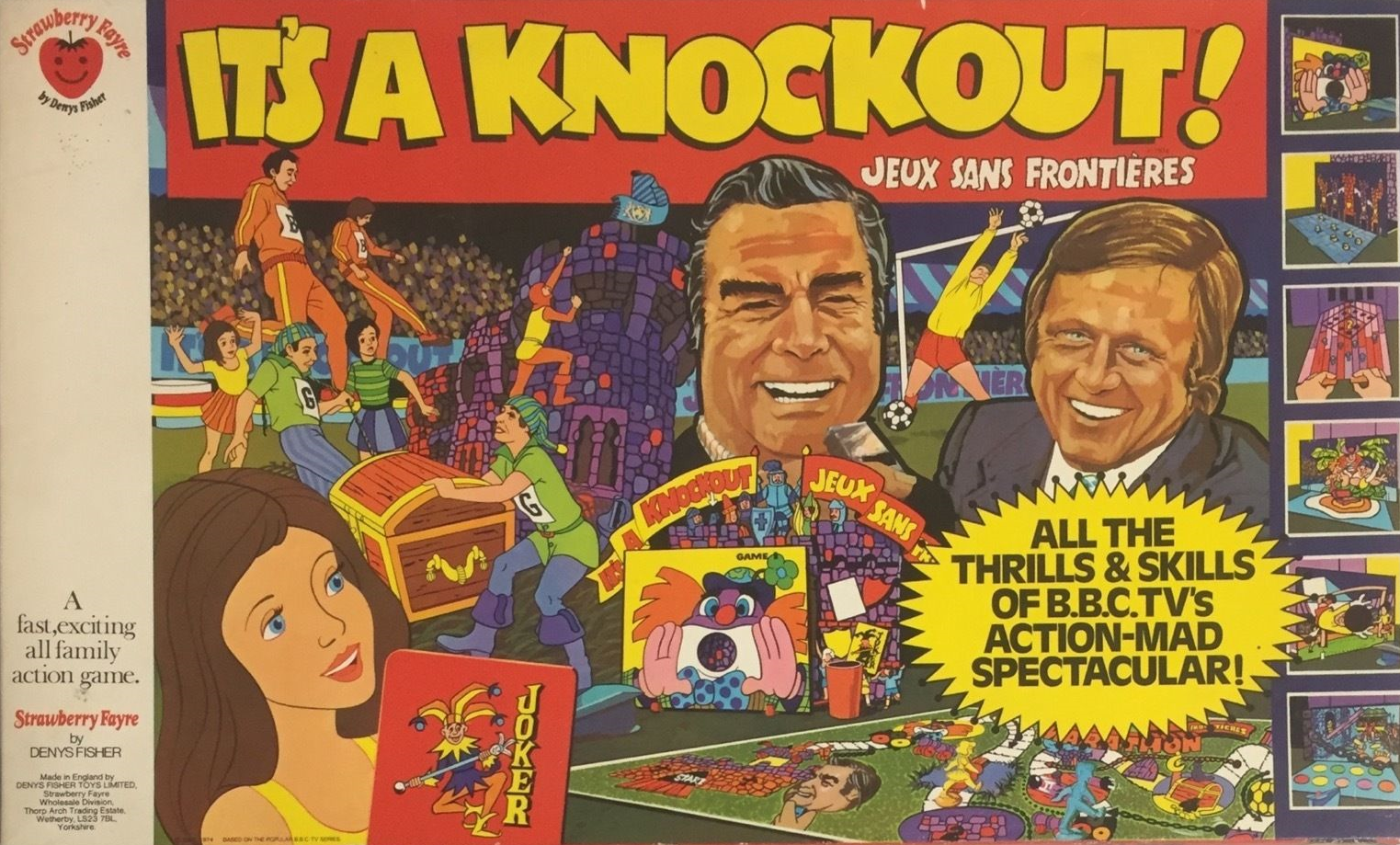
It's A Knockout!

And if you want potentially troublesome artwork, look no further than the box of this over-complicated affair based on the popular BBC... whatever in the name of sanity it was, prominently featuring a certain disgraced celebrity splashed across a good third of the available space. Requiring substantial pre-game assembly and an assortment of 'mini-boards', the overall effect is a strange attempt at replicating the onscreen madness of people in cow costumes falling into giant paddling pools and audiences who seemed to make as much noise when silent as when roaring with laughter by pitting players against each other in flimsy approximations of such zany and madcap sports as tiddlywinks, target shooting and good old patriotic football, the latter presumably included with the aim of preventing them pesky remoaners from refusing to suck it up like good loosers and sneakily pretending it's actually Jeux Sans Frontieres. All of which is academic, frankly, as the latterday unpleasant associations mean that nobody is likely to be playing it anyway. Not that what came next was really that much better, mind...


Miss World (1974)

Miss World Game

Yes, you too can experience the 'glamour, tension and excitement' of the outmoded beauty contest that people keep trying to inexplicably revive, as creepy-looking cheap plastic dolls make their way on a 'World Tour' around a board dotted with glamour, travel, money and men who 'know what to do', hoping to beat all the others to the 'Golden Spotlight' stage. In the nearest thing that can be found to fairness it is at least an ambitious and unusual three-dimensional gameplay gambit, and did include a black doll at a time when such a move would probably have provoked the average adherent of the Miss World contest to smash their head against a piece of paper until the blood spelt out a letter to the Daily Mail demanding that someone hurry up and invent Nigel Farage, but there's no getting away from the fact that everything about it is built on a solid foundation of wrong, and doubtless there were many ugly scenes that Christmas Day as inattentive relatives bought a copy for someone with a distinctly unimpressed mother. Possibly mindful of this, the following year's Miss UK variant scaled it back into a basic board and card game with even the slightest hint of strategy and intelligence involved, but at the end of the day we're still with the protesters flourbombing Bob Hope. If only there was an environmentally-aware peace-promoting cyborg with a roll-back arm around when we needed one.


The Six Million Dollar Man (1975)

The Six Million Dollar Man

Bostin' Steve Austin has his telescopically-eyed work cut out for him as there are three exact replicas of him on the Bionic loose, and the only way to prove that he's the real deal is by completing a set of Ludo-esque 'missions' on a game board. It's spinners, cards and Miss A Turn squares all the way without acheiving or including anything even halfway rivalling Denys Fisher's still-impressive range of Six Million Dollar Man action figures, but having the players genuinely not knowing which of them is the genuine article is a novel twist, and it was sufficiently successful to be followed later in the year by Bionic Crisis, a quasi-electronic effort that saw players attempting to revive a kaput Steve Austin by deciphering his circuitry without accidentally blowing a fuse. All in all, an admirable attempt to match the imagination and innovation of a forward-thinking TV smash, but even these two were essentially just a warm-up for the next Denys Fisher offering.


War Of The Daleks (1975)

War Of The Daleks

Released just as Davros made his inaugural trundle across the screen, the 'second wave' of Dalekmania gave rise to this mighty effort, which was better than anything released during original 'Dalekmania' and possibly even better than any other board game ever. On top of a dazzlingly-illustrated sprung dancefloor-esque board of wedding cake thickness, comic strip 'rebels' make their way towards a Dalek Command Centre in the hope of destroying it, while eight excellently rendered chunky plastic Daleks (complete with utterly pointless and function-free revolvable head sections) rotate around exterminating any player that gets in their path. Even at the end there's one last twist, as when the infiltrated Command Centre literally collapses, there's a rogue component that could result in you blowing yourself up as part of the heroic quest and technically not really winning. Although Terry Nation would usually let any old bollocks go by in the name of squeezing a bit more money out of his creations, this was an of an unusually high standard for early Doctor Who merchandise, so we can only guess at how exciting an actual Doctor Who game based on Doctor Who itself would have been.


Doctor Who (1975)

Doctor Who

Tom Baker counters! A blue plastic Tardis! Alien planets featuring dinosaur things biting chunks out of spaceships! 'Computer Printout' cards! A thrill-a-move race through time and space! All of which can only go so far towards disguising the fact that this is really just yet another Ludo variant, albeit with the Tardis allowing you to move - gasp - two spaces at once. One of the finest-looking items of seventies Doctor Who merchandise - and, lest we forget, available in two different box designs - but also one of the least satisfying to actually use for its intended purpose. Still more fun than Battle For The Universe, though.


The Guinness Game Of World Records (1975)

The Guinness Game Of World Records

What would any self-respecting child want even less than a gigantic ton-weighing book crammed full of facts and figures about the world's biggest leaf? That's right, a board game that attempted to reflect its McWhirter-recorded contents by requiring them to answer arcane statistical questions about the best/worst/longest immersed and complete a series of Waddington's Games Compendium-esque sub-tiddlywink plastic 'challenges', as demonstrated on the box by a misleadingly awestruck Bristow-alike. Tailor made for parents who enjoyed shouting at you for 'not trying hard enough', this was less a game than an 'outward bound activity day' in your very own home in a handy cardboard box.


Are You Being Served? (1975)

Are You Being Served?

Displaying more attention to the logistical realities of retail than the actual sitcom did, this gaudily realised suspiciously Cluedo-esque effort requires players to pick a character - yes, you can even be Young Mr. Grace - and thriftily stock up on clobber to flog in Grace Bros. This relatively sober gameplay design may not have been especially evident from the box, which featured Mrs Slocombe looking disapprovingly, Miss Brahms looking appreciatively, Mr Lucas looking lecherously, Mr Grainger looking analytically, Captain Peacock looking stoically, Mr Humphries looking alarmedly and Mr Rumbold looking lord-alone-knows-whattishly at a pair of ladies' pants.


Bruce Forsyth's Generation Game (1975)

Bruce Forsyth's Generation Game

His face may take up the lion's share of the box design - and there were two of them too - but there's no indication whatsoever that Bruce actually wants to play this game with you. Instead there's a model of the set complete with sliding doors, an oversized countdown clock and a series of fun-for-all-the-family challenges involving some flimsy plastic props, and not even a single plastic Brucie in 'thinker' pose to go with them. So, relatively faithful to the format of the show, but not really anything more significant than you could have made up when trying to 'play' The Generation Game at home on a wet Saturday afternoon. Or, as the host might have had it, "I'll just make a note of that... rip-off!". But at least you can still play it in polite society...


Jimmy Savile's Pop Twenty (1975)

Jimmy Savile's Pop Twenty

Well, there's no getting away from this "great new game that captures all the excitement of today's pop scene", despite it involving little more than moving boringly around a board filled with Roy Wood-esque 'rockers', embarrassingly unrealistic 'fans' and cigar-chomping 'manager' figures in pursuit of 'gold discs', complete with a patronisingly excitement-free 'turntable' in the middle, and all of it suspiciously redolent of the perspective of someone who was determined to use 'the pop scene' to their personal advantage whilst neither knowing nor caring what it actually involved. So little surprise about their choice of celebrity endorsement, then. "Join in the chart-topping race and head for the Number 1 spot with Pop Twenty!", lies 'Yours Groovily' on the box. It's pleasing to surmise that few would have done even at the time.


James Hunt's Grand Prix Racing Game (1976)

James Hunt's Grand Prix Racing Game

The bad boy of Formula One gets his 1976 World Championship victory commemorated with his very own board game, involving natty plastic cars guided around a deceptively simple-looking racetrack via a complicated system of cards to determine speed, acceleration, petrol et al, with the winner being the first to complete the democratically nominated amount of laps. An accurate reflection of his celebrated skill and judgement on the circuit, all told, though sadly there were no cards to represent being booted out of £3,000,000 'lovenests'.


The George V. Mildred Dice Game (1976)

The George V. Mildred Dice Game

Quite what possessed someone to put TV's top dysfunctional sitcom couple on the box of a barely modified adaptation of enduring dice game Duell will have to remain a mystery. But that's exactly what this is, and nothing more. You'll search in vain for a 'FEED TRUFFLES MISS A TURN' square or a plastic model of Tristram's tyre-fashioned 'Space Station'. And this wasn't even the most inexplicable celebrity comedy tie-in released by Denys Fisher...


The Morecambe & Wise Game (1976)

The Morecambe & Wise Game

For no readily obvious, sane or logical reason, Etic And Ern saw fit to lend their names and images to this perplexing variant on the Connect 4 formula which somehow involved flipping around Andy Warhol-esque images of their sunshine-requesting faces. Not exactly a popular feature of their BBC shows, it has to be admitted, although rumours persist that it may have been a weekly occurrence when they went to Thames at the end. Anyway, you can hear lots more about this game in this edition of Looks Unfamiliar.


Rod Hull's Emu Game (1976)

Rod Hull's Emu Game

A fully operational glittery blue bird-skewed variant of the widely-bastardised proto Pac-Man Mr Mouth game, involving flipping counters into the rotating mechanical beak of TV's top Parky-twatter, replete with authentically luxurious fur. Sadly, despite the implications of the title and indeed his appearance on the box, Rod appears to have been otherwise engaged, doubtless lured away by the suggestion of green jelly. Either that or he'd been promised that there was another Rod Hull And Emu Game in the pipeline.


The Bionic Woman (1976)

The Bionic Woman

Although spun off from The Six Million Dollar Man, The Bionic Woman wasn't just a direct airlift only with hydraulic knockers or something, but a hugely successful series in its own right, with its own cast of characters, thematic obsessions, moral perspective and strictly observed limitations on bionic capabilities. This game on the other hand wasn't THAT far removed from the Six Million Dollar Man one, but it did at least kit out Jaime with a more complicated board, a more complicated set of interlocking assignments, and the unpredictable random appearance of Steve Austin, not always in a directly useful capacity. Sadly, The Bionic Dog does not show up demanding Bonio.


Bat-Man (1977)

Bat-Man

Holy Rare Internationally Licensed Variants Of Top-Selling Board Games! Now almost impossible to find in a half-complete state for less than seventeen million pounds, this appears to have been a 'darker' rejigging of an existing American board game based on the Caped Crusader, with a standard board replaced by an overhead view of Gotham City, a handful of thoroughly expected 'constantly moving' villains on the run, and boring plastic pegs replaced with stand-up Batman and Robin counters which - excitingly - could be role-reversed by players as and when their individual skillsets were called on. Sadly, however, this was just pre-the Filmation series, so we don't get Bat-Mite popping up offering to help. Completists may also wish to seek out the All-Star Comic Action Heroes Game, which roped in several of their DC Comics pals to help but was otherwise more or less exactly the same.


The New Avengers (1977)

The New Avengers Board Game

Gentlemen - we can reissue the The Six Million Dollar Man board game with the artwork changed... we have the technology! Yes, it's more or less the exact same 'mission'-skewed setup as before, only reconfigured to feature Steed, Purdey and Gambit taking on The Cybernauts alongside entirely canonical villains The Mad Major and The Scarlet Skull. Also apparently includes a 'unique' umbrella and hat-themed spinner. Yes, whatever you say, Denys. Not strictly a board game, but it's worth pointing out that this did come accompanied by The New Avengers Shooting Game, which is now worth a small fortune but was not exactly in keeping with the spirit of the series. And which, surprisingly, was not reissued to cash in on The Professionals instead. In fact, astonishingly, that doesn't seem to have inspired any board games at all. Presumably Bodie thought dice were 'namby pamby'.


Multi-Coloured Swap Shop (1978)

Multi-Coloured Swap Shop

Despite the regulation cover-dominating photo of Noel, and despite the repeated artwork appearance of Posh Paws, this ambitious 'computer'-aping semi-mechanised affair audaciously concerned itself with the actual basic phone-in toy exchange framework of Swap Shop, rather than any acknowledgement of the pop groups, the interruptions from The Odd Ball Couple and Skip And Fuffy, or John Craven exhorting us all to take a look at some of Britain's disappearing wildlife. Thus it was that one of the very few tangible reminders of a genuinely revolutionary Saturday Morning show came to embody the very detail that the fewest people remember about it. Meanwhile, if you don't want your mind to liquify, try not to concentrate on the fact that most of the actual real life 'swaps' probably included all of the above games.

Playing pieces from the Miss World Game.


If you want to hear me on the radio talking about Denys Fisher board games, including an amusing story about the Miss World game, then you can find that here.

You can find an expanded version of this piece, with more on the board games and the story behind Denys Fisher Toys, in Can't Help Thinking About Christmas, available in paperback here or from the Kindle Store here.


You can find lots more about old TV shows and ridiculous tie-in merchandise in Well At Least It's Free, available in paperback here or from the Amazon Kindle Store here.

Drahvin Saturday


If you've read my book Not On Your Telly, then you'll probably have seen a piece about when a copy of Air Lock, the long-lost third episode of the 1965 Doctor Who story Galaxy Four, turned up a while back. More specifically, it was a piece about how excited I was by the discovery, yet how different the whole experience was from the time that I got to see a much-copied VHS dub of the similarly recovered second episode of The Evil Of The Daleks back in 1987.

Now, purely on the basis of having thought of a David Bowie-related pun that was too good not to use but which I'm almost certainly not the first person to have thought of and which is of absolutely no other practical relevance whatsoever, I'm going to take a look at what else was on offer on television and radio on 25th September 1965. Despite the excitement that it caused for Doctor Who fans, who could finally see the hot blonde Drahvins in full man-subjugating action, not to mention The Rill finally appearing in something other than a Rare Photo, Air Lock was hardly the most high-profile archive television find of recent times; indeed, even when its discovery was announced, it was overshadowed by the simultaneous turning up of David Bowie's Top Of The Pops performance of The Jean Genie. There's probably a theme developing here somewhere, actually, but let's not go overboard with the attempts at logic and cohesion. Anyway, even so, it's still probably the most celebrated and widely recognised programme transmitted that day, but was there anything else similarly long-lost that would make for an equally astonishing find? Never mind that, what about the possibility that there was the odd programme we all know and love but not in the sort of manner that makes us remotely interested in the transmission date? What about all the complete and utter waffle that sat somewhere inbetween? Well, there's only one way to find out. And it involves making some tea first, apparently.


As you're probably already imagining, BBC1 was more or less goal to goal sporting excitement until Juke Box Jury showed up at 5.15, with Petula Clark, Buddy Greco, Virginia Lewis and, erm, Jonathan King giving their verdict on whether Today, Tonight And Tomorrow by The Chosen Few, Poor Old Johnny by Twinkle, Everybody Loves A Clown by Gary Lewis And The Playboys and the splendidly-titled Gyp The Cat by Bobby Darin would be 'Hits' or 'Misses' (clue - they weren't hits). Following an episode of The Dick Van Dyke Show featuring a guest appearance by Chad And Jeremy - who, despite being just about the most serious and proto-progressive of any of the 'British Invasion' acts, bafflingly seemed to show up clowning around on just about every American TV show in existence - there's a second BBC outing for top Canadian comics Wayne And Shuster. As some of you reading this will no doubt be aware, their inaugural appearance a couple of weeks earlier had featured a sketch in which they traded zingers on the set of as-yet untransmitted Doctor Who story Mission To The Unknown complete with Daleks. Amazingly, this sketch does actually still exist, but it's also quite some considerable distance from being anything resembling 'funny' so perhaps we can be grateful that rights complications prevented it from showing up as a DVD extra. Anyway, while there were definitely no Delegates in the second episode, it did coincidentally feature Johnny Clayton, who had played one of them (let's not even get into that here) in Mission To The Unknown, as a supporting actor. Also hovering around in the background were Petula Clark, Una Stubbs and The Dudley Moore Trio, who on the basis of the available evidence were quite possibly the most entertaining factors in the entire show.


Aside from the time-honoured Saturday Night Western - on this occasion Marlene Dietrich vehicle Rancho Notorious - the rest of the evening on BBC1 was taken up by imported entertainment from comic folk singer of 'Camp Granada' impenetrableness Allan Sherman, and crooning Bear-asking-for-'cookies'-botherer Andy Williams, followed by - more intriguingly - mother and daughter Margaret and Julia Lockwood in The Flying Swan, a comedy drama about a hotel owner and her air hostess daughter. Reportedly somewhat on the surreal side, it sounds very much like a series well worth dusting down and revisiting, and as this week's instalment The Contract - in which Carol finally gets to achieve her longstanding ambition of actually flying a plane - is one of only two known to survive, maybe we might get the chance to do that soon. Oh, was that a hint I dropped just there? Well it pays to be subtle. The evening finishes off with Robin Day, Ian Trethowan and Kenneth Harris reporting from the Liberal Party Assembly, and with everything the way it is right at the moment you're probably thinking that political television coverage of any sort can fuck the fuck off and that you're glad that we won't be dwelling on this. Woah ha ho, just you wait.


BBC2 at this point only had a handful of hours to play with, so why they chose to waste the vast majority of them on - you guessed it - the Liberal Party Assembly is beyond explanation, though at least it would have countered any accusations of MSM BAIS!!!!8. More suitable second channel fare comes later in the form of head-hurting woman-turns-tables Polish subtitled psychosexual proto-Blow Up pop art drama Innocent Sorcerers, an Australian Television Service presentation of The Barber Of Seville from that year's Bregenz Festival, and of course Late Night Line-Up, in which Denis Tuohy, Michael Dean, Nicholas Tresilian and Joan Bakewell were almost certainly talking about Innocent Sorcerers, probably talking about Wayne And Shuster, possibly talking about The Drahvins, and more than likely throwing heavy objects in the general direction of the Liberal Party Assembly.


Over on the Home Service, there's an alarming battery of short individual news shows - amongst them Outlook, Today's Papers, From Our Own Correspondent, a confusing repeat of Friday's Ten To Eight as Ten To Seven, Farming Today and On Your Farm, Sounds Topical, The Weekly World and In Your Garden, presented by one 'Roy Hay' - where you would now just get a single over-arching magazine show. There are a fair few religious shows - indeed, several of the news shorts were disconcertingly billed as having a 'Christian slant', as if one was needed on gas being struck in the North Sea - and some educational broadcasts which must have had the poor unfortunates forced to listen to them on a Saturday morning wishing that the wireless had never been invented. Matters pick up sharply with a repeat of the 30th May 1965 edition of Round The Horne - featuring Kenneth Horne: Special Agent in 'The Eiffel Tower Is Stolen', a visit to Julian And Sandy at Bona Pets, and Rambling Sid Rumpo treating us to The Cornish Lummock Woggling Song - and the previous Monday's Desert Island Discs with castaway Rita Tushingham. Her wide-ranging choices included Sibelius, Peggy Lee, The Modern Jazz Quartet and as was apparently law in the mid-sixties The Beatles, while her luxury was apparently the Albert Memorial. As there is no known surviving recording of this edition, we can only guess at Roy Plomley's mock-bemused witticisms about the sheer impracticality of this suggestion.

At 2.15 Afternoon Theatre presented the thrilling-sounding Encounter In Corsica by J.M. Fairley, in which a mysterious stranger with a secret joins the crew of a yacht who include TV's Cyber-Controller Michael Kilgarriff, while at 8.30 Saturday Night Theatre presented an adaptation of John Galsworthy's The Skin Game, starring Wilfred Pickles alongside that (Cyber)man Kilgarriff again. There's some lively exhortations to dance along at home with the Yearning Saunter and the Royal Highland Scottische in Those Were The Days at 6.45, John Bowen ruminating on Thomas Berger's hilarious Wild West parody Little Big Man in The World Of Books at 10.30, and The Reverend R.T. Brooks offering to Lighten Our Darkness at 10.45. The evening ends with some decidedly pastoral Music At Night courtesy of oboeist Sarah Francis and pianists Wilfrid Parry and Iris Loveridge, followed by the Forecast For Coastal Waters and the sound of Damon Albarn exploding circa 1994. Hang on, though, what's that lurking at 10pm there? Oh it's the Liberal Assembly. Yeah, where was that dial again?


Flipping over to the Third Programme, Hans Keller and company weren't going to be lowering themselves to waste their time on such uncouth cultural barbarians as politicians, so thankfully there's a brief respite from the Liberal Assembly here. Instead it's a non-stop Drivetime-esque diet of hardcore classical music, with brief diversions for a repeat of a 1963 presentation of John Mortimer's A Voyage Around My Father starring Andrew Sachs, Hugh David and Gabriel Woolf and his 'sibilant' voice, and for the truly amazing-sounding Violence In Poetry. This was, it appears, a spirited debate on the subject between outspoken critical types Donald Davie, Anthony Thwaite, Edward Lucie-Smith, Peter Porter, Vernon Scannell and Philip Hobsbaum, centered around extracts from the works of Allen Ginsberg, Ted Hughes, Philip Larkin, Thorn Gunn and Robert Lowell; not all of which, warned Radio Times, might actually be permissible for broadcast in the finished programme. As well as undoubtedly being a valuable snapshot of an era when attitudes to freedom in the arts were rapidly becoming polarised, it's also exactly the kind of discussion show that was wont to lead to frayed tempers, raised voices, and on occasion leather elbow-patched scuffling on the studio floor.


As you can imagine, matters were a great deal lighter over on the Light Programme, with upbeat and cheerful sounds pretty much the entire day through. We're up at 5.30 for Morning Music from The Swinging Strings with Jimmy Leach And His Organolians (currently appearing at the Promenade Bandstand, Aberystwyth), and that's really only the tip of the samba-tinged iceberg. Once the BBC's flagship pop show, Saturday Club is gamely holding its own against the onslaught of Top Of The Pops with the aid of Wayne Fontana And The Mindbenders, The Moody Blues and pop-folk latterday cult favourites New Faces, while Lance Percival promises 'some records, odd sounds, odd voices and half an hour of quiet pandemonium' in Lance A'GoGo, Mark Wynter 'sings a song or two and introduces' the dreadfully-titled Wynter In Swingtime, there's a Fanfare from The New Radio Orchestra conducted by Dalek Films soundtracker Malcolm Lockyer, Steel Men hitmaker 'Rog' Whittaker natters to The Alabama Hayriders, The Strawberry Hill Boys and Murray Head in the Folk Room, The Cambrian Male Voice Choir 'and their friends' belt out some songs from Wales in All Together, Moira Anderson Can't Help Singing, Sidney Bowman And His Orchestra with 'MC Stanley Wilson' announce it's Time For Old Time ('Old Skool', surely?), and the brilliantly named Yes, It's Great Yarmouth hurries Matt Monro, The Bachelors, Joe Brown And The Bruvvers, Peter Goodwright, Freddie 'Parrot Face' Davies and whoever or whatever The BBC Summer Show Band might have been on and off a doubtless very cluttered stage. Now THAT's how you do Light Entertainment, Ian Nightly Show. In between, Katie Boyle oversees short-lived Eurovision Song Contest spin-off West German Broadcasting Service co-production Pop Over Europe, probably managing not to say 'suck it up loosers you lost so suck it up whatever the fuck that actually means' along the way, and there's also some up to the minute youth-orientated news, views, comments and up to the minute hit pop discs from Roundabout '65, sadly dating from before Michael Palin's brief stint as a co-host.

On into the night, Francisco Cavez And His Latin Rhythm chip in from the Savoy Hotel, while Eric Winstone of ridiculous Doctor Who theme cover infamy has to make do with Butlin's in Bognor Regis, and DJ before there were DJs Pete Murray takes us off into the small hours with prototype 'music magazine' show Late Night Saturday, boasting an interview with Dusty Springfield about the making of Everything's Coming Up Dusty alongside Pete's pick of the highlights from the latest LP and EP releases. He probably didn't play Look On Yonder Wall by The Paul Butterfield Blues Band, mind.


In short, if you'd opted for the Light Programme, then you would have more or less managed to avoid any and every mention of those old school tie bores droning on and on and on and on without letting anyone else get a word in edgeways until they start foaming at the mouth and falling over backwards. If you wanted to see as well as hear your all-singing all-dancing bright brash Light Entertainment fun, though, then you'd have been wanting ITV. Slotted around the inevitable daytime's barrage of sport and regionally-varying repeats of the likes of The Saint, The Four Just Men, Undermind, The Sullavan Brothers (yes that is spelt correctly) and the mysterious Broad And Narrow, about which little is known but hopefully it was a sitcom about Ian Broad and Ian Narrow who are forced to live together and occasionally do something that makes them realise they are more similar than they think and they both look at the camera sort of meaningfully, you could also find ITV's flagship pop show fallen on hard times and shorn of half its title Lucky Stars with appearances by The Tornados, Dusty Springfield, Alex Harvey, The Candy Dates and, apparently, 'Heather', not to mention the hapless hit-deficient Gary Lewis; Opportunity Knocks! saluting some of its recent winners including folky trio The Headliners and jazz trumpeter Bruce Adams; and some last-thing-at-night laughs with It's Bob Monkhouse!, offering "some zany advice on real estate", it says here. And what a fine thing that is to have as the absolute last programme on television anywhere that da... oh.


So, that's 25th September 1965, and while there were plenty of shows that probably sound more interesting as historically adrift titles and billings than they ever would in actuality (oh and Wayne And Shuster), there's also The Flying Swan and Violence In Poetry, both of which sound so potentially amazing that you'd almost want to see them even more than three more episodes of Hot Drahvin Action. Almost. And it turns out there wasn't any David Bowie anywhere on any channel on this day after all, which put paid to a planned joke halfway through. Still, however good that Saturday's television and radio may or may not have been, at least they wouldn't have to put up with the sonorous drivel of bastards not replying to a straight question for the rest of the week. No, definitely not.


Not On Your Telly, which has that Doctor Who feature we were talking about at the start in it, is available in paperback or from the Kindle Store.

The Dalek Invasion Of RAF Finningley


For all that they might have gone on about their collective fear of typecasting, the various 'classic' Doctor Who lead actors didn't half jump at the chance of an in-character tie-in appearance. Whether it was Jon Pertwee tussling with Aggedor at Glorious Goodwood, Tom Baker dispensing pseudo-scientific facts about his favourite best aliens on Animal Magic, or Colin Baker going on a ride at Blackpool Pleasure Beach for some reason, costumed-up 'canon'-taxing guest spots were a regular and recurring feature of Doctor Who in its original incarnation. Even Richard Hurndall got to do his "and greetings to you from The Time Lords!" gibberish on a couple of occasions, though nobody has ever been quite sure about what character he was actually 'in'. On rare occasions the companions got in on the act as well, particularly on Crackerjack (don't) for some reason, and that's not even getting started on Celation from The Daleks' Master Plan guest-presenting Points Of View.

Sadly, Celation's little chat - if ever a chat as was - with Robert Robinson no longer exists, but at least it was actually recorded and televised in the first place. During the sixties, before anyone really had the means or indeed the inclination to preserve them in any form, there were literally hundreds of tie-in appearances - particularly at the height of 'Dalekmania' - that came and went and faded into hazy memory with only the odd press cutting to prove they happened, from stage plays to charity events to pop single-plugging to visitors at a Daily Mail-sponsored exhibition being ferried past a collection of Doctor Who aliens in a 'Brainy Train', whatever one of those was exactly. And then there was William Hartnell's disconcerting enthusiasm for making appearances at airfields.

Presumably as an adjunct of his previous starring role in long-running ITV sitcom The Army Game, Hartnell appears to have been invited along to air shows and open days roughly every three minutes, and he also appears to have never turned any of them down. Quite often he would show up in character and costume as The Doctor, sometimes with Daleks in tow, and there was even a vague accompanying 'mini-adventure' narrative of sorts; after his speech is interrupted by an 'Anti-Magnetic Device', The Doctor discovers that the Daleks have constructed a 'fort' on the airstrip, and dashes off to alert his good friends at the RAF who promptly unleash a couple of torpedoes and blow the malevolent interlopers sky high. Terry Nation's feelings on this somewhat off-agenda use of his creations are sadly not recorded, although the escapade did usually involve the nobody-would-ever-suspect-a-thing deployment of a 'double' for Hartnell during the more action-packed moments, which was at least in keeping with the usual mode of practice for his actual television adventures.

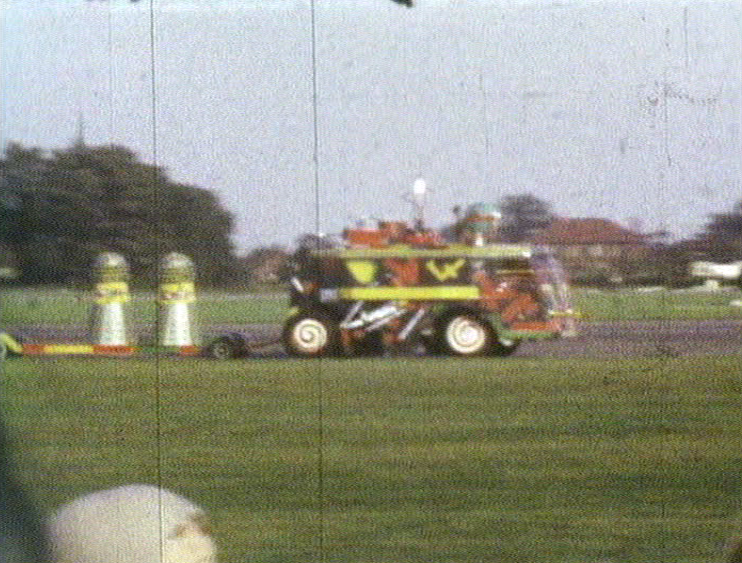
Needless to say, very little evidence of any of these events now remains, apart from - staggeringly - some full colour cine camera footage of one of them. On Saturday 18th September 1965 – the same day that Trap Of Steel, the long-lost second episode of the decidedly Dalek-free Galaxy 4 was transmitted by BBC1 – TV’s Doctor Who William Hartnell took part in an RAF Finningley air show along with some Daleks. Well, we say ‘Daleks’, but that's a very loose interpretation of the term. Anyway, we may not have the sights and sounds of that thrill-packed day, but the few existing seconds of moving footage give us a good idea of... well... not very much at all really.


In an unexpected new twist to the big news story of 1963, William Hartnell arrives at Dealey Plaza; controversy and debate will subsequently rage over whether The Thin White Crochety Old Man was giving an 'inappropriate' salute or simply waving to a fan.


Dangling from a helicopter due to some unspecified 'mini-adventure' plot detail, Hartnell's stunt double puts in an unconvincing bid to secure the role of the next Milk Tray Man. Meanwhile, down on the ground, you can just about make out one of the 'Daleks'. Looks pretty convincing from this distance, doesn't it? Well, just you wait.


With full strength undiluted 'Dalekmania' taking full effect, the crowds are clearly enthralled by the unfolding spectacle. So much so, in fact, that they haven't noticed The Queen arriving to take a look. She preferred The Voord anyway.


After someone realises that the audience would probably feel a bit short-changed without one, some sort of cage box thingy that we're probably best off not knowing the real purpose of is hastily redecorated as a vague approximation of a 'Tardis', which some high-spirited youngsters promptly attempt to upend. Clayton Hickman is reportedly 'concerned' by this turn of events.


As everyone knows, Daleks should only be demonstrated to youngsters by qualified experts in lab coats, and the organisers of the air show have gone one better and added to an already star-studded bill by persuading The Prof from Vision On to do the honours. Here he is also introducing some young attendees to a haphazardly repainted diving bell with random number labelling and some kind of lurid red jagged symbol on top. Meanwhile if anyone can identify that crater-festooned planet, please get in touch.


"But how did the Daleks get up stairs? Eh? Eh? The stairs? How did they get up them? Eh?". By walking on their feet. A fact so widely known and recognised that these two youngers cannot even be bothered turning their heads to have a look.


The most convincing Dalek yet achieves speeds in excess of 234.9mph, before breaking off and heading for Brand's Hatch, where it effortlessly beat Lorenzo Bandini and Graham Hill into second and third place.


In a neat bit of cross-promotion, The Mystery Machine tows two reconfigured shuttlecocks past the awestruck crowds. How this fitted into the 'story' is anyone's guess, frankly.


And finally, the fun family day out concludes with a precision-targeted explosion in which everyone's favourite TV villains are seared from existence in a torrent of smoke and flame. In fairness, it's amazing to think that any visual record of an event of this kind exists at all, let alone in colour. In equal fairness, it's also amazing to think that this and many, many, many other examples of harmless yet decidedly off-message ridiculousness were signed off, approved and authorised where nowadays they would be sent packing at the very first hint of a Brand Awareness meeting. Honestly, providing a bit of cheap and cheerful extra-curricular entertainment for average everyday mainstream viewers of a popular television show - what a thought. It's almost worth writing to Points Of View about.


You can read more about Doctor Who's early extra-curricular activities, including a little-known radio appearance by the Daleks, in Not On Your Telly.

Looking Back At... The Dalek Invasion Of Earth


Back in 1964, The Daleks really were The Masters of Earth. You might think it's a big event when the BBC unveil the trailer for the trailer for the 'minisode' preceding the new series of Doctor Who, but that's got nothing on the runaway levels of sheer excitement that greeted their first ever return appearance. At that point, with the possible exception of The Beatles (and that's only 'possible'), The Daleks were pretty much the biggest thing on the planet. They didn't call it ‘Dalekmania’ for nothing, you know.

World's End, the first episode of The Dalek Invasion of Earth, was transmitted by BBC1 at 17.40pm on 21st November 1964, and judging from the accompanying publicity it's probably safe to say that one or two people were reasonably keen on seeing it. But what else might they have watched or listened to whilst whiling away the Dalek Hours until it was on, or indeed afterwards while trying to chill out and stave off the big Post-Dalek Comedown? Well, get warming up your set - television or wireless - as we're going to be taking a look at some of the highlights of what else was on offer that day. As well as one or two that were absolutely not highlights in any way whatsoever...

7.15 On Your Farm (Home Service)
"A weekly review of the agricultural scene introduced by Charles Jarvis". The Weekend Starts Here!

10.0 Saturday Club (Light Programme)
A special edition of what was then the BBC's then-flagship pop programme - it was actually still more popular and influential than Top Of The Pops for a brief while - as Brian Matthew takes a Fab Four-inspired trip to Hamburg to catch up with John, Paul, George and Ringo's reissue-friendly former bill-sharer Tony Sheridan. He also found time to have a chat with Wenn Doch Jede Woche Mal Der Erste Wär hitmaker Gus Backus, popular beat combo The Rattles, and 'Rocking Stars'-toting bandleader Günter Fuhlisch, whose collective fans quite possibly included the stars of...

12.30 Komm Mit! (BBC1)
The BBC used to make loads of these light drama-based foreign language instruction courses - see also Cold War-tinged ski resort thriller Suivez La Piste! and Cold War-tinged alien-on-Earth thriller Slim John - though there was probably slightly less in the way of Eastern Bloc allegory on the agenda as ‘Heidi’ and ‘Dieter’ attempted to obtain tickets for the opera, doubtless with mildly amusing consequences. Incidentally, ‘Komm Mit’ means, essentially, ‘Come With’, so at least you've learned something today.


1.40 Desert Island Discs (Home Service)
Honor Blackman chats to Roy Plomley and judo-throws a load of classical and jazz waxings – not to mention Johnny Dankworth's original The Avengers theme, which is good and not rubbish like you think – overboard from the sinking ship. She also wants Michelangelo’s David as her luxury item for some reason. Can't possibly begin to imagine why.

4.0 Open House (BBC2)
Time for the first big ‘I... what?’ moment of the day, as Gay Byrne presides over a bafflingly disparate collection of 'People-Places-Pops' which takes in Marvin Gaye, The Merseybeats, Valerie Masters Tony Osborne And His Orchestra and that hep cat all the kids were going crazy for, Dr. Michael Winstanley, alongside some prominently-billed extracts from the big screen version of Lord Of The Flies. We can but hope that this was all more hip and happening than it sounds.

5.15 Juke Box Jury (BBC1)
David Jacobs presides over the typically unlikely combination of Spike Milligan, Alma Cogan, Pete Murray and a very young Liza Minnelli - then appearing with mother Judy Garland in a 'songs from the musicals' extravaganza at the London Palladium - venturing their opinion on a handful of the latest pop waxings, including top discs from The Everly Brothers, Sandie Shaw, Herman's Hermits, Frank Ifield, and those Beatle Boys with their new offering I Feel Fine. As you can see from this still from the single's promo video, Ringo wasn't even the best exercise bike rider in The Beatles.


5.50pm Thank Your Lucky Stars Special (ITV)
And speaking of I Feel Fine, The Beatles were also busy belting it out on the 'other channel' along with She's A Woman, I'm A Loser and Rock'n'Roll Music, while Brenda Lee and Freddie And The Dreamers waved haplessly from the corner. In fact it was audience-chasing all the way on ITV tonight, with Thank Your Lucky Stars followed by Danger Man grappling with The Colonel's Daughter at 7.25pm, now forgotten big comedy name of his day Arthur Haynes at 8.25pm, now even more forgotten Good Honest Copperin' action serial Gideon's Way at 9.10 pm, light-hearted Rantzen-purloined current affairs reports from On The Braden Beat at 11.05pm, and a repeat of five-year-old drama series HG Wells' The Invisible Man at 11.30pm. And that's literally all that we can find to say about ITV on that day, in an article with the primary purpose of celebrating the odd, the unusual, the inexplicable and the just plain uncelebrated of television of yesteryear. This should be printed out and stapled to the foreheads of anyone involved with those boneheaded 'Dismmantal Biassed BBC NOW pls' campaigns. You won't know what you're losing until it's gone so fight them while there's still time. Though, in fairness, they do have such powerful and overwhelming evidence of the need for 'reform' at their disposal...

6.0 Historic French Organs: 3: Saint- Maximin (Third Programme)
“Music by Couperin played by Michel Chapuis on a gramophone record” BBC FAKERY

6.30 The Beat Room (BBC2)
Top of the Pops
’ more musically credible EPs-and-live-bands-based counterpart weighs in with Pat Campbell introducing performances from The Rockin' Berries, Jackie De Shannon, Heinz and The Paramounts, all of whom were pretty big names at the time but whom only shortly afterwards would be left mumbling “I have a horsey... neigh... neigh” in the wake of Rubber Soul. And, erm, Peter And The Headlines, who weren't. Incidentally, you can read all about David Bowie's early appearances on The Beat Room in The Camberwick Green Procrastination Society.


7.30 Starlight Hour (Home Service)
It's slightly strange to think that radio variety shows were once such a big deal, but they were and here's one of the biggest of them. Kenneth Horne introduces singers Janet Coster, Maryetta Midgley and John Hauxwell, violinist Alan Loveday, comics Kenneth Connor, June Whitfield and Ronnie Barker, proper ac-tor Naunton Wayne, and The Starlight Orchestra conducted by Malcolm Lockyer, with a script provide by Rentaghost creator Bob Block. All of the above doubtless had much more high profile things to be getting on with at the time, which gives some indication of just how high esteem radio was still held in back then. In fact, we can see some of those high profile things now; “Naunton Wayne is in ‘The Reluctant Peer’ at the Duchess Theatre; Kenneth Connor in ‘A Funny Thing Happened on the Way to The Forum’ at the Strand Theatre; Maryetta Midgley in ‘Camelot’ at the Theatre Royal, Drury Lane, London; John Hauxwell broadcasts by kind permission of the Sadler's Wells Opera Company”. What's more, Naunton Wayne was also the lead in a translation of Carlo Fruttero and Franco Lucentini's on-your-bike-Black-Mirror dark sci-fi comedy The Memory Machine on The Third Programme earlier in the evening. Stitch that, Live at the Apollo!

7.50 The Black And White Minstrel Show (BBC1)
It'd be preferable not to even mention this, except that... "'The Black and White Minstrel Show' is appearing at the Victoria Palace, London and at the Grand Theatre, Leeds". The actual programme?!

10.05 Jazz 625 (BBC2)
Coleman Hawkins tootles out some high-definition sounds with the aid of Jimmy Woode on bass, Jo Jones on drums, Sir Charles Thompson on piano and Harry 'Sweets' Edison on trumpet. The Jazz Names Shop had evidently closed just before they got there.

10.20 Not So Much A Programme, More A Way Of Life (BBC1)
The toned-down replacement for That Was the Week That Was, which the BBC had cancelled earlier in the year due to governmental pressure (though they face-savingly, or if you will misleadingly, claimed it was due to a need to remain impartial with an election in the offing - how times have changed) came in for such a bashing from the wider satirical community – most infamously Private Eye's flexidisc Not So Much A Programme, More A Shower Of Shit – that today even dedicated comedy historians seem to know little about what went on in it. This is particularly astonishing given that more or less every edition – including this one – still exists. So what would Frost, Rushton, Bron, Bird, Hudd, Sherrin and company have been casting their Friday Night Armistice Satirical Eye over this week? Well, British Troops were finally withdrawing from Kenya, Pope Paul VI had postponed a vote on Religious Liberty, and The Times had just published an article declaring that the Satire Boom had outstayed its welcome. And then of course there was the return of those Dalek characters...


The Camberwick Green Procrastination Society, featuring tons more about old TV and sixties pop music, is available in paperback here, from the Kindle Store here, or as a full-colour eBook here.