Showing posts with label not the nine o'clock news. Show all posts

Top Of The Box

Top Of The Box by Tim Worthington - excellent cover art by Graham Kibble-White

Top Of The Box is the story behind every single released by BBC Records And Tapes, from Every Loser Wins to Awesome Dood!.

Between 1970 and 1990, BBC Records And Tapes released almost three hundred singles, ranging from some of the best known and most loved theme tunes in television history to full-length versions of ones that nobody had even asked for a short version of to begin with. Along the way they also put out one-off oddities by everyone from George Formby impersonators and up-and-coming folkies to a 'computer orchestra' and some posh blokes going on about how marvellous The Queen is. Oh and then there's the one that's just the sound of someone hitting a phone.

Possibly the most bafflingly diverse catalogue of singles ever issued, viewed as a whole, it's a fascinating indication of what really was popular - and sometimes unpopular - with viewers at the time. Top Of The Box tells the story behind each of these singles, taking in familiar names, cult artists and obscure bafflements alike, and including the likes of Simon May, Peter Howell, Nick Berry, David Munrow, Roy Castle, Anita Dobson, Fascinating Aida, Aled Jones, Hazel O'Connor, Richard Stilgoe, Spike Milligan, Johnny Dankworth, Eric Clapton, The Grange Hill Cast, The Dooleys, Alan Hawkshaw, Enya, Keith Mansfield, Julie Covington, Georgie Fame, Godiego, Lena Zavaroni, Brown Sauce, Alan Price, Russell Grant, Kenneth Williams, Floella Benjamin, The Not The Nine O'Clock News Team, B.A. Robertson, Paddy Kingsland, Richard Denton & Martin Cook, The BBC Radiophonic Workshop, and of course Keith Harris & Orville. So many singles by Keith Harris & Orville. Including one that wasn't even released...

You can get Top Of The Box as a paperback here or as an eBook here, or from the Kindle Store here, and - after thanking Graham Kibble-White for the excellent cover art - I'll just leave you with a couple of personal favourites from the catalogue...


Fun At One - The Shows I Couldn't Find...


If you've been reading Fun At One, you'll know that there's a lot of fascinating stuff in Radio 1's Comedy Back Catalogue. A lot of it was available during research, some - notably Chris Morris' 1990 debut on the station - was smoked out as a result of the book being published, and some... well it's just as elusive as ever. Here are ten shows that could do with turning up - some of which aren't even in the BBC Sound Archive - so if you know where to get hold of any of them, please give me a shout...


The Baron


Other than a very brief clip of him startling commuters with a portable record player, absolutely nothing has turned up of Radio 1's original camera-shy anarchist of the airwaves.


Star Special - Michael Palin


In the late seventies and early eighties, Radio 1 gave over the post-Top Forty slot on Sunday evenings to celebrities acting as DJs, including David Bowie, Frank Zappa, Neil Innes, Billy Connolly, Clare Grogan, Jasper Carrott, Sparks, Mickey Dolenz, Ian Dury, Debbie Harry, Chas & Dave and countless others. Most of them are out there, but not the appearance by a Ripping Yarns/Life Of Brian-era Palin. You might also want to keep an eye out for him talking about Monty Python: The Case Against on a certain magazine show we'll be hearing quite a lot about in the next couple of entries...


Marvin The Paranoid Android on Studio B15


As part of promotion for The Hitch-Hiker's Guide To The Galaxy, Marvin The Paranoid Android took part in a phone-in on Radio 1's magazine show Studio B15, with his responses written by Douglas Adams - who also later appeared on Studio B15's& successor Saturday Live to give a similarly elusive plug for The Meaning Of Liff. And that's not the last we'll be hearing about Studio B15...


Beatnews


Long before hitting the big time, Stephen Fry contributed a regular parody of Radio 1's Newsbeat to Studio B15, which came to an abrupt end when he turned in a parody of jingoistic Falklands War coverage. BBC Bias in action, there. Though even that wasn't his first appearance - Studio B15 also ran a feature on Fry and Laurie around the time of The Cellar Tapes.


Not The Nuptials


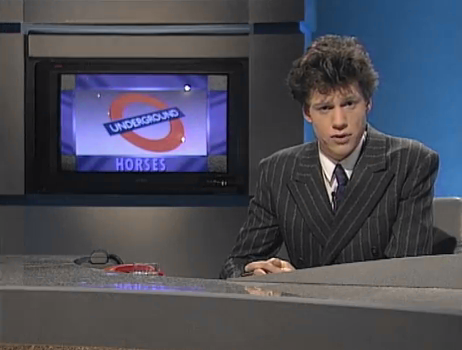
More than likely the least reverential part of the BBC's Royal Wedding coverage - a one-off Radio 1 special by the Not The Nine O'Clock News gang. They also showed up loads of times in various combinations on Roundtable and especially on Studio B15, notably reading out Griff and Pam's 'Valentine Poems' and a behind-the-scenes feature on the making of Series Three. Surprisingly for a show with such an enduringly obsessive fanbase, none of this seems to be out there.


'neil'


The most media-friendly of The Young Ones was all over the BBC at the height of the show's popularity, most notably guesting on Lenny Henry's Radio 1 show, where he attempted to persuade the host to play an Incredible String Band record. neil was also a guest on countless editions of Roundtable and Saturday Live, showing up on the latter on one occasion with 'Mike' in tow; possibly the only in-character promotional appearance Christopher Ryan ever did. Incidentally, Dawn French and Ade Edmondson, amongst others, also showed up on Lenny's show.


Punt And Dennis - Follow That Star!


When The Mary Whitehouse Experience became a hit, there were numerous attempts to get the cast involved in the more general day to day happenings on Radio 1, including this serialised retelling of the Nativity for Simon Mayo's Breakfast Show in 1989. Unlike just about everything else under the Mary Whitehouse Experience banner, this has never resurfaced anywhere.


The Borderline


A one-off 1991 pilot for a Friday Night variety show recorded at the venue of the same name, hosted by Lenny Henry and with material written by a very young Graham Linehan and Arthur Mathews; so obscure that the writers didn't even know it had gone out. Then there's also the dance music shows guest-hosted by Delbert Wilkins, which few heard due to them going out over New Year. And Tracey Ullman briefly had a show too, which there's scant evidence of out there.


Manchester - So Much To Answer For


Not quite his Radio 1 debut - he'd produced and presented Saturday Live for a spell - but Mark Radcliffe's association with the station really began with this idiosyncratic 1990 documentary about the 'Madchester' music scene. Also rather difficult to find is Lard's 1993 series Glitter And Twisted, a comic Glam Rock retrospective presented by Noddy Holder, as indeed is anything of the variously Mark Radcliffe/Mark Kermode-hosted arts show The Guest List.


Radio Fab FM


A couple of hours before The End Of An Era went out on BBC1, Mike Smash and Dave Nice took over Radio 1 for the afternoon. No prizes for guessing what got played.

So if you know where to get hold of any of the above, please get in touch. Or indeed if you know where to get hold of Jake Thackray presenting My Kind Of Folk, or all three of The Goodies on Roundtable, or Spinal Tap on Saturday Live, or Andy Partridge's 'Agony Andy' segments for Janice Long's show, or the Cult Film Corner on Holiday On The Buses, or complete editions of Walters' Weekly, or Radio 1's 'Easy Night' with Kevin Greening, Jo Whiley and Graham Norton, or...


Fun At One - The Story Of Comedy At BBC Radio 1 is available in paperback here or from the Kindle Store here.

The Best Pictures Are In The Radio (Times)

"Here is a box, a musical box, wound up and ready to play, and this box can hide a secret inside... can you guess what is in it today?"

The simple, long-lost thrill of researching popular culture of the past in the pre-Internet era is a subject that I've talked about extensively before - notably in the opening chapter of Not On Your Telly, and in a podcast about a copy of Halliwell's Film Guide that I once bought from the 'Withdrawn' box in my local library (it's a lot more interesting than it sounds, honest) - and yes, you guessed it, it's a subject that I'm about to talk about extensively yet again.

Back in the days when the closest evolutionary relative of IMDB was those books called things like Variety's Sci-Fi Enthusiast's Guide To Out Of This World Movie Credits From Space, which were produced to such high and exacting standards that practically every page had half line gaps in the middle of words, the absolute and almost inconceivably exotic researching holy grail was access to back issues of Radio Times and TV Times. Definitive, unarguable (well, sort of - but that's something that would come to light much later) records of what had been on radio and TV, who had appeared in and made it, and where and when it went out, and all of it without having to wade through interminable wittering about Project UFO first. Of course, if for some strange reason you did want to know about the UK transmissions of Project UFO, then you could find them in there too, but that's by the by.

Eventually, and more by accident than design, I did manage to locate a collection of bound volumes in the awe-inspiring city centre library; although they would later restrict access to dedicated researchers who were prepared to sign official-looking forms and then wait twenty minutes while the staff mysteriously disappeared and returned with the requested copies occupying about a sixteenth of the space on the world's squeakiest trolley, back then they were just sitting on a shelf and you essentially had the free run of TV listings from 1962 to date. Unfortunately this did mean that some prat had already gone through and torn out all of the pages referring to Doctor Who, or worse still carefully levered them out with a craft knife leaving damaging lacerations on all the surrounding pages too, but in all honesty that was really just a minor annoyance. There was so much more in there to find out about than the even by then already overdocumented Doctor Who, and that so much more was precisely what I was in search of. There was, if you will, so much more than TV Times in TV Times magazine. Except that doesn't really work as Doctor Who was in the Radio Times. But you get the general idea.

Suddenly, there were so many longstanding back-of-the-mind questions that could quite concievably be answered. What were the storylines of the untransmitted episodes of Hardwicke House? Did Channel 4 really show a documentary with clips from 'Video Nasties'? Was there any truth in the rumour that Monty Python's Flying Circus hadn't been properly repeated prior to 1986? Didn't TV Times used to use bizarre 'genre' icons in their listings? Did the abandoned Not The Nine O'Clock News launch make it as far as being scheduled? Was Lenny Henry really a DJ on Radio 1? What about that reference somewhere once to a Billy Liar TV series? Had I just imagined Rubovia? And what in the name of all that is sane and rational was Whoops Baghdad? All of these, and more, would soon find their sometimes surprising resolutions. But what I looked up first was something else entirely.

Camberwick Green had been quietly retired from the BBC's lunchtime children's schedules in 1985 - having been shown over thirty times since its debut in 1966 - and like any other TV or radio show (or even film) that had been consigned to the archive shelves in the days before there was the technology or impetus to sell it all back to us constantly, it had already slipped into a sort of cultural limbo. You didn't have to look very far to find evidence that it had existed, of course, but the actual show itself already seemed intangibly remote and distant, far in the subconscious depths of character songs drilled into your memory by repetition and fraught recollections of never being quite sure about that clown in the opening and closing titles. It was something that had once been a permanent fixture in the background but had since retreated inaccessibly into a big box marked 'the past', and that sense of the inaccessible recent past was what drove me to look up its very first transmission.

And there it was - Monday 3rd January 1966, 1.30pm on BBC1, an episode billed as '1: Peter The Postman' and described as 'For the very young'. To be honest, all of the handful of accompanying credits were details that I knew already anyway, involving names that were all too familiar from the clown-rotated credit scroller, but what was really arresting was the small accompanying illustration of the aforementioned Peter The Postman, and a single line in italics at the foot of the listing reading 'See page 19'. And on page 19, there it was - a full-size version of the artwork, featuring Peter Hazel standing atop the Music Box (although for some reason he had actually been drawn taller than it), accompanied by a short and noticeably hyperbole-lacking piece introducing the various characters, hinting at (though stopping short of explicitly stating) its status as the first truly independent production to be made for the BBC, and handily explaining the stop-motion animation process for the benefit of question-plagued parents.

And that, amazingly, was how you launched a major new small-screen venture in 1966. Other highlights for that Monday picked out on the same page included Bob Monkhouse in a 'straight' role in Thirty Minute Theatre, Peter Falk (who apparently "holds an 'Emmy' award, which he won for his part in 'The Price Of Tomatoes'") guesting in The Danny Kaye Show, an episode of Hugh And I - "more comic adventures with Terry Scott and Hugh Lloyd" which had apparently been picked out on the basis of having a new theme tune - and an interesting-sounding documentary named Women In Europe, which looked at how our more progressive continental neighbours were opening out employment opportunities and featured an interview with the Soviet Union's first female commercial pilot. What Mrs. Dingle The Postmistress would have made of all that is anyone's guess.

Since then, for various reasons, I've done a good deal more research into Camberwick Green and its various sequels and spin-offs. Along the way I've got to see the original black and white 'pilot' version of '1: Peter The Postman' with its notorious animation blunder, waded through a stack of paperwork outlining the tedious contractual reasons behind Chigley's disappearance from the schedules for a couple of years in the late seventies, and even heard a Danish-dubbed version of the Welcome To Camberwick Green album (or, in old krone, 'Velkommen Til Grønærteby'). But none of this has ever matched the thrill of finding that small quarter-page introductory piece, and indeed that evocative artwork, probably produced in minutes flat for a magazine that by its very definition had the shortest of shelf lives, but which all this time later remains resonant with the 'feel' of a lost world of prehistoric broadcasting. Of course, so deeply ingrained was the show in the formative experiences of successive generations that we're actually overdue a politician proclaiming that we should "all try to be a bit more like the people of Camberwick Green". To which we should say fine, as long as they personally are prepared to be visited by the clown late at night.

Ten TV Pilots That Didn't Fly


Sometimes, you'll hear about a forthcoming TV show called something like John Lloyd's Newsround or World In Acton. Then when you finally see it, it's called Have I Got News For You or In Bed With Medinner and is more or less a different programme. Other times, you'll buy a DVD on the strength of an 'unbroadcast pilot', only to find out it's basically the first episode with a different credit font. What, though, of the shows where the pilot almost got it right, but still had one or two details that caused last-minute backroom brow-furrowing? Here's ten of the least seen, yet most interesting, tryouts for what eventually became hugely popular TV series…


Blackadder


Wars Of The Roses-set throne-grabbing chicanery with different Baldrick. Uses much the same script as the first episode proper, only without any of the lavish location filming, and comes across as an uneasy mish-mash of The Black Adder and Blackadder II. Evidence of this historical diversion is notoriously not recorded in any extant Encyclopaedia Blackaddica, reportedly due to an unspecified party blocking its use even in clip form.


Vic Reeves' Big Night Out


Charmingly unpolished straight-up transfer of original stage show. Long list of very slightly different stuff includes location filming, starry 'showbiz' backdrop, early version of the 'Let's Have A Little Bit More' song, and Luther Vandross trying to eat a slipper. Even more disorientating than the show itself, and about as far removed from Shooting Stars as you can get. Mysteriously absent from the 'Complete Series' DVD, along with about twelve million other things.


Doctor Who


BBC entrust technically demanding new sci-fi show with 'crotchety' star to young and inexperienced producer and director. Pilot episode comes back with unlikeable characters, malfunctioning scenery, technobabble dialogue and frankly ridiculous bleeps and thunderclaps all over the theme tune. BBC roll eyes and order young and inexperienced producer and director to try again. Second time's the charm. It's thanks to this kind of forward thinking that we got the Voord.


The Day Today


Shaky first attempt at making very visual TV show out of very non-visual radio show. Most of the characters and gags are just about there, but it looks and sounds like it was made for about seven pence, while Chris Morris looks about twelve. Most of it ended up reused in the series, with the notable (and puzzling) exception of multi-handed After Dark sendup 'Debate 2000.' See also the Brass Eye pilot, which despite being more whimsical than the eventual series was rejected by the BBC as 'too savage.'


Not The Nine O'Clock News


Bonkersly unrecognisable jamboree of hastily jettisoned ideas that nearly went out. The introductory gag about a 'cheap tatty revue' was worryingly accurate for this far-from-cutting-edge topical satire with a huge ensemble cast (boasting only Atkinson and Langham from the show proper) and proto-Spitting Image puppets, which was scheduled but then pulled when someone called a general election and a rethink ensued. Good news for those who like actual cutting edge topical satire. And trucking.


Fawlty Towers


Moderately different we're-running-short-of-ideas-now first attempt at A Touch Of Class. When it was originally taped, Polly was introduced as a philosophy student in a variant on the 'flogging something to departing guest' scene. Post-show humming and harring by Cleese and Booth led to them going back and reshooting a couple of scenes to make her into an art student. Would it still have become a comedy classic without this last-minute rethink? Erm, yes.


Spitting Image


Latex lampoonery with a slight difference. The first couple of episodes, under the short-lived producership of Tony Hendra, were weird enough, but for the very first edition they went one weirder, and showed it to a studio audience. However, the audience didn't laugh enough, doubtless due to Hendra-occasioned weirdness, so they dubbed on the taped reaction to rubber-faced ribaldry-toting warm-up man Phil Cool instead. And then took it off the broadcast version altogether.


Camberwick Green


Puppet-essaying test shoot later repurposed as fully functional Peter Hazel The Postman episode. Which you've all probably seen dozens of times, but have you ever noticed the not-like-the-other-episodes giveaways like the scenery wilting in stop-motion under the studio lights, the context-free presence of a Wicker Man-esque ritualistic 'Post Office Dance', or - most disconcertingly - that the puppets all have mouths?? And not static mouths, either. Don't have nightmares.


30 Rock


Dry-run shenanigans for series about dry-run shenanigans. Compared to the actual transmitted first episode, this one's pretty much all there, except that they're working on a show called Friday Night Bits with Jenna DeCarlo, and the Jenna DeCarlo in question is played by erstwhile Saturday Night Live Fey-pal Rachel Dratch. With almost postmodern irony, she 'tested' badly and was replaced for the series by Jane Krakowski as a differently-surnamed Jenna.


Heroes


Overlong rambling doodle-in-the-margin-heavy demo version of first episode proper. Matt and his different wife discover their friend is a radioactively-charged Islamic extremist sleeper agent, Isaac hacksaws his own hand off due to 'heroin,' and 'Paul Sylar' shows up at the end in a silly hat. Ruthless concept-editing resulted in the peerless first season, but after that they just seemed to fling all the rough unworkable ideas in regardless.


You can find more about Camberwick Green and early Doctor Who in Well At Least It's Free, available in paperback here or from the Kindle Store here.