Entrepreneur, engineer and inventor of the Spirograph, Denys Fisher was the creative driving force behind an enduring and very very 'British' toys and games company. No, seriously. You really don't have any idea of just how idiosyncratically regionally niche-targeted their output was. Despite being at least partly bankrolled by the vastly more internationally aware Palitoy - which in turn was at least partly bankrolled by American-as-they-come toy and game conglomerate Hasbro - Denys Fisher Toys specialised in securing the rights to what were in the main the most localised and parochial of cultural phenomena imaginable and creating toys and games around them. Famously this included the first ever range of Doctor Who action figures, less famously the official Roger De Courcey's Nookie Bear Ventriloquist Doll, and a staggering quantity of board games.
From sportsmen to disc jockeys, from disruptive puppets to inevitable gift books from well-meaning relatives, if a single child so much as recognised it in passing then Denys Fisher would rush out a board game based on it, and the less chance that the concept had of inspiring international licensing deals the better. Some of these, it has to be said, were of remarkably high quality and equally high concept. Others were very much not. Here then are some of the good, the bad, and the based around a scrawny old bastard...
On The Buses (1973)

It's easy to forget just how popular On The Buses really was in its day. Mainly because of its wince-inducing attitude towards women and minorities and the fact that it appeared to have left all of its jokes back at the depot, but even so, it's worth pointing out that it inspired no less than three hit feature films and - more importantly - a board game. Which, to be honest, is actually quite fun, involving little more than successfully collecting and dropping off three passengers without being interrupted by Blakey by means of dice, cards, a zany road map, and chunky plastic buses and punters. Denys Fisher specialised in making simple gameplay concepts into visually and often mechanically elaborate affairs, and you'd be hard pushed to find a better example of the phenomenon than this. Yes, that was me being nice about On The Buses. I 'ate you, Butler.
Harvey Smith's Show Jumping (1974)

Dad's Army (1974)

Cartoonish counters depicting the entire regular cast make their way across a military map of Walmington-On-Sea, upending Nazi insignias and replacing them with the good old British Union Flag. Yes, you did read that right, and owing to this uneasy combination of cuddly bumbling loveableness and blood-chilling verboten symbolism it's now almost impossible to buy or sell a copy of this game on leading auction sites. Honestly, it's almost as though someone was erring on the side of caution when it came to facilitating the dissemination of potentially and widely-acceptedly offensive and upsetting material and wanted to make sure they were doing the right thing by the overwhelming majority of their customers. What will Plastic Bertrand and those Eurocrats in Brussels think of next?!
It's A Knockout! (1974)
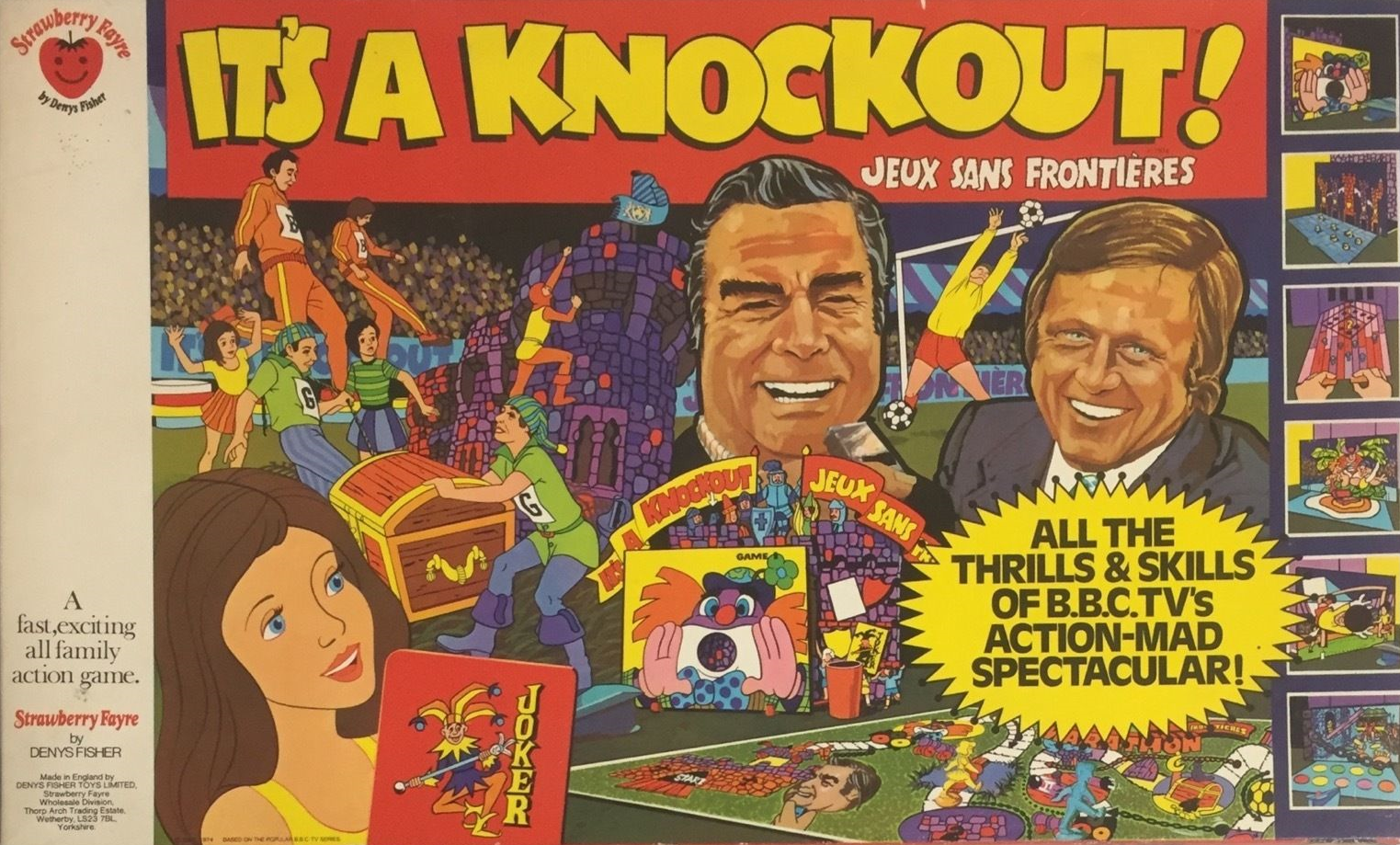
And if you want potentially troublesome artwork, look no further than the box of this over-complicated affair based on the popular BBC... whatever in the name of sanity it was, prominently featuring a certain disgraced celebrity splashed across a good third of the available space. Requiring substantial pre-game assembly and an assortment of 'mini-boards', the overall effect is a strange attempt at replicating the onscreen madness of people in cow costumes falling into giant paddling pools and audiences who seemed to make as much noise when silent as when roaring with laughter by pitting players against each other in flimsy approximations of such zany and madcap sports as tiddlywinks, target shooting and good old patriotic football, the latter presumably included with the aim of preventing them pesky remoaners from refusing to suck it up like good loosers and sneakily pretending it's actually Jeux Sans Frontieres. All of which is academic, frankly, as the latterday unpleasant associations mean that nobody is likely to be playing it anyway. Not that what came next was really that much better, mind...
Miss World (1974)

Yes, you too can experience the 'glamour, tension and excitement' of the outmoded beauty contest that people keep trying to inexplicably revive, as creepy-looking cheap plastic dolls make their way on a 'World Tour' around a board dotted with glamour, travel, money and men who 'know what to do', hoping to beat all the others to the 'Golden Spotlight' stage. In the nearest thing that can be found to fairness it is at least an ambitious and unusual three-dimensional gameplay gambit, and did include a black doll at a time when such a move would probably have provoked the average adherent of the Miss World contest to smash their head against a piece of paper until the blood spelt out a letter to the Daily Mail demanding that someone hurry up and invent Nigel Farage, but there's no getting away from the fact that everything about it is built on a solid foundation of wrong, and doubtless there were many ugly scenes that Christmas Day as inattentive relatives bought a copy for someone with a distinctly unimpressed mother. Possibly mindful of this, the following year's Miss UK variant scaled it back into a basic board and card game with even the slightest hint of strategy and intelligence involved, but at the end of the day we're still with the protesters flourbombing Bob Hope. If only there was an environmentally-aware peace-promoting cyborg with a roll-back arm around when we needed one.
The Six Million Dollar Man (1975)

Bostin' Steve Austin has his telescopically-eyed work cut out for him as there are three exact replicas of him on the Bionic loose, and the only way to prove that he's the real deal is by completing a set of Ludo-esque 'missions' on a game board. It's spinners, cards and Miss A Turn squares all the way without acheiving or including anything even halfway rivalling Denys Fisher's still-impressive range of Six Million Dollar Man action figures, but having the players genuinely not knowing which of them is the genuine article is a novel twist, and it was sufficiently successful to be followed later in the year by Bionic Crisis, a quasi-electronic effort that saw players attempting to revive a kaput Steve Austin by deciphering his circuitry without accidentally blowing a fuse. All in all, an admirable attempt to match the imagination and innovation of a forward-thinking TV smash, but even these two were essentially just a warm-up for the next Denys Fisher offering.
War Of The Daleks (1975)

Released just as Davros made his inaugural trundle across the screen, the 'second wave' of Dalekmania gave rise to this mighty effort, which was better than anything released during original 'Dalekmania' and possibly even better than any other board game ever. On top of a dazzlingly-illustrated sprung dancefloor-esque board of wedding cake thickness, comic strip 'rebels' make their way towards a Dalek Command Centre in the hope of destroying it, while eight excellently rendered chunky plastic Daleks (complete with utterly pointless and function-free revolvable head sections) rotate around exterminating any player that gets in their path. Even at the end there's one last twist, as when the infiltrated Command Centre literally collapses, there's a rogue component that could result in you blowing yourself up as part of the heroic quest and technically not really winning. Although Terry Nation would usually let any old bollocks go by in the name of squeezing a bit more money out of his creations, this was an of an unusually high standard for early Doctor Who merchandise, so we can only guess at how exciting an actual Doctor Who game based on Doctor Who itself would have been.
Doctor Who (1975)

Tom Baker counters! A blue plastic Tardis! Alien planets featuring dinosaur things biting chunks out of spaceships! 'Computer Printout' cards! A thrill-a-move race through time and space! All of which can only go so far towards disguising the fact that this is really just yet another Ludo variant, albeit with the Tardis allowing you to move - gasp - two spaces at once. One of the finest-looking items of seventies Doctor Who merchandise - and, lest we forget, available in two different box designs - but also one of the least satisfying to actually use for its intended purpose. Still more fun than Battle For The Universe, though.
The Guinness Game Of World Records (1975)

What would any self-respecting child want even less than a gigantic ton-weighing book crammed full of facts and figures about the world's biggest leaf? That's right, a board game that attempted to reflect its McWhirter-recorded contents by requiring them to answer arcane statistical questions about the best/worst/longest immersed and complete a series of Waddington's Games Compendium-esque sub-tiddlywink plastic 'challenges', as demonstrated on the box by a misleadingly awestruck Bristow-alike. Tailor made for parents who enjoyed shouting at you for 'not trying hard enough', this was less a game than an 'outward bound activity day' in your very own home in a handy cardboard box.
Are You Being Served? (1975)

Displaying more attention to the logistical realities of retail than the actual sitcom did, this gaudily realised suspiciously Cluedo-esque effort requires players to pick a character - yes, you can even be Young Mr. Grace - and thriftily stock up on clobber to flog in Grace Bros. This relatively sober gameplay design may not have been especially evident from the box, which featured Mrs Slocombe looking disapprovingly, Miss Brahms looking appreciatively, Mr Lucas looking lecherously, Mr Grainger looking analytically, Captain Peacock looking stoically, Mr Humphries looking alarmedly and Mr Rumbold looking lord-alone-knows-whattishly at a pair of ladies' pants.
Bruce Forsyth's Generation Game (1975)

His face may take up the lion's share of the box design - and there were two of them too - but there's no indication whatsoever that Bruce actually wants to play this game with you. Instead there's a model of the set complete with sliding doors, an oversized countdown clock and a series of fun-for-all-the-family challenges involving some flimsy plastic props, and not even a single plastic Brucie in 'thinker' pose to go with them. So, relatively faithful to the format of the show, but not really anything more significant than you could have made up when trying to 'play' The Generation Game at home on a wet Saturday afternoon. Or, as the host might have had it, "I'll just make a note of that... rip-off!". But at least you can still play it in polite society...
Jimmy Savile's Pop Twenty (1975)

Well, there's no getting away from this "great new game that captures all the excitement of today's pop scene", despite it involving little more than moving boringly around a board filled with Roy Wood-esque 'rockers', embarrassingly unrealistic 'fans' and cigar-chomping 'manager' figures in pursuit of 'gold discs', complete with a patronisingly excitement-free 'turntable' in the middle, and all of it suspiciously redolent of the perspective of someone who was determined to use 'the pop scene' to their personal advantage whilst neither knowing nor caring what it actually involved. So little surprise about their choice of celebrity endorsement, then. "Join in the chart-topping race and head for the Number 1 spot with Pop Twenty!", lies 'Yours Groovily' on the box. It's pleasing to surmise that few would have done even at the time.
James Hunt's Grand Prix Racing Game (1976)

The bad boy of Formula One gets his 1976 World Championship victory commemorated with his very own board game, involving natty plastic cars guided around a deceptively simple-looking racetrack via a complicated system of cards to determine speed, acceleration, petrol et al, with the winner being the first to complete the democratically nominated amount of laps. An accurate reflection of his celebrated skill and judgement on the circuit, all told, though sadly there were no cards to represent being booted out of £3,000,000 'lovenests'.
The George V. Mildred Dice Game (1976)

Quite what possessed someone to put TV's top dysfunctional sitcom couple on the box of a barely modified adaptation of enduring dice game Duell will have to remain a mystery. But that's exactly what this is, and nothing more. You'll search in vain for a 'FEED TRUFFLES MISS A TURN' square or a plastic model of Tristram's tyre-fashioned 'Space Station'. And this wasn't even the most inexplicable celebrity comedy tie-in released by Denys Fisher...
The Morecambe & Wise Game (1976)

For no readily obvious, sane or logical reason, Etic And Ern saw fit to lend their names and images to this perplexing variant on the Connect 4 formula which somehow involved flipping around Andy Warhol-esque images of their sunshine-requesting faces. Not exactly a popular feature of their BBC shows, it has to be admitted, although rumours persist that it may have been a weekly occurrence when they went to Thames at the end. Anyway, you can hear lots more about this game in this edition of Looks Unfamiliar.
Rod Hull's Emu Game (1976)

A fully operational glittery blue bird-skewed variant of the widely-bastardised proto Pac-Man Mr Mouth game, involving flipping counters into the rotating mechanical beak of TV's top Parky-twatter, replete with authentically luxurious fur. Sadly, despite the implications of the title and indeed his appearance on the box, Rod appears to have been otherwise engaged, doubtless lured away by the suggestion of green jelly. Either that or he'd been promised that there was another Rod Hull And Emu Game in the pipeline.
The Bionic Woman (1976)

Although spun off from The Six Million Dollar Man, The Bionic Woman wasn't just a direct airlift only with hydraulic knockers or something, but a hugely successful series in its own right, with its own cast of characters, thematic obsessions, moral perspective and strictly observed limitations on bionic capabilities. This game on the other hand wasn't THAT far removed from the Six Million Dollar Man one, but it did at least kit out Jaime with a more complicated board, a more complicated set of interlocking assignments, and the unpredictable random appearance of Steve Austin, not always in a directly useful capacity. Sadly, The Bionic Dog does not show up demanding Bonio.
Bat-Man (1977)

Holy Rare Internationally Licensed Variants Of Top-Selling Board Games! Now almost impossible to find in a half-complete state for less than seventeen million pounds, this appears to have been a 'darker' rejigging of an existing American board game based on the Caped Crusader, with a standard board replaced by an overhead view of Gotham City, a handful of thoroughly expected 'constantly moving' villains on the run, and boring plastic pegs replaced with stand-up Batman and Robin counters which - excitingly - could be role-reversed by players as and when their individual skillsets were called on. Sadly, however, this was just pre-the Filmation series, so we don't get Bat-Mite popping up offering to help. Completists may also wish to seek out the All-Star Comic Action Heroes Game, which roped in several of their DC Comics pals to help but was otherwise more or less exactly the same.
The New Avengers (1977)

Gentlemen - we can reissue the The Six Million Dollar Man board game with the artwork changed... we have the technology! Yes, it's more or less the exact same 'mission'-skewed setup as before, only reconfigured to feature Steed, Purdey and Gambit taking on The Cybernauts alongside entirely canonical villains The Mad Major and The Scarlet Skull. Also apparently includes a 'unique' umbrella and hat-themed spinner. Yes, whatever you say, Denys. Not strictly a board game, but it's worth pointing out that this did come accompanied by The New Avengers Shooting Game, which is now worth a small fortune but was not exactly in keeping with the spirit of the series. And which, surprisingly, was not reissued to cash in on The Professionals instead. In fact, astonishingly, that doesn't seem to have inspired any board games at all. Presumably Bodie thought dice were 'namby pamby'.
Multi-Coloured Swap Shop (1978)

Despite the regulation cover-dominating photo of Noel, and despite the repeated artwork appearance of Posh Paws, this ambitious 'computer'-aping semi-mechanised affair audaciously concerned itself with the actual basic phone-in toy exchange framework of Swap Shop, rather than any acknowledgement of the pop groups, the interruptions from The Odd Ball Couple and Skip And Fuffy, or John Craven exhorting us all to take a look at some of Britain's disappearing wildlife. Thus it was that one of the very few tangible reminders of a genuinely revolutionary Saturday Morning show came to embody the very detail that the fewest people remember about it. Meanwhile, if you don't want your mind to liquify, try not to concentrate on the fact that most of the actual real life 'swaps' probably included all of the above games.

If you want to hear me on the radio talking about Denys Fisher board games, including an amusing story about the Miss World game, then you can find that here.
You can find an expanded version of this piece, with more on the board games and the story behind Denys Fisher Toys, in Can't Help Thinking About Christmas, available in paperback here or from the Kindle Store here.