Showing posts with label swap shop. Show all posts

BWAMmM it’s ZOKKO!


It Started With Swap Shop was the name of a light-hearted retrospective broadcast by BBC2 in 2006, ostensibly celebrating thirty years of Saturday morning television but concentrating on one particular key example of the genre; Noel Edmonds’ Multicoloured Swap Shop. Like so many other light-hearted histories of the timeslot, this made the mistake of implicitly crediting Edmonds and company with the invention of the show format and pretty much the first ever use of the timeslot full stop. There were in fact a handful of now pretty much forgotten antecedents of Swap Shop, although the reasons for their being left out of such an overview are quite understandable. Saturday Scene, dating from 1973 and effectively the first use of the now-familiar Saturday morning format, was an ITV show, while the BBC’s own previous attempts at finding something suitable for this awkward timeslot were, to be blunt, just too downright weird to revisit.

Prior to 1968, neither the BBC nor ITV had really paid much attention to Saturday mornings. Although attendances were already dwindling, there still remained a strong and long-established tradition of Saturday morning cinema clubs, which provided young audiences with several hours’ worth of cartoons, serials and onstage games and entertainment. With broadcast technology still in its infancy, there seemed little point in starting up transmission for the benefit of an audience that would mostly be otherwise engaged. Usual practice – as far as the BBC was concerned – was simply to run an old film serial or an imported cartoon series after their transmission tests early in the morning, then possibly another before Grandstand started at midday, and leave screens blank for the remainder of the morning. Early in 1968, as part of a general overhaul of their output instigated by incoming departmental head Monica Sims, the BBC Children’s Department began to look into the idea of introducing structured programming to Saturday mornings.


Between 30th March and 22nd June 1968, an experimental – in both senses – magazine show called Whoosh! was added to the Saturday morning schedules. Devised by former Play School production team Cynthia Felgate and Peter Ridsdale-Scott, Whoosh! featured Play School presenter Rick Jones, ballet dancer turned comedienne Dawn Macdonald - who got the job after sending Felgate a photo of herself pulling a ridiculous face - and former child actor Jonathan Collins in what Radio Times described as ‘a place where anything can happen’ – in other words a surreal, psychedelically-decorated studio set full of eccentric prop machinery, where they tried to solve riddles and puzzles with the occasional filmed insert cued in to show them venturing ‘outdoors’. While this was some way away from the later style of Saturday morning shows, it nonetheless anticipated their energy and interplay, and predilection for offbeat storyline-driven formats.

While Whoosh! was certainly successful, and viewers enjoyed the heavy element of write-in interactivity, Sims felt that a more loose and fast-moving format akin to a televised comic was more appropriate for Saturday mornings, and was inclined to dispense with human presenters altogether. Eventually an experimental thirteen-week slot was decided on, and Children’s Department veteran Molly Cox, who had partly devised Jackanory and acted as its first director, was asked to come up with a suitable format in collaboration with newcomer Paul Ciani. Cox and Ciani shared Sims’ feelings about the kind of material appropriate for the timeslot; Saturday cinema had been a rowdy, colourful affair with plenty of action and comedy, and as such they took advantage of the perceived lack of need for a human presenter as an opportunity to pack as much action, comedy and pop music as possible into the available timeframe. The result of this meeting of minds was Zokko!, an 'electronic comic' that would zip between short features at high speed, and sought to replicate the effect of a reader flicking through an actual comic in search of their favourite strips and features. The show would contain a combination of in-house animation, stock footage, pop music, and a small amount of specially shot light entertainment material, all cut together using ‘pop art’ editing effects and graphical design that might more normally have been found on shows like Top Of The Pops or Spike Milligan’s Q5. The overall effect of this was, needless to say, disorientating and deeply strange. Introduced by a lengthy Radio Times piece urging viewers to 'Place a regular order with your television set NOW!', accompanied by an eye-catching Roy Lichtenstein-like pop-art illustration proclaiming 'BWAMmM it’s ZOKKO!', Zokko! began its first thirteen-week run on 2nd November 1968.

‘Perplexing’ is not too strong a word to use about Zokko!, and it virtually defies description even today. In place of the rejected human presenter, the production team opted instead for a talking pinball machine. Built by BBC Visual Effects designer Mike Ellis (father of later Blue Peter presenter Janet), this was a fully functioning prop, with its electronic voice provided by Brian Hodgson of the BBC Radiophonic Workshop. This would link the entire programme by autoplaying games, with each score corresponding to a different item, which would appear ‘through’ the holes in the pinball table as the robotic voice intoned the appropriate announcement (“Zokko … Score 15 … Serial”). Some of these items were made up of handy filler material that happened to be available, such as stock footage of racing car speed tests and bulk-bought Disney extracts, but unusually for a programme of this nature the vast majority were specially made in-house. As well as basic animations telling corny jokes (many of them penned by moonlighting novelist Ted Lewis) and short silent films of surreal slapstick gags, each edition of Zokko! included a running serial, pop records, and a live variety act.


Spanning the entire run, the sci-fi adventure yarn Skayn – concerning the theft of a gravity-wave-hologram capable of causing the Earth and the Moon to collide – was told through huge blow-ups of comic strip-style panels drawn by Leslie Caswell, with a pre-recorded dialogue track provided by prolific character actors Gordon Clyde, Sheelagh McGrath and Anthony Jackson. Unconventionally presented and drenched in bleeping Radiophonics, the serial segments came across as strangely tranquil and hypnotic, contrasting effectively with the loud and frenetic style of the rest of the programme. Leaning strongly towards jazzy ‘beat’ outfits like The Alan Price Set, Georgie Fame And The Blue Flames and The New Vaudeville Band, the pop tracks were accompanied by extremely well directed shorts reflecting the lyrical themes of the chosen numbers, some of which were also used in editions of Top Of The Pops.

Meanwhile, the variety acts simply turned up and did their stage performance within the very cramped confines of the Zokko! studio, doubtless causing severe logistical problems for the numerous jugglers. Even the basic list of artistes who appeared on the show makes for fascinating reading, featuring such evocative and long-forgotten names as The Tumblairs, The Skating Meteors, and The Breathtaking Eddy Limbo and ‘Pat’. A handful of more established acts would also show up including conjuring legend Ali Bongo; veteran brother and sister acrobatic duo Johnny and Suma Lamonte; visiting American Phil Enos and his Amazing Comedy Car; and popular illusionist and judo expert Geoff Ray, who though now retired still proudly includes Zokko! on his CV. Most notorious however were Arthur Scott and his Performing Seals, who left the tiny studio reeking so strongly of fish that recording was disrupted for days afterwards.

If this all sounds like a rather mindbending assembly of entertainment, its disorientating nature was amplified to nightmarish and jaw-dropping proportions by the adoption of a deeply psychedelic ‘Swinging London’ visual style, complete with flashing designs that looked garish even in black and white, captions written in lettering that would not have appeared out of place in an advert for a Carnaby Street boutique, and crash zooms on a modishly redesigned poster of Lord Kitchener. Even by the standards of the day this was a visually arresting approach, but the target audience seem to have taken it in their stride and Zokko! proved highly popular, with so many viewers writing in about the programme that the production team eventually had to start sending out postcards ‘from’ the talking pinball machine. Indeed, Zokko! was promptly repeated in full in the regular Wednesday afternoon children’s’ schedules from 6th August 1969, and Brian Fahey’s catchy theme music was released as a single, with the Band Parade music that also featured in the show on the b-side.


While the BBC had reverted to their regular Saturday morning pattern of a lone edition of Deputy Dawg once the first run had finished, a second series of Zokko! had been planned from very early on, and indeed would follow virtually straight on from the repeat run. With the Radio Times proudly proclaiming 'All For Fun! Fun For All! Tar-rah!', Zokko! returned for another thirteen week residency on Saturday mornings, starting from 6th December 1969. Although the new series retained the same production team, some significant changes were made; the sometimes excessively psychedelic design elements were toned down slightly in favour of a stark ‘two tone’ approach, and the pinball machine device was dropped altogether. The reasons for this decision have never been disclosed, although it is rumoured the expensive prop was damaged in storage and the cost of repairs would have been beyond the means of the meagre budget allocated for the second run. Despite this, Radio Times’ introduction to the new series promised the return of 'the old favourites and some new ones', alongside 'a brand new music machine, the like of which has never been seen before'. Said device was essentially a scaled-down Top Of The Pops set with a revolving stage, festooned with flashing lights and surrounded by gigantic bubbling test tubes, and resembling an antique pipe organ rebuilt to the specifications of the set designer of Willy Wonka And The Chocolate Factory. Filmed with camera angles better suited to a raucous pop music show - and more than likely the inspiration for the remarkably similar ‘Jackie Charlton and the Tonettes’ sketch in the second series of Monty Python’s Flying Circus, recorded shortly after the second series of Zokko! had aired - the indefinable contraption would pump out excerpts from stage musicals and instrumental pop hits while punningly appropriate inanimate objects revolved in the centre.

While this occupied the linking role formerly occupied by the pinball machine, the actual contents of the show remained much the same and just as mind-frazzling as ever. The animations, pop films, awful jokes, Disney extracts, stock footage, jarring bursts of exclamation marks and electronically treated voices were all back on board. Skayn returned for a new eight-part adventure, this time sent to investigate saboteurs at large on a moon colony, and the final five shows of the run were given over to the big top crime thriller Susan Starr Of The Circus, with voices provided by Jennifer Hill, Alan Devereux and Stanley Page,. The variety acts, meanwhile, remained as deliriously esoteric as before, top acts this time including The Skating Fontaines ('Thrills at Speed'), Ronny Cool ('Fantasy in Flames'), The Tricky Terriers ('Dog-gone Fun!'), Paul Fox ('The Act That’s Full of Bounce') who amusingly shared his name with the then-controller of BBC1, and Annalou and Maria, who promised 'A Feather and Fur Fantasy' that was doubtless far more innocent than it sounds.

Zokko! was last sighted on television screens on 28th February 1970, but its brief burst of ragged psychedelic lunacy had certainly left an impression on viewers, and would prove to have a more enduring legacy. Clearly undeterred by the sheer oddness of the results, the BBC would continue to allow Ciani to carry out equally unhinged experiments at finding a suitable format for Saturday morning television. Ed And Zed, which enjoyed a brief run later in 1970, paired Radio 1 DJ Ed Stewart with a robot assistant named Zed (voiced by Anthony Jackson) for a similar menu of low-key serials and Disney excerpts, although they were allowed to have proper bands in the studio this time. That said, given said musical acts included former Bonzo Dog Doo-Dah Band ‘mad scientist’ Roger Ruskin-Spear and his performing robots, this may not have been as much of a concession to sensibility as it might appear. This was followed in 1973 by Outa Space!, a show ‘presented’ by a pair of disembodied alien hands at the controls of a spaceship, in which the ever-present Disney footage rubbed shoulders with a familiar diet of pop-soundtracked films, semi-educational inserts on dinosaurs, and the gripping storyboard serial Vidar And The Ice Monster.


Although it may seem something of a massive jump from these insane early efforts to the more familiar format that has pretty much defined Saturday morning television from the arrival of Saturday Scene and Multicoloured Swap Shop onwards, the truth of the matter is Zokko! and company are essentially a rough pencil sketch of the final format. This is particularly pertinent when Zokko! is compared directly to early editions of Swap Shop; the obvious difference of an avuncular unscripted presenter and live interaction with viewers aside, they have much in common, with the musical inserts simply replaced by proper bands and the Hanna Barbera and Gordon Murray animations standing in for bulk-bought Disney. Even the whimsy and corny jokes are essentially similar; all that Swap Shop really did was to give them more structure and bring in John Craven as a comedy straightman. Although Molly Cox would soon return to the relative normality of factual programming, her subsequent credits including Take Hart, Roy Castle Beats Time and Why Don’t You?, Paul Ciani would later put the lunacy he had learned on Zokko! and its follow-ons to good use. Most prominently he would serve as the longtime director and producer of Rentaghost (again featuring Anthony Jackson), The Basil Brush Show and Crackerjack!, but also helmed a number of long-forgotten yet fondly-remembered offbeat children’s comedy shows such as Hope And Keen’s Crazy House, Bonny! and Great Big Groovy Horse, as well working on many top-rated light entertainment series including The Kenny Everett Television Show, The Paul Daniels Magic Show and Top Of The Pops, where he somehow resisted the temptation to fill the stage with bubbling test tubes.

Sadly, but not entirely unpredictably, very little of Zokko! now survives in the archives. The original master tape of the final second series edition escaped wiping by pure chance, and more recently a telerecording of a compilation edition of highlights from that run was recovered from a private collector. On the plus side this does mean that both Skayn and Susan Starr have had their adventures - or at least a fragment thereof - preserved for posterity, but unfortunately, bar a couple of photographs, nothing remains of the talking pinball machine that seems to have burnt itself indelibly onto so many memories. It’s a fair bet that even the slightest thought of It Started With Zokko! would be enough to give documentary and clip show producers weeks of psychedelically-flashing radiophonically-doused nightmares, but in all fairness Zokko! really was where it all began. Well, unless you count Whoosh!.


If you're interested in the obscure and now largely lost corners of sixties television, then you might also enjoy this feature on The Newcomers.


This piece is adapted from Noise! Adventure! Glitter!, an article featured in my book Well At Least It's Free. You can get Well At Least It's Free in paperback here or from the Kindle Store here.

The TV That Time Forgot: Rubovia


While Camberwick Green and Trumpton are widely-quoted cornerstones of any self-respecting conversation about old children's television, it's difficult enough to find anyone who remembers Chigley with a sufficient degree of certainty to be able to say which characters were in which. When it comes to Rubovia, you might as well not bother even asking them. In fact, it's not unusual to find yourself being accused of just having made it up.

It wasn’t made up, though, and in fact this wasn’t actually the first that viewers had seen of the magical medieval kingdom. In the late fifties and early sixties, Rubovia was a regular fixture at Saturday teatimes on the BBC, as a series of comic plays presented by the BBC Puppet Theatre. Rubovia creator Gordon Murray then moved into both independent production and stop-motion animation, and spent the rest of the decade working on the three shows set in the fictional yet very believable county of ‘Trumptonshire’. The BBC would continue repeating Camberwick Green, Trumpton and Chigley well into the eighties; Murray was keen to continue making new shows, however, and after a couple of false starts he was commissioned by the BBC in 1975 to produce a remake of Rubovia in his distinctive and now familiar animation style.

King Rufus XIV and Queen Caroline were the reigning monarchs of this decidedly offbeat kingdom, aided and abetted by the put-upon Lord Chamberlain, Farmer Bottle, Rubina the cat, Caroline’s pampered pet dragon Pongo, MacGregor the Chinese Native American 'businessman', card game-loving neighbouring monarch King Boris of Borsovia, and court magician - in addition to practically every other job title he could affix his name to - Albert Weatherspoon, whose utter ineptitude with all things sorcery-related was invariably the cause of whatever odd happenings with exploding wine and levitating noblemen were perplexing everyone that week. Brian Cant, who had narrated the earlier 'Trumptonshire' shows, was not available to resume his duties for Rubovia; the character voices were handled instead by Roy Skelton - who had contributed to the earlier Rubovia plays - with narration provided by Gordon Murray himself, and music from Murray’s longtime associate Freddie Phillips. 

Although Rubovia was exactly the sort of wacky surrealist stop-motion quasi-sitcom that all of this suggests, the BBC - for reasons best known to themselves - decided to air it in the lunchtime Watch With Mother timeslot aimed at pre-school viewers. Gordon Murray, who had intended it for the afternoon children’s schedules and a slightly older audience, was surprised at this and felt it was too sophisticated and dialogue-heavy for the Watch With Mother audience; the fact that it never really caught on and disappeared after only a couple of repeat runs would seem to suggest he was correct. Murray's subsequent shows, the equally if not even more humorous Skip & Fuffy and The Gublins, would find a far more suitable home as inserts in Noel Edmonds’ Multicoloured Swap Shop.

Surprisingly, despite its latterday obscurity, there was a large amount of Rubovia merchandise available at the time - including books, a record, jigsaws, a board game, a plasticine modelling set, and a strip in Pippin In Playland comic that ran into the early eighties - but even that wasn’t quite enough to prevent it from becoming the ‘forgotten’ fourth show, and little more than a troubling hazy memory for people who can’t quite work out how a dragon would have fitted in to Trumpton.


If you've enjoyed this, you might also like this feature on The Herbs.


This is an abridged excerpt from 'The TV That Time Forgot', a longer piece about many more obscure and forgotten TV shows in Not On Your Telly, which is available in paperback here or from the Kindle Store here.

A Fast Exciting All Action Game

War Of The Daleks

Entrepreneur, engineer and inventor of the Spirograph, Denys Fisher was the creative driving force behind an enduring and very very 'British' toys and games company. No, seriously. You really don't have any idea of just how idiosyncratically regionally niche-targeted their output was. Despite being at least partly bankrolled by the vastly more internationally aware Palitoy - which in turn was at least partly bankrolled by American-as-they-come toy and game conglomerate Hasbro - Denys Fisher Toys specialised in securing the rights to what were in the main the most localised and parochial of cultural phenomena imaginable and creating toys and games around them. Famously this included the first ever range of Doctor Who action figures, less famously the official Roger De Courcey's Nookie Bear Ventriloquist Doll, and a staggering quantity of board games.

From sportsmen to disc jockeys, from disruptive puppets to inevitable gift books from well-meaning relatives, if a single child so much as recognised it in passing then Denys Fisher would rush out a board game based on it, and the less chance that the concept had of inspiring international licensing deals the better. Some of these, it has to be said, were of remarkably high quality and equally high concept. Others were very much not. Here then are some of the good, the bad, and the based around a scrawny old bastard...


On The Buses (1973)

On The Buses

It's easy to forget just how popular On The Buses really was in its day. Mainly because of its wince-inducing attitude towards women and minorities and the fact that it appeared to have left all of its jokes back at the depot, but even so, it's worth pointing out that it inspired no less than three hit feature films and - more importantly - a board game. Which, to be honest, is actually quite fun, involving little more than successfully collecting and dropping off three passengers without being interrupted by Blakey by means of dice, cards, a zany road map, and chunky plastic buses and punters. Denys Fisher specialised in making simple gameplay concepts into visually and often mechanically elaborate affairs, and you'd be hard pushed to find a better example of the phenomenon than this. Yes, that was me being nice about On The Buses. I 'ate you, Butler.


Harvey Smith's Show Jumping (1974)

Harvey Smith's Show Jumping

1972 Olympic Equestrian Hero and tabloid-infuriating flicker-of-'V's'-at-judges lends his name to this curious gameplay mish-mash involving dice, cards and good old fashioned chucking plastic horses around a board in an attempt to attain the perfect Descending Oxer. "You can't get nearer to the real thing without taking part", says Harvey, which as non-committal aversions of endorsement go is right up there with "With Richard Hurndall you got a complete character".


Dad's Army (1974)

Dad's Army

Cartoonish counters depicting the entire regular cast make their way across a military map of Walmington-On-Sea, upending Nazi insignias and replacing them with the good old British Union Flag. Yes, you did read that right, and owing to this uneasy combination of cuddly bumbling loveableness and blood-chilling verboten symbolism it's now almost impossible to buy or sell a copy of this game on leading auction sites. Honestly, it's almost as though someone was erring on the side of caution when it came to facilitating the dissemination of potentially and widely-acceptedly offensive and upsetting material and wanted to make sure they were doing the right thing by the overwhelming majority of their customers. What will Plastic Bertrand and those Eurocrats in Brussels think of next?!


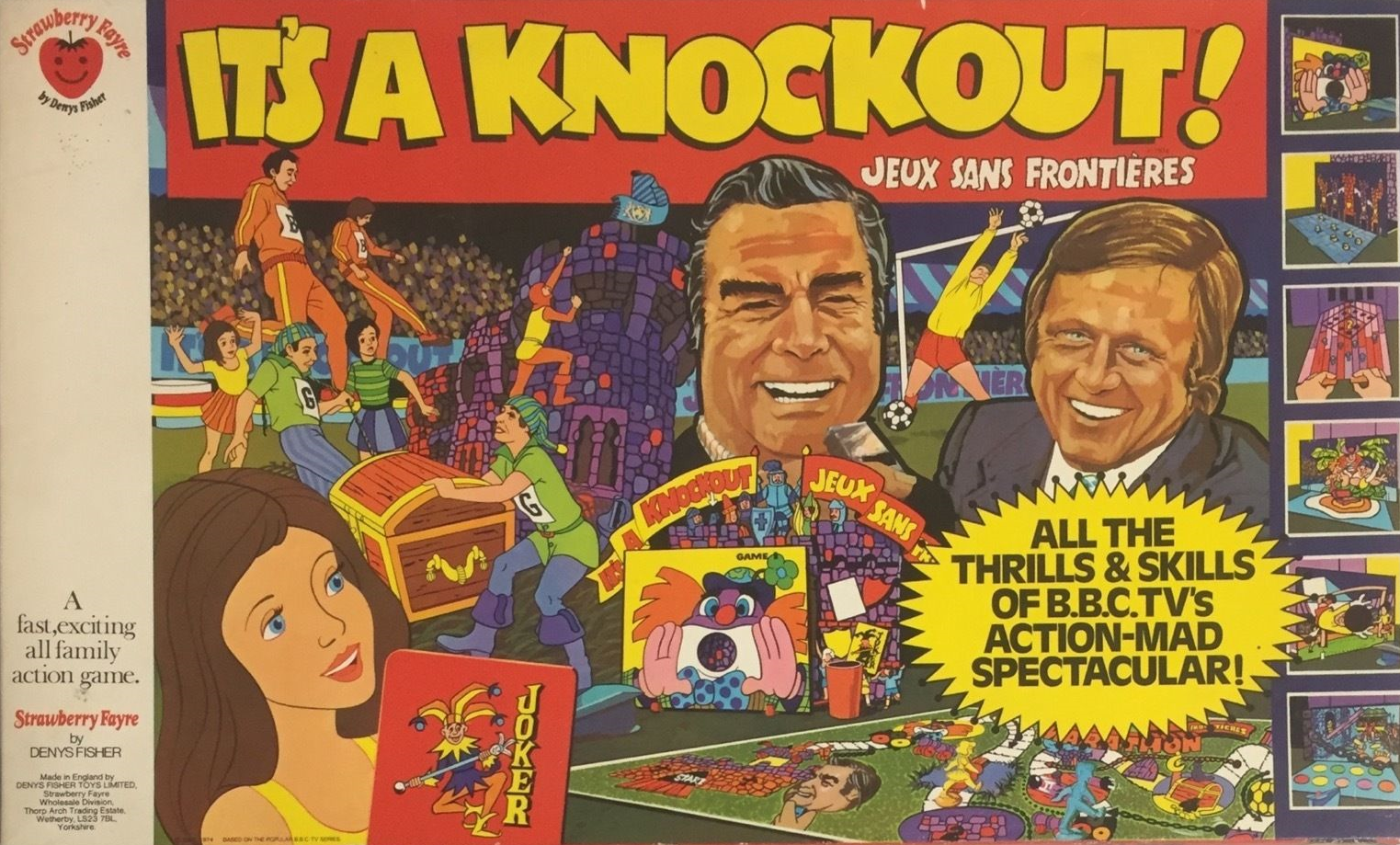
It's A Knockout! (1974)

It's A Knockout!

And if you want potentially troublesome artwork, look no further than the box of this over-complicated affair based on the popular BBC... whatever in the name of sanity it was, prominently featuring a certain disgraced celebrity splashed across a good third of the available space. Requiring substantial pre-game assembly and an assortment of 'mini-boards', the overall effect is a strange attempt at replicating the onscreen madness of people in cow costumes falling into giant paddling pools and audiences who seemed to make as much noise when silent as when roaring with laughter by pitting players against each other in flimsy approximations of such zany and madcap sports as tiddlywinks, target shooting and good old patriotic football, the latter presumably included with the aim of preventing them pesky remoaners from refusing to suck it up like good loosers and sneakily pretending it's actually Jeux Sans Frontieres. All of which is academic, frankly, as the latterday unpleasant associations mean that nobody is likely to be playing it anyway. Not that what came next was really that much better, mind...


Miss World (1974)

Miss World Game

Yes, you too can experience the 'glamour, tension and excitement' of the outmoded beauty contest that people keep trying to inexplicably revive, as creepy-looking cheap plastic dolls make their way on a 'World Tour' around a board dotted with glamour, travel, money and men who 'know what to do', hoping to beat all the others to the 'Golden Spotlight' stage. In the nearest thing that can be found to fairness it is at least an ambitious and unusual three-dimensional gameplay gambit, and did include a black doll at a time when such a move would probably have provoked the average adherent of the Miss World contest to smash their head against a piece of paper until the blood spelt out a letter to the Daily Mail demanding that someone hurry up and invent Nigel Farage, but there's no getting away from the fact that everything about it is built on a solid foundation of wrong, and doubtless there were many ugly scenes that Christmas Day as inattentive relatives bought a copy for someone with a distinctly unimpressed mother. Possibly mindful of this, the following year's Miss UK variant scaled it back into a basic board and card game with even the slightest hint of strategy and intelligence involved, but at the end of the day we're still with the protesters flourbombing Bob Hope. If only there was an environmentally-aware peace-promoting cyborg with a roll-back arm around when we needed one.


The Six Million Dollar Man (1975)

The Six Million Dollar Man

Bostin' Steve Austin has his telescopically-eyed work cut out for him as there are three exact replicas of him on the Bionic loose, and the only way to prove that he's the real deal is by completing a set of Ludo-esque 'missions' on a game board. It's spinners, cards and Miss A Turn squares all the way without acheiving or including anything even halfway rivalling Denys Fisher's still-impressive range of Six Million Dollar Man action figures, but having the players genuinely not knowing which of them is the genuine article is a novel twist, and it was sufficiently successful to be followed later in the year by Bionic Crisis, a quasi-electronic effort that saw players attempting to revive a kaput Steve Austin by deciphering his circuitry without accidentally blowing a fuse. All in all, an admirable attempt to match the imagination and innovation of a forward-thinking TV smash, but even these two were essentially just a warm-up for the next Denys Fisher offering.


War Of The Daleks (1975)

War Of The Daleks

Released just as Davros made his inaugural trundle across the screen, the 'second wave' of Dalekmania gave rise to this mighty effort, which was better than anything released during original 'Dalekmania' and possibly even better than any other board game ever. On top of a dazzlingly-illustrated sprung dancefloor-esque board of wedding cake thickness, comic strip 'rebels' make their way towards a Dalek Command Centre in the hope of destroying it, while eight excellently rendered chunky plastic Daleks (complete with utterly pointless and function-free revolvable head sections) rotate around exterminating any player that gets in their path. Even at the end there's one last twist, as when the infiltrated Command Centre literally collapses, there's a rogue component that could result in you blowing yourself up as part of the heroic quest and technically not really winning. Although Terry Nation would usually let any old bollocks go by in the name of squeezing a bit more money out of his creations, this was an of an unusually high standard for early Doctor Who merchandise, so we can only guess at how exciting an actual Doctor Who game based on Doctor Who itself would have been.


Doctor Who (1975)

Doctor Who

Tom Baker counters! A blue plastic Tardis! Alien planets featuring dinosaur things biting chunks out of spaceships! 'Computer Printout' cards! A thrill-a-move race through time and space! All of which can only go so far towards disguising the fact that this is really just yet another Ludo variant, albeit with the Tardis allowing you to move - gasp - two spaces at once. One of the finest-looking items of seventies Doctor Who merchandise - and, lest we forget, available in two different box designs - but also one of the least satisfying to actually use for its intended purpose. Still more fun than Battle For The Universe, though.


The Guinness Game Of World Records (1975)

The Guinness Game Of World Records

What would any self-respecting child want even less than a gigantic ton-weighing book crammed full of facts and figures about the world's biggest leaf? That's right, a board game that attempted to reflect its McWhirter-recorded contents by requiring them to answer arcane statistical questions about the best/worst/longest immersed and complete a series of Waddington's Games Compendium-esque sub-tiddlywink plastic 'challenges', as demonstrated on the box by a misleadingly awestruck Bristow-alike. Tailor made for parents who enjoyed shouting at you for 'not trying hard enough', this was less a game than an 'outward bound activity day' in your very own home in a handy cardboard box.


Are You Being Served? (1975)

Are You Being Served?

Displaying more attention to the logistical realities of retail than the actual sitcom did, this gaudily realised suspiciously Cluedo-esque effort requires players to pick a character - yes, you can even be Young Mr. Grace - and thriftily stock up on clobber to flog in Grace Bros. This relatively sober gameplay design may not have been especially evident from the box, which featured Mrs Slocombe looking disapprovingly, Miss Brahms looking appreciatively, Mr Lucas looking lecherously, Mr Grainger looking analytically, Captain Peacock looking stoically, Mr Humphries looking alarmedly and Mr Rumbold looking lord-alone-knows-whattishly at a pair of ladies' pants.


Bruce Forsyth's Generation Game (1975)

Bruce Forsyth's Generation Game

His face may take up the lion's share of the box design - and there were two of them too - but there's no indication whatsoever that Bruce actually wants to play this game with you. Instead there's a model of the set complete with sliding doors, an oversized countdown clock and a series of fun-for-all-the-family challenges involving some flimsy plastic props, and not even a single plastic Brucie in 'thinker' pose to go with them. So, relatively faithful to the format of the show, but not really anything more significant than you could have made up when trying to 'play' The Generation Game at home on a wet Saturday afternoon. Or, as the host might have had it, "I'll just make a note of that... rip-off!". But at least you can still play it in polite society...


Jimmy Savile's Pop Twenty (1975)

Jimmy Savile's Pop Twenty

Well, there's no getting away from this "great new game that captures all the excitement of today's pop scene", despite it involving little more than moving boringly around a board filled with Roy Wood-esque 'rockers', embarrassingly unrealistic 'fans' and cigar-chomping 'manager' figures in pursuit of 'gold discs', complete with a patronisingly excitement-free 'turntable' in the middle, and all of it suspiciously redolent of the perspective of someone who was determined to use 'the pop scene' to their personal advantage whilst neither knowing nor caring what it actually involved. So little surprise about their choice of celebrity endorsement, then. "Join in the chart-topping race and head for the Number 1 spot with Pop Twenty!", lies 'Yours Groovily' on the box. It's pleasing to surmise that few would have done even at the time.


James Hunt's Grand Prix Racing Game (1976)

James Hunt's Grand Prix Racing Game

The bad boy of Formula One gets his 1976 World Championship victory commemorated with his very own board game, involving natty plastic cars guided around a deceptively simple-looking racetrack via a complicated system of cards to determine speed, acceleration, petrol et al, with the winner being the first to complete the democratically nominated amount of laps. An accurate reflection of his celebrated skill and judgement on the circuit, all told, though sadly there were no cards to represent being booted out of £3,000,000 'lovenests'.


The George V. Mildred Dice Game (1976)

The George V. Mildred Dice Game

Quite what possessed someone to put TV's top dysfunctional sitcom couple on the box of a barely modified adaptation of enduring dice game Duell will have to remain a mystery. But that's exactly what this is, and nothing more. You'll search in vain for a 'FEED TRUFFLES MISS A TURN' square or a plastic model of Tristram's tyre-fashioned 'Space Station'. And this wasn't even the most inexplicable celebrity comedy tie-in released by Denys Fisher...


The Morecambe & Wise Game (1976)

The Morecambe & Wise Game

For no readily obvious, sane or logical reason, Etic And Ern saw fit to lend their names and images to this perplexing variant on the Connect 4 formula which somehow involved flipping around Andy Warhol-esque images of their sunshine-requesting faces. Not exactly a popular feature of their BBC shows, it has to be admitted, although rumours persist that it may have been a weekly occurrence when they went to Thames at the end. Anyway, you can hear lots more about this game in this edition of Looks Unfamiliar.


Rod Hull's Emu Game (1976)

Rod Hull's Emu Game

A fully operational glittery blue bird-skewed variant of the widely-bastardised proto Pac-Man Mr Mouth game, involving flipping counters into the rotating mechanical beak of TV's top Parky-twatter, replete with authentically luxurious fur. Sadly, despite the implications of the title and indeed his appearance on the box, Rod appears to have been otherwise engaged, doubtless lured away by the suggestion of green jelly. Either that or he'd been promised that there was another Rod Hull And Emu Game in the pipeline.


The Bionic Woman (1976)

The Bionic Woman

Although spun off from The Six Million Dollar Man, The Bionic Woman wasn't just a direct airlift only with hydraulic knockers or something, but a hugely successful series in its own right, with its own cast of characters, thematic obsessions, moral perspective and strictly observed limitations on bionic capabilities. This game on the other hand wasn't THAT far removed from the Six Million Dollar Man one, but it did at least kit out Jaime with a more complicated board, a more complicated set of interlocking assignments, and the unpredictable random appearance of Steve Austin, not always in a directly useful capacity. Sadly, The Bionic Dog does not show up demanding Bonio.


Bat-Man (1977)

Bat-Man

Holy Rare Internationally Licensed Variants Of Top-Selling Board Games! Now almost impossible to find in a half-complete state for less than seventeen million pounds, this appears to have been a 'darker' rejigging of an existing American board game based on the Caped Crusader, with a standard board replaced by an overhead view of Gotham City, a handful of thoroughly expected 'constantly moving' villains on the run, and boring plastic pegs replaced with stand-up Batman and Robin counters which - excitingly - could be role-reversed by players as and when their individual skillsets were called on. Sadly, however, this was just pre-the Filmation series, so we don't get Bat-Mite popping up offering to help. Completists may also wish to seek out the All-Star Comic Action Heroes Game, which roped in several of their DC Comics pals to help but was otherwise more or less exactly the same.


The New Avengers (1977)

The New Avengers Board Game

Gentlemen - we can reissue the The Six Million Dollar Man board game with the artwork changed... we have the technology! Yes, it's more or less the exact same 'mission'-skewed setup as before, only reconfigured to feature Steed, Purdey and Gambit taking on The Cybernauts alongside entirely canonical villains The Mad Major and The Scarlet Skull. Also apparently includes a 'unique' umbrella and hat-themed spinner. Yes, whatever you say, Denys. Not strictly a board game, but it's worth pointing out that this did come accompanied by The New Avengers Shooting Game, which is now worth a small fortune but was not exactly in keeping with the spirit of the series. And which, surprisingly, was not reissued to cash in on The Professionals instead. In fact, astonishingly, that doesn't seem to have inspired any board games at all. Presumably Bodie thought dice were 'namby pamby'.


Multi-Coloured Swap Shop (1978)

Multi-Coloured Swap Shop

Despite the regulation cover-dominating photo of Noel, and despite the repeated artwork appearance of Posh Paws, this ambitious 'computer'-aping semi-mechanised affair audaciously concerned itself with the actual basic phone-in toy exchange framework of Swap Shop, rather than any acknowledgement of the pop groups, the interruptions from The Odd Ball Couple and Skip And Fuffy, or John Craven exhorting us all to take a look at some of Britain's disappearing wildlife. Thus it was that one of the very few tangible reminders of a genuinely revolutionary Saturday Morning show came to embody the very detail that the fewest people remember about it. Meanwhile, if you don't want your mind to liquify, try not to concentrate on the fact that most of the actual real life 'swaps' probably included all of the above games.

Playing pieces from the Miss World Game.


If you want to hear me on the radio talking about Denys Fisher board games, including an amusing story about the Miss World game, then you can find that here.

You can find an expanded version of this piece, with more on the board games and the story behind Denys Fisher Toys, in Can't Help Thinking About Christmas, available in paperback here or from the Kindle Store here.


You can find lots more about old TV shows and ridiculous tie-in merchandise in Well At Least It's Free, available in paperback here or from the Amazon Kindle Store here.

Gordon Murray's Multi-Coloured Swap Shop


This isn't going to be a 'tribute' to Gordon Murray as such, mainly because I feel that the various lengthy pieces I've written about his work stand up perfectly well as 'tributes' in their own right. If you're interested and haven't seen them, then let's just get them out of the way in a brisk Fire Brigade Roll Call style - first episode of Camberwick Green, last episode of Chigley, middle episode of Trumpton, how Radio Times covered the launch of Camberwick Green, where Jimi Hendrix got the idea for The Wind Cries Mary from, article on forgotten 'fourth' show Rubovia, review of the Camberwick Green LP, in-depth look at the making of all three series, Cuthbert, Dibble, Grubb. And indeed 'pheep'.

Instead, I'm going to be asking for your help in paying an even bigger and better tribute to Gordon Murray - helping to track down a long-lost bit of his television history...


On 20th October 1979, Gordon Murray was the main studio guest on BBC1's Saturday Morning show Noel Edmonds' Multi-Coloured Swap Shop. This came about largely as a result of his later puppet comedy shows aimed at an older audience, Skip And Fuffy and The Gublins, having been used as inserts in Swap Shop; a number of viewers had written in asking how they were made, and given that Noel and company were always enthusiastic about the idea of taking the audience 'behind the scenes', it made perfect sense to get him on to talk about them. He also brought along a number of puppets and props from Camberwick Green, Trumpton, Chigley, Rubovia and even some of his earlier productions, and gave away a Gublin as a prize in a write-in competition.

I remember watching this and being absolutely fascinated by the explanations and demonstrations of how stop motion animation worked, how he came up with characters and names, how Brian Cant ended up as the narrator and so forth. I didn't win the Gublin, though. Incidentally that week's show also featured an interview with Tommy Steele as well as a Debbie Harry lookalike contest, and a report on 'Trotting' as a potential new sport. Sadly, Gordon's views on any of the above are not recorded.

Literally not recorded in fact. Sadly, this is amongst the many editions of Swap Shop that were not retained by the BBC, and so far no off-air recording has surfaced. As far as I'm aware, this was the only occasion on which he was interviewed about the shows at this length and in this depth, so it would be nice for everyone to be able to see it again. If by some slim chance you've got a copy, please let me know and I'll make sure that the right people get hold of it. And now, if you'll excuse me, there's the Six O'Clock Whistle...


If you're interested in lost television, you might also like this feature on the 200th edition of Jackanory.


The Camberwick Green Procrastination Society, which includes features on Trumpton, Chigley and Camberwick Green, is available in paperback here, from the Kindle Store here, or as a full-colour eBook here.