Showing posts with label tv 'girl' (test card). Show all posts

Wake Up And Look At This Thing That I Bring...


A look through Emily's shop window at a couple of things you might have missed if you haven't been following my main site (which you can find here)...


And You And I Would Call Them Dragonflies


The story of my long search for the original recordings of the music from Bagpuss, with all manner of diversions about 'Acid Folk' and making tapes from off-air VHS recordings of Cable TV repeats, and a look at the new Bagpuss soundtrack CD. Which is handy. You can read it here.


Shindig! Issue #85


I've got a feature in the latest issue of Shindig! about the hidden beat, psych and folk highlights in the BBC Records And Tapes catalogue, featuring everyone from the BBC Radiophonic Workshop to the Play Away team, and even TV 'Girl' and 'Clown' (Test Card). Find out more about it here.


I've Heard Of Politics, But This Is Ridiculous


Now that charity shops are better organised and make more money for charity with sensible prices, it's a lot less fun rooting through them. Although they do smell slightly less of damp cardboard.
Back in the days when everything was stacked together in haphazard piles without any thought for genre, media or even size, though, you could chance upon something that literally changed the way you thought about everything. Well, that or fifteen copies of that The Adriatic Formula book.
This is the story of how I found an early sixties book based on a then long-forgotten television satire show, and how that changed everything for me. Read all about it here.


You can find more tales of record collecting in dingy charity shops and hunting for obscure television soundtrack music in my book Can’t Help Thinking About Me, available in paperback here or from the Kindle Store here.

Looks Unfamiliar Halloween Extra: "Last Play School House On The Left"

BBC Test Card F, as discussed by Tim Worthington, Ben Baker and Phil Catterall in the Halloween Special of Looks Unfamiliar.


Looks Unfamiliar Halloween Extra: “Last Play School House On The Left”

It’s time for a creepy treat from the archives as Tim Worthington, Ben Baker and Phil Catterall count down the Top Twenty Five Things That You Were Scared Of As A Youngster That Weren’t Supposed To Be Scary! Yes, it’s time to hide behind the sofa from Camberwick Green, Return To Oz, Test Card F, Picture Box, Raggerty, World In Action, Professor Yaffle, The Open University, Angie Baby, Ode To Billie Joe, Spitting Image, Vrillon Of Ashtar Galactic Command, The Blue Peter Boat and much, much, terrifyingly more. Along the way we’ll be waving cheerfully to some Video Nasties to avoid looking at the Children’s section, meeting Parky The Lion, learning why The Muppets aren’t frightening but their eyes are, finding out which family friendly cinematic icon was really a man who exploded and went inside out, and in a lighter moment recalling the classic scene where Terry Scott falls through a chair. And right at the end, there’s our very own scary broadcast intrusion featuring a dog dressed as an elephant… stitch that, ‘Pipes’!.

DOWNLOAD IT HERE - SUBSCRIBE IN ITUNES - RSS


You can hear Phil on Looks Unfamiliar here, and Ben here and here. There's also a special with Ben looking at Looks Familiar, the show that gave Looks Unfamiliar its name, here.

You can find more regular editions of Looks Unfamiliar here.


Looks Unfamiliar - the show about the things you remember that nobody else does

Looks Unfamiliar is hosted by Podnose.


Support Looks Unfamiliar by buying one of Tim's books! Can't Help Thinking About Me is brand new and features loads of brand new material, and you can get it in paperback here or from the Kindle store here.

Stop Getting 'Clown' Wrong!


Early in 1967, BBC Engineer George Hersee unwittingly created a modern design icon. Back in the days when anyone who owned a television would have owned an analogue set that relied on a cathode ray tube, and would only have been able to choose from a handful of channels that conveniently shut down both overnight and for the majority of the daytime anyway, the Test Cards that showed up for half an hour or so at the start and close of broadcasting hours were not only a common sight but also served a crucial technical purpose. Carefully designed with appropriate geometrically precise uses of shapes and shades, not only did they give the ‘backroom boys’ at the television stations themselves an opportunity to check that everything was working correctly ahead of the actual programmes going out, they also allowed the owners of television shops to ensure that their display models were giving the best possible output, and served a similar purpose for television engineers called out to attend to sets that had gone ‘on the blink’.

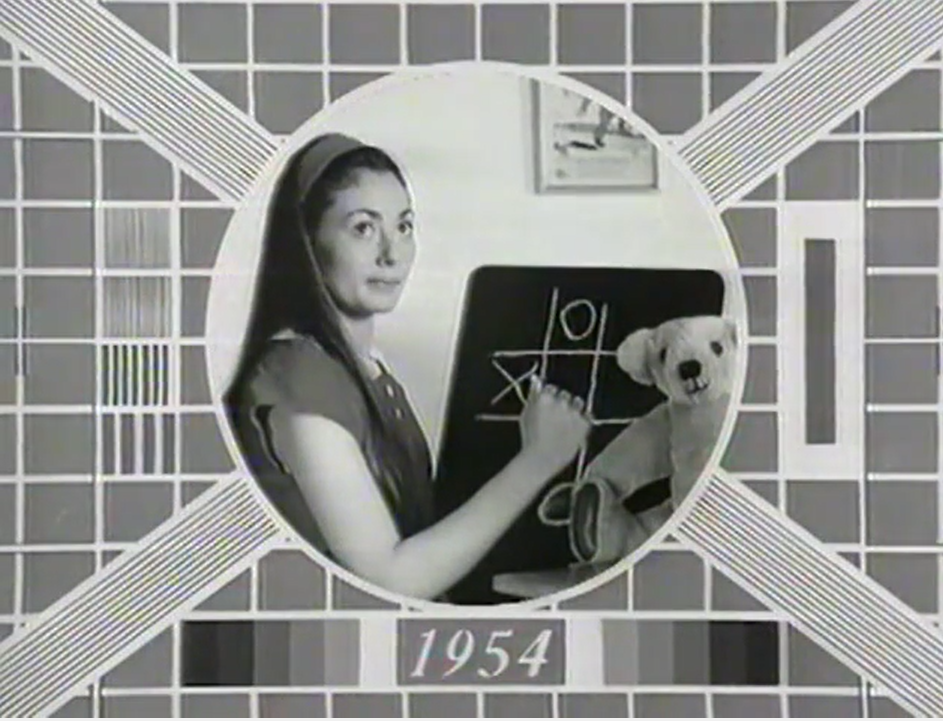
With colour test transmissions due to begin imminently, Hersee – a BBC engineer since the late forties – had been charged with producing a new card that could be used for testing colour equipment. His innovation was to fill the central circle with a colourful photographic image in lieu of yet more gradations; after considering and rejecting prototypes using a fashion model, on the grounds that the Test Card was expected to have a long shelf life in the way that fashions do not, he opted instead for a photograph of his eight year old daughter Carole, dressed in a red top and hairband and a tartan skirt, and locked in the middle of a game of noughts and crosses on a blackboard against her home-made toy clown Bubbles. Not only did Test Card F become convenient and universally-deployed visual shorthand both for technical issues and for ‘television’ in general, it also struck terror into several generations of uncomprehending youngsters unnerved by the fixed grins of the unmoving duo - who, as everyone knew, might suddenly move at any minute - while jaunty non-copyright big band music played underneath.

Needless to say, Test Card F also became a widely-adopted and much-loved target for parody. And almost every single one of those parodies fell down on one small but crucial detail - none of them could ever quite get the Clown right. Take, for example, the noughts and crosses enthusiasts' appearance in legendary BBC time travel drama Life On Mars, spooking the adult Sam Tyler with memories of their spooking the young Sam Tyler whilst viewers laboured under the misapprehension that there might actually be a proper ending to all of this after all. As you can see, Bubbles had clearly spent the intervening years taking full advantage of every fast food restaurant offer shoved through his door, having already inexplicably expanded by one foot in size.


Well, you could be forgiven for thinking, that's quite a recent example, and maybe they were largely working from memory. After all, it isn't even on that much these days, is it? True, but if anything, contemporaneous parodies of Test Card F were even further wide of the 'nought'. For example...


1989, and Spitting Image decides for no readily obvious reason to run a sketch about 'Clown' going on strike because he is a football hooligan and being replaced by Nicholas Witchell or something. Quite how this gave a show renowned for its cruelly latex lampooningly accurate attention to facial and physical detail license to depict him as having a huge spherical head and disproportionately frame-hogging body will have to remain a mystery. Still, in fairness, this was around the time that Spitting Image was getting a bit experimental and trying their hand at other animation styles and indeed featuring human actors, the very first of whom was one Nick Hancock. Who at that point was arguably best known for this bit of prop-based mayhem...


Hancock And Mullarkey's celebrated 'TV Themes' routine saw them rapidly change into costumes and throw around props while a medley of small-screen signature tunes played behind them, from cardboard flames with dancing on a chair to sausage-on-a-fork-and-shooting-up shenanigans. It was an extremely funny piece that never failed to have studio audiences in worryingly excessive hysterics, and right in the middle they threw in a quick Test Card F gag, which scored high marks by featuring a suitably schmaltzy reading of All My Loving. Examine it too closely, though, and you can't help but notice that Nick Hancock has simply reached for the nearest 'clown' wig and is shamelessly relying on a quick spot of cognitive association from the LWT-bound shriekers. Nice how accurately Neil Mullarkey has captured the 'Girl's tie as well. But what if Ben Kingsley, Test Card F Parody Union is behind door?


The normally devastatingly spot-on children's sketch show that was more adult than most adult sketch shows End Of Part One lowers its batting average here a bit by not even bothering to mock up a vague approximation of Bubbles, opting instead for a nondescript doll attached to some balloons that must have made it pretty hard to get a game of noughts and crosses underway. No wonder Fred Harris looks alarmed.


And finally for now, here's an early nineties advert for Granada Television Rentals, which not only gets the launch date of Test Card F wildly wrong but also goes to the vast and thoroughly salary-justifying expense of replacing the clown with a teddy bear. Because they are exactly the same thing, aren't they? Anyway, we're now returning you to the proper Test Card and some music, but if you know of any other examples boasting similarly high levels of devotion to accuracy, do get in touch. You may even want to tell me on Twitter that The Boosh dressed up as 'Girl' and 'Clown' once. I was not aware of that!!4


If you've enjoyed this article, you can find more about Test Card F, Radio Times and other items of old-skool BBC iconography - not all of it entirely respectful - in my book The Camberwick Green Procrastination Society, available in paperback here, from the Kindle Store here, or as a full-colour eBook here.

Listen With TV 'Girl' (Test Card)

Bang On A Drum - Songs From Play School And Play Away

Between 1969 and 1973, BBC Records And Tapes released a couple of dozen LPs on their short-lived 'Roundabout' imprint. Specifically aimed towards younger listeners, and presumably named in honour of a certain animated show that would have been very much on their radar at the time, the Roundabout series of albums started out strange and got even stranger, with a short and unwarranted outburst of sensibility in the middle. Here, then, is a guide to what you might expect to find if you chance upon one of these decidedly odd records lurking at the back of the 'Soundtracks' section in one of the larger charity shops...


RBT1 Fun At The Zoo

BBC Records And Tapes - Fun At The Zoo

Leading naturalist Eric Simms invites us along on an All Back To Mine-style rifle through his personal collection of sound captures from zoos in That London. All immaculately recorded and sounding nice and nice and punchy in that mono field recording kind of a way, but it's debatable how much 'fun' this actually is for the young listeners, let alone the poor old elephants and tigers. You had to be there, I guess. Paul Simon's views on the album are not on record.


RBT2 Come To A Party


Perhaps indicating that they weren't quite ready to fork out for any actual actors or presenters to do the roundabouting duties just yet, BBC Radio producer Gordon Snell takes the frightfully well-spoken lead for a series of party games and songs, including quick Radiophonic Workshop-assisted rounds of Musical Bumps, Guess The Noise, O'Grady Says..., Polly Put The Kettle On, Oranges and Lemons, and, erm, 'Islands, Balloon and Parcel'. No, us neither. He also gets to read out one of his self-penned nonsense stories, 'How The Plonks Got Their Hair'. It's even weirder than you're thinking.


RBT3 Listen With Mother


Only three whole releases in, they've finally opted to put one out based on an actual recognisable children's programme, with the cast of long-running stories, songs and percussion radio hoedown Listen With Mother ushered into a recording booth to re-interpret some of their greatest hits for the listening masses. So basically the tambourine-thumped expected likes of Ring A Ring O' Roses, Little Bo Peep, This Is The Way The Ladies Ride and The Grand Old Duke Of York, alongside such slightly more esoteric fare as A Fishing Rod For Carlos, A Pig With A Wig, From The Cabbage Patch To Australia and, erm, Gay Go Up And Gay Go Down. Moving hastily on...


RBT4 Animal Magic


Still persisting with that off-putting generic front cover branding, but at least they've wheeled out a potentially interest-attracting big name this time around, in the form of veteran anthropomorphist and Public Enemy Number Fifty Three Million Johnny Morris, indulging in much the same sort of skidding-penguin-saying-"look-out-below-fellars!" antics as on the televisual version of Animal Magic, only this time without the televisuals. And what do you know, it works pretty much just as well. Plus, thankfully, he doesn't start warbling on about Gemini The Sealion here either.


RBT5 Jackanory


The BBC's kaleidoscope-fronted storytelling slot makes a hazardous book-TV-vinyl triple-jump with a quartet of readings of traditional folk tales - one each from England, Ireland, Scotland and Wales - culled from the show itself, complete with that never-explained 'hallucinogenic tree' iconography on the back cover. One-woman vaudeville act and pre-war TV mainstay Maureen Potter, Dempsey And Makepeace-botherer Ray Smith, Jackanory Week One helmsman Lee Montague, and Magnus Magnusson - with nary a 'started so I'll finish' gag in sight - do the royalty-free reading out honours. Distinctly short on grooves.


RBT6 Party Time


Gordon Snell's back, and this time he's armed with tongue-twisters, games of I-Spy and, well, more or less exactly the same as before, basically. The only real difference being that the generic cover art has undergone a less-than-subtle overhaul that might lead more suspicious minds to question exactly what refreshments were on offer at said party. Tizer, Caramac and blackcurrant jelly, obviously.


RBT7 The Wizard Of Oz


The optical cause for concern may well continue, but here for the first time ever the cover-mounted roundabout gets ditched in favour of some of the Hilary-Hayton-meets-Jelly-Tots interpretations of the lead characters from Jackanory's celebrated 1970 reading of Frank L. Baum's film-inspiring fantasy novel, as narrated (and indeed re-narrated for this release) by Bernard Cribbins with bits and pieces of hamfisted sound effects and loungey keyboard music. Nobody has tried syncing this up with The Dark Side Of The Moon as far as anyone knows.


RBT8 Magic Roundabout


Eric Thompson, the theme music, and straight-ahead no-nonsense re-recordings of ten original nonsense-crammed stories complete with obscure characters, incessantly-volumed boings, and Dylan and Brian apparently trying to play Rainy Day Women #12 And 35. Do you need any more qualification? Oh you do? Right, well, maybe somebody's been going on about The Magic Roundabout quite a bit recently...


RBT9 Listen With Mother No.2


The cover art experiments continue and everything's gone a bit E Arth Welcome, suggesting that we're about to be treated to a downbeat spoken word version of There's A Hole In My Bucket over a looped bit of Etienne de Crecy. Sadly, though, it's just a bunch of typical Listen With Mother stories with names like Mrs. Moppingdust And The Lettuce Thief and The Six Thin Brothers, though you do have to wonder if Thom Yorke was listening in for The Unhappy Computer.


RBT10 Play School


As the back cover photos which make the presenters look like they've just spilled out of a 'psychedelic' nightclub in a late sixties British spy thriller suggest, you'll find a far more far-out calibre of stories on here, including bleepy retro sci-fi tone poem The Moon Rocket, freestyle-inviting break-heavy animals-go-prog jolliness Fearless Fred's Amazing Animal Band, and the Radiophonic Workshop-assisted tale of everyday existentialism amongst the Splodges. Sampled by more than one dance artist, despite being a spoken word record. Stitch that, Gordon Snell!

It seems that there never was an RBT11, so instead it's straight on to... 


RBT12 The Adventures Of Sir Prancelot 


John Ryan's oft-forgotten post-Mary, Mungo And Midge middle ages tomfoolery steps into stereo for this epic-length crusade to the Holy Land, which would make this one of the highlights of the catalogue if it wasn't for one major drawback - while the sleeve makes a big deal of the inclusion of the bonkers electric sitar-led Jester-mimed what's-that-got-to-do-with-medieval theme music, it's actually only in heavily edited form and in one speaker. Tell those moogs funks breaks merchants on eBay where they can moog funk break it.


RBT13 Camberwick Green


A straight reissue of 1966's Welcome To Camberwick Green, giving listeners another chance to enjoy Peter Hazel and Windy Miller wandering aimlessly about in a flimsy pretext to cram in crisp clean mono versions of pretty much all of the songs from the show, some of them in vocal AND instrumental versions to boot. It's OK, you can come back now. 'The Clown' isn't on the cover.


RBT14 Music Time


In its original black and white 'Pie Chart'-heralded incarnation, Music Time was a very different show, and leaned very much towards the the Corn Riggs Are Bonnie end of the musical scale. Here letter-e-deficient duo Mari Griffith and Ian Humpris take us through some stark acoustic renditions of folk songs from around the world, including Deaf Woman's Courtship, Goodbye Old Paint, O Waly Waly and the ever so slightly dubious Man In The Wood. Cadet Rousselle was not available for comment. Other than to confirm that he has houses three.


RBT15 Bedtime Stories


Johnny Morris rattles through a selection of self-penned yawn-friendly yarns, apparently derived from 'The Post Office Dial-A-Bedtime-Story Service', and introducting us to the likes of Snapper The Crocodile, Snowdrop The Polar Bear, Tubthump The Gorilla (who presumably gets knocked down, but he gets up again), and... well, you get the picture. He doesn't tell one about that lamp, though.


RBT16 Mary, Mungo And Midge


TV's premier Girl/Dog/Mouse ensemble make it to vinyl with a handful of 'your favourite stories from BBCTV' (which doesn't include the one about the clock so that's false advertising for starters), which might lose something with the absence of the minimalist cardboard cutout animation but at least you get lovely medium-fi versions of the opening narration and closing music. There's also reputedly a 'break' hidden away on there somewhere, but even Spindarella hasn't been able to locate it.


RBT17 Bang On A Drum - Songs From Play School And Play Away


Oh yes, this is everything that cover promises. And so much more. Ridiculous Pickettywitch-meets-Mike-Westbrook Pop/Acid Folk/Brit-Jazz hybrid musical mismatch very much to the fore as various frustrated singer-songwriters who'd been reduced to presenting Play School to make ends meet get the opportunity to rework some of their back catalogue flops for younger listeners, going absolutely musically overboard on the way. Rammed from start to finish with hidden delights like Early In The Morning, Sunbeams Play, The Israeli Boat Song, I Like Peace I Like Quiet, and of course the much-sampled Bang On A Drum itself. Notice also how Hamble appears to just be attacking the air with her fists. Just adds to the mounting evidence, frankly.


RBT18 Adventures Of Parsley


Ten retold tales from the post-The Herbs excursion into free-form scattershot five-minute surrealism, with Parsley and Dill (who - controversially - 'narrates' a handful of them) joined by a procession of Guest Herbs and that Farfisa-blinking-in-and-out-of-dimensional-plane theme music in all of its bass speaker-blowing glory. Wonder if that geezer who was always looking for 'THE HERBS LP' in the Record Collector 'Wanted' listings ever found a copy?


RBT19 Play Away


A pretty good attempt at doing a full edition of Play Away in sound only, meaning that there's sketches, gags, poems and free-form parlour games in between all of the music. Famed combination of Blaxploitation funk and Dawkins-esque rationalism Superstition is the obvious standout, though the likes of The Party Is About To Begin, Words Words Words, Umbababarumba and an energetic rattle through If I Had A Hammer are also ever so slightly good, and then on the non-musical side there's the word-walloping playlet Captain Kipper's Clipper. Note also the use of Toni Arthur's arse as a selling point.

As there was no RBT20, let's give thanks to The Lord for...


RBT21 Songs Of Praise For Young Folk


They're all we need to lift our lift our lift our lift our hearts. BBC Records And Tapes' early output was full of these Pete Seeger-inspired 'making worship fun' efforts performed in cahoots with then-struggling now-collectable Acid Folkies - previous offerings had involved the likes of Heather Jones, Dana Stirk and The Crown Folk - and this collaboration between a load of caterwauling kids and the label's in-house psych-heads Trane was no exception, treating listeners to renditions of such oddly-titled God-botherings as There Is A God, O Ru-Ru-Ru, Fisherman Peter and, erm, Love Came A-Tricklin' Down. But while it may be talked about in hushed tones by pillocks with wonky hats nowadays, was it a turntable favourite with youngsters back then? More than likely not.


RBT101 Bobby Lamb And The Keymen


What happened to RBT's 22 to 100 is something we may never know, and sadly listeners would be denied the chance to hear albums based on On The Farm and Mandog, as we leap straight on to... um... Radio 2 favourites Bobby Lamb and his Hammond-hammering wah wah-peddling backing ensemble taking a psych-lounge stroll through a handful of recent top pop disc hits. From a modern day Exotica fan's point of view there's no arguing with the escalating mayhem of their take on The Fool On The Hill, or the slow-burning funk of Harlem Nocturne and Cinnamon And Cloves, and it's rounds of applause all round when Paddy Kingsland of the BBC Radiophonic Workshop shows up to splatter some elastic Moog all over Aquarius, but you really do have to feel for any child who might have been inadvertently bought this when they were hoping for a selection of songs from Hope And Keen's Crazy Bus or something.


RBT102 The Many Voices Of Peter Ustinov


Explorer! Fitness Instructor! Croupier! Lord Mayor's Croupier! It seems we're straying a bit from the original Roundabout brief here, as rather than showing off his best Frank Spencer, TV's That Bloke Where You Were Never Quite Sure Exactly What He Did spends an entire two sides of vinyl deep in 'After Supper Conversation' with those teen sensations all the kids were going crazy for, Cliff Michelmore, Kenneth Allsop and Derek Hart. The latter clearly having left The Bishop Of Woolwich and a Nude Man at home on this occasion.


RBT103 Girl On the Test Card 


Pete Winslow and his not-particularly-onomatopaeic 'King Size Brass' tootle their way through a selection of commercially-available renditions of the non-commercially-available instrumentals regularly heard behind BBC Test Card F; the sleeve notes suggest that this was due to overwhelming viewer interest, though it's more than possible that TV's Scariest Bastards simply marched on BBC Records And Tapes and demanded the release themselves. To be honest, from Take Your Time to Menorcan Mardi Gras, it's all rather jolly, perky and ultimately 'beat'-free fare - even the misleadingly promisingly-titled Six Two Five 405 - but hidden away right at the end you'll find the nigh-on seven minute intergalactic groove of Space Chariots. How come it suddenly gets so interesting? You are not entitled to ask.


RBT104 S'Wonderful


You must remember that huge seventies craze for big band swing, when all the kids downed spacehoppers in favour of dusty old wax cylinders of The Edison Concert Band? No? Well it clearly happened, as here's BBC Records And Tapes' attempt to cash in on the phenomenon with a handful of lively toe-tappers cobbled together from other previous non-Roundabout releases and a distinctly un-childfriendly cover. Either that, or 'Girl' and 'Clown' really did manage to get their feet under the musical table - indeed, as if to underline this, there's a track from Girl On The Test Card included here - and this change of direction was taken merely in the desperate hope of keeping them happy. In which case we would like to categorically state that this is all jolly good, and well done everyone involved, and now please move on as there is nothing more to see here.


RBT106 Jumping To Fame - The Story Of Showjumping Today


At least some semblance of an acknowledgement of what young people like here - well, a certain percentage of them won't shut up about wanting to own a horse - with a cut-down version of a Radio 4 series featuring Jeanine McMullen chatting to equestrians great and small about their Square Oxer shenanigans. It also clearly jumped RBT105 too, as there's no record of that ever having been released.


RBT 107 With Brass And Strings 


Another collection of stuff culled from other extant Big Band-friendly releases, including renditions of the themes from those top children's favourites Softly Softly, Owen M.D., Van Der Valk and the Shipping Forecast (and another tip of the blue triangular hat to TV 'Clown' and 'Girl'). And with that, the Roundabout experiment was quietly retired. Or, if you will, stopped rotating. Sorry.


Top Of The Box, the story behind every single released by BBC Records And Tapes (including more from 'Girl' and 'Clown', but don't let that scare you away), is available here.

The Wind Cries (Mickey) Murphy


Those of you who've been following my ramblings for a while might just have noticed that I have a slight tendency to occasionally tie in musings and theorising on sociocultural phenomena with BBC Test Card F, the bastard creepy photo of a sinisterly-smiling girl locked in an interminably paused game of chalkboard noughts and crosses with a nightmarish multicoloured clown in the middle of a mish-mash of hazardous-looking tuning grids. Some of you may also be aware that I'm something of an admirer of sixties pop trailblazer Jimi Hendrix, at least in his Experience era, and indeed once became drawn into a RHLSTP (RHLSTP!)-bookending Twitter discussion with Richard Herring about which Rodney Bewes sitcom themes Hendrix might realistically have added some guitar work to.

As such, if you're at all clued up about either subject, you're probably now expecting this article to be a detailed examination of the well-known story that Hendrix wrote The Wind Cries Mary while waiting, in front of the TV with guitar in hand, for his then-girlfriend (and journalist, which rarely gets mentioned) Kathy Etchingham to come home following an argument, drawing unlikely inspiration for the opening line "and the clowns have all gone to bed" as Carole Hersee and her garish combatant stared menacingly out towards him to the sound of tuneless big band babble at the end of an evening's viewing. Well, yes, it's a great story, and one that I'll freely admit - on account of having heard Kathy recount it herself in person - that I've repeated as fact before now. But there's also a bit of a problem with it.


As far as anyone can properly ascertain (and no, this is not a green light for ident obsessives to harangue me with herning demands to rewrite the piece to their own speficiations), Test Card F was first transmitted by BBC2 on 2nd July 1967, while The Wind Cries Mary had been released as a single on 5th May 1967. And, more problematically still, had been recorded on at De Lane Lea studios on 11th January 1967, famously put together on the spot after Hendrix turned up with a new song when The Experience had nominally convened to put Purple Haze down on tape. Even allowing for all for all that slowed-down spaceman-voiced blabbering about bending the rules of space and time on Third Stone From The Sun, could Jimi Hendrix really have foreseen the future of broadcast continuity with such uncanny accuracy? Well no, he couldn't. But my contention here is that the story is more or less true, only slightly distorted by the passage of time, the vagaries of popular culture, and, well, Love Or Confusion, and that Kathy Etchingham was simply getting her TV Clowns wrong.

Let's consider a few suitably hazy, if not purply, variables here - putting it as delicately as possible, it doesn't exactly sound like this was the only row the couple had, and it's easy for emotionally-charged details to become conflated and confused; there's nothing - especially given the sheer amount of times that the Test Card in whatever alphabetical incarnation would have been seen in a single twenty four hour stretch back in the days of daytime and overnight closedowns - to suggest what time of day the storming out, the waiting and the songwriting took place. All we know for definite is that Hendrix turned up to the studio with the song completed, and while it's tempting from a narrative point of view to suggest that he'd written it the night before, in all likelihood it probably took a couple of days to compose; and noughts-wielder Bubbles was far from the only clown hovering silently around the nation's television sets around that time. Yes, in case you hadn't worked it out already, it's my contention that Jimi Hendrix had actually been watching Camberwick Green.


Not convinced? Or simply rolling your eyes in exasperated amusement at my shoehorning in of yet another of my popular cultural touchstones? Well, let's crunch a few numbers. Peter The Postman, the first episode of Camberwick Green (which you can read a lot more about here), was repeated by BBC1 - its fourth showing in twelve months - at 1.30pm on 6th January 1967. The full opening lyric of The Wind Cries Mary is of course "after all the jacks are in their boxes, and the clowns have all gone to bed", and as Camberwick Green infamously ended with the episode's central character rotating away into a Music Box, followed by a terrifying glowering clown operating a roller caption with the show's end credits on them (and, perhaps not coincidentally, all of it accompanied by some natty and inadvertently UK Psych-friendly guitar work from Freddie Phillips), it doesn't take much in the way of imagination-stretching to see that this is a much better fit than Test Card F would have been even if it was a chronological possibility.

It's also worth noting that Tuesday 10th January saw the first showing of Miss Lovelace And The Mayor's Hat, the second episode of Camberwick Green's near-neighbouring follow-on companion show Trumpton, which depicted lugubrious Park-Keeper Mr. Craddock and his broom indulging in what can only be described as a spot of "drearily sweeping", though he was noticeably less concerned with the broken pieces of yesterday's life than he was with silver paper, toffee paper, dirty bit of cardboard, chair ticket, bus ticket, button from a dress, chocolate wrapper, envelope, another bit of cardboard, and the vexing question of why 'they' can't use litter bins and not make such a mess. Though, that said, he does immediately go into a rant about a broken bench (which ultimately leads to the Mayor's hat being propelled into a tree, but that's another story). It's not beyond the realms of possibility that the only-recently-arrived-in-the-UK guitarist might have been sufficiently intrigued by his new TV puppet pals to follow their exploits regularly, and that this might also have worked its tenuous way into his new lyrics. Though admittedly any attempt to claim that the solo from The Wind Cries Mary was in any way inspired by the 'Joe So Sad' music from Monday 10th's instalment of the racy urban Hammond-scorch-soundtracked escapades of juvenile petrolhead upstart Joe would most likely be a theoretical leap too far.

So, much like my suggestion to Richard Herring that Rodney Bewes' confused anecdote about singing with Hendrix might have actually related to the theme from Dear Mother Love Albert, there you have it. The Wind Cries Mary probably was inspired by a stray bit of emotional ennui-driven TV-gawpage after all, just not in the way that everyone thought it was. And conspiracy theorists may like to take note that this is the third song, after Happy Time by Tim Buckley and The Gnome by Pink Floyd, that I've directly attributed to the influence of the closing sequence of Camberwick Green. Can I possibly extend this seemingly ridiculous notion any further? Pass me that copy of AMMmusic1966...


If you've enjoyed this article, you can find lots more like it in The Camberwick Green Procrastination Society, available in paperback here, from the Kindle Store here, or as a full-colour eBook here.

ITV 59 - All Your ITV Favourites (And Flower Stories) Part Two: Idents


ASDFGFGFHFG! NELE!

Sorry, don't know what happened there. Welcome, one and all, to the second part of our celebration of forty nine years of the bits on ITV that weren't the programmes but weren't the adverts either (so apologies in advance to Tank from the Walkers Crisps advert). We're going to be skipping the Test Card, as there's only really the Simple Minds-purloined IBA Colour Bars and the slightly earlier black and white one where it looks like when a DVD player goes wrong between chapters worth writing about (and the rogue appearances by BBC Test Card F in some ITV regions has already been covered here), so instead we're moving straight on to the big bewildering company logos the various regions used to say "I MADE THIS" at the end of their programmes. Or, if you will, the 'idents'. Let's rock!

 
We're going to be approaching these in an entirely arbitrary order, so what better place to start than with Grampian, regional-churner-outer for those north of north of north of the border from 1961 right up to 2006, when it was subsumed by one of its broadcast neighbours. Primarily known for an endless parade of heavyweight documentaries, though viewers who fell within its catchment area will be well used to interminable regional opt-outs featuring Runrig jumping over a model of 'Nessie' or something in lieu of the final episode of a networked drama serial they'd been following for ten weeks. Anyway, their stamp of quality was this Saltire-riffing minimalist affair that played out to a shrill burst of Scotland The Brave. Not much potential for surrealist tangents there, really.

 
Off at an actual geographical tangent, however, viewers slightly less north of north of north of the border were serviced by Scottish Television, or STV for short, whose still-thriving blend of costume drama and zany younger viewer mayhem was originally signposted by a lion-in-rectangle gambit calling to mind a design on one of those swanky chocolate biscuits that relatives always had, before they went all BBC Schools Diamond-plagiarising with a mid-seventies switch to white on blue abbreviated chunkiness. Then in the eighties they opted for a blocky cyberpunk thistle, doubtless rendered on one of those computers that cost about a million behind-the-scene-feature-friendly pounds to run and required several days to draw three seconds of animation, whereas nowadays the same effect can be achieved by someone with access to Windows Live Movie Maker on its basic settings and a microphone with loads of buzz on it in about fifteen minutes. This wasn't so much cutting edge and futuristic as a bank manager's idea of cutting edge and futuristic, and pretty much par for the course in the era that gave us the P-p-p-peanutritious! advert. And indeed very much where the rot began to set in... but more about that later.


Down on the, erm, border, Border Television carried out their nation-straddling transmission relay duties under the blue and white banner of a sort of stylised 'B' where nobody could ever actually tell what in the name of sanity it was supposed to be. But that level of self-aggrandisment was pretty much par for the course for a company whose nearly every last second of original programming was entitled 'Border [Something]', with the notable exception of theme-song-censorship-stricken Krankies vehicle The Joke Machine.


Continuing our voyage round the 'regions' that were actually technically slightly more substantial than 'regions' before we get to anything anywhere near England - specifically for the purposes of getting up the noses of those inexplicable hordes of mouth-frothing send-'em-all-back merchant ident freaks - it's time to alight upon greener pastures and Ulster TV's inaugural medical-chart-out-of-hospital-drama-title-sequence jagged line hoo-hah, and its subsequent subsumation into a game show prize-esque stylised TV statuette reportedly fashioned out of metal recovered from the film prints of junked local TV productions, so there may well be bits of a couple of long-lost much-vaunted Jack Rosenthal comedy-dramas in there. No, stop scraping. You can't recover them that way.


The mysterious Television Wales And West was the original reins-taker for the corresponding crossover area between Wales and the West Country, who apparently produced a grand total of no programmes whatsoever for the wider network. However this did mean that they could take a progressively bilingual approach to their local-only output, with a bold late-night-satire prefiguring wallop for the English language stuff, and a natty dragon for Welsh-spoken offerings like Amser Te (apparently literally 'Tea Time'). Anyway, they soon got the long-railway-station-name-pronouncing boot to be replaced by...


...the mighty HTV, makers of true televisual milestones like Into The Labyrinth and Paint Along With Nancy, frustraters of billions of hapless transmitter-failure-stricken Granada youngsters stuck watching Ffalabalam instead of something they could actually comprehend, and purveyors of possible the most far-out idents ever to be seen in the entire history of television, firstly an eye-hurting collision of strobing stripes like, well, The Waltham Green East Wapping Carpet Cleaning Rodent And Boggit Extermination Association's idea of 'psychedelic' frankly, and latterly the sliding white-on-blue lines accompanied by what appeared to be an analogue synth thrown into a jacuzzi.

...and that seems as convenient a moment, and indeed as a 'GRRR POLETICALLY CORRECT BRIGADE : ('-moaner infuriating a moment, as any to take a short break before embarking upon a tour of the remainder of the regions. So we'll see you again in Part Two!

no nele tehre will notf be part two

part