Showing posts with label granada. Show all posts

Manchester


"Tony Wilson, who around this time was regularly featuring punk and New Wave acts on his Granada Television arts show So It Goes, was well known for his aesthetic tastes, interest in futuristic design, and fervent belief that Manchester could become a leading city on a global platform, and Factory’s output and indeed general outlook inevitably began to reflect his obsessions, with its eclectic and cerebral roster of artists encompassing arty funk outfit A Certain Ratio, classically-influenced guitar pop band Durutti Column, and confrontational stand-up comedian John Dowie, whilst the label’s musically diverse releases were given a unifying style by the minimalist and industrial-influenced designs of artist Peter Saville, and in turn by Wilson’s insistence on appending 'FAC' production codes to every project from album and single releases to the purchase of new office equipment; given his political sympathies, the absence of the second part of the word may not have been coincidental. By the early eighties, now with Joy Division's manager Rob Gretton and producer Martin Hannett as partners, and a recently-acquired nightclub, The Hacienda (FAC 51), as a base of operations, Factory was both as successful and as influential as an independent label could hope to be, particularly following the release of New Order’s acclaimed 12” only single Blue Monday in 1983"

When I think of Manchester, I tend to think of Tony Wilson. True, if you grew up in the Granada region, where he kept on fronting regional news and arts shows even when operating on a national and even global platform, and had a liking for the bands signed to his Factory label (yes, even Northside), this is hardly exactly a shocking revelation, but there's a little more to it than that. During some pretty dark and directionless times when the city was struggling every bit as much as any of its industrial neighbours, and beaten down so much that in many ways it had started to fight itself as much as it was being fought, he never ever lost his faith or his vision. The art, culture, inclusivity and rich creative and industrial history of the city, he argued, would always win out - the people would always win out - and one day Manchester would become an example to the entire world.

Although this never quite happened in the way he envisaged, and the numerous false starts and near misses must have frustrated him deeply - although the early nineties bid for Manchester to host the 2000 Olympics was both entertainingly over-ambitious, and a worthwhile show of strength and defiance towards those that preferred to write off Manchester and its neighbours as grey, derelict relics of a bygone age full of uneducated flat-capped Neanderthals; it's also entirely possible that the London 2012 bid might not have been quite so successful without its example to go by - there's a sense in which, way way beyond 'Cool Britannia', the nineties saw the entire UK become something at least vaguely in line with what Tony Wilson always believed Manchester to be. Not that he would really have conceded that, though. As nor indeed would Liam or Noel Gallagher, but we'd need to go too far into the history of alternative music to explain that.

From the collapse of Factory, which he breezily told fellow Granada Reports reporter Bob Greaves would "come back and carry on, but maybe not in the form everyone's expecting" (and in a sense it did with Oasis, which really wasn't what anyone was expecting), to his own later health struggles which he used to highlight the problematic and seemingly arbitrary allocation of NHS treatment funding, Tony Wilson faced pretty much anything that was thrown at him with optimism, practicality and wit, never suggesting there were easy answers to difficult questions and strongly believing that it was incumbent on all of us - including him - to work towards addressing issues that the authorities seemed unable to. Most of all, though, he loved to root for his hometown, and recent events have underlined just how much he and several others like him are missed in the social media age. There are modern-day equivalents around, of course, but they really don't get the exposure. It's them we should be listening to, though, rather than furious didactic combatants for the coveted 'Green Jumper' award for being Best At Being Right-On 1983, braying weasel-word Watch With Mother puppet bigots in suits that would shame someone drinking Special Brew on a bus at 10am, or shrieking car alarms salivating about how many comments they will get on their 'thinkpiece' the next morning.

Shaun Ryder, whom most eighties record companies would not have allowed past reception but whom Wilson was convinced was a 'poet' and didn't care who laughed at that, once recorded a song for Factory that ended - at least in its superlative 12" reading - with an exhortation to "think about the future". Which is what we should all do, frankly, and leave the shock value hatemongers famous and non-famous who've bored us senseless for too long now where they belong, and where too many people once thought Manchester itself belonged - the past.

Ferry Cross The Mersey (Unless It's Raining)


On 2nd June 1979, arguably the weirdest idea for a Saturday Morning TV show ever - and less arguably the most technically ill-advised - set sail around the ITV regions. Launched by Granada on a wave of local talent, The Mersey Pirate was ambitious, live, witty, and conspicuously up to date with current trends in pop music. It was also broadcast live from the middle of a notoriously weather-battered body of water, and, well, a bit of a mess. But the kind of compelling, memorable and glorious mess that you just don't get in this slicker and more sophisticated age, when people actually sit down and think before putting programmes on air.


Inspired in no small part by Gerry And The Pacemakers' 1964 top ten hit Ferry Cross The Mersey, and the modicum of lasting international fame that this had given the handful of boats that lurch daily between Liverpool, Birkenhead and Wallasey, The Mersey Pirate commandeered long-serving ferry The Royal Iris for a weekly splash of Saturday Morning fun. Literally commandeered in fact, as the show occupied every last corner of this ad-hoc floating television studio, including - most infamously - the deck. If you're already thinking that sounds like a somewhat precarious arrangement, then just you wait. You really haven't heard the half of it yet.

Launched on 28th April 1951, The Royal Iris was as dedicated to leisure cruises as it was to the practicalities of daily commuting, boasting a dancefloor and stage, tea room, buffet, cocktail bar and even its own miniature fish and chip shop. Needless to say it was a popular choice for Mersey-crossing as part of days and indeed nights out, and doubtless foremost in Gerry Marsden's thoughts when he sat down to write Ferry Cross The Mersey; though the film based on the song - now probably never likely to be seen again on account of its heavy Savile content - was actually shot aboard less elaborately-appointed rival ferry the Mountwood, while that weird colour promo film with Gerry and assorted inauthentic-looking 'Pacemakers' scampering about the deck with distinctly seventies haircuts was filmed on the Woodchurch. It would clearly take something more ambitious, technically complex, bewilderingly concieved and simultaneously surfing trends and not understanding what they actually were to begin with to get The Royal Iris on screen. And that's precisely what The Mersey Pirate was.


With ATV's groundbreaking outburst of Saturday Morning mayhem Tiswas having proved an unexpected phenomenon when it finally started edging out into other regions, rival ITV broadcasters were only too keen to get in on the act and set out to provide their own distinctive take on this wild combination of comedy, cartoons, heavy viewer interaction and general air of not particularly controlled anarchy. Quickest off the mark were LWT with Our Show, which unwisely handed over the presentational reins to 'talented' youngsters, and Southern with Saturday Banana, which saw Bill Oddie and Metal Mickey doing their best to achieve wackiness without even a fraction of the resources available to Chris Tarrant and company (and yes, Oddie did indeed contribute a heavily funk-inflected and tune-deficient theme song). Always one of the artier and more technologically ambitious of the ITV regional franchise holders, Granada instead took a look at what was literally to hand, and decided on a format that would involve doing their live two-and-a-bit-hours of weekend entertainment from a working ferry and using almost exclusively local talent. Thus it was that a weird geodesic dome was constructed on the deck of The Royal Iris, a hapless 'backroom boy' stood on top of a building in the then-rundown docklands holding out a UHF receiver, and The Mersey Pirate cast off into uncharted and decidedly choppy televisual waters.

The basic conceit of The Mersey Pirate - not a million miles from the technological truth, if we're being honest about it - was that it was an actual 'pirate' broadcast, breaking in to the ITV transmission for unathorised Saturday Morning fun with the aid of a cobbled-together broadcast setup. This was actually something of a hot topical issue at the time, with the dawn of public access media hovering close on the horizon, and Vrillion Of Ashtar Galactic Command having only recently hijacked Southern TV's news programme to spread his intergalactic message of peace and love. A very different kind of 'anarchy' to Tiswas, but one that nonetheless caught the imagination of a large percentage of its target audience, and in particular the ones who could more normally be found 'playing' television with the aid of a modified cardboard box and reluctantly recruited 'studio guests'.

However, with little in the way of contemporary inspiration to draw on, The Mersey Pirate looked back instead to a similar phenomenon from the recent past, and styled itself loosely on the poptastic Pirate Radio boats that had so irked and eluded the authorities in the mid-sixties, with attendant Merseybeat reference points to boot. To this end, the presenters were all assigned nautical roles; club comic Duggie Brown, then well known to viewers for his Shep's Banjo Boys-accompanied gagsmithery on Granada's famously 'unpolished' standup show The Comedians, was the nominal host, or 'Captain', of both the boat and the pirate broadcast. Voluble Radio City DJ Billy Butler, the very definition of 'locally famous', was the 'Entertainments Manager', alongside comedy folk-singing 'Bolton Bullfrog' Bernard Wrigley as the ship's chef, up and coming actor Paul Clayton as the Chief Petty Officer, and Frank Carson as a sort of gag-crazed Long John Silver. Also along for the ride - not that any of the above were aware of it - were a couple of somewhat less reputable youngsters.


Philosophical teenage tearaway Franny Scully and his somewhat less philosophical sidekick Mooey had first appeared in the mid-seventies, in a series of short plays that Alan Bleasdale had written for Radio Merseyside. In 1977 Bleasdale adapted the plays into a best-selling novel, which led to the BBC commissioning Scully's New Year's Eve, an energetic and sharply funny entry in the ever-unpredictable Play For Today strand, for broadcast on 1st January 1978. Andrew Schofield and Ray Kingsley would later rerprise their respective roles as Scully and Mooey for the 1984 mini-series Scully, which is both as vivid a snapshot of rough-and-ready four letter-friendly early Channel 4 as you're likely to find, and for an entire generation the ultimate example of the Programme You Had To Sneakily Watch On The Portable. In between came this unusual engagement, recasting the pair as stowaways who snuck aboard the ferry each week, incurring the somewhat hypocritical wrath of the 'pirates' but inevitably doted on by the old dears who did the actual on-board work. Ironically, given that they are the most established and well-realised characters in the whole setup, Scully and Mooey are a large part of the reason why The Mersey Pirate didn't really 'work'. Bleasdale's high quality and genuinely witty material sits jarringly in the middle of other less sophisticated comic dialogue - sometimes literally in the middle of it, as there are times that it seems like he's added their lines into someone else's sketches - and the transition between the two is never exactly easy.

In contrast to their more cerebral musings, Duggie Brown and Billy Butler proved a particularly effective combination, with the former's polished audience-ready approach working well against the latter's more sharp and quick-witted pop DJ style. Bernard Wrigley lent a suitably manic air as he improvised and over-acted wildly around scripted sketch material, and Frank Carson - who of course could also be found appearing regularly on Tiswas - was essentially just Frank Carson, albeit with a neat running gag about the on-board child audience fleeing in terror from his awful puns as he read out the 'Pirate News At Eleven'. Also perhaps more suitable for the majority of the target audience were the Dave Prowse-devised 'keep fit' segement Ship Shape, fashion tips from local radio presenter Therese Birch - host of the part-networked LBC children's show Jelly Bone - in Decked Out, a weekly update on the Top Twenty, and the energetic open air games played whenever weather permitted. And as we shall see, those last three words were key to the strange tale of The Mersey Pirate.


However, before Scully and Mooey become too consumed with existentialist angst, it's worth pointing out that the show also did a great deal to reflect the more esoteric and fashion-conscious tastes of a certain percentage of its intended audience, aware as they were that strange post-punk things were happening right on their doorstep. The theme music was a frantic slap bass-led discofied reworking of Ferry Cross The Mersey, and there were plenty of filmed insert features on local artistic happenings, while The Royal Iris' ballroom - which not that long ago had played host to The Beatles and company - became the ship's 'disco', home to performances by the suspiciously hip'n'happening likes of Echo & The Bunnymen, Lene Lovich, Bad Manners and and The Undertones; in reality, they were probably the only bands who were both near enough and prepared to get up at that hour on a Saturday morning. Meanwhile, although this will have meant little to anyone outside of the immediate vicinity, Granada were keen to play up the 'pirate broadcast' conceit in a very real and interactive sense. Much-coveted Mersey Pirate mugs and 'I SAW THE MERSEY PIRATE' badges were distributed to those hardy souls who had spent the duration of the show languishing in the grim breeze-battered surroundings of the Pier Head, waiting to cheer the ship's company back in to shore, and they even staged an 'open day' inviting all and sundry (including a certain aspirant TV historian youngster) to wander around the ferry and see how the show was made, the results of which were filmed and shown as a mini-documentary as part of the following Saturday's edition.

However, it was to be precisely those feats of dockside technical wizardry that would guide The Mersey Pirate onto the rocks. Adverse weather conditions would regularly cause outdoor features to be delayed or abandoned, leading to improvised fill-ins with Butler chasing Mooey and Scully around indoors, and would also wreak havoc with the precarious broadcast setup, causing sound and picture interference and even on occasion scuttling the entire programme, prompting the hasty deployment of old cartoons and film serials to fill the resultant gap in the schedules. The Mersey Pirate sailed merrily on, but a genuine squall was looming in the form of the technicians' strike that blacked out the entire ITV network over the late summer of 1979. This unexpected interruption more or less did for the series, which would otherwise have run through to mid-September. Small wonder, then, that it's almost impossible to accurately pinpoint exactly how many editions of The Mersey Pirate actually went out - and indeed how much of each one went out - between 2nd June and the last TV Times-billed edition on 25th August 1979.


The Mersey Pirate had certainly been given a high profile launch, with prominent TV Times listings and a coveted Look-In cover feature, but even that wasn't enough to stop it from being washed overboard. Yet even aside from the technical problems and the sheer bad luck, its biggest stumbling block was that it was in many ways both behind and ahead of the times. The show did its best to capitalise on the rise of a new wave of Liverpool-based pop acts but was literally a couple of months too early for this; and at the same time it harked back to nostalgia for an era that even many of the Merseybeat region's own inhabitants had yet to get properly nostalgic for. In many ways, it was an unsuccessful attempt to do what the similarly-inclined The 8:15 From Manchester would manage to pull off a decade later, proving that there maybe is something in this rivalry business after all. Some of the cast would show up in character in local panto later in the year, but to all intents and purposes that was the end of The Mersey Pirate. Granada would try again the following year with Fun Factory, a gag-heavy and decidedly indoors effort that retained Billy Butler and Therese Birch alongside newcomers Gary Crowley, Jeremy Beadle and Kurt Knobbler the robot, which proved successful enough to return in 1981. After that they perhaps wisely decided to leave Saturday Mornings to their competitors.

Unfortunately, there are apparently only two and a bit editions of The Mersey Pirate still in existence - reportedly due to technical issues preventing the live broadcasts from being satisfactorarily recorded (cue a deafening chorus of archive TV obsessives getting angry about salt water on forums) - and neither and a bit of them appear to feature the 'Open Day'. Meanwhile, the poor old Royal Iris was taken out of active service in 1991, upon which it was bought by a business consortium who intended to turn it into a 'floating nightspot' but were denied planning permission, and has basically just sat around rusting ever since. In 2010, it was reported that the RNLI had disturbed some intruders on board the boat; presumably, Scully and Mooey's alibis are intact.


You can find lots more about bizarre TV shows that history forgot in my book Not On Your Telly.

This Was England '90


Hidden somewhere deep within a photo album at my parents' house, there's a snap of myself and my siblings on Christmas Day in 1989. In amongst the tableau of hastily unwrapped hair straighteners, Stephen King novels, Neighbours-related board games and boxes of orange Matchmakers, you can just about make out a grinning youngster holding up an 808 State album and sporting the unmistakeable telltale combination of a long-sleeved What The World Is Waiting For t-shirt - note, not a Fool's Gold one - and an overgrown centre parting; the trouser cuffs, sadly, are out of shot, but it's a fair bet that they fitted the stylistic bill too. And you won't win one of the boxes of orange Matchmakers for deducing that it was me.

By that point I had already become a fairly obsessive and evangelical follower of The Stone Roses and indeed pretty much all of the other similarly-minded bands that emerged from Manchester (and, let's be honest about it, a fair few other Northern towns and cities, and even London managed to come up with a couple of decent ones too) around the same time. They weren't in fact the first of the 'Madchester' bands that I'd discovered; that honour went to Happy Mondays, and you can find the tale of my constantly-thwarted efforts to get hold of the 12" of 24 Hour Party People after hearing John Peel play it one evening in Well At Least It's Free. Peel never really played The Stone Roses - as was his idiosyncratic wont, he had cultivated a bizarre dislike of them despite enthusiastically championing dozens of other outfits who sounded similar without being even a tenth as good - so I'd been seeing their name mentioned in increasingly excited terms in the music press for a good while before I actually heard them. But that all changed when I was illictily staying up late one night in January 1989 to watch The Other Side Of Midnight, a regional ITV arts show presented by Tony Wilson, and four moptopped casuals (and their oft-forgotten effect box-operating sidekick) showed up doing a dancey and hypnotic jangly guitar-pop song with mesmeric lyrics to match. It was that immediate. On the basis of one performance of one song, I suddenly had a new favourite band. And not just a favourite band, one that eclipsed anything I'd liked before, from The Smiths and My Bloody Valentine to Bomb The Bass and N.W.A. and, well, even Happy Mondays. It was not unreasonable to say that I was now something of a fan of The Stone Roses.


Within days I'd got hold of their previous single Elephant Stone, closely followed by the imminently-released Made Of Stone, and although I have to confess to feeling a bit ripped off by the backward versions of the a-sides that helped pad out both of those 12"s, the other b-sides were intriguing enough to draw me futher in. Then in July came She Bangs The Drums, featuring two of the best b-sides in the entire history of singles ever, and more pertinently a third on which they finally got the hang of this 'backwards' lark and came up with something that was shimmering and ethereal yet also sonically overwhelming, and better still didn't bear any relation to anything that you'd already forked out for. Well, not at that point anyway. The self-titled debut album, meanwhile, had sneaked out initially unnoticed in early May; as unbelievable as it may seem nowadays, I had some trouble getting hold of it in the week of release, and after being told by at least one high street store that "we don't always stock all the independent records" I eventually managed to find a copy in - appropriately enough, given its fusion of sixties and nineties pyschedelia - the 'New Dance Releases' rack in Penny Lane Records. THAT song from THAT television appearance was there in all of its elongated transcendent glory, and better still also appeared in a superb reworked backwards form (and there were photos of the performance in the sleeve art too), and seemingly every other track was every bit as good, from the nigh-on ten-minute closing number which spiralled out from a dynamic Byrds-go-Motown song that you would not have liked to have been the lyrical target of into an immense early seventies-style stop-start funk workout, to the brief and to-the-point burst of folk song with literal monarchy-targeting lyrics that seemed genuinely shocking at the time. Yes, even to someone who had been playing Fuck Tha Police on a loop for months on end. Cultural differences are a foreign country.

Bob Stanley's Melody Maker review of The Stone Roses famously concluded "this is simply the best debut LP I've heard in my record buying lifetime; forget everybody else, forget work tomorrow", and for me and countless others like me, the effect was similarly immediate. Here was a band that seemed destined to change all the rules without following anyone else's, for whom great things seemed ahead both artistically and commercially, and whose surly dismissals of the idea of being in competition with anyone from The Rolling Stones downwards seemed more a statement of fact than arrogance. This was a feeling that was only compounded with the release late in the year of the swaggering folky groove of What The World Is Waiting For, and its initially ignored double a-side Fool's Gold, a no-holds-barred dive into the cutting edge world of samples, loops and breakbeats. No matter how many times the word 'down' might have been repeated in the second verse, there was no keeping Fool's Gold down and the single was quickly flipped, leading to the celebrated same-edition Top Of The Pops debuts of The Stone Roses and Happy Mondays just as the eighties receded from view. We were, as that song that they had started doing live but hadn't released yet had it, on the verge of something shining. And coming throu-oo-ou-ah-ou-ah-oo-wa-ough.


As 1990 dawned, The Stone Roses were everywhere. There were the chart-hogging reissues of earlier singles, the innovative-for-the-time one-off outdoor shows in unlikely locations - most infamously North West industrial park Spike Island - the splendiferous top five single One Love, and the cover of every magazine from Sky to Smash Hits. And then... nothing. Alerted by a shrewd advisor to a ropey clause in an early contract, they entered into litigation that was supposed to free them up to take on the world, but instead dragged everything into a whirlpool of appeals and counter-appeals, with the band left unable to record or even visibly write anything new for fear that they might have to forfeit material if matters didn't go their way. And somehow, this just added to the momentum, with credible rumours circulating that they were quietly planning the album that would wipe the floor with the pop, rock and dance establishment in one fell swoop, and palpable excitement when an impatient NME journalist tracked them down to a rehearsal room and was politely ejected with a handful of trademark Ian Brown zen mutterings before they had a chance to hear a single note of new music. Four long years later, the legal coast was finally clear and... well, this article isn't about that. Nor about the bands that I got into while waiting for The Stone Roses to reappear (although you can find a whole book by me about that here). It's about something else that Happened Next.

It was around this time that I started to get the first stirrings of a nasty feeling that my past was being sold back to me. By early 1994, I was at University and the Student Union astutely put on a couple of 'Madchester' revival nights, drawing in a surprisingly large crowd who were as pleased to hear New FADS as they were The Stone Roses, Happy Mondays or Inspiral Carpets. Then they put one on later in the year, following the rise of Oasis, and it all seemed to have changed; 'mad fer it' types vacated the dancefloor at the first bars of Shall We Take A Trip?, Can You Dig It? and All On You (Perfume), besieged the DJs with requests for 'anything by Oasis', and took to greeting any Stone Roses number with whoops, cheers, football-style group hugs, and embarrassing displays of bottle-in-hand Liam Gallagher-aping dancing. That's where it started, and it's got worse from there.


You might be surprised at this point to discover that this is one of the few things in the entire history of the universe that I'm not about to blame on Oasis. In fairness to Noel Gallagher, he only ever really posited The Stone Roses as one of a wide number of influences, and even then spoke more of drawing inspiration from their attitude and appearance than from their music (a point that The Stone Roses' own Gary Mounfield seemed to agree on when he launched into a fairly voluble rejoinder to a clueless 6Music presenter's offhanded comment that Oasis had 'carried on where The Stone Roses left off', stating with audible irritation that he felt the 'arty, intelligent' Blur who had, crucially, 'heard Wire and Syd Barrett' had more in common with his former outfit). Oasis were many things but they were not Stone Roses copyists either musically or image-wise; they simply had the misfortune to play into the hands of tedious rock journalists and broadcasters furrowing their brows over where those troublesome 'Madchester' characters fitted into their easily-defined off-the-peg History Of Rock where everything started with Love Me Do, and a financially battered former record label keen to make as much money as they could out of their departed signings' comparatively small back catalogue.

Suddenly, after being ignored and even derided as a curious relic from a bygone age, The Stone Roses were apparently 'Classic Rock' through and through. Those misfiring rip-off backwards b-sides were reclaimed as 'genius' via swathes of floridly-written gibberish. Silly opinions were vouchsafed about the comparative lack of worth of the likes of The Mock Turtles, The Paris Angels and Candy Flip, for whom, according to the 'Pocket Essential Guide' to 'The Madchester Scene', "a seventh level of imitation Madchester hell" was apparently waiting; this might have come as something of a surprise to anyone who bought and liked Strawberry Fields Forever. Suspicious accounts were given of the Spike Island concert as some kind of harmonious pilgrimage to a utopian musical bliss, without a single mention of the smell, the dodgy sound system, the deep techno warmup acts, or the gangs of ne'er-do-wells who clearly weren't there for the music (and, conversely, referring to the venue as a 'derelict wasteland' when it had actually been reclaimed as a 'green space' several years previously), almost as though they might not actually have been there. Most infuriatingly of all, it somehow became acceptable to refer to 'She Bangs The Drum'. Singular. By the sort of people who would fly off the handle if anyone put a 'The' in front of 'Pixies'.

Meanwhile, although Silvertone's determination to exploit every last scrap of Stone Roses material that they happened to have lying around actually started as a good thing - fans desperate for new material were more than rewarded with the studio version of Where Angels Play and the Adrian Sherwood take on One Love, while singles and rarities compilation Turns Into Stone can in retrospect be viewed as the second album that should have been - matters rapidly went downhill, from Blackpool Live hardly exactly capturing what was great about the band, through the just about doing-what-it-says-on-the-tin The Complete Stone Roses, down past the endless and barely distinguishable remixes of Fool's Gold and increasingly contrived repackagings of the album, and reaching a wince-inducing nadir with The Remixes, a whole album's worth of modern-day overhauls nobody asked for.


Eventually, the two dovetailed in time for - you guessed it - the twentieth anniversary of the album's release, prompting a flurry of toturous music press waffle (though, admirably, almost blanket silence from the band themselves), and a paving slab-sized ludicrously-priced anniversary box set that would have had those 1989 record store employees guffawing in disbelief, and which provoked me into penning the following snarky outburst for my then-current blog:


The Stone Roses 20th Anniversary Box Set: What You Get For Your £873.54"The Stone Roses 20th Anniversary Box Set: What You Get For Your £873.54

- The Stone Roses and Turns Into Stone for at least the fifteenth time, as if there isn't a single person in the world who doesn't already own both of them eighteen million times over

- Blackpool Live for at least the fifteenth time, as if there is a single person in the world who ever wanted to willingly own it in the first place


- lyric booklet with lots of extraneous commas

- exclusive John Squire art print of something

- USB memory stick containing rare photos (like that one of them all crouching on a rooftop), rare videos (only ever previously available on the five hundred different Stone Roses videos and DVDs), rare screensavers, rare wallpapers, and a rare documentary featuring two hours' worth of some 'Madchester veteran' music journalist you've never bloody heard of, but absolutely no contributions whatsoever from the band themselves

- £50 to buy the 2-Disc version of The Complete Stone Roses, featuring several tracks inexplicably omitted from this box set, from some greedy fucker on Amazon Marketplace


- Why The Roses Were Top, Man!: an exclusive memoir by That Fat Bloke Doing An Air-Punching Dance To Waterfall In Every Indie Disco In the World

- Somewhere Soon by The High


- free 'Space Spinner'

- full colour poster of Gonch, Robbie and 'Trew'

- the baffled disdain of anyone who bought the album in 1989 after being told by two major high street stores that "we don't always stock all of the independent albums" and loved it and played it until the tape literally fell apart and they had to buy another eighteen months later and who got caught up in the excitement of this arty, intelligent band (where's all this nonsense about them being 'lads' come from?) threatening to smash into the upper echelons of chart stardom and dethrone the mainstream megastars and ultimately failing but spectactularly so and in any case they paved the way for Britpop to make that a reality five years later and who can't help but feel ever so slightly cheated by the 'Classic Rock Radio' fodder and mediocre student t-shirt industry they've since become courtesy of people who weren't even born in 1989 but have still come up with this make believe scenario in which everything changed forever when the entire world went Stone Roses crazy as opposed to just a few of the hipper types in school and some students you knew while everyone else was too busy listening to The Chimes and saying "these bands you like, how come I've never heard of them in the charts?" because it wasn't all Madchester in 1989 you know there was The Sundays and The Heartthrobs and the collapse of the Eastern Bloc and Emma Thompson's awful sketch show these youngsters today they don't know they're born and I'll tell you what I bet they never snogged Alison Lee either etc etc..."


Ahead would come that dismal Spike Island film and Shane Meadows' muddly documentary, and, basically, that's how we've got from someone discovering The Stone Roses by seeing them do Waterfall on a small-hours regional-only TV show in 1989 to Bradley Wiggins claiming that he discovered them by seeing them do Don't Stop on a children's TV show after coming home from school in 1991, and nobody batting an eyelid.

Doubtless by the time that you've read this far, there'll already be someone on Twitter scoffing "heff peff have you ever met mr pot mr kettle?????". And yes, back in 1989 - at least in terms of my interest in sixties music, archive TV etc - I almost certainly was guilty as charged. But, crucially, it was precisely this moving of the Stone Roses-related goalposts that taught me never to accept notions of 'The Past' on face value and to always go back and look at things in a wider cultural and technological context, to think about the mechanics of their production, and to get a first hand impression of how they were genuinely recieved at the time. And that, ladies and gentlemen, is how you end up on a national news broadcast with a big caption saying 'CLANGERS EXPERT'.

Anyway, I can't tell you how many times I listened to the 12" of Fool's Gold over that Christmas. But I also can't tell you how many times around the same time I listened to The Madchester Rave On EP, The Island Head EP, Boing!, Nowhere, Quality Street, Two Sides, A Life With Brian, Madstock, Leisure, Pigeonhole, Sundew, Some Friendly, Ninety, Native Place or Chicken Rhythms. Oh alright, I can tell you that one. Once.


You can find much more about the late eighties and early nineties indie scene in my book Higher Than The Sun.


If you've enjoyed this article, you can find lots more like it in The Camberwick Green Procrastination Society, available in paperback here, from the Kindle Store here, or as a full-colour eBook here.

ITV 59 - All Your ITV Favourites (And Roland's Countdown To Christmas): Christmas Special!


Merry Christmas! If you're a regular reader of this blog, you may well remember that, earlier in the year, we ran a special series of articles looking at ITV's inter-programme iconography of years gone by, which took in startup sequences, IDEANTS, MORE IDENATS, EVEN MORE IDENEATASF, Oracle, Children's ITV, The News, Schools And Colleges, TV-am and Channel 4, and - but of course - Continuity Slides. You may also recall that the previous year, we ran a similar series about the BBC, ending with a Christmas Special that opened with an impassioned plea to defend the BBC against the machinations of politicians and media moguls with your bare hands if you have to.

This corresponding look at ITV's old-skool festive trimmings will thus correspondingly open with an impassioned plea to, um, watch ITV every now and then when some thing that you think looks quite good from the trailer but then turns out to actually be a bit boring when you see it though it used to be good when they had Spitting Image and The Equalizer or something is on. Yes, there's not really that much shouting to do, so instead let's get straight on with the utterly respectful and thoroughly technically detailed celebrating of the golden age of TV continuity...


Needless to say, it was pretty much par for the course for the regional ITV companies to add a bit of seasonal snazz to their all-too-familiar idents (NO THIS MU ST NOT RTEMBER THE REAL REASONS WE CELEBNRATE CHRISTHMAS IT IS NOT BECAUSE NELE). Up at the top there you can see Yorkshire's bird-tastic 'Chevron' caught in a sudden downpour of snow, LWT's bing-bonging racially dubious sitcom-bookending letters caught under a deluge of, erm, snow, Granada at least having the gritty northern integrity to use a bit of frost instead of all that snow them namby pamby Southerners are all wearing now (yes, we know Yorkshire isn't in the 'South', but try telling that to a born and bred Granadalander), Central going overboard with the satin and tat and inadvertently turning their famed 'world' into something resembling a sought-after ancient artefact with mystical powers in a mid-eighties post-Indiana Jones adventure movie, and finally those inverterate scrooges at Ulster casually adorning their usual insignia with the sort of lazy colour scheme and iconography that you'd more normally find on a generic sharp-cornered Christmas Card sent to you by a local business that you'd briefly spoken to on the phone back in February but they've forgotten to put your name in it anyway. Yeah, Deck The Halls.


One peculiar offshoot of this was that the regional companies became bizarrely obsessed with using their idents (DONT FEED THE NELE DONT LET HIM KNOW ITS CHIRISMTAS TIME AGAIN) as putative wrapping paper patterns. At the top we can see a particularly HTV-obsessed Teddy, doubtless hoping that Santa has brought him a DVD of a celebrated HTV-sourced supernatural children's serial which comes with a book about all those sort of shows written by someone not a million miles from here, and below that Central breaking out the lavish opulence to suggest that all manner of lavish blockbusting high-spectacle programming was bursting to get out from beneath that paper. And exactly what lavish blockbusting high-spectacle programming did they have in store for us that Christmas...?

Oh.


If you were lucky, the continuity announcers in your region would similarly make an effort and loosen their ties by, ironically, straightening their ties a bit. Here's Granada's top levity-merchant Colin Weston bidding viewers a jolly Yuletide...


...and Charles Foster's getting nattily in on the act too...


Hang on a minute... Parky? What's he doing here?! Don't start adjusting your set just yet - unfortunately, despite extensive research, it's proved impossible to locate an image of fellow Granada anchor Jim 'Beardy Man' Pope doing his trademark 'refreshed' fivedollarsgedouddahere late night bit to camera, so Mr. Parkinson has generously agreed to appear as an illustration in its place. Anyway, that's the last we'll be seeing of him.


Some regions were so giddy with Advent excitement that they'd even stump up the readies for a full-on animated Christmassy trailer, which makes it all the more ironic that this particular example from TVS should be so breezily fanfaring the company that would later buy the rights to their archive then promptly trash all the paperwork so that nobody could repeat or release any of the programmes even if they could navigate all the labyrinthine rights clearances and disproportionate licensing fees surrounding forgotten videotaped studiobound nonsense from the past that only about three people on The Mausoleum Club would be interested in buying on DVD in the first place anyway. And if that bastard mouse has been anywhere near The Boy Who Won The Pools with a big magnet, it'll be Song Of The South, The Story Of Menstruation and Nazi Supermen Are Our Superiors on a loop on Christmas Day next year

Anyway, what festive delights from the TVS archive are Walt's boys currently blocking access to...?


Oh.


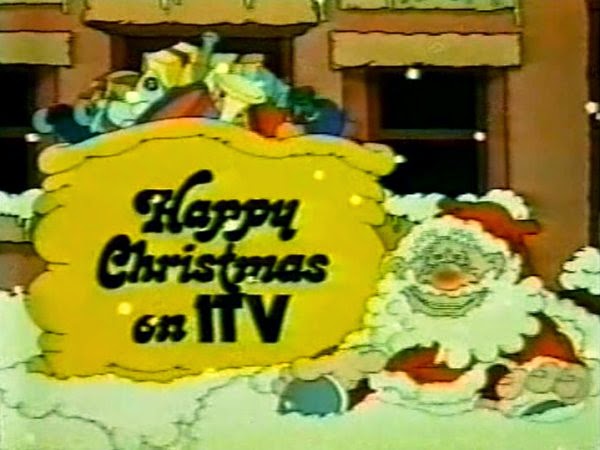
ITV as a whole would even sometimes fork out for its own generic one-size-fits-all Let's Get The Regions Together overarching animated promos, such as this one featuring a dilapidated Santa apparently played by a melted TV 'Ernie' (Sesame Street), and the below slightly more classy one which appears to feature the houses from the Rainbow title sequence being visited by Peter Petrelli and Sylar after they'd acquired that 'light' power that was in the Volume Three publicity material but then never featured in the show itself. Put a sock in it, 'Mohinder'.


And from three wildly disparate years (well, sort of), here are a couple of examples of how they routinely introduced their programming on the three Festive Big Guns. As you can clearly see, the ITV scheduling cards were somewhat slightly bigger on razzle-dazzle, iconographic tradition and indeed overall coherency than the equivalent offerings from the BBC.


Until, that was, the late eighties, when they suddenly got all abstract and computer graphical and subsequently never quite managed to recapture that lost impact, as can be seen above with the rather inappropriate choice of present for an ITV viewer of the BBC Globe, and the Swatch-esque counterpart to the Oh Fuck Off-era BBC2 logo. Can we move on to the next bit now? Thanks.


Those zany funsters at ITN were always first to jump on the Christmas bandwagon, as can be seen from their logo's wanderings in a giant snowflake-bedecked Winter Wonderland which perhaps didn't sit too comfortably with the latest updates about industrial unrest and hostage dramas, and from the year that one of their 'backroom boys' learned how to do a SCREEN$ on the ZX Spectrum. BONG Ninja steals computer disc from Research Centre BONG Blue Head On Legs evades Park Keepers for third day running BONG An attempt to attack Thorin with the Troll's Path is prevented by Not Being Able To Fucking Type BONG Can we stop now? BONG Alright pack it in or I'll start repeating my claim to have once finiBONGshed Bugaboo The Flea by hitting all the keys in frustration BONG right you fucker I'm BONG pulling the power supply out BONG yeah, not so Robot Voice now, are you?


Surprisingly, given how obsessed they were with the glitz and glamour (albeit glitz and glamour affixed to shoddy makeshift studio walls that fell over while someone cued up the wrong camera) all year round, TV-am were bafflingly subdued when it came to Christmastime, usually with just a tree and couple of decorations up in the studio and a couple of festively-themed items and caption card-trimmings per day. As you can see, the average late December schedule wasn't exactly overflowing with bluntly-named Holly And Ivy-evoking programme subdivisions, though hands up who initially misread that as 'Christmas Cockney'. Though of course there was the year that they put on Roland's Countdown To Christmas, a whole twenty four days' worth of Nyeh-Hehhhhh-fuelled advent calendar opening with nary a cricket bat in si*SMOOOSH*


Oh Channel 4. How well you started, with even the standard issue snow on the logo somehow managing to look arty and new and vital, but then you had to get all low-key and 'tasteful' and... well, we don't even like to think about the later years. But there's one thing we just can't help but mention...


Yes of course, it's 1987's 'Yes Of Course - Christmas On 4!' robots! Quite what possessed anyone to headlight the Festive Season with a bunch of smug trapped-finger-inviting sub-CP & Qwikstitch rickety Royal Bank Of Scotland-esque animated automatons playing a game of charades in which they were apparently required to guess the identity of specific generic times of year on overall channels rather than programme titles is anyone's guess, but they introduced those omnibus repeats of Dick Spanner like nobody's business. And let's see just what Christmassy fun Channel 4 had in store for us that year...


Oh.

Anyway, overall, this has been rather a fun trip through the outer reaches of the archives, if not quite as enjoyable nor indeed as funny as the BBC one was, and if that's not a metaphor for something very pertinent then frankly we don't know what is. And sorry about those intrusions into the text earlier. The IBA inform us that normal service has now been resumed.


If you've enjoyed this article, you can find lots more about stuff you just don't see on television any more in Not On Your Telly, which is available in paperback here or from the Kindle Store here.