Showing posts with label central. Show all posts

Thanks For Dropping By

This look at the mid-eighties ITV sitcom Girls On Top - an undervalued and often forgotten early attempt at putting 'alternative' comedy in a mainstream timeslot - was originally written for the television review site Off The Telly. This slightly rewritten and updated version was intended for my published anthology Not On Your Telly, but ended up being left out as, well, it just felt a bit more well known than everything else covered in there. On reflection it probably wasn't but hey ho. Anyway, here, for the first time ever, is the full unexpurgated history of Girls On Top. You should still get Not On Your Telly, though, because it's good.


As strange as it may appear from this distance, television was initially very nervous of Dawn French and Jennifer Saunders. Of the original rising stars of the alternative comedy scene, they were the last to make their name in the medium by some distance. While this has often been attributed to the simple fact they were the dominant female presence in the movement – their comedy presumably unable to totally counteract the sexism it so frequently railed against – the reality is it was far more a result of the sheer strength of their humour. Much of French and Saunders’ early act was deliberately challenging and taboo-breaking, and while they made guest appearances in such shows as Friday Night And Saturday Morning and Whatever You Want, the first programme to capture them in full unrestrained flow – an edition of Channel 4’s stand-up anthology series The Entertainers (the name chosen as a deliberate counterpoint to ITV’s decidedly more ‘traditional’ The Comedians) – was bumped back from its usual 8:30pm slot to close to midnight. They were, of course, well known for their participation in the likes of The Young Ones, not to mention impressive turns as writers and performers on The Comic Strip Presents …, but as the middle of the eighties approached they had still yet to secure a headlining series of their own; and this was not for want of trying.

Early in 1982, French and Saunders had met Ruby Wax, a vivacious American actress who had been living and working in the UK since the mid-seventies, and was then contributing material to long forgotten Channel 4 chat show spoof For 4 Tonight. Finding that they had much in common, the three began to work on an idea for a prospective television vehicle based around their respective stage personas. It was obvious from the outset that the best way to get three such obnoxious and self-centred characters together was to have them forced by circumstance and desperation to share a flat, with none of them possessing the means, the motivation or indeed the intellect to get out and move somewhere better.

After initial writing meetings and discussions about possible storylines, they felt they needed a fourth lead character for balance, and French’s husband-to-be Lenny Henry suggested Tracey Ullman, whom he had recently worked with on three series of the vaguely ‘alternative’ BBC sketch show Three Of A Kind. Although barely into her twenties, Ullman had already enjoyed a dramatic rise to fame, initially drawing acclaim as a straightforward comic actress before demonstrating her versatility to a far wider audience with Three Of A Kind and its somewhat more variable stablemate A Kick Up the Eighties. In tandem with these projects, she had enjoyed considerable success as a pop singer, scoring hits with a number of sixties-tinged songs given a slight comic twist and memorably overtly comic videoes. In addition to her remarkable skills as a performer, Ullman brought an all-important bankable 'name' to the project, and it may well have been her involvement that ultimately secured a surprisingly high profile slot for what was a mildly 'dangerous' effort from a group of still largely unknown performers.


ITV's midlands franchise holder Central were sufficiently impressed by the resultant pitch to commission a pilot, which was made over the summer of 1983 under the title Four F’s to Share. While nothing of this pilot ever seems to have surfaced - it was later extensively rewritten and almost completely reshot as the first series opener Four-Play - it was clearly strong enough for Central to commission a series of thirteen episodes to go into production the following year. However, the projected recording dates in April 1984 fell victim to by industrial action, and despite some talk of an autumn remount it eventually transpired no convenient dates would be available until the New Year. According to some sources, Wax and Ullman used this unexpected break in production to collaborate on scripts for a series of standalone comic playlets, which ultimately came to nothing.

When the team finally returned to the studios in January 1985, so long had elapsed since the recording of the original pilot it was decided simply to remount production, with the first episode effectively acting as a ‘new’ pilot. It is likely the characters, performances and entire concept had already been sharpened considerably during this eighteen-month delay, but the new studio dates also brought with them a vital change on the production side. Whereas the original pilot had been handled by a team more used to working on Central’s traditional sitcoms, Paul Jackson, a young producer with a strong understanding of alternative comedy, and who had worked with the main performers in various permutations as far back as 1980, was assigned to take over the project. Now renamed Girls On Top, the new sitcom was finally ready to go before the cameras.

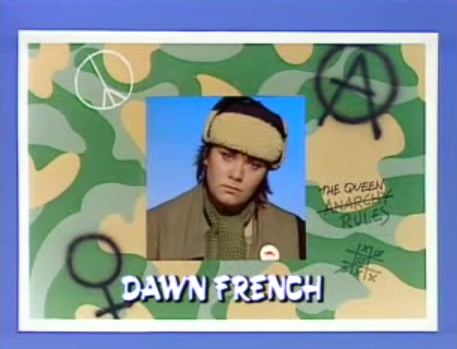
Wax’s loud, attention-demanding stage persona was streamlined for Girls On Top into Shelley Dupont, a brash drama student with plenty of ego but precious little discernible talent. French became Amanda Ripley, a humourless diehard left-wing feminist whose ideology was decidedly at odds with her rarely-satiated hunger for men, while Saunders became Amanda’s dozy, lethargic childhood friend Jennifer Marsh, a girl without a malicious thought - or possibly a thought of any kind - in her head. Ullman, meanwhile, quickly developed the part of Candice Valentine, a bitchy and manipulative It Girl who associated with the rich, powerful and glamorous, yet was still not above committing acts of petty theft against her flatmates. Rounding off the main cast was veteran actress Joan Greenwood as Lady Carlton, an eccentric romantic novelist who doubled-up, arguably not entirely to her own awareness, as the girls’ landlady.


Perhaps inevitably, much of the humour in Girls On Top revolves around the massive clash of personalities between the equally voluble and volatile Shelley and Amanda, with Jennifer playing less of a part in the dialogue but indulged with extended physical comedy sequences based on her immense lack of intellect and self-awareness. However, it is Candice who really steals the show, not least on account of her often lengthy 'solo' sequences taking place in a surreal, dreamlike world of glamorous discos and exclusive nightclubs, where it is never entirely clear to the viewer whether or not this is all simply taking place inside her head. The scripts for the first series were primarily written by French, Saunders and Wax, with Ullman contributing additional material and Ben Elton acting as script editor.

Introduced by a stylish theme song performed by the cast and written by Chris Difford and Glen Tilbrook of Squeeze, Girls On Top finally found its way onto ITV when the first run of seven episodes appeared in an 8.30pm Wednesday timeslot from 23rd October 1985. Storylines included Candice’s attempts to hoodwink Shelley into appearing in an ‘adult’ film, Jennifer being kidnapped and held to ransom, Amanda’s pathetic attempt at staging a multi-cultural street festival, the disappearance of Lady Carlton’s stuffed dog, and more attempts at dodging rent payments than the combined cast could have counted on their collective fingers. Among those making guest appearances were Helen Atkinson-Wood, Helen Lederer, Alan Rickman, Robbie Coltrane, Mark Arden, Stephen Frost, Simon Brint, Roland Rivron and – in a fantastic semi-regular turn as Amanda’s jumpsuited feminist activist co-conspirator – Harriet Thorpe.

Despite the inevitable limitations of its timeslot and prominence – although the writers did their best to find increasingly subtle ways around this – Girls On Top was an instant and deserved hit with both the regular sitcom audience and fans of the alternative scene alike. Its brashness and vulgarity were neatly balanced by the air of surrealism and the traditional bright lights and studio audience sitcom setup. Some observers have maintained the series was simply a carbon copy of The Young Ones, and superficially this criticism would appear to hold some weight. The basic setting is the same, and even the characters themselves are not that dissimilar – Amanda and Rik are certainly very close contemporaries, with Shelley effectively taking the place of Vyvyan, Jennifer as Neil and Candice as Mike. However, it is true that at least three of the characters were simply extensions of what their respective performers had been doing on stage for several years beforehand, and even taking usual television production practices into account, the idea of someone intentionally commissioning a series which was at that point barely more than a cult hit and literally only a couple of months old does stretch credibility somewhat.

What is perhaps most surprising about Girls On Top in retrospect was how much they were able to get away with in a prominent pre-watershed timeslot. While there is no actual swearing, there is a fair amount of what would be generally deemed ‘bad’ language, and a good deal of explicit sexual references, many of which were arguably still shocking in the mid-eighties. Central did in fact have some worries about this, but the writers preferred to leave the ensuing arguments in the capable hands of Paul Jackson, who was well experienced in negotiating with more conservative contemporaries. In any case, on some occasions Central seemed to be making a fuss over absolutely nothing, and Wax has often wearily recalled being informed of concerns that the utterly fictional Irma La Douce might sue for defamation of character.

By the time the first run of Girls On Top was being transmitted, Tracey Ullman was already in talks with American television networks about the possibility of her own solo project. This would eventually result in the acclaimed The Tracey Ullman Show, a series of offbeat playlets - some possibly derived from the abandoned series mooted during the interruption to production of Girls On Top - that ran on Fox between 1987 and 1990, although its success has since been somewhat overshadowed by the fact that it also included the television debut of The Simpsons. These negotiations precluded the possibility of Ullman appearing in the second series of Girls On Top, recorded in the early summer of 1986, but rather than replace her, Wax, French and Saunders opted instead to write Candice out. Ullman was ultimately available to record a small amount of material for the first episode, but her absence would leave the second series sorely lacking when it finally appeared in October 1986.

Candice had of course originally been added to the show to create a stronger dynamic between the other three leads, and her absence had an inevitable effect on the quality of Girls On Top. The main problem with the new batch of six episodes, which commenced on 30th October in the same timeslot, was not simply that they missed Candice and her glitzy fantasy world, but that the other characters had also been noticeably reshaped to compensate for her absence. This inevitably did not prove to be a successful move; Shelley’s brashness and confidence were noticeably toned down, Amanda was revealed to be unexpectedly weak-willed and easily manipulated by men, and most jarringly of all Jennifer became something of a scheming bitch, siding with whichever of the others she stood to gain the most from. This resulted in a muddled dynamic with less inspired interplay between the flatmates, and sadly as a consequence was just not as funny.


In fairness, and as Dawn French hinted at when interviewed for Roger Wilmut’s history of Alternative Comedy Didn’t You Kill My Mother-In-Law?, there may just not have been as much spare time and energy to spend working on six new scripts of Girls On Top. They entered production unexpectedly soon after the first batch, presumably in a bid to capitalise on the show's success, and the three leads had already planned to use this time working on other projects. Wax was engaged on a number of other writing assignments, while French and Saunders - the latter of whom was also pregnant during this time - were hard at work both on Ben Elton’s BBC sitcom Happy Families (also produced by Paul Jackson) and their The Comic Strip Presents… film Consuela. Ultimately, however, the second series was a massive comedown after the offbeat vulgar charm of the first. This is not to say it does not have its moments. The first episode, in which Amanda and Shelley are both accused of murdering Candice by assisting one of her 'mystery' illnesses - in reality she had run away to marry a rich nobleman, suggesting her apparent delusions may have been truthful after all - is well up to standard, while others featured entertaining guest appearances by Harry Enfield, John Sessions, Hugh Laurie, and Katherine Helmond as Shelley’s mother, but as a whole it failed to work as well as the first run had done. Even the theme song, remixed to remove Ullman’s vocals, seemed a pale shadow of its former self. On a brighter note, the second run did come accompanied by the only item of Girls On Top merchandise - a tie-in paperback, written by the cast and published by HarperCollins, which was every bit as brash, vulgar and indeed amusing as the first set of episodes.

With the final episode featuring the main characters apparently killed in an explosion – yet another unintentional but widely-derided echo of The Young OnesGirls On Top made its final appearance on 11th December 1986. Despite never giving an inch in terms of the strength of its content, the success of the show in its unlikely timeslot did much to make this new strain of comedy acceptable in the eyes of the wider viewing public. It also acted as a springboard for the cast to find their way into similar areas. However, this success did not extend to all parties involved – early the following year, Central attempted to fill the gap that Girls On Top had left in their output with the similarly conceived Hardwicke House, which was rapidly pulled after only two episodes had been broadcast.

Sadly, and perhaps on account of the lacklustre second series, Girls On Top is now regarded as one of the lesser achievements of the 'alternative' comedy boom. But at least initially it was a sterling effort and deserves slightly more respect than its reputation might suggest. Yet arguably the biggest laugh of the entire series was that, having been shunned by television virtually outright for so long, Dawn French and Jennifer Saunders beat their contemporaries into the mainstream schedules by some considerable distance.


And if you want to know more about Hardwicke House, you can find the full story of that - and much more besides - in my book Well At Least It's Free, available in paperback here or from the Kindle Store here.

ITV 59 - All Your ITV Favourites (And Roland's Countdown To Christmas): Christmas Special!


Merry Christmas! If you're a regular reader of this blog, you may well remember that, earlier in the year, we ran a special series of articles looking at ITV's inter-programme iconography of years gone by, which took in startup sequences, IDEANTS, MORE IDENATS, EVEN MORE IDENEATASF, Oracle, Children's ITV, The News, Schools And Colleges, TV-am and Channel 4, and - but of course - Continuity Slides. You may also recall that the previous year, we ran a similar series about the BBC, ending with a Christmas Special that opened with an impassioned plea to defend the BBC against the machinations of politicians and media moguls with your bare hands if you have to.

This corresponding look at ITV's old-skool festive trimmings will thus correspondingly open with an impassioned plea to, um, watch ITV every now and then when some thing that you think looks quite good from the trailer but then turns out to actually be a bit boring when you see it though it used to be good when they had Spitting Image and The Equalizer or something is on. Yes, there's not really that much shouting to do, so instead let's get straight on with the utterly respectful and thoroughly technically detailed celebrating of the golden age of TV continuity...


Needless to say, it was pretty much par for the course for the regional ITV companies to add a bit of seasonal snazz to their all-too-familiar idents (NO THIS MU ST NOT RTEMBER THE REAL REASONS WE CELEBNRATE CHRISTHMAS IT IS NOT BECAUSE NELE). Up at the top there you can see Yorkshire's bird-tastic 'Chevron' caught in a sudden downpour of snow, LWT's bing-bonging racially dubious sitcom-bookending letters caught under a deluge of, erm, snow, Granada at least having the gritty northern integrity to use a bit of frost instead of all that snow them namby pamby Southerners are all wearing now (yes, we know Yorkshire isn't in the 'South', but try telling that to a born and bred Granadalander), Central going overboard with the satin and tat and inadvertently turning their famed 'world' into something resembling a sought-after ancient artefact with mystical powers in a mid-eighties post-Indiana Jones adventure movie, and finally those inverterate scrooges at Ulster casually adorning their usual insignia with the sort of lazy colour scheme and iconography that you'd more normally find on a generic sharp-cornered Christmas Card sent to you by a local business that you'd briefly spoken to on the phone back in February but they've forgotten to put your name in it anyway. Yeah, Deck The Halls.


One peculiar offshoot of this was that the regional companies became bizarrely obsessed with using their idents (DONT FEED THE NELE DONT LET HIM KNOW ITS CHIRISMTAS TIME AGAIN) as putative wrapping paper patterns. At the top we can see a particularly HTV-obsessed Teddy, doubtless hoping that Santa has brought him a DVD of a celebrated HTV-sourced supernatural children's serial which comes with a book about all those sort of shows written by someone not a million miles from here, and below that Central breaking out the lavish opulence to suggest that all manner of lavish blockbusting high-spectacle programming was bursting to get out from beneath that paper. And exactly what lavish blockbusting high-spectacle programming did they have in store for us that Christmas...?

Oh.


If you were lucky, the continuity announcers in your region would similarly make an effort and loosen their ties by, ironically, straightening their ties a bit. Here's Granada's top levity-merchant Colin Weston bidding viewers a jolly Yuletide...


...and Charles Foster's getting nattily in on the act too...


Hang on a minute... Parky? What's he doing here?! Don't start adjusting your set just yet - unfortunately, despite extensive research, it's proved impossible to locate an image of fellow Granada anchor Jim 'Beardy Man' Pope doing his trademark 'refreshed' fivedollarsgedouddahere late night bit to camera, so Mr. Parkinson has generously agreed to appear as an illustration in its place. Anyway, that's the last we'll be seeing of him.


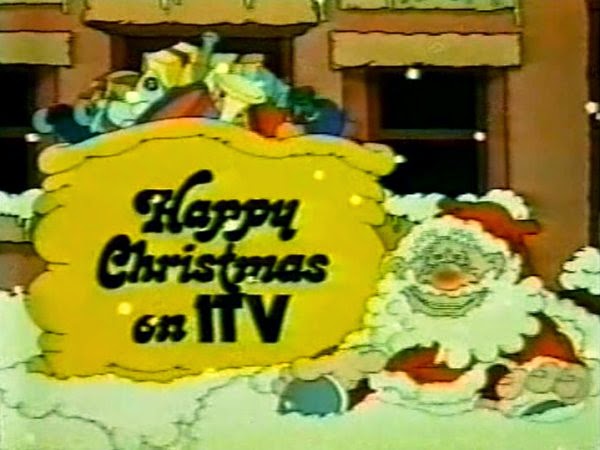
Some regions were so giddy with Advent excitement that they'd even stump up the readies for a full-on animated Christmassy trailer, which makes it all the more ironic that this particular example from TVS should be so breezily fanfaring the company that would later buy the rights to their archive then promptly trash all the paperwork so that nobody could repeat or release any of the programmes even if they could navigate all the labyrinthine rights clearances and disproportionate licensing fees surrounding forgotten videotaped studiobound nonsense from the past that only about three people on The Mausoleum Club would be interested in buying on DVD in the first place anyway. And if that bastard mouse has been anywhere near The Boy Who Won The Pools with a big magnet, it'll be Song Of The South, The Story Of Menstruation and Nazi Supermen Are Our Superiors on a loop on Christmas Day next year

Anyway, what festive delights from the TVS archive are Walt's boys currently blocking access to...?


Oh.


ITV as a whole would even sometimes fork out for its own generic one-size-fits-all Let's Get The Regions Together overarching animated promos, such as this one featuring a dilapidated Santa apparently played by a melted TV 'Ernie' (Sesame Street), and the below slightly more classy one which appears to feature the houses from the Rainbow title sequence being visited by Peter Petrelli and Sylar after they'd acquired that 'light' power that was in the Volume Three publicity material but then never featured in the show itself. Put a sock in it, 'Mohinder'.


And from three wildly disparate years (well, sort of), here are a couple of examples of how they routinely introduced their programming on the three Festive Big Guns. As you can clearly see, the ITV scheduling cards were somewhat slightly bigger on razzle-dazzle, iconographic tradition and indeed overall coherency than the equivalent offerings from the BBC.


Until, that was, the late eighties, when they suddenly got all abstract and computer graphical and subsequently never quite managed to recapture that lost impact, as can be seen above with the rather inappropriate choice of present for an ITV viewer of the BBC Globe, and the Swatch-esque counterpart to the Oh Fuck Off-era BBC2 logo. Can we move on to the next bit now? Thanks.


Those zany funsters at ITN were always first to jump on the Christmas bandwagon, as can be seen from their logo's wanderings in a giant snowflake-bedecked Winter Wonderland which perhaps didn't sit too comfortably with the latest updates about industrial unrest and hostage dramas, and from the year that one of their 'backroom boys' learned how to do a SCREEN$ on the ZX Spectrum. BONG Ninja steals computer disc from Research Centre BONG Blue Head On Legs evades Park Keepers for third day running BONG An attempt to attack Thorin with the Troll's Path is prevented by Not Being Able To Fucking Type BONG Can we stop now? BONG Alright pack it in or I'll start repeating my claim to have once finiBONGshed Bugaboo The Flea by hitting all the keys in frustration BONG right you fucker I'm BONG pulling the power supply out BONG yeah, not so Robot Voice now, are you?


Surprisingly, given how obsessed they were with the glitz and glamour (albeit glitz and glamour affixed to shoddy makeshift studio walls that fell over while someone cued up the wrong camera) all year round, TV-am were bafflingly subdued when it came to Christmastime, usually with just a tree and couple of decorations up in the studio and a couple of festively-themed items and caption card-trimmings per day. As you can see, the average late December schedule wasn't exactly overflowing with bluntly-named Holly And Ivy-evoking programme subdivisions, though hands up who initially misread that as 'Christmas Cockney'. Though of course there was the year that they put on Roland's Countdown To Christmas, a whole twenty four days' worth of Nyeh-Hehhhhh-fuelled advent calendar opening with nary a cricket bat in si*SMOOOSH*


Oh Channel 4. How well you started, with even the standard issue snow on the logo somehow managing to look arty and new and vital, but then you had to get all low-key and 'tasteful' and... well, we don't even like to think about the later years. But there's one thing we just can't help but mention...


Yes of course, it's 1987's 'Yes Of Course - Christmas On 4!' robots! Quite what possessed anyone to headlight the Festive Season with a bunch of smug trapped-finger-inviting sub-CP & Qwikstitch rickety Royal Bank Of Scotland-esque animated automatons playing a game of charades in which they were apparently required to guess the identity of specific generic times of year on overall channels rather than programme titles is anyone's guess, but they introduced those omnibus repeats of Dick Spanner like nobody's business. And let's see just what Christmassy fun Channel 4 had in store for us that year...


Oh.

Anyway, overall, this has been rather a fun trip through the outer reaches of the archives, if not quite as enjoyable nor indeed as funny as the BBC one was, and if that's not a metaphor for something very pertinent then frankly we don't know what is. And sorry about those intrusions into the text earlier. The IBA inform us that normal service has now been resumed.


If you've enjoyed this article, you can find lots more about stuff you just don't see on television any more in Not On Your Telly, which is available in paperback here or from the Kindle Store here.

ITV 59 - All Your ITV Favourites (And Which Way To The War?) Part Four: Even More Idents

PEOPLES OF THE UNVIERSR PLEASE ATETNTD CAREFULLY

IT AHS COME TO OUTR ATTNETION THAT THERE HAVE BEEN TOO MANY IDENATS ON THIS BLOG LATELY

ATTENTION

THISD IS NOT AN ACCEPTBALE SDTATE OF AFFAIRS AND IF IT IS ALLWOED TO CONTINUE TOO FAR WE WILL END UP WHITH THE ELEUIDVEN O'CLOCK SHOW BACK

NO MORE IDENTSF

NO

NELE

THE HANDBAGJD AND THE GLADRAGS THAT BECAME JOHN HANNAS FAVOURITE SUPPER TIME


Well, we apologise for that short break in transmission, during which you probably had to sit through that Butterfly Ball thing again, and let's just see if we can't now return you to our regular programming. Hello, one and all, and welcome to the third and final (TAHT IS NOT SOON ENOGUH SOON) instalment of our series-within-a-series look at the various variations on regional insignias of ITV franchise holders passim, before they all got bought up by Disney and thrown in a burning bin to impress Reece Shearsmith, and indeed before the entirety of ITV itself was subsumed by the unstoppable Chewits-endangering region-scoffing rise of Carlton Television, a phenomenon which as any self-respecting MP knows is a prime example of BBC 'Bias'. Just imagine if it had been SelecTV instead, and in place of Celebrity Juice we'd have all those wall-to-wall repeats of Hadleigh. Anyway, the final leg of our tour of the regions starts by stopping off here...


Where ast tha bin since ah saw thee? In the Yorkshire TV region! Yes, it's the plain-speaking flat-capped cobble-streeted home of the makers of such televisual landmarks as Rising Damp, Emmerdale Farm, Follyfoot, Topper's Tales, Tarby's Frame Game and Matthew Corbett And Sooty "In Search Of Gulliver", which were invariably introduced by the so-called 'chevron', though many observers have noted that it actually bore a far closer resemblance to a 'bird' as seen in a chortle-free newspaper cartoon about Thatcher/Major teetering on the 'economic' edge of Beachy Head, and a five-note brass harrumph through something that sounds nothing at all even remotely like On Ilkla Moor Baht 'at. And, what with being all no-nonsense and common sense and dripping sandwiches and all that, they rarely ever messed around with said 'chevron', and while Twitter may regularly reverberate with endless live tweeting of when it twatted Dusty Bin at the start of 3-2-1, this was very much an isolated incident and you never exactly saw it, say, turning into a 'flying v' guitar at the behest of Animal Kwackers, or being called a 'barstard' by Alan B'Stard. Below are two very rare examples of promotion-orientated jiggerypokery, firstly a standard issue 'one pill makes you larger' mind expansion gambit from the late sixties, and secondly a salutation to any passing aliens that might have been looking in (so, Vrillon of Ashtar Galactic Command, then) with a somewhat overblown boast about reaching a very small percentage of the viewing audience. Meanwhile, improbably, a bewildering amount of people claim to have been somehow frightened by the 'chevron'. What did they think it was going to do?! Fly out of the TV and 'yellow' at them?


The green glowing I AM ALIEN FROM PLANET MARS-esque variant noted above would doubtless have been of great interest to the galactic emissary who allowed himself to be used as a logo for original Midlands ITV-profferer ABC.


But soon enough he headed off back into space, to warn his home planet of the Earth people and their Pathfinders To Venus, and consequently the regional franchise for the Midlands was handed over to Lord Grade's ATV and their none-more-ITV ident, featuring as it did that infamous speaker-rattling double-whammy fanfare with added binging and bonging, and 'colour'-denoting representation of what appears to be Mickey Mouse turned upside down and subjected to a chemical leakage from developing fluid, self-animatedly giving way to the emblematic Zippy/Al Jardine/Graham Taylor-head-shaped logo. And this celebratedly bombastic in-your-face bit of televisual arrestingness almost always found itself attached to equally arresting programming, from The Strange World Of Gurney Slade to Sapphire & Steel to Pipkins, and woe betide anyone who witters over a stretched still of it while pretending to introduce some woeful long-forgotten daytime talk show where the real original continuity announcers probably just shouted "PISS 2" and hoped for the best anyway.


Yikes - head for the hills, everyone! ATV handed over the Midland reins to Central in 1982, inadvertently letting slip the dogs of war and unleashing Hardwicke House on a traumatised public who are still recovering to this day. Not far behind in the viewer-spooking stakes came hard-hitting swindle exposure courtesy of The Cook Report, MURDERS PUPPETS extravaganzas Pullover and Fox Tales (and, according to some, Spitting Image when not moving), chillingly post-Cold War tug-of-rights-stricken The Little Green Man, the sweary-graffiti-shouty-theme-song end credits of Murphy's Mob, endless spooktacular contributions to Dramarama, and the general horror of those song-and-dance prone kids in Emu's Pink Windmill Show, with the result that many viewers can now no longer see their original solarized Christmas Tree bauble and corresponding synth hum without hiding behind the 'sofa' that nobody ever actually hid behind. Later in the eighties this would evolve into a paint-splattering computerised approximation of the original 'globe' - apparently referred to in official parlance as the 'cake', though anyone who has ever eaten any cake that looked even marginally like that requires immediate help - and a more assured synth fanfare that bore an uncanny resemblance to The Robinsons' doorbell on Neighbours. Also included for sheer amusement is the ludicrous 'Central Into The 90's' turn-of-the-decade variant, doubtless intended to signpost a brave new world of Press Gang and, erm, Press Gang, but these days calling to mind little other than Inspector Morse donning a hooded top and buying an Inspiral Carpets 12".


Being prominent denizens of so-called (by planks writing pretentious thinkpieces about not very much in particular) 'Granadaland', Inspiral Carpets themselves would have been otherwise engaged charting the evolution of the Anthony H. Wilson-pointing-out 'G', from its early appearances as a lone 'G'-deficent arrow (to denote 'North', of course), through a brief misguided excursion into just rendering the company's name in the same font they used for the signage on their Service Station/TV Rental Shop sideline, and into the classic Bob Greaves-era A Handful Of Songs-prefacing 'grinning face' Coronation Street-bookender and its later bevelled and Silver Plated 25th Anniversary upgrades, the latter of which is particularly noteworthy for having introduced Show They Can Never Repeat Now par excellence How To Be Cool. And what's more, it used to turn into a fucking HOUSE at the start of Hickory House. Stitch that, 'Chevron'!


And finally, it's time for Tyne Tees, and its legendary Yer Programme's On blippery synth clarion call for 'Gog' from The Paper Lads, and the root cause of a million juvenile misconceptions that 'Tees' was somehow 'North East' for telly. And with tha- oh. It's exploded. Oh well, join us again next time when we'll be taking a look at - wait for it - Oracle...!


If you've enjoyed this article, you can find lots more about stuff you just don't see on television any more in Not On Your Telly, which is available in paperback here or from the Kindle Store here.