Yes, it's a great big post about the BBC Radiophonic Workshop! Sort of. One of the problems with taking a short break from this blogging malarkey - which I have done recently, in order to give you all a chance to read
The Very Best Of Paintbox,
The Big Book Of TATP and
Super Expanded Deluxe Edition (there'll be a test later) - is that you invariably end up leaving a post that you thought was going to turn into another chart-topper half-finished, and then when you eventually come back to it you just can't work out what you would have been driving towards.
One such yanked-from-the-archives half-finished chart-topper-that-never-was began with this promising-sounding bit of history about the BBC Radiophonic Workshop...
If you own the excellent career-spanning 2CD compilation
BBC Radiophonic Workshop - A Retrospective, chances are that you may not have listened to the second disc very much. In fact, you may not even have sat through it in full at all.
Stretching from 1981 to 1997, it captures the Workshop's composers, musicians, and providers of burbling scraping noises in the years after computerised sound manipulation - or, if you will, samplers, sequencers and software - had revolutionised their whole approach to making music. In the exciting new World Of Tomorrow of MIDI and the Fairlight CMI and what have you, it was now possible for those with the technological knowhow to create the kind of full-sounding ultra-realistic soundtracks that TV producers had always wanted almost at the touch of a button, though arguably at the expense of the sonic invention, make-do-and-mend electronic creativity, and, well, ridiculous noises that had characterised the Workshop's earlier output. And it's hard to argue with the idea that, as a consequence, while their compositions and arrangements became infinitely more sophisticated and suited to their intended purpose, this was somewhat at the expense of actual standalone listenability. While that second disc does indeed do a sterling job of representing the breadth and variety of their output during those years, and there are a couple of brighter moments such as Paddy Kingsland's tracks from
The Hitchhikers Guide To The Galaxy (which are much more listenable than they have any right or reason to be), Peter Howell's decidedly odd 'escaping fish' rendition of Saint-Saens'
Aquarium, stray bits of backing atmospherics from the likes of
Captain Zep - Space Detective and
Ghost In The Water, the unexpected familiarity of opening theme from late eighties Children's BBC technologically risible 'computer hacking' thriller
Dead Entry, and the fact that something called
Slambash Wangs Of A Compo Gormer was actually broadcast, taken as a whole it's a bit of a musical endurance test and perhaps it's hardly surprising that so many should choose to give it a wide berth.
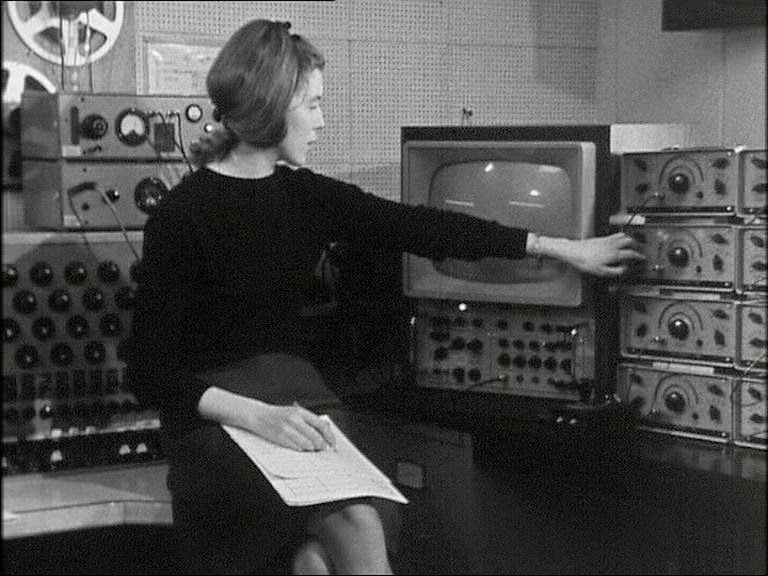
What this has also meant though, unfortunately, is that another chapter of the Workshop's history has been given almost as wide a berth by association. Perhaps understandably, a widespread belief seems to have taken hold that the only 'true' incarnation of the Radiophonic Workshop was when the likes of Delia Derbyshire, John Baker and David Cain were chopping up bits of backward tape with school geometry sets before whizzing off to the Roundhouse to listen to AMM melting a bin. There is certainly some mileage in this in theory, but in practice it just ends up excluding the second wave of prog-rock one-man-bands that took up residence in the mid-seventies with their Micro Moogs, vocoders and funny two-guitars-stuck-together things in the early seventies; the aforementioned likes of Paddy Kingsland, Roger Limb and Peter Howell, who were collectively responsible for all that stuff that sounded like Henry VIII playing with a pocket calculator that you used to get backing film of Russian Space Station experiments.
A pretty strong starting point, but where was it all leading? Well, that's as big a mystery as
The Chem Lab Mystery (Maddalena Fagandini, 1963).