Showing posts with label robert robinson. Show all posts

The Dalek Invasion Of RAF Finningley


For all that they might have gone on about their collective fear of typecasting, the various 'classic' Doctor Who lead actors didn't half jump at the chance of an in-character tie-in appearance. Whether it was Jon Pertwee tussling with Aggedor at Glorious Goodwood, Tom Baker dispensing pseudo-scientific facts about his favourite best aliens on Animal Magic, or Colin Baker going on a ride at Blackpool Pleasure Beach for some reason, costumed-up 'canon'-taxing guest spots were a regular and recurring feature of Doctor Who in its original incarnation. Even Richard Hurndall got to do his "and greetings to you from The Time Lords!" gibberish on a couple of occasions, though nobody has ever been quite sure about what character he was actually 'in'. On rare occasions the companions got in on the act as well, particularly on Crackerjack (don't) for some reason, and that's not even getting started on Celation from The Daleks' Master Plan guest-presenting Points Of View.

Sadly, Celation's little chat - if ever a chat as was - with Robert Robinson no longer exists, but at least it was actually recorded and televised in the first place. During the sixties, before anyone really had the means or indeed the inclination to preserve them in any form, there were literally hundreds of tie-in appearances - particularly at the height of 'Dalekmania' - that came and went and faded into hazy memory with only the odd press cutting to prove they happened, from stage plays to charity events to pop single-plugging to visitors at a Daily Mail-sponsored exhibition being ferried past a collection of Doctor Who aliens in a 'Brainy Train', whatever one of those was exactly. And then there was William Hartnell's disconcerting enthusiasm for making appearances at airfields.

Presumably as an adjunct of his previous starring role in long-running ITV sitcom The Army Game, Hartnell appears to have been invited along to air shows and open days roughly every three minutes, and he also appears to have never turned any of them down. Quite often he would show up in character and costume as The Doctor, sometimes with Daleks in tow, and there was even a vague accompanying 'mini-adventure' narrative of sorts; after his speech is interrupted by an 'Anti-Magnetic Device', The Doctor discovers that the Daleks have constructed a 'fort' on the airstrip, and dashes off to alert his good friends at the RAF who promptly unleash a couple of torpedoes and blow the malevolent interlopers sky high. Terry Nation's feelings on this somewhat off-agenda use of his creations are sadly not recorded, although the escapade did usually involve the nobody-would-ever-suspect-a-thing deployment of a 'double' for Hartnell during the more action-packed moments, which was at least in keeping with the usual mode of practice for his actual television adventures.

Needless to say, very little evidence of any of these events now remains, apart from - staggeringly - some full colour cine camera footage of one of them. On Saturday 18th September 1965 – the same day that Trap Of Steel, the long-lost second episode of the decidedly Dalek-free Galaxy 4 was transmitted by BBC1 – TV’s Doctor Who William Hartnell took part in an RAF Finningley air show along with some Daleks. Well, we say ‘Daleks’, but that's a very loose interpretation of the term. Anyway, we may not have the sights and sounds of that thrill-packed day, but the few existing seconds of moving footage give us a good idea of... well... not very much at all really.


In an unexpected new twist to the big news story of 1963, William Hartnell arrives at Dealey Plaza; controversy and debate will subsequently rage over whether The Thin White Crochety Old Man was giving an 'inappropriate' salute or simply waving to a fan.


Dangling from a helicopter due to some unspecified 'mini-adventure' plot detail, Hartnell's stunt double puts in an unconvincing bid to secure the role of the next Milk Tray Man. Meanwhile, down on the ground, you can just about make out one of the 'Daleks'. Looks pretty convincing from this distance, doesn't it? Well, just you wait.


With full strength undiluted 'Dalekmania' taking full effect, the crowds are clearly enthralled by the unfolding spectacle. So much so, in fact, that they haven't noticed The Queen arriving to take a look. She preferred The Voord anyway.


After someone realises that the audience would probably feel a bit short-changed without one, some sort of cage box thingy that we're probably best off not knowing the real purpose of is hastily redecorated as a vague approximation of a 'Tardis', which some high-spirited youngsters promptly attempt to upend. Clayton Hickman is reportedly 'concerned' by this turn of events.


As everyone knows, Daleks should only be demonstrated to youngsters by qualified experts in lab coats, and the organisers of the air show have gone one better and added to an already star-studded bill by persuading The Prof from Vision On to do the honours. Here he is also introducing some young attendees to a haphazardly repainted diving bell with random number labelling and some kind of lurid red jagged symbol on top. Meanwhile if anyone can identify that crater-festooned planet, please get in touch.


"But how did the Daleks get up stairs? Eh? Eh? The stairs? How did they get up them? Eh?". By walking on their feet. A fact so widely known and recognised that these two youngers cannot even be bothered turning their heads to have a look.


The most convincing Dalek yet achieves speeds in excess of 234.9mph, before breaking off and heading for Brand's Hatch, where it effortlessly beat Lorenzo Bandini and Graham Hill into second and third place.


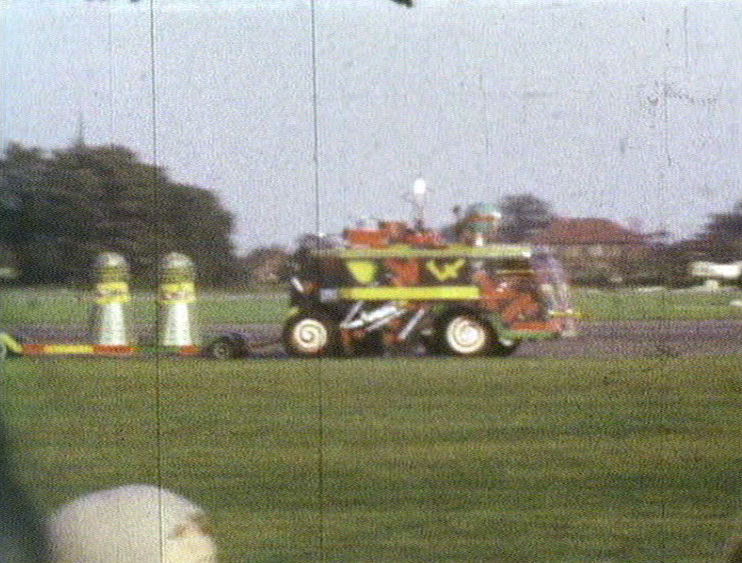
In a neat bit of cross-promotion, The Mystery Machine tows two reconfigured shuttlecocks past the awestruck crowds. How this fitted into the 'story' is anyone's guess, frankly.


And finally, the fun family day out concludes with a precision-targeted explosion in which everyone's favourite TV villains are seared from existence in a torrent of smoke and flame. In fairness, it's amazing to think that any visual record of an event of this kind exists at all, let alone in colour. In equal fairness, it's also amazing to think that this and many, many, many other examples of harmless yet decidedly off-message ridiculousness were signed off, approved and authorised where nowadays they would be sent packing at the very first hint of a Brand Awareness meeting. Honestly, providing a bit of cheap and cheerful extra-curricular entertainment for average everyday mainstream viewers of a popular television show - what a thought. It's almost worth writing to Points Of View about.


You can read more about Doctor Who's early extra-curricular activities, including a little-known radio appearance by the Daleks, in Not On Your Telly.

Ask The Family: A Psychedelic Nightmare Introduced By ROBERT ROBINSON


Ah, good evening, and often may you say that the television shows that seem the strangest now were the ones that seemed the most mundane and quotidian at the time. No matter how good they may be, those that tried to be unusual now only really look like another era's idea of 'unusual'. Whereas those that simply existed, with their lack of audiovisual trimmings, their quaint meldings of one medium's stylistic preferences with another's format and technology, and their now almost completely unrelatable 'real time' feel, now come across like a quasi-hallucinatory vision of an alternate reality. Plus they're often quite unintentionally amusing too. One such show, if ever a show as was, was Ask The Family, which ran on BBC1 between 1967 and 1974. That much, is certain.

Ask The Family was just one of many highbrow quiz shows - including Call My Bluff, Brain Of Britain and The Book Game - hosted by critic, author, columnist and all-round polymath Robert Robinson. He had started his career as a heavyweight political pundit, and his 'descent' into quizzing ubiquity is often held up as a textbook example of 'how the mighty have fallen'; however Robinson himself claimed that he'd moved in this direction voluntarily after growing tired of the "sonorous drivel" of politicians. It was, he noted, "impossible to make the bastards reply to a straight question", and the comparative appeal of Brain Of Britain and company lay in the fact that they were "just a game". It was, in effect, a Godfrey Humphrey-style sophisticated satirical attack on the entire political establishment, and one so precision-targetedly aaaaaaahhhhhhhhh that even Tony Parsons didn't expect it. Or did expect it. Or was expecting us to expect that he wouldn't expect it. Or however that works exactly.


The basic format of Ask The Family was that two sets of smugly well-read families - often, it has to be said, displaying scant awareness of how they might look on screen - would vie to outdo each other as all-round smartarses while Robert Robinson posed cultured and literate puzzlers on science and history and the like, famously divided up into bizarre 'Father And Eldest Child Only'-type designations. Generally this would take the form of logical posers of the 'if you took off from New York and landed in Moscow with a brief stopover in Helsinki, what would the time difference be?' variety, which the audience on the whole found baffling. Its only concession to modernity and television technology came in a round where the teams would be asked to identify an object photographed in extreme close-up; usually this would conclude with some trademark Robinson haughty waffle along the lines of "a... video... recorder; a device, they tell me, that allows one to permit the recording of the output of one television channel, whilst watching the output of another... whatever will they think of next!". The Large Hadron Particle Collider, mate. That's what they thought of next.

It's often been remarked that the families being asked on Ask The Family bore absolutely no resemblance to any that you might have encountered in real life. In actual fact, they were everywhere. They were the exact same families as the ones at the end of the street where the children had SLAVE-1, Mr Frosty and Turn The Terrible Tank, but instead insisted on playing some tedious and impenetrable heraldry-related board game that went on forever and had a load of Charles I blokes on the box. Small wonder, then, that they should have been in such a clamour to compete on so polite, excitement-averse and intellectual superiority-conferring a game show. To the extent, in fact, that calling it a 'game show' looks somehow wrong. 'Game' would normally tend to suggest some element of fun might have been involved at some point.

The deeply strange thing, however, was that you would neither have known nor expected this (no, not even you, Tony Parsons) from the deeply strange opening titles. And that's opening titles plural. More than once, Ask The Family adopted visuals and indeed music that didn't just give a completely misleading idea of what was to follow, but appeared to belong to an entirely different television show from an entirely different planet.


There's modishly mind-expanding graphics and colours, there's migrane-inducing op-art monochrome refractions, and then there's the original Ask The Family opening titles. Beginning with a deck of Happy Families cards bearing illustrations apparently based on one of Bjork's nightmares, they would flip over to reveal a series of orange and purple hard-psych fractal designs of the kind that hippies were fond of using to determine your inner aura strength or whatever it was that week, finally zooming in on the one that deployed the time-honoured 'Candlestick or Two Faces?' optical illusion while the show's title appeared in a font that more rightly belonged on a birthday card sent by Yoffy from Fingerbobs to Tarot from Ace Of Wands. Looking more like you'd finally caved and allowed that weird 'mystical' girl in school to read your 'vibrations' than you were about to watch some clean-cut types vying to name the greatest number of winged insects, the overall effect was not dissimilar to one of those elaborate fold-out paper engineering-facilitated Prog Rock album sleeves where nobody bought them at the time and they're worth a small fortune undamaged now. Small wonder, then, that these visuals had music to match.

Robert Robinson's appearance being heralded by relentless sitars and a beat that would have had Zeenat Aman and company up on their feet in any given Bollywood offering might sound like something that the so-called 'satirists' might have made up as an incongruous comical wheeze, but - staggeringly - it was absolutely true. Acka Raga had originally been recorded by that famously far-out acid visionary Mr. Acker Bilk, whose version has a fantastically ludicrous 'Light Programme Goes East' vibe to it, sounding more or less equivalent to The Paul Butterfield Blues Band being produced by Norrie Paramor. The version that enlivened Ask The Family, however, was as interpreted by Brit-Jazzers Joe Harriott and John Mayer (and of course their 'Double Quintet') for their self-explanatory groundbreaking 1967 album Indo-Jazz Fusions, melding herky-jerk Prog-Jazz rhythms with traditional percussion and lashings of sitar. And, incidentally, you do have to wonder if Paul Weller had the Ask The Family opening titles in mind when he was putting together a certain pseudonymous sitar-dominated dancefloor smash...


It was, to all intents and purposes, like some sort of Chapter 24-instructed pocket nirvana tucked away at the start of an evening's entertainment on BBC1; something that was underlined by the fact that Dutch psych-rockers and Venus hitmakers Shocking Blue were sufficiently inspired by a chance sighting of Ask The Family on an early UK jaunt that they ended up putting a slightly more funked-up cover of Acka Raga on their somewhat suspiciously strewn torn card-covered LP At Home. But as the late seventies drew near, this sort of transcendental incongruity could not last. Plots to overthrow Harold Wilson were fomenting behind closed Gentlemen's Club doors with padded leather upholstery on them, the punks were waiting in the wings to shout 'BARSTARD' at Father and Youngest Child Only, and the brandy-in-decanter blokes in suits at the BBC had had quite enough of this longhaired multicoloured popular beat disobedience. It was time for change. And how.


The hippy dream had turned sour, and Ask The Family promptly defected to a neo-Illiberalist totalitarian state. Acka Raga was replaced by Sun Ride, a thoroughly inappropriately-named 'in Soviet Russia, family asks you' Cimbalom-sourced outbreak of Cold War Spy Film-hued menace provided by one John Leach. In tandem with this, the visuals were replaced by a creepy-looking rotating Edwardian family painted on the side of some weird spinning metallic fairground optical illusion thing. From the look of them, you wouldn't particularly want to ask this family anything, other than to please stop trying to steal your face.


The ramifications of this were immediate and far-reaching. Millions of children dived behind 'the sofa' whenever the continuity announcer mentioned Ask The Family. Go Video and Vipco became locked in a fierce bidding war for the rights to top Video Nasty Robert Robinson Presents The Everyman Book Of Light Verse - Live. The various rival TV 'Clowns' put aside their differences and penned an open letter objecting to this base infringement on their audience-terrifying territory. The BBC 'Top Brass' had to act, and while Sun Ride stayed, the creepy gaudy family were discarded in favour of more up to date iconography of the sort that would more normally have been found introducing a BBC2 magazine show that looked at topical issues from 'an angle'. Rumours that they had been discovered advancing on the question mark coat hanger pin man from the start of Over The Moon cannot be confirmed.


The 1980s. The microchip revolution. The dawn of Home Entertainment. A time when the likes of Equinox and Zig Zag were taking enormous leaps forwards and introducing themselves to viewers with digitally-generated neon and chrome lettering and scorching blasts of Korg. Odd, then, that Ask The Family opted not so much to move with the times as to move backwards away from them. A radical overhaul - though the show itself, of course, remained resolutely the same - brought in a polite arrangement of Scott Joplin's piano-punishing standard Maple Leaf Rag, accompanied by photo-animation of a for once perfectly normal-looking family, pulling puzzled faces around a red and white check tablecloth and an inexplicably oversized teapot. Seemingly self-destructively determined to mark itself out as an anachronism, the writing was on the wall for Ask The Family, and even someone viewing the wall in extreme close-up could see it.


But ah, the pity of it, starp and trivvock. While they still kept Maple Leaf Rag, the final series in 1984 opted for a much more hip and with-it ITV Daytime game show-style video grid showing the 'families' being jovial and light-hearted, along with a couple of frames of Robert Robinson doing likewise in a bizarre 'Smuggins goes zanes' gambit. Needless to say, it didn't work, and Ask The Family was one of the first casualties of the BBC Daytime-funding Night Of The Long Schedules that put paid to so many long-running old-favourites in the mid-eighties. Time, our old enemy, had rolled round again. It bade us goodbye, it bade us farewell, but aaaaah, tussock, flip and fourpence... not for long?


Ahhh, would that it were. Attempts to revive Ask The Family have been decidedly few, and decidedly less than successful. UK Gold had a go in the late nineties, with Alan Titchmarsh fronting a not particularly updated update that retained Sun Ride over a montage of 'highbrow' slides of microscopes and gorillas and the like, and - oddly - the original 'optical illusion' logo. Unfortunately, this proved to be even less entertaining than the drying paint at least one family was presumably called upon to identify in close-up, and nobody really noticed it happening. Not so the 2005 revival with Dick'n'Dom - theme music a hazardously Bhangra-ed up version of the original Acka Raga - which replaced all the staid 'improving' stuffiness with loud hooters and messy energetic rounds involving donkey masks for some reason, drawing the ire of many of the original's production team and even the Eeny Meeny Macka Racka Rare Are Dominacka Shickeypoppa Dickywhoppa Om Pom Stick-toting duo themselves soon identified the whole venture as a 'disaster'. Meanwhile, Acka Raga found its way back into the charts courtesy of a bizarre Şımarık-esque 'And An Extra Point For Being So Knockers' hookah-toking vocal reworking by saucy Russian Indie-Dance outfit Reflex. What would Robert Robinson have said?!


So ah, here's a thing, it only remains for me to declare Ask The Family the sort of programme that despite its opening title weirdness was defiantly and deliberately out of step with the times from the word go, and yet paradoxically exactly the sort of programme that all channels should be reclaiming that dull start-of-the-evening wasteland with now. As long as they keep all the reality and celebrity stuff as well, mind. We're not the Ask The Family families, you know.

Ten TV Opening Titles That Promised More Than They Delivered


A good set of opening titles can rope in viewers and set the mood for a TV show perfectly. That's providing, however, that they actually bear some relation to the show they're attached to. Over the years there've been many that gave a misleading impression of the contents, looked as though they belonged to something else entirely, or, in some extreme cases, made great play of something that never so much as appeared in the show itself. We're talking edgy satire introduced by some bloke carrying curry past a tramp, promises of rural backwoods horror undermined by endless scenes of attractive youngsters having 'issues', and the discovery that, at least in animated form, Oliver Hardy can fly by flapping his arms. Here are ten of the most fraudulent, ill-fitting and just plain bewildering, and that's not even getting started on the likes of Spaced and Lost that just didn't bother having one at all...


Odd One Out


Guess-centric low-level-prize Paul Daniels-fronted game show introduced by onomatopoeic Ronnie Hazlehurst theme music, not-particularly-computery 'computer' graphics, and a procession of montages of premise-explaining still photos showing the host puzzled, then halfway there, then finally identifying the odd one out. You may like the opening titles; you may like the show itself not a lot.


Pebble Mill At One


Jaw-dropping ITC-rivalling anything-can-happen-in-a-lunchtime-chat-show quick-cut montage of presenters haring around in sports cars, people jumping from windows, rollerskaters bursting through reception and Spike Milligan being 'zany', all of it set to the most inappropriately blockbusting music of all time. Except whenever you were off school, when it always seemed to be laid-back thesps plugging the latest BBC costume drama and Roger Whittaker doing New World In The Morning.


Ask The Family


Sitar-underscored psychedelic migrane-inducement with stylised fractal-design playing cards rendered against Modern Jazz raga, looking and sounding as though it should be the 'cartoon bit' in a big-screen freak-out, but actually giving way to Robert Robinson sedately quizzing 'father and youngest child only' about what the time would be if you took off in Moscow and landed in Tokyo after a brief stopover in Helsinki. And an extra point for being so weird!


The Flintstones


Prehistoric animated tweeness and cause of widespread viewer bafflement over fact that, throughout the opening AND closing credits, Fred and company are accompanied by a Dino-cahooting sabre-tooth tiger, unpreturbed by the car being upended by that giant rib but famously taking umbrage at being put out for the night. It's even namechecked in the theme song, yet rarely - if ever - sighted in the show itself.


Return Of The Saint


Secret agent revivalism heralded by a marvel of pre-CGI visual trickery, wherein Simon Templar's 'Pin Man' emblem takes on animated form in a live-action setting (complete with shadow), walloping tracksuited henchmen and jumping onto moving lorries before finally relieving some foxy chick of her feather boa. Cue mass younger viewer switchoff when it then gave way to Ian Ogilvy doing 'espionage'.


Heathcliff


Animated feline anti-socialness from perrennial second-stringers Ruby Spears, originally packaged with somewhat more ectoplasmic supporting feature Dingbat And The Creeps. The BBC purchased it in humdrum cat form only, but nobody thought to amend the end credits, leading to widespread younger viewer confusion over why that vampire dog, walking jack-o-lantern and skeleton with a sink plunger on its head never appeared in the show.


Once Upon A Time... Man


Speaker-rattling Bach overload and audacious animated gambit showing evolution of man - from creation of the universe (with baffling cameo by seventies puppet bear Barnaby) to the moment the earth went 'fut' - terrifies unsuspecting school holiday viewers out of their wits. Unasked-for something-got-lost-in-translation history lesson from meddlesome chimp/bloke with long white beard/robot calendar thing doesn't.


Stop Look Listen


Tarrant-narrated fly-on-the-wall 'look at life' schools TV double-whammy; to the accompaniment of a sub-Focus zapping synth and 'angry' flute workout, you'd get either the show logo with a strobing zoom effect straight out of late seventies disco, or a starkly-animated self-drawing face in zany rainbow shades. Neither of which quite reflected the 'social science'-tinged musings on someone who repaired telegraph poles that followed.


Brass Eye


Much-copied - usually by 'straight' news shows - satire-fanfaring assemblage of swirly current affairs graphics, clips from the show itself, and Liam Gallagher flicking a v-sign, only with a little-noticed hidden bit. Watch closely, and you'll see a hefty amount of extracts from what appears to be an unused sketch, featuring Morris bothering John Major at an anti-drugs rally, then chasing a man along a rooftop waving some 'cake' around. Whatever was going on, it was probably more exciting than that 'Drug Office' drudgery.


Play School


Pre-school Hamble-equipped opening voiceover clearly refers to 'windows one, two, three, four', visually reinforced by all known incarnations of the accompanying stylised house, but in the show itself - no matter what That Bloke In Work Who's Good At Pub Quizzes might insist - there were only ever three; Round, Arched and Square. This might well have changed with the notorious early eighties makeover, but frankly nobody could be bothered checking.


The Seventy Eighth Annual Academy Salute To Eighty Seven Million Years Of The BBC Part 10: Continuity Slides


Yes, it’s the moment you’ve all been waiting for, especially if you’ve absolutely no interest in base sarcasm with occasional factual accuracy about old-skool BBC presentation techniques but have still read eight lengthy posts about it anyway – the final part of our Rifle Through The BBC’s Big Bin Where They Threw All The Old Test Cards And Things Like That Once They’d Stopped Using Them. And that final bit of old-skool presentation? Why, it’s ‘continuity slides’ – in other words, those captions with a show title and accompanying photo that they used to flash up while telling you what was on and when. Nowadays just about the only place you’ll see them is in extras on ‘classic’ Doctor Who DVDs, and even then they’re hidden extras half the time anyway, but some of them were gloriously bonkers and deserve another outing. And how many of the initially-thought-of list of examples do you think we actually managed to find? Clue: it’s not many…

 
In most of the other instalments, we’ve generally seen things start to get graphically more interesting (and indeed graphically more interesting) some time around 1966. Continuity slides, however, were still languishing in the doldrums of ‘get a sensible-looking publicity still and slap the show’s name on it’ even in the early seventies, as you can see from the Cambridgian post-satire double-bill above. Possibly this was some sort of quasi-magnanimous gesture related to the slow regional roll-out of colour broadcasting, as though they didn’t want those who still got a black and white signal to feel like they were missing out on the ‘fun’ (though if it was then clearly nobody was brave enough to tell ‘Girl’ and ‘Clown’ to fall into line), but it doesn’t really do us much good in terms of this here humorous overview, and worse still it means we are denied the opportunity to chortle at ludicrous-looking slides for R.3. Anyway, the times they were indeed a-changing, just a little bit later than they did for everything else on the BBC.


Once a bit of colour and flair finally did come along, standard practice for BBC1 in those post-Psychedelic days was to get a recognisable bit of iconography from the show – such as the grinning visage of lumbering detective Cannon – and spread it out across the slide in an Andy Warhol-aping arrangement of alternating hues. The existence of such slides, incidentally, made it all the more hilarious when a similar Tardis-shading gambit turned up on a Doctor Who DVD a couple of years back, and know-all fans fell over themselves in their haste to publically cry ‘FAKE!!’. Meanwhile, BBC2 had their arty and intellectual reputation to think of, and so avoided such excursions into colour-crazy hoo-hah in favour of more straightforward imagery, such as this abstract rendition of a bloke looking through a security door for a showing of George A. Romero’s big screen bio-terrorism fable The Crazies.


Indeed, BBC2 were noticeably keen to avoid doing anything so lowbrow as actually featuring a proper image from the programme itself, preferring instead to employ the services of somewhat more vague and generic iconography. Take the above slides, the first promoting literary discussion show The Book Programme, with this week’s lineup of Tommy Vance, Louis Barfe, a generic second division Britpop guitarist, Mr Davenport from Rentaghost, Nick Griffin and Russ Abbot’s C.U. Jimmy, and the second pushing weekly Jimmy Smith-heralded economic affairs hoedown The Money Programme, marking out its heavyweight status with the cunning use of exotic ‘foreign’ currency.


Sometimes, you do have to wonder exactly who these slides were aimed at. Take BBC1′s push for the 1978 Miss World contest – an event that was already on the ropes thanks to years of feminists protesting by punching that Christmas Tree Delegate out of Doctor Who And The Mission To The Unknown and shouting “I will personally spit in every fiftieth burger” at Alan Driscoll Lead Singer Of Techno Band thewomb, and frankly needed all the help it could get – which basically involved a group of artistically-rendered ‘lovelies’ of the sort that were only ever found attractive by blokes with moustaches in early seventies sitcoms who said “WOOOOARGH, EH?” a lot. Meanwhile, BBC2 clearly believed that the correct way to entice viewers towards straight-faced current affairs analysis was with a big picture of Denis Healy.


Continuity slides often had to be assembled at very short notice, especially if they were for BBC1 and even more especially if they were related to the moveable ‘feast’ that was live sports coverage. Consequently, as we’ll be seeing quite a few times in the upcoming examples, there was rarely ever enough time to make sure that the assembled image actually made any visual or indeed conceptual sense. Still, it’s handy to have such an of-its-time reminder of the 1978 World Cup, a tournament famous for the short-lived rule that all players had to use a giant ball while performing the Snoopy dance.


If you had a little more time to devote to slide-construction, the results were often markedly superior. Take for example these two Christmas-themed efforts from the late seventies, where somebody’s taken the time and trouble to do a proper and proportionally correct photographic montage. On the left we have Larry Grayson, about to get his arm trapped in the door he was always exhorting all and sundry to ‘shut’, and on the right the ascendent phenomenon of Dallas, with the cast handily positioned in front of the Stars and Stripes so you knew it was ‘American’.


And of course – as you should know already – nowhere was time, money and effort in shorter supply than in the allegorically underfunded world of BBC Schools And Colleges, where the already cheap continuity slide layout was made to look cheaper still through the continual use of the most battered, badly cropped, poorly focused and logically taxing photos that were lying nearest to hand, regardless of whether they actually hailed from the programme in question or not. This photo of Peter Combe and That Annoying Trilly Woman from Music Time, for example, has clearly been trodden on a couple of times. And why are they so keen to avoid the child on the far right of the photo? And this wasn’t even the one we wanted to use…


Hang on a minute… Parky? What’s he doing here?! Don’t start adjusting your set just yet – unfortunately, despite extensive research, it’s proved impossible to locate that generic BBC Schools slide with two cartoon birds in hats, or the one for BBC Schools show W.A.L.R.U.S. with a load of teens with seventies haircuts seemingly cut out of a larger photo with blunt scissors, or the Camberwick Green one with the puppets looming menacingly towards the screen, or the extreme close-up of The McWomble, or that poorly-cropped one of Roobarb in a pirate’s hat, or indeed most of the ones that were originally shortlisted when this piece was in the planning stages, so Mr. Parkinson has generously agreed to appear as an illustration in its place. Anyway, that’s the last we’ll be seeing of him.


Happily, something from that initial list that did turn up was a couple of examples of the short-lived rebranding of the lunchtime slot formerly known as Watch With Mother as ‘See Saw’, invariably bookended (though sadly never literally bookended by Professor Yaffle) by a slide featuring two characters from that day’s show – usually visibly cut out of an old tie-in storybook, which amusingly resulted in Gabriel The Toad from Bagpuss being featured still in his tin - balancing precariously on the world’s most geometrically improbable see-saw; unless, of course, there was no available visual reference material for the show in question – as with Chock-A-Block, Bric-A-Brac, Stop! Go! and, well, any of the ones with punctuation in the title really – when they would just use a close-up of the empty see-saw instead. It’s a shame they didn’t extend this to the rest of their output, thereby denying us the chance to see a see-saw mounted Craven and Darius Jedburgh introducing Edge Of Darkness.


Anyway, back to the often perplexing choice of slide-mounted imagery, and while we’ve said plenty about how ridiculous the ‘non-canon’ choices could sometimes be, that doesn’t mean to say that ‘on-topic’ choices were neccessarily any better. Reluctantly sidestepping the overarching question of why anyone would need to be reminded when the News is on anyway, using a still of that animated paper lantern from the News-y opening titles du jour was an utterly ridiculous and self-defeating idea, as any casual and inattentive viewer (which, let’s face it, anyone watching at midday in the days before the arrival of an actual daytime service would have been) would see it from the corner of their eye and mistakenly assume it was the actual opening titles. You didn’t get that with your two cartoon birds in hats.


So, it’s time we had a TV Burp-style face-off to decide which was the best out of the precision-targeted and woefully-vague image choice gambits, and it’s going to take place on the hallowed turf of school holidays morning schedules. In the blue corner we have improving arts and crafts education-through-the-back-door long-runner Why Don’t You…?, represented by that smartarse telly from the Janis Joplin-soundalike-era opening titles (though it wasn’t quite ‘smart’ enough to realise that it was technically actually urging viewers to switch it off and not bother watching it again… stitch that, you smug 625-Line pillock), and in the red corner, strategem-meets-surrealism daily piece-move-chronicle Play Chess, a peculiar mix of child genii, computer graphics, and confusing comic tales about The One They Called… The Bishop, signified by some, well, chess pieces. Hmmm, we’re not really anywhere nearer a resolution, are we? Oh well, Round 2…


So let’s try again… taking up the bat this time is Ron Pickering-compered school sports day writ large We Are The Champions, signposted with the Children’s BBC ‘balloon’ variant (as covered in more detail here) and some indefinably gleaming gold thingy that is presumably made up of a gaggle of overexposed trophies, and BBC2 bowling with a what-it-says-on-the-tin counterpart for the quite possibly misleadingly exciting-sounding Whicker! And… no. Still no firm conclusion. In summary then, they’re both as ‘tops’ as anything!


For no reason other than that they were both inexplicably amusing, here’s a brace of mid-eighties BBC1 comedy continuity slides. First up, The Best Of Three Of A Kind (which really must have been a short show), with a picture that in no way illustrates the alleged animosity between certain cast members nor indeed the other one attempting to cling to the coat-tails, or if you will vest-top straps (CALM DOWN WHEDON), of a slightly more Hollywood-bound colleague. This is followed – probably quite literally followed in the schedules too – by legendary culture clash-fixated urban unrest-com The Front Line, with Alan Igbon and Paul Barber poised to demonstrate the theme song’s claim that Malcolm and Sheldon do indeed fight like ‘cat’ and ‘dog’. And guess which one of them’s out on DVD…?


We’re now heading towards the timeframe in which this long-serving continuity slide layout was starting to look a little tired, as exemplified by this ludicrously outmoded bit of Eurovision-pluggage, featuring a pretty nondescript drawing of what appears to be Neil Innes’ ‘French Crooner’ character with his features shunted haphazardly around his face a la Mr. Robinson The Window Cleaner from Trumpton. And this was 1984 – they’d invented the Sinclair QL by then!!


Similar ‘could try harder’ comments could not unreasonably be scrawled in the margin of this generic ‘late film’ gambit. The tinting is presumably there to misleadingly suggest to feverish adolescents that the film they’re about to sneakily watch will be both ‘red hot’ and ‘blue’, as opposed to the reality that it was probably just The Spy With My Face yet again, which is fair enough as far as it goes but y’know… they were competing with Video Nasties here!


And to put the top hat on it (in fact, a slide for Top Hat or indeed The Top Hat Rabbits would have worked just as well here), here’s a tired old slide layout with tired old photos of the tired old adventures of a tedious dog, and a show that, while pretty good, was still being transmitted from tired old prints with whopping great subversion-removing Boss Cat-style jump cuts in them. Ring out the old, ring in the new…


And what exactly are camp daytime chefs (“I’ll just get the sage” – “oh well, you’d know all about that!!”) Hudson & Halls toasting in this brand new colourful arrangement for the brand new colourful BBC Daytime service…?


Only the arrival of the new COW-based computerised graphical design setup, that’s what! And here it is in action, proving that with a swish enough system, even dull ‘zoo vet’-based drama One By One could be made to look, well, still a bit dull and ‘zoo vet’-based really, but you get the general idea. And with the advent of this exciting new technology, and how much visual flair we’ve already credited BBC2 with, and indeed the rapidly approaching end of this series of features, you can bet they’ll have used the new system to do something really spectacular.


Oh fuck off.


Ah, the pity of it, time, our old enemy, comes round again. Bish and trivvock, this is the final part of the final edition of, if you will, our little jaunt, as ever a jaunt as was. Yes, sadly, this is the conclusion of That BBC Continuity Through The Ages Thing That There Never Did Quite Seem To Be A Suitable Title For, though in pleasingly true BBC continuity voiceover fashion, it’ll be back for a special outing later in the year. And there’ll be a new and equally ridiculous series starting here on very soon too. So, in conclusion, thank you for reading, and please be upstanding for our national anthem…


…and now, please be seated again, as it’s time for the first part in our brand new series, The Changing Face Of Michael Parkinson:


Hang on a minute… Bagpuss? What’s he doing here?!…