Showing posts with label 1986. Show all posts

Dear Father Christmas, I Would Like The Following (In 1986)


CLICK HERE FOR AN UPDATED VERSION OF THIS FEATURE


"I don't want a lot for Christmas", Mariah Carey once sang. This is an adage well worth adhering to. Personally I am only hoping to receive a Camberwick Green Village Playset with the street lamp intact, the original film spool of Doctor Who And The Mission To The Unknown, and two Karen Gillans waving a bottle of Macallan 50.

However, this was not always the case, and back in the greedy capitalist eighties, come Christmas time the grabbing hands grabbed all they could, only with chunky green and white mittens on or something. Others may have yearned for B.A.R.T., Rock Lords or one of those big Ferrero trays with the two other foul-tasing liqueur-based ones, but back in 1986 there was only one present I wanted. Well, five, to be honest, but this was the age of the Filofax-toting 'entrepreneur'.


Back To Skool


Skool Daze, a noisy, witty and fast-moving game about trying to 'liberate' a disapproving report card from under the noses of a staffroom full of academic archetypes and stereotypes, was arguably the single greatest computer game ever made for the once-mighty rubber-keyed ZX Spectrum. It sold in such deservedly high quantities that manufacturers Microsphere - whose very name recalls a lost era when the word 'micro' was seen as a powerful futuristic totem and an authentic glimpse of things to come, and whose other releases included Wheelie, Skyranger, Contact Sam Cruise and the ever-playable ZX Sideprint - couldn't resist the temptation to produce a sequel, and that's where it all started to come undone. Where the original had restricted its gameplay to one single cramped-yet-capacious scrolling school building, Back To Skool ("Skooldaze Too", as it described itself in an hilarious Grimleys-tempting Slade-style misspelled cover tag gambit that no doubt backfired and saw more than one purchaser complaining to WH Smith that they didn't in fact have two games on the tape as promised) expanded the concept to bring in an adjoining girl's school, with a playground straddling the two, and a load of jolly hockeystick-wielding St Trinian's escapees to join the established cast of Einstein, Boy Wander, Mr Wacker et al. And whereas the objective of the original game had been simple and straightforward, involving little more than judicious use of a pixelated catapult and a book about historical battles, Back To Skool had a rambling, nonsensical and almost unplayably complicated plot which took in a bicycle, a water pistol and, erm, some stray frogs. The must-have game of the year, no question, but it took a couple of months for everyone to start admitting it wasn't quite what they had been expecting. "Please sir, I cannot tell a lie... BACK TO SKOOL is rubbish!".


Santa Claus Is On the Dole


Following on from the irony-caked runaway success of supposed-to-be-a-sendup-of-novelty-hits-but-ended-up-a-novelty-hit-itself The Chicken Song earlier in the year, Spitting Image made another bid for chart stardom with the unfairly overlooked Santa Claus Is On The Dole. Penned by imminent Red Dwarf launchers Rob Grant and Doug Naylor and perennial Christmas-hater and skinner alive of Roland Rat Phil Pope, half withering social satire, half silliness for silliness' sake, unlike The Chicken Song this was planned as a seasonal market-cornering single from the outset, which makes it all the more surprising that it only just limped into the top twenty and has been pretty much forgotten since then. Anyway, ignore the revisionists - Spitting Image was fantastic and in the days before the noble art of satiyrre was tainted forever by The 11 O'Clock Show and Chris Morris' Steamhammer thingy, any release containing any of the uniformly ace songs was a must-have for anyone who liked their devastating critiques of the Thatcher regime served up with a side order of silly puppets hitting each other. The b-side, the Ian Hislop-instigated The First Atheist Tabernacle Choir, was top stuff too. And why get it for Christmas rather than just buying it yourself? Because the ever so slightly more expensive 12" version contained proper extended versions of both songs, with extra comedy material and everything. You try telling the multi-format fixated young people of today that, and they won't believe you.


Now That's What I Call Music 8


Nowadays we're all more familiar with the Now series of compilations as a long unending string of shoddy cash-ins, but back when the concept was first launched, it seemed new and exciting to be able to get that many chart hits for minimal financial outlay. Plus in those days they couldn't convince every record company or pop star to play ball, meaning that there were often hefty gaps where massive chart hits should have been that ended up plugged with all manner of straight-in-at-number-twenty-six obscura. Adhering to the usual vague thematic approach that it sort of loosely took in the age of vinyl, tape and four sides to every double-album, Now That's What I Call Music 8 - which by then had jettisoned its baffling 'pig with headphones' motif in favour of oh-so-eighties cover designs based on silk, satin or in this case some strangely warped chrome - started off with a strong collection of what could be loosely termed Radio-Friendly Big Pop/Rock Hits. Duran Duran's ace comeback single Notorious, Pet Shop Boys' dog bark-equipped Suburbia, The Communards with politically subtext-laden video-accompanied Don't Leave Me This Way, Aerosmith and Run DMC's urban myth-inducing Walk This Way, and the incomparable Breakout by Swing Out Sister rubbed shoulders with Steve Winwood's quite good but a bit out of place in such company Higher Love, OMD's boring Forever Live And Die, and Genesis' frankly awful In Too Deep. Side Two took a dance/soul approach and was therefore duly mentally marked as The One To Fast Forward To The End Of. It starts off well enough with Cameo's Top Of The Pops viewer-infuriating Word Up! and Mel & Kim's Showing Out (Get Fresh At The Weekend), a song that was pretty much The Clothes Show made music, but soon tailed off with overly repetitive offerings from Jaki Graham and Janet Jackson, Boris Gardiner's ear-offending I Wanna Wake Up With You, that We Don't Have To Take Our Clothes Off thing, and Grace Jones' I'm Not Perfect (But I'm Perfect For You), which barely even qualifies as a song. For some reason, The Human League's Human is plonked in the middle of all this too. Side Three, almost equally skippable, is the muso-friendly one; Big Country, Huey Lewis And The News, Peter Gabriel and Kate Bush joining forces for half the expected impact, they're all there in full-on dreariness mode, mercifully interrupted by The Housemartins, Madness, Status Quo's only halfway decent record of the entire decade, and the most unlikely inclusion on a Now album ever, Billy Bragg's Greetings To The New Brunette. Finally, Side Four is something of a White Elephant Stall, yet all the same manages to pretty much sum up 1986 in eight tracks flat, key highlights being Kim Wilde's ridiculous cover of You Keep Me Hangin' On, Dr And The Medics' flop revival of Waterloo, It Bites' Calling All The Heroes, and two date-specific television spinoff singles par excellence - Paul Hardcastle's one-time Top Of The Pops theme The Wizard, included here with runout groove message from Geoffrey Bayldon intact, and Nick Berry's May-composed soundtrack to Lofty sliding down his bedroom door, Every Loser Wins. It was the best of Now albums, it was the worst of Now albums, and on hearing it more than a few decided to finally throw in the towel with chart music take the plunge and see what that NME mail-order cassette C86 that everyone was raving over was all about.


Cool It!


From the neon suits and is-he-alternative-comedy-or-isn't-he? positioning of its rubber-faced star, to the Housemartins-like theme tune and accompanying pastel shaded semi-animated opening titles, there was no television show more intrinsically and unequivocally '1986' than BBC2's surprise sandwiched-between-repeats-of-Fawlty-Towers-and-new-episodes-of-Victoria-Wood-As-Seen-On-TV hit vehicle for the versatile impressionist Phil Cool. That year, excitingly, BBC Video had finally stopped charging eight hundred and seventy six million pounds for their wares and had started to make stuff available at a more affordable 'Budget Price', and while massive queues were forming (literally) for copies of Watch With Mother and Doctor Who And The Death To The Daleks, discerning comedy fans were equally keen to get their hands on this hour-long compilation of Cool with the old BBC Video 'star' logo tacked on to the start. Unfortunately - well, not exactly unfortunately, as it was still ace, but view the comment in context - this material was actually culled from the previous year's overlooked tryout run of three shows, presented here pretty much in their entirety but with a decidedly sparse set of opening titles in place of the definitive item. Still, how many comics do you know who can get a massive laugh out of 'doing' Rik Mayall, just by moving their mouths a bit and not actually saying anything?


The Utterly Utterly Merry Comic Relief Christmas Book


While Comic Relief is undeniably serving a useful purpose and a good cause in general, it has to be said that much of its associated spinoff fundraising merchandising falls distinctly into the 'will this do?' bracket. And next time Peter Kay does unspeakable things to an innocent 'pop classic', let's hope that the answer is 'no it fucking won't'. Time was, though, when with Comic Relief you really did get something substantial for your donated money, especially to accompany its launch in 1986 when they came up with the still-entertaining Cliff Richard & The Young Ones single, a genuine bona fide all-star live comedy stage show that later became an equally great album and video, and The Utterly Utterly Merry Comic Relief Christmas Book; edited by Douglas Adams and Peter Fincham, as if that wasn't recommendation enough, and just look at the contents. An exclusive new Hitchhikers story! Meaning Of Liff addenda! Otherwise unpublished Adrian Mole! The Young Ones' Nativity Play! Material from the then still-lost Out Of The Trees! Contributions from the writers of Yes, Minister and Spitting Image! Angus Deayton, Lenny Henry, Terry Jones and Mel Smith in general! And most notoriously of all, Richard Curtis' controversial The Gospel According To A Sheep, which got the book withdrawn under blasphemy laws following complaints from idiot God-botherers who decided that likely extra future sales and the ensuing benefit for people dying of hunger in the third world wasn't worth offending their religious sensibilities for! It's funny, and it's controversial - beat that, Don't Get Done Get Dom Meets Mock The Week!


Meanwhile, if you're still wondering what to put on your own Christmas List this year... how about one of these?


You can find an expanded version of this article, with more about much-desired Christmas Presents old and new, in Can't Help Thinking About Me, available in paperback here or from the Kindle store here.

Thanks For Dropping By

This look at the mid-eighties ITV sitcom Girls On Top - an undervalued and often forgotten early attempt at putting 'alternative' comedy in a mainstream timeslot - was originally written for the television review site Off The Telly. This slightly rewritten and updated version was intended for my published anthology Not On Your Telly, but ended up being left out as, well, it just felt a bit more well known than everything else covered in there. On reflection it probably wasn't but hey ho. Anyway, here, for the first time ever, is the full unexpurgated history of Girls On Top. You should still get Not On Your Telly, though, because it's good.


As strange as it may appear from this distance, television was initially very nervous of Dawn French and Jennifer Saunders. Of the original rising stars of the alternative comedy scene, they were the last to make their name in the medium by some distance. While this has often been attributed to the simple fact they were the dominant female presence in the movement – their comedy presumably unable to totally counteract the sexism it so frequently railed against – the reality is it was far more a result of the sheer strength of their humour. Much of French and Saunders’ early act was deliberately challenging and taboo-breaking, and while they made guest appearances in such shows as Friday Night And Saturday Morning and Whatever You Want, the first programme to capture them in full unrestrained flow – an edition of Channel 4’s stand-up anthology series The Entertainers (the name chosen as a deliberate counterpoint to ITV’s decidedly more ‘traditional’ The Comedians) – was bumped back from its usual 8:30pm slot to close to midnight. They were, of course, well known for their participation in the likes of The Young Ones, not to mention impressive turns as writers and performers on The Comic Strip Presents …, but as the middle of the eighties approached they had still yet to secure a headlining series of their own; and this was not for want of trying.

Early in 1982, French and Saunders had met Ruby Wax, a vivacious American actress who had been living and working in the UK since the mid-seventies, and was then contributing material to long forgotten Channel 4 chat show spoof For 4 Tonight. Finding that they had much in common, the three began to work on an idea for a prospective television vehicle based around their respective stage personas. It was obvious from the outset that the best way to get three such obnoxious and self-centred characters together was to have them forced by circumstance and desperation to share a flat, with none of them possessing the means, the motivation or indeed the intellect to get out and move somewhere better.

After initial writing meetings and discussions about possible storylines, they felt they needed a fourth lead character for balance, and French’s husband-to-be Lenny Henry suggested Tracey Ullman, whom he had recently worked with on three series of the vaguely ‘alternative’ BBC sketch show Three Of A Kind. Although barely into her twenties, Ullman had already enjoyed a dramatic rise to fame, initially drawing acclaim as a straightforward comic actress before demonstrating her versatility to a far wider audience with Three Of A Kind and its somewhat more variable stablemate A Kick Up the Eighties. In tandem with these projects, she had enjoyed considerable success as a pop singer, scoring hits with a number of sixties-tinged songs given a slight comic twist and memorably overtly comic videoes. In addition to her remarkable skills as a performer, Ullman brought an all-important bankable 'name' to the project, and it may well have been her involvement that ultimately secured a surprisingly high profile slot for what was a mildly 'dangerous' effort from a group of still largely unknown performers.


ITV's midlands franchise holder Central were sufficiently impressed by the resultant pitch to commission a pilot, which was made over the summer of 1983 under the title Four F’s to Share. While nothing of this pilot ever seems to have surfaced - it was later extensively rewritten and almost completely reshot as the first series opener Four-Play - it was clearly strong enough for Central to commission a series of thirteen episodes to go into production the following year. However, the projected recording dates in April 1984 fell victim to by industrial action, and despite some talk of an autumn remount it eventually transpired no convenient dates would be available until the New Year. According to some sources, Wax and Ullman used this unexpected break in production to collaborate on scripts for a series of standalone comic playlets, which ultimately came to nothing.

When the team finally returned to the studios in January 1985, so long had elapsed since the recording of the original pilot it was decided simply to remount production, with the first episode effectively acting as a ‘new’ pilot. It is likely the characters, performances and entire concept had already been sharpened considerably during this eighteen-month delay, but the new studio dates also brought with them a vital change on the production side. Whereas the original pilot had been handled by a team more used to working on Central’s traditional sitcoms, Paul Jackson, a young producer with a strong understanding of alternative comedy, and who had worked with the main performers in various permutations as far back as 1980, was assigned to take over the project. Now renamed Girls On Top, the new sitcom was finally ready to go before the cameras.

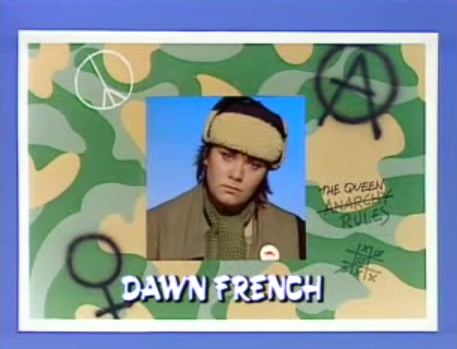
Wax’s loud, attention-demanding stage persona was streamlined for Girls On Top into Shelley Dupont, a brash drama student with plenty of ego but precious little discernible talent. French became Amanda Ripley, a humourless diehard left-wing feminist whose ideology was decidedly at odds with her rarely-satiated hunger for men, while Saunders became Amanda’s dozy, lethargic childhood friend Jennifer Marsh, a girl without a malicious thought - or possibly a thought of any kind - in her head. Ullman, meanwhile, quickly developed the part of Candice Valentine, a bitchy and manipulative It Girl who associated with the rich, powerful and glamorous, yet was still not above committing acts of petty theft against her flatmates. Rounding off the main cast was veteran actress Joan Greenwood as Lady Carlton, an eccentric romantic novelist who doubled-up, arguably not entirely to her own awareness, as the girls’ landlady.


Perhaps inevitably, much of the humour in Girls On Top revolves around the massive clash of personalities between the equally voluble and volatile Shelley and Amanda, with Jennifer playing less of a part in the dialogue but indulged with extended physical comedy sequences based on her immense lack of intellect and self-awareness. However, it is Candice who really steals the show, not least on account of her often lengthy 'solo' sequences taking place in a surreal, dreamlike world of glamorous discos and exclusive nightclubs, where it is never entirely clear to the viewer whether or not this is all simply taking place inside her head. The scripts for the first series were primarily written by French, Saunders and Wax, with Ullman contributing additional material and Ben Elton acting as script editor.

Introduced by a stylish theme song performed by the cast and written by Chris Difford and Glen Tilbrook of Squeeze, Girls On Top finally found its way onto ITV when the first run of seven episodes appeared in an 8.30pm Wednesday timeslot from 23rd October 1985. Storylines included Candice’s attempts to hoodwink Shelley into appearing in an ‘adult’ film, Jennifer being kidnapped and held to ransom, Amanda’s pathetic attempt at staging a multi-cultural street festival, the disappearance of Lady Carlton’s stuffed dog, and more attempts at dodging rent payments than the combined cast could have counted on their collective fingers. Among those making guest appearances were Helen Atkinson-Wood, Helen Lederer, Alan Rickman, Robbie Coltrane, Mark Arden, Stephen Frost, Simon Brint, Roland Rivron and – in a fantastic semi-regular turn as Amanda’s jumpsuited feminist activist co-conspirator – Harriet Thorpe.

Despite the inevitable limitations of its timeslot and prominence – although the writers did their best to find increasingly subtle ways around this – Girls On Top was an instant and deserved hit with both the regular sitcom audience and fans of the alternative scene alike. Its brashness and vulgarity were neatly balanced by the air of surrealism and the traditional bright lights and studio audience sitcom setup. Some observers have maintained the series was simply a carbon copy of The Young Ones, and superficially this criticism would appear to hold some weight. The basic setting is the same, and even the characters themselves are not that dissimilar – Amanda and Rik are certainly very close contemporaries, with Shelley effectively taking the place of Vyvyan, Jennifer as Neil and Candice as Mike. However, it is true that at least three of the characters were simply extensions of what their respective performers had been doing on stage for several years beforehand, and even taking usual television production practices into account, the idea of someone intentionally commissioning a series which was at that point barely more than a cult hit and literally only a couple of months old does stretch credibility somewhat.


What is perhaps most surprising about Girls On Top in retrospect was how much they were able to get away with in a prominent pre-watershed timeslot. While there is no actual swearing, there is a fair amount of what would be generally deemed ‘bad’ language, and a good deal of explicit sexual references, many of which were arguably still shocking in the mid-eighties. Central did in fact have some worries about this, but the writers preferred to leave the ensuing arguments in the capable hands of Paul Jackson, who was well experienced in negotiating with more conservative contemporaries. In any case, on some occasions Central seemed to be making a fuss over absolutely nothing, and Wax has often wearily recalled being informed of concerns that the utterly fictional Irma La Douce might sue for defamation of character.

By the time the first run of Girls On Top was being transmitted, Tracey Ullman was already in talks with American television networks about the possibility of her own solo project. This would eventually result in the acclaimed The Tracey Ullman Show, a series of offbeat playlets - some possibly derived from the abandoned series mooted during the interruption to production of Girls On Top - that ran on Fox between 1987 and 1990, although its success has since been somewhat overshadowed by the fact that it also included the television debut of The Simpsons. These negotiations precluded the possibility of Ullman appearing in the second series of Girls On Top, recorded in the early summer of 1986, but rather than replace her, Wax, French and Saunders opted instead to write Candice out. Ullman was ultimately available to record a small amount of material for the first episode, but her absence would leave the second series sorely lacking when it finally appeared in October 1986.

Candice had of course originally been added to the show to create a stronger dynamic between the other three leads, and her absence had an inevitable effect on the quality of Girls On Top. The main problem with the new batch of six episodes, which commenced on 30th October in the same timeslot, was not simply that they missed Candice and her glitzy fantasy world, but that the other characters had also been noticeably reshaped to compensate for her absence. This inevitably did not prove to be a successful move; Shelley’s brashness and confidence were noticeably toned down, Amanda was revealed to be unexpectedly weak-willed and easily manipulated by men, and most jarringly of all Jennifer became something of a scheming bitch, siding with whichever of the others she stood to gain the most from. This resulted in a muddled dynamic with less inspired interplay between the flatmates, and sadly as a consequence was just not as funny.


In fairness, and as Dawn French hinted at when interviewed for Roger Wilmut’s history of Alternative Comedy Didn’t You Kill My Mother-In-Law?, there may just not have been as much spare time and energy to spend working on six new scripts of Girls On Top. They entered production unexpectedly soon after the first batch, presumably in a bid to capitalise on the show's success, and the three leads had already planned to use this time working on other projects. Wax was engaged on a number of other writing assignments, while French and Saunders - the latter of whom was also pregnant during this time - were hard at work both on Ben Elton’s BBC sitcom Happy Families (also produced by Paul Jackson) and their The Comic Strip Presents… film Consuela. Ultimately, however, the second series was a massive comedown after the offbeat vulgar charm of the first. This is not to say it does not have its moments. The first episode, in which Amanda and Shelley are both accused of murdering Candice by assisting one of her 'mystery' illnesses - in reality she had run away to marry a rich nobleman, suggesting her apparent delusions may have been truthful after all - is well up to standard, while others featured entertaining guest appearances by Harry Enfield, John Sessions, Hugh Laurie, and Katherine Helmond as Shelley’s mother, but as a whole it failed to work as well as the first run had done. Even the theme song, remixed to remove Ullman’s vocals, seemed a pale shadow of its former self. On a brighter note, the second run did come accompanied by the only item of Girls On Top merchandise - a tie-in paperback, written by the cast and published by HarperCollins, which was every bit as brash, vulgar and indeed amusing as the first set of episodes.

With the final episode featuring the main characters apparently killed in an explosion – yet another unintentional but widely-derided echo of The Young OnesGirls On Top made its final appearance on 11th December 1986. Despite never giving an inch in terms of the strength of its content, the success of the show in its unlikely timeslot did much to make this new strain of comedy acceptable in the eyes of the wider viewing public. It also acted as a springboard for the cast to find their way into similar areas. However, this success did not extend to all parties involved – early the following year, Central attempted to fill the gap that Girls On Top had left in their output with the similarly conceived Hardwicke House, which was rapidly pulled after only two episodes had been broadcast.

Sadly, and perhaps on account of the lacklustre second series, Girls On Top is now regarded as one of the lesser achievements of the 'alternative' comedy boom. But at least initially it was a sterling effort and deserves slightly more respect than its reputation might suggest. Yet arguably the biggest laugh of the entire series was that, having been shunned by television virtually outright for so long, Dawn French and Jennifer Saunders beat their contemporaries into the mainstream schedules by some considerable distance.


And if you want to know more about Hardwicke House, you can find the full story of that - and much more besides - in my book Well At Least It's Free, available in paperback here or from the Kindle Store here.

Streetsounds 17: Electric Boogal... No, That Doesn't Work


In 1986, I won a competition in Smash Hits. Though I'm not really quite sure of how and why I did.

Rather than the can of Citrus Spring autographed by Phil Cool that you might well be expecting, the prize in question was a copy of Streetsounds 17. As the name suggests, this was the the seventeenth instalment in the Streetsounds label's lengthy series of compilations of hot new electro, hip-hop and breakbeat tracks. Despite having more than a passing interest in the genre, and being the proud owner of K-Tel's surprisingly strong if slightly dubiously promoted Rap It Up collection, I don't recall ever being particularly desperate to get hold of this or indeed any other edition of Streetsounds. Scanning the lists of winners of other competitions in the same issue, I suspect that I may actually have been after the 12" of Rockin' With Rita by Vindaloo Summer Special, and had just entered the Streetsounds 17 one on a whim due to having a spare stamp.

In order to win a copy, you were challenged to explain, in an essay lasting no longer than five words, why Prince was so short. "The effects of Purple Rain" was my aaaaahhh-tastic pseudo-satirical response, which clearly amused Sylvia Patterson and company sufficiently for them to send me one of the fifty copies on offer. It arrived before the issue with the list of winners came out, in fact, and once it did hit the 'newsstands' I became something of a minor celebrity in school for a week or so. We had to make our own 'trending' in those days.

Anyway, I was reminded of this recently while I was scouring 1986 issues of Smash Hits as research for an article about Now - The Summer Album; which none of you actually read, clearly on account of the MSM bias against me. Sadly, I don't actually have the issue itself any more - a shame as it was the one with the brilliant feature on where the money that you spent on records actually went - but thanks to the fantastic Like Punk Never Happened, here's that list of winners in full. It's particularly interesting to see that the other winners included one 'Scott Walker'. There was such a prominent electro influence on Tilt after all.


However, while that issue of Smash Hits may have long since disappeared into the great magazine-based Bermuda Triangle of the rest of your family denying all knowledge of what might have happened to it, I do still have Streetsounds 17 itself. Not that I really remember very much about it - like all of the Streetsounds label's billions of releases, it was aimed primarily at hip DJs and people playing at being hip DJs, and intended as a way of getting hold of hot new tracks cheaply and easily rather than an actual coherent listening experience. So there's really not much of an excuse for not giving it another spin, is there?

Streetsounds 17 has an indistinct photo of an anonymous street funkateer in a long mac on the cover, and this sense of anonymity also extends to its contents. Many of the featured acts are so low-profile and little-remembered that it's virtually impossible to find an actual photo of them, and only three of the featured tracks resemble even anything approaching a hit single. Janet Jackson's oft-overlooked second hit Nasty might seem a surprising inclusion for such a radically urban and cutting edge series, but it was also a good deal harsher sounding than her usual fare; which is probably the reason why it's oft-overlooked, in fact. This is even more true of the 12" Extended Version included here, which strips it down to some suitably nasty-sounding beats that feel a lot closer to mid-eighties hardcore rap than mid-eighties Motown slickness.

Plenty of slickness can nonetheless be found on Step By Step by T.C. Curtis, the Jheri Curl-sporting synth-funk polymath who somehow failed to break through to mainstream success, despite appearing at the end of side two of every below-par Now! That's What I Call Music rip-off in existence. Step By Step may be presented here in an exclusive 'Streetsounds Remix', but it's still true to say that if you did ever catch one of those end-of-side-two tracks, then you'll have a fair idea of what this likeable but undistinguished mid-paced hoarse-voiced workout sounds like. It's worth noting that a now somewhat unfortunate yodel starts to creep in towards the end, though.


If we're being honest about it, though, most of you will probably have no idea of who T.C. Curtis even was, and if we're positing him as the third most famous artist featured on Streetsounds 17 (we'll get to the second later) then you've got some sense of just how obscure the others actually are. Sharp-suited Oran 'Juice' Jones-alike Michael Jonzun, who throws a hefty helping of vogueish Nu Shooz-esque 'barking dog' voice samples into Can't Fool Us, and Give Me Up non-hitmaker Beau Williams, whose primary gimmick was to fool you into thinking he was singing about a girl when he was actually singing about God, do at least have something approaching a traceable career path. As do Skipworth And Turner, the duo behind the energetic 'Streetsounds Exclusive Edit' of Children's ITV Game Show-friendly-synth-festooned Can't Give Her Up, whose main contribution to musical history was giving Kenny Thomas another hit nobody asked for by writing Thinking About Your Love. Actually, apparently they're different songs, but I couldn't be bothered checking and anyway, there's no point allowing the opportunity for a good Kenny Thomas gag to go by.

Above and beyond that, though, we're adrift in a fathomless factual void of sequinned jackets and Yamaha DX7s. Colors, the unimaginatively-named outfit responsible for the Mario Kart backing music-like Pay Me Back My Love, may possibly have featured veteran session singer Vaneese Thomas but nobody seems to be quite sure about that. Given that it opens with the same sort of over-extemporising saxaphone as any given mid-eighties US TV show, and continues in a suitably mediocre sub-Al Jarreau style, you'd be forgiven for assuming that Cargo, whose Love You So (Without You) is yet another 'Streetsounds Exclusive Mix' ('featuring Dave Collins'), were as American as they came. Yet, bafflingly, the credits seem to indicate they were not just UK-based but actually led by veteran beardy jazzers Mike Carr and Dick Morrissey. Meanwhile, Sleeque have fallen so far off the factual radar that they might as well not have even existed, which is a shame as their sturdy proto-Acid Jazz stomper One For The Money, with its amusing interpolation of the lyrics from Blue Suede Shoes, is the best track on here by some considerable distance.

Former disco ensemble who'd moved with the times Zapp, whose Computer Love (Extended Version) was presumably not a tribute to Zzap!64, sit uneasily somewhere between the two as they seem to have been around for several thousand years without anyone actually noticing them. On the evidence of this 'dreamy' soundscape that clocks in at nearly ten minutes without offering a single robot voice, this is hardly surprising. It's doubtful that it would even have appealed to nominally music-averse sci-fi fans because 'space'.


Right at the end, however, comes the 'Special Extended Remix' of Set Me Free by Birmingham's own Jaki Graham. Seemingly hovering around the charts for the entirety of 1986, even the regular version of Set Me Free was already a touch overlong and repetitive, so making it even longer still seems like an act of wilful obnoxiousness verging on madness. That's how they did 'remixes' back then, though, and frankly it's exactly what we want here. Turning a likeable if lightweight spot of full-throated jazz-funk into something approaching art terrorism exemplifies both everything that was wrong and everything that was right about mid-eighties pop music at the same time, and stands out way more than any of the seemingly endless procession of seemingly endless pleasant enough in-one-ear-and-out-of-the-other exhortations for swanky types in Midnight Starr-inspired clobber to get on down on the dancefloor that you'll find elsewhere on the album.

The regular version of Set Me Free did of course appear on Now! That's What I Call Music 7, which in addition to being a hugely listenable vivid and vibrant snapshot of the diversity of the mid-eighties pop charts, is also the very best Now! album bar none. Yes it is. Stop arguing. Yet for all their wilful angularness, we should be glad that the likes of Streetsounds and the Indie Top 20 series (which you can find Dave Bryant's excellent album-by-album review of here) existed, as they're probably the only way of really accurately measuring what went on beyond the Top Forty short of inventing a time machine and posing as Eugene Wilde. A pose that no doubt involved reclining forward into the camera lens with a satin jacket and a huge grin.

So, that's how I ended up with Streetsounds 17 instead of Rockin' With Rita. But can you guess which one of them I later ended up mentioning in a book?


If you want to read more of my Smash Hits memories, you can find them here.


If you've enjoyed this article, you might enjoy my book The Camberwick Green Procrastination Society in paperback here, on the Kindle Store here, or as a full-colour eBook here.

Now! That's What I Call Some Songs That Vaguely Allude To 'Summer'


Let's face it, pretty much every issue of Smash Hits for the entire eighties was memorable from start to finish. But for some reason, the one published 16th July 1986 - with, of all people, The Jesus And Mary Chain on the cover - has the edge over all of the others. Well, for one really quite obvious reason.

Although the issue was jampacked with start-of-the-school-holidays hilarity, this reason wasn't the debate on whether we should keep the Royal Family (against - Bronski Beat, The Jesus And Mary Chain, Sade, Robert Smith, Annie Lennox, Mick Hucknall, Morrissey, Spandau Ballet, OMD, Dr Robert, The Housemartins, everyone involved with Red Wedge basically; for - Gary Numan, Claire Usher). Nor was it the deliberately tedious Cream facts tying in with I Feel Free showing up in "that Renault 21 TV ad where some rich snoot-bloke gets in his motor car and swishes off down country lanes", or the Sam Fox/Sly Fox-inspired boxout on Great Foxes In Pop (including, inevitably, Bruce "Fox"ton, "bass player with The Jam whose ties were ever a visual "treat" and whose solo "career" has been a blazing inferno of silence"). Nor the 'Get Smart' special on The Smiths, Black Type consulting The Party Pop-Up Book Of Unexplained Phenomena by "Dr" Jonathan Miller and Roy Castle ("remaindered" at 95p - a snip!), Cock Robin's album getting one out of ten, or the utterly pointless and unwarranted 'Day In The Life' of Roses-toting One Hit Wonder Haywoode (who would of course experience a brief One Hit Aftershock with the release of Hits 5). Not even the rightly snorted-at photo of The Cult posing moodily with some gung-ho American Football players.

No, it was the hilariously flippant attempt by some staff writer - most likely Tom Hibbert and/or Sylvia Patterson - at filling up a particularly threadbare instalment of regular gig listing "Happenings" with a spurious billing for Upper Bubblington Village Fete, featuring such top in-joke derived attractions as Reg "Reg" Snipton And His Banjo Boys, Reg "Reg" Snipton And His Banjo Gals, Mad Goths, The Complete Bastards, Flower Arranging And The Feminist Experience (Group Activity Orchestrated By Dame Margot Riviera), Pepe And Lord Alfred, and Throw A Coconut At Reg "Reg" Snipton. That isn't really enough to base a full-length article on, though, so instead let's turn our suitably summery attention to the other real memory-imprinter in that issue of Smash Hits - the advert for Now - The Summer Album.


In actual fact, there were TWO adverts for Now - The Summer Album in that issue; the regular full page full colour launch promotion from Now! themselves (strapline - "You Can't Imagine Summer Without It"), and another informing readers that it was available for 'A Cool £6.99' from John Menzies ('subject to availablity'). The announcement of any new Now! Album was always an attention-catching moment, of course, but this wasn't just any new Now! Album. This was a direct follow-on from the previous December's massively successful Now - The Christmas Album, and as such it boasted a double-album's worth of 'Golden Oldies' rather than recent chart-toppers. The only factor that unified them was that they were all in some way related to the vague and amorphous concept of 'Summer'. And, as we shall see, often that really was the only way in which they were related. And sometimes even that didn't really apply.

Lacking the cohesive precision-targeted line-up of cohesive precision-targeted seasonal cash-in records that at least aimed towards a recognisably similar sound of Now - The Christmas Album, Now - The Summer Album vaulted between decades, moods and musical styles like someone showing off on the trampolines at Pontins, and generated about as much sales excitement as the three days of hot weather we get before it starts throwing it down with rain again. It was, basically, aspiring towards the kind of summer that we just don't get over here, where Hot Rods, Holiday Romances, Beach Parties and Sizzlin' Food Shacks took second place to interminably delayed car journeys, endless imported children's serials on both channels, extortionately priced Big Feast variants, and weather-battered 'staying with relatives' seaside breaks where the highlight of the holiday was watching local fishermen helping to right a fishmonger's white van that had overturned on wet sand. True, many experienced all of the above and more on their actual summer holidays wherever in the Mediterranean was 'in' that year, but they preferred to remind themselves of this by bulk-buying the current novelty dance-pop favourites of Europe's leading discotheques and didn't we know it (that year's primary offender - Brother Louie by Modern Talking). The sort of Summer Hits that Now - The Summer Album compiled sort of came and went without ever really lodging in anyone's memory as a musical reminder of hot fun in the summertime. It was, if we're being blunt about it, the soundtrack to the sort of summer that the average Now!-album buyer never actually had.

Suppose, though, that you were the sort of average Now!-album buyer who had a keen interest in pop music from 'them days' at a time before it was really very easy to actually get hold of any of it. Suppose you'd been fascinated by a tracklisting that even looked esoteric in an advert when you didn't know what any of the songs sounded like. Suppose you'd even chanced upon a copy in an actual John Menzies whilst seeking refuge from the rain on exactly that sort of holiday, and rued the fact that you were unable to afford it, not least because you'd only just bought Now! That's What I Call Music 7. Suppose also that, some years later, you'd chanced upon a stray copy abandoned in a by then all-Compact Disc radio station and ensured that it 'accidentally' 'fell' into your bag. How would this most angular and unlikely of Now!-spinoffs (and that's angular and unlikely even in comparison to Now Dance) measure up against the promise of that imagination-firing advert?


Well, it's all such a strange and haphazard arrangement of musical selections that it's probably worth looking at them in very loose 'genres' rather than any kind of sequential order. Though don't assume from this that they're grouped in any sort of logical or coherent manner; the actual album zigzags back and forth with such casual disregard for mood, style and tempo that you have to wonder exactly what kind of a barbecue it might conceivably have soundtracked. It's perhaps surprising, then, to discover that an entire quarter of the double album is given over to what could loosely be described as relatively recent hits. That said, this in itself highlights two of the major issues affecting Now - The Summer Album - the baffling absence of certain tracks that you would have thought would have been first on the list for inclusion, and the fact that even within this narrowly defined subsector, there is little musical coherence or indeed any relation at all between any of them.

You'll search in vain for fresh-in-the-memory big-hitters Club Tropicana, Here Comes The Summer, I Won't Let The Sun Go Down On Me, Long Hot Summer or Holidays In The Sun - all of them either on Now!-affiliated record labels or indeed by Now! regulars - on Now - The Summer Album. In their place you'll find a fair half-dozen Raiders Of The Pop Charts-troubling contemporaries of dubious 'summer' credentials and, in some cases, limited appeal. The Level 42 song that non-Level 42 fans 'quite like', but that Level 42 fans aren't that fussed about, The Sun Goes Down (Living It Up) is as much about nuclear paranoia as it is about casual sex with that girl 'making eyes' in a flourescent-and-chrome holiday camp nightclub. It may well have been the breakthrough fairly successful mid-chart hit for the Isle Of Wight funk group, but for all the expected slap bass dexterity it doesn't really go anywhere and doesn't feature anywhere near enough high-pitched Mike Lindup vocal silliness or Angus Deayton-lookalike mundanity Boon Gould guitar. And above all doesn't really have that much obvious to do with 'summer'.

Similarly, KC And The Sunshine Band's irritatingly chirrupy Give It Up represented the very last gasp of disco and became a de facto 'summer song' by virtue of its chart timing and theme park tannoy-friendly sound, as the lyrics just seem to be a phatic declaration to some girl that she might as well go out with him if she feels like it. Presumably it was the ‘Sunshine Band’ bit that helped swing its inclusion here. In contrast Walking On Sunshine by Katrina And The Waves (previously of course on Now! 5) at least makes some effort towards a valid 'summery' theme, both in its lyrics and in its studiedly contemporary-yet-retro sound, notably that surftastic one-note guitar solo. Although it was a substantial hit at the time, Walking On Sunshine was one of those records - like its close contemporary The Whole Of The Moon - that subsequently became even more popular still; one of the select few 'oldies' that even the up-to-the-minute commercial pop stations kept on playing and playing and playing, and an inevitable choice of accompaniment for roller discos and bouncy castles and the like. In fact, it probably became more of a summer favourite after the release of Now - The Summer Album.

It's often forgotten that, for all their singalong punchy brass-driven radio-friendliness, Katrina And The Waves had their roots in arty post-punk experimentalism, and the remainder of the 'current' acts on the compilation occupy a similarly uneasy middle ground between proto-indie and pop. Not that any of them sound particularly like each other, mind. Nick Heyward and his fellow hair-mousse-overdoers in Haircut One Hundred give Fantastic Day a hazy jazzy summery jangly sound with Weekend Break-alluding lyrics to match, though it's quite surprising to discover that the song was actually a hit much earlier in the year. It's also got an unnervingly similiar chord progression to the end theme from Camberwick Green, though cunningly sped up so 'Clown' would never suspect a thing. Martha And The Muffins' somewhat over-lauded Echo Beach, on the other hand, opts for sub-Numan yearning for some dystopian futuristic Beach Of Tomorrow rather than holidays in sunnier climes, and is quite icily synth-driven in its New Waviness to boot, but it says 'Beach' in the title so in it goes. The Barracudas, with their Arthur-Lee-catching-a-wave Pirate Radio-friendly musical sensibilities, always sounded like they'd rather have been anywhere but the early eighties, and their stray hit Summer Fun makes this explicit with its use of an actual sixties American radio ad as an intro (not to mention the slightly less successful follow-up single (I Wish It Could Be) 1965 Again). Ironic, then, that their Ramones-meet-The-Beach-Boys-at-a-leaky-bus-stop number is the closest yet to actually evoking a typical British summer, making no false promises of anything other than an opportunity to make the most of a brief window of sunshine.

Above and beyond their recognisability and obvious commercial appeal, it's difficult to see what these inclusions had to offer thematically to this most thematically ambitious of compilations. The era in which they'd dominated the summer airwaves (well, even that wasn't applicable for Fantastic Day) was still too recent for anyone to feel anything resembling nostalgia towards it; in any case, for certain pockets of the UK, those late seventies/early eighties summers were something that they were most likely in no hurry to look back on. In all seriousness, they would have been better off putting Summer Run, Junior's reworking of Mama Used To Say as the theme for the short-lived yet seemingly endless TV-am Summer Holiday Morning fill-in Data Run variant of the same name, on there. At least it would have had some semblance of actual summer-related nostalgia value.


Needless to say, there is a good deal more focus, point and purpose shared by the equal number of tracks that had clearly been brought in to represent the so-called 'Summer Of Love'. Amazingly, for once, the compilers of a mainstream compilation managed to pick out a handful of tracks that, while not quite The Waltham Green East Wapping Carpet Cleaning Rodent And Boggit Extermination Association, still all managed to sit more comfortably on the folky semi-psychedelic half-mind-alter-y side of things than the twaddle they usually pull out of the bag whenenever Polly Toynbee starts droining on in short sentences about miniskirts and 'flower power' and That Was The Week That Was. In fact, they work so well in this context that you can practially hear Kevin Arnold going into a voiceover reflecting ruefully on the lessons he learned from whatever moneymaking 'chores' he had been handed in tandem with those three other kids that he hung around with whenever Winnie and Paul went away for the summer.

On Groovin', those previously clean-cut and presentable Young Rascals start their descent into full-on hippydom, a move that saw them daringly drop the 'Young' bit of their name in order to appear more 'far-out' (just wait until you get a load of It's Wonderful, Mr. America!). It's a strong and inventively-arranged song only slightly marred by its reliance on that Brian Hyland-esque shrill treble-heavy production that too many people inexplicably thought was a good idea in the sixties, and a clip-cloppy home on the range feel that, while certainly ideal for 'groovin' on a sunday afternoon or otherwise in the Midwest, made it somewhat less than sonically relatable for youngsters trying to chat up girls playing tennis in the local municipal park while dark clouds swirled three o'clockishly overhead. While we're on about unnecessary apostrophes, there's the ever-splendid California Dreamin' by The Mamas And The Papas, which may have a suitably summery sound but - and it's always worth pointing this out - is set in the autumn and spends almost its entire duration complaining about cold weather. And therefore, whatever their intent back in 1967, is inadvertently the most accurate depiction of a British summer that you're likely to find in a pop song.

This would be all very well and good if it wasn't for the fact that, but for a couple of misguided souls who drew CND symbols and wrote 'Imagine' on their school bags, by the mid-eighties hippydom, 'flower power', soft psychedelia and the Summer Of Love itself were all as naff as naff could be. They were the preserve of bores who kept going on and on about how much better everything was in 'the sixties', daytime TV presenters dressing up in kaftans and doing ludicrous 'hip lingo' for silly features, and impenetrable nostalgia documentaries that sought to draw a clip montage straight line between Thunderbirds and Jean Shrimpton. Crown Prince of these Clown Princes was 'The Voice Of' Scott McKenzie and his drippy call to whatever the opposite of arms is, San Francisco (Be Sure To Wear Flowers In Your Hair). While the media's insistence on depicting this weedy Walter The Softy Takes Acid folk-pop effort as the high watermark of psychedelia still rankles, and it was decisively trounced by both The Flowerpot Men's Let's Go To San Francisco ("where the flowers grow up to the sky", apparently) and The Animals' amusingly ridiculous San Franciscan Nights, distance and perspective allows you to appreciate that it's actually a fairly decent song and that sitar bit is really quite impressive and dramatic. Still, its tinkly and faraway bell-shaking peace and love vibes held little resonance for youngsters for whom 'summer' and 'flowers' meant either an interminable enforced trip to the garden centre (where they had invariably just sold out of the ice lollies that your parents would not have sodding well bought you anyway), or some live edition of Gardener's World expanding exponentially into the timeslot of your favourite comedy show. Speaking of which, that old-skool sweeping orchestral Gardener's World theme would probably be side one track one of a more geo-culturally realistic version of Now - The Summer Album. Let's not even meet these damn hippies halfway.

Let us be thankful, then, for the unpromisingly-named The Lovin' Spoonful, who show up with two consecutive tracks on side four (which still looks a tad incongruous even now, though as we shall see they are far from the only act to get two songs on the album) and offer a somewhat more robust Electric Jugband glimpse of the moment just before 'flower power' broke; when there was definitely something in the air, but on this evidence it was anyone's guess whether it would be a blissful heat haze or hammering hailstones. This is especially true of Summer In The City, a traffic-paced stop-start ode to the lack of joys of gainful employment in the sweltering heat as contrasted with ‘skirt’-pursuing nighttime balminess, embellished with enough ear-infuriating rush-hour sound effects to make Michael Douglas snap in Falling Down all over again, and which accurately evokes the sheer annoyance and discomfort of not being free to groove, wear flowers in your hair or even live it up until the sun goes down on a swelteringly hot day. It also, it's worth pointing out, bears more than a passing resemblance to the theme song from Children's BBC migrane-inducer Stop-Go!, and indeed Paul Weller's entire solo career. On the other side of the coin, there's also the loping whistly anthem for lounging around doing fuck all (apart from, erm, falling on your face on somebody’s new-mown lawn) Daydream, which occupies similar territory to Groovin' but with a more abrasive sound and a drier sense of humour.

It's odd to think that, despite their huge success only a relatively short while earlier, The Lovin' Spoonful were virtually forgotten by 1986 and were probably the second most '...who?' inclusion on Now - The Summer Album (we'll be coming to the 'most' one later). The same could not be said, however, of The Monkees, not least on account of the fact that the BBC had been repeating their series relentlessly over the past couple of summer holidays (and you can read more about that here). This was especially true of 1986, when the scheduling of episodes of The Monkees seemed to stretch gloriously on into infinity, alongside an equally if less glorious stretching on into infinity of youngster-aimed 'make your own entertainment' show Why Don't You...?, and those moments when the actual schedule itself seemed to stretch on into infinity (which once again you can read more about here). This Nesmith-driven tempora-spatial disruption assumed even further mind-blowing dimensions if you were prone to spending your school holidays at a local pool's 'swim club' which habitually included A Little Bit Me, A Little Bit You in the cheery backstroke-assisting sounds pumped out across the tannoy. As you're by now expecting, Daydream Believer has absolutely nothing whatsoever to do with 'summer' (not that you should pay much attention to anyone claiming that it does have any particular 'meaning'), but its presence here finally gives us something tangible and recognisable that we can latch on to as specifically 'summery' for the sort of people who would have been buying this album if they had actually been able to afford it. If only it had come accompanied by Hazel O'Connor singing Get Set For Summer.


Moving on from The Monkees and The Lovin' Spoonful, and indeed thankfully Woodstock-fixated didacticism, to 'The Sixties' in general, Do It Again is often fanfared as a triumphant return to The Beach Boys' 'classic' sound, but actually feels a tad polite, restrained and apologetic when compared to their actual 'classic sound'. They were always at their best when Brian Wilson and Mike Love were waging an art-vs-commerce creative war that culminated in the SMiLE-related studio dustups, and no matter who you feel 'won', the fact remains that once the battle was over they were never quite the same again. Unluckily for Do It Again, California Girls is on hand elsewhere on the album to demonstrate just how that 'classic' sound actually sounded, with the rug pulled from under Mike Love’s ode to the comparative average arse size in varying American states by Brian Wilson tacking on one of the most peculiar intros in pop history. It's not difficult to see how barely six months later, they were squaring up to each other in the studio about a song sung from the perspective of a crow. Stitch that, ‘Murs’.

By 1986, of course, The Beach Boys had become 'hip', at least with the too-cool-for-school types in school more normally to be found practicing their high fives in letterman jackets. This was largely on account of the cheap and easy availability of SMiLE-averse compilation 20 Golden Greats in all of its fuzzy sound quality glory, though more cynical types might teasingly suggest that they all knew California Girls better from sendups like Russ Abbott's hilarious Upper Norwood Girls and that not at all remotely sexist British Caledonian advert. Less fortunate in this regard were Those Beatle Boys, who - despite a sneaking upsurge of interest in Sergeant Pepper's Lonely Hearts Club Band - were still roundly dismissed as being as naff as, well, Scott McKenzie. Perhaps that's partly why, oddly, EMI briefly began allowing their songs to appear on high-profile compilations in the mid-eighties, in the hope of luring in a whole new generation of punters who could be persuaded to pay full price for the same songs seventeen million times. These included the Music For Pleasure collection 20 Fab No.1's Of The Sixties (and, erm, Savile's Time Travels - 20 Golden Hits Of 1963), and - perhaps surprisingly - two songs on Now - The Summer Album.

At this point, you're probably running through the entire Beatles discography in your head and trying to work out which two songs were actually about the 'summer'. Well, the answer is that there aren't any, but that didn't stop Ashley Abram and Box Music from marching straight on with their track selection. Presumably sidestepping I'll Follow The Sun on account of its somewhat negative 'Dinners'-goes-walkabout vibes, and Sun King because they wanted listeners to keep hold of whatever remained of their sanity, they opted instead for the rather more popular choices of All You Need Is Love and Here Comes The Sun. Although its only tenuous connection with the theme of this album is that it was Number One for the majority of the 'Summer Of Love', All You Need Is Love is an interesting inclusion here in the sense that, while on actual Beatle albums it's invariably swamped by more inventive, psychedelic and melodically/instrumentally interesting numbers, when it's in isolation you realise what a deceptively clever (and wittily performed) song it really is. Here Comes The Sun, which if we're being honest about it never even really sounded that much like it was by the actual Beatles and not just George, can't help but stand there doing an I Have A Horsey Neigh Neigh number next to its more illustrious counterpart, but in fairness at least it actually mentions the summer.

Far more deserving of a place on this album, both on account of its subject matter and its redolence of a lost era when everyone would politely head off for seaside towns for a week and join in with all manner of uncool holidaymaking hilarity, rather than get stressed about going to, staying at and coming back from some 'sophisticated' destination interspersed with gallons of jagerbombs, is Summer Holiday by Cliff Richard And The Shadows. For anyone who doesn't know, this was the theme from the rather quite splendid 1963 film of the same name in which Cliff, The Shadows, Lauri Peters, Una Stubbs and Jeremy Bulloch borrow a double-decker bus for a spot of European sightseeing, and was knocked off the top of the charts by the also-from-the-same-soundtrack Foot Tapper by The Shadows, now more commonly known as the music when Your Old Mate Brian Matthew says that's the lot for this week, see you next week. It should be emphasises that at no point do they have cause to shout "LOOK OUT! VYYYYYYYVYAN!", though they are joined at one point by a stowaway that Cliff is especially cross to find out is actually a fully grown woman in disguise and not a young boy after all. Moving rapidly on, Summer Holiday was exactly the sort of film that anyone listening to this compilation would have seen a million times on interminable Summer Holiday afternoons while trying to work out what a 'Bachelor Boy' was and what was so good about being one, and so this jaunty, likeable and fantastically arranged number is a very welcome inclusion here. Even if it is hard to avoid the temptation to shout "it's raining, nyeh-hehhhh" over the top. More of a surprising inclusion, but an even more welcome one, is The Day I Met Marie, Cliff's Hank Marvin-penned Baroque Pop ode to how he'll not forget that happy night he chanced upon some young lady in a haystack. They didn't send a camera crew to cover that.


Beyond that, there are a couple of Nostalgia Souvenir Spread-friendly sixties-ish types who get a single song on the compilation; and all of them, oddly, with a reason why they don't quite fit. Mungo Jerry's jugband-goes-prog ode to going ha ha this a way ha ha that a way when the weather's fine and you got women you got women on your mind In The Summertime was probably almost genuinely inescapable back in 1970 and deservedly so, but by the time it showed up here was about to fall very rapidly from favour owing to a certain unfortunate line (though the less said about that radio edit that went "have a drive have a drive" the better). Nowadays, you're only marginally more likely to hear it than their famously airwave-eluding chart-topper Baby Jump. As fantastic as it is, someone presumably missed the sarcasm in The Kinks' Sunny Afternoon, and there are those that believe that the narrator may even be deluding himself about the good weather anyway. Lazy Sunday by The Small Faces is up there with The Lovin' Spoonful and The Day I Met Marie as an inspired inclusion, not least because it was still some years before their 'rediscovery' and it probably hadn't been heard that much between 1968 and then. It's an amazing song, but yet again one that - those lengthy Coach Trip To The Centre Of The Mind psychedelic bucket-and-spade interludes (which in themselves make you wonder why we didn't get Good Vibrations instead of Do It Again) aside - doesn't really seem to have very much to do with the summer at all. Well not any more than The Universal at any rate. Which is a touch inconvenient for anyone who might previously have described it as "Anthony Newley Goes To The Seaside Ferdy Ain’t Been Seen ‘As ‘E? changing hut-leaping cockney caterwauling about mods being thwarted in seaside amok-running plans by legions of deckchair-bound disapproving types with knotted hankies atop their heads, leaving quite literally no room for ‘ravers’", but hey ho.

Going back slightly further in time, to the bit in Summer Holiday before it goes into colour if you want to be cinematic about it, there area handful of songs that hail from a long-lost era when holidaymaking was more innocent and simplistic a pursuit, and 'summer fun' was literally just being outdoors. As if to underline this, Eddie Cochran's still thrilling Summertime Blues is a lament for how annoyed he is by 'The Man' (who in all manifestations still seems to talk with the same third-Muppet-from-the-left voice) preventing him from lazing around doing nothing; he even takes his problem to Plastic Bertrand and those Eurocrats in Brussells who regret to inform him that are unable to help, which doubtless struck a chord with a young Nigel Farage. The Drifters' Under The Boardwalk effortlessly captures the tinkly charms of a time when a stroll and an ice cream were high entertainment on a summer's day, though the compilers must have been kicking themselves when only twelve months later, The Drifters and Bruce Willis came up with an effectively updated version that seemed to stay in the charts into the autumn and beyond. Long-forgotten Kramer lookalike Jerry Keller was the man behind hotrods-and-soda-pop celebration of taking your best girl to the park Here Comes Summer, one of those 'golden oldies' that the Radio 1 Roadshow would always insist on foisting upon a Duran-hungry audience, but which - surprisingly - actually turns out to be quite likeable.

And then there's the darkest seventies, represented here by a procession of slick bolted-together pop-soul anthems tailor-made for car radios in true and-they-wonder-why-punk-happened fashion. One of those songs where you can never quite make your mind up whether it's any good or not, The Isley Brothers' Summer Breeze sees Psychedelic Soul take a bit of ‘me time’ after all that early seventies stuff about taking to the streets, stopping instead to smell the roses (well, jasmine) and take in the scenery, including those oh-so-summery ‘newspapers’, but still throwing in a bit of untamed fuzz guitar to scare any passing Republicans. Much the same is true of Lovely Day by Bill Withers, mercifully presented here in its original incarnation and not that hideous 'Woo! YEAH'-heavy 'Sunshine Mix' that blighted the charts shortly thereafter. Mind you, that note he famously holds for ages; it's hardly Captain Beefheart destroying a high quality studio microphone by singing into it, is it. 10cc's (cough) 'problematic' yet inexplicably popular Dreadlock Holiday should not even be allowed on the same holiday island as the rest of their output, and even Elton John himself probably can't remember how Island Girl went. Somewhere, The Barracudas were sharpening their Rickenbackers.


So then... what, apart from all the highlights that we've already picked out, are the real highlights of Now - The Summer Album? Well, oddly enough, it's the two that don't really fit even into any of the loosely-assembled stylistic brackets we've identified along the way. Both must have seemed bafflingly off at a Private Beach-occupying tangent at the time, and to be honest they still do now. And they're both fantastic.

The Girl From Ipanema appears here credited to Astrud Gilberto alone, rather than the two blokes who insisted their name went on the label in a jaw-dropping display of 'stand back luv, the men are in charge'-ness, and sure enough it's a severely truncated edit omitting much of their hoo-hah. It would be tempting to say that music's loss is feminism's gain, except that this does mean that we get to fully concentrate on the gap-toothed first lady of Bossa Nova getting a bit ‘and then they lez up’ about some hottie strolling along the beachfront while each one she passes goes "aaaaah", presumably in a non-Tony Parsons fashion. At the time that Now - The Summer Album came out, the other sixties selections seemed remote and rarely-glimpsed enough; The Girl From Ipanema, and other similar esoteric stray hits from other non-pop genres, were so far off the average pop fan's radar that they may as well have been from another planet. And perhaps that's part of the reason why, a couple of years later, so many of them started raiding charity shops for unlikely-looking albums hiding similarly exotic grooves. After all, you could always guarantee finding so many of them on holiday that you had trouble carrying them all home.

Then there's Summer (The First Time) by Bobby Goldsboro. Wikipedia believes that this tale of balmy evening horseplay with an 'older lady' belongs firmly in the 'Adult Contemporary' genre, but its piercing Test Card F-esque one-note string section, Casio test-tone piano riff, heat-haze synth tones, overpowering sound effects and crashing orchestral interlude designed to denote their 'getting it on' seem to exist outside anyone's established norms of musical genres, coming across as a very expensive lo-fi bedroom recording using highly paid session musicians. It's also got absolutely effortlessly brilliant lyrics, descriptive and elliptic yet highly sexually charged and very much to the point - in fact it's surprising it actually got enough radio play to become a hit back then - with much dwelling on heaving knockerage and, erm, 'helping hands'; although his insistence on emphasising the prominence of her facial features does make his conquest sound alarmingly like Father Bigley. And then at the end, the lyrics simply loop back to the start, as though he's caught in some kind of sexual time loop to rival the opening of Sweet Sweetback's Badasssss Song. Doubtless this drove Mary Whitehouse into short-lived radio-berating paroxysms of outrage, but there are few listeners who won't find that this strikes a chord and stirs up memories of that boy with the summer job at the local newsagents or that girl playing tennis in the park that time. Or, if raining, and it probably WAS fucking raining, whoever you fancied on Home And Away at that point.


Of course, there's every chance that Mr. Goldsboro's tales of scoring were every bit as exaggerated as those lurid yet unverifiable accounts of holiday romances in the Mediterranean that the more loudmouthed types in school would venture forth whether asked to or not come September. Yes, we're at the end of Now - The Summer Album, and the end of the school holidays, and the return of, well, school, looms close on the horizon. You're back from your family holiday, you're in that weird end of August limbo with nothing to do (especially if those scrooges at the BBC ended their daytime programming a week early), and Melissa from Great Yarmouth will never write back. What's worse, everyone from home has come up with a new running joke in your absence that you can never quite get to the bottom of. And that copy of Now - The Summer Album remained steadfastly in John Menzies. Ahead lie autumn evenings, Telly Addicts and the interminable stretch towards the next major school holiday... but that's a whole different Now! album.

There's no getting away from the fact that Now - The Summer Album singularly failed to do whatever it was that it set out to do in the first place, but in its marketing-led desperation to fill enough sides of vinyl to actually constitute a releasable album, it somehow became a work of accidental genius. Even on the most lazily slung-together 'Summer' compilation - and there have been many thousands of them since (oh and Summer Chart Party) - you would never find such a baffling and coherency-free collection of mismatched pop songs from mismatched genres and mismatched eras. If Bobby Goldsboro was a themed compilation, then this dates from the very start of that hot afternoon in the first day in June when the sun was a demon. By the time that Now! That's What I Call Summer came out in 2014, he'd seen the sun rise as a man, and frankly we'd lost something a bit more than virginity along the way.

As for Smash Hits, they would continue to mercilessly ridicule anyone who came along with a gimmicky summer smash for many years thereafter. In 1991, highly touted post-New Kids On The Block American act The Party - Chase, Damon, Tiffini, Deedee and Albert - saw fit to inflict a particularly lightweight bit of pop rap named Summer Vacation on the post Now - The Summer Album populace in the hope of scoring a UK chart breakthrough. Their review ran as follows: "Scientific Fact! The Sun is a huge burning ball of gas which one day will burn out and take most of the Solar System with it. How's about that then, 'Albert'?".


Special thanks to Brian McCloskey for finding Upper Bubblington Village Fete - see his excellent Smash Hits Archive here.


If you've enjoyed this, you can find a feature on the first spinoff, Now Dance, here.


If you've enjoyed this article, you might enjoy my book The Camberwick Green Procrastination Society in paperback here, on the Kindle Store here, or as a full-colour eBook here.

Hits 5 Revisited: Side Four


We're now onto the fourth and final side of Hits 5, and if ever we were going to tear through the fabric and unleash a cosmic refracted blast of pure undiluted 1986, culminating an unending fountain of Citrus Spring, then that moment is now...


Red Box - 'For America'


So, after eight whole tracks (well, seven whole tracks if we don’t count True Colors, which we definitely shouldn’t) of musical and lyrical blandness with too much post-Berlin warbly synth bass, we’re finally clear of the ‘ballads’ side of Hits 5; and good thing too, as the overall uninterestingness of the music on offer has led to a corresponding lack of interest in the ensuing writeups. Try as you might, you just can’t get people to read an entry on a Lionel Richie song that probably even Lionel Richie himself has forgotten about, no matter how many ludicrously obscure references to 1986-specific catchphrases you contextlessly crowbar into it. Thankfully, we’re now onto the fourth and final side of this hit-compiling double album, and indeed onto a selection of much more interesting artists who came and went in a whirlwind of none-more-1986-ness. Not least the ones that have the honour of opening side four…

Better known to their friends and family as Simon Toulson-Clarke and Julian Close, Red Box formed in the early eighties with the intention of fusing synthpop with influences from Native American folk music and globo-politically-conscious lyrics to match. Initially signed to infamously eccentric indie label Cherry Red, they were soon snapped up by WEA, whose apparent sanity-defying belief that the wordy musos with their tin can drum sounds could become a sound commercial prospect was proved not to be quite such a defiance of sanity after all when Lean On Me (Ah-Li-Ayo) barged its way through the post-Live Aid chart clamour for dreary stadium rock to become one of the biggest hit singles of 1985.

By the end of the year they had an entire album pretty much in the can, but oddly, the label chose that exact moment to get cold feet about the angular uncommerciality of the whole enterprise, seemingly having completely forgotten their chart-hogging antics of about five minutes previously and darkly muttering that they were contractually bound to deliver something ‘for America’. Upon which Toulson-Clarke and Close duly wrote and recorded For America, a song that piled on the ethnic chanting and percussion even more heavily whilst also taking Uncle Sam to task for his less than enlightened military track record and national obsession with style over content. And, to the surprise of all concerned, it was an even bigger hit, bagging the duo an appearance on Wogan where they played with cardboard instruments to make a satirical point about something or other. Parent album The Circle And The Square was admittedly a flop, barely scraping the top seventy five in the UK on original release, though it stands up as one of the best releases of the decade and has recently been reissued on CD with tons of bonus tracks, including one which is possibly the only known record ever to sample Michael Parkinson.

Other than the fact that its pointedly Reagan-baiting lyrics are troublingly just as topical and pertinent now as they were in late 1986 (well, apart from the “urelei-urelei-urelei-urelei-urelei-urelei-ay urelei-urelei-urelei-urelei-urelei-urelei-USA” bit, but then nobody could understand that even at the time), one of the most interesting features of For America is that – production aside – it doesn’t really sound like a pop record from late 1986. It’s all violins and accordians and ethnic drums and it shovels on the World Music thing to an extent that even Hollywood Beyond would have considered a bit much, and then probably done an advert for The News On Sunday with Boys Wonder while scoffing Cheese Dips in protest. Similarly, the vocals are delivered in a soft non-commital style quite at odds with the aggressive barking favoured by other chartbound critics of US foreign policy at the time (reinforced by a video that combines the band being comically attacked by flying examples of American iconography intercut with shots of foxy chicks in ‘Uncle Sam-antha poses for FHM’ getup), and yet which one had unsuspecting pop loving youngsters joining in with the sarcastic “every house should have its hat on”? And yet it remains by far the best song on the whole of Hits 5, and arguably one of the best songs of the eighties full stop. And there you were dismissing it as mock-indie for the Roland Rat – The Series demographic. See? It’s better than that Rod Stewart song already. And there’s plenty more long-forgotten offbeat interestingness to come…


The Psychedelic Furs - 'Heartbreak Beat'


As we saw a couple of tracks ago, bagging the title theme to a big-budget film was a surefire way of scoring a massive transatlantic – and often even worldwide – hit in the mid eighties. The rarely mentioned dark side of this phenomenon, though, was that it was really all just about the song, or maybe even all just about the film, and nobody much cared who was singing it. There was never much chance of a substantial follow up hit, and for every million copies of Take My Breath Away sold, there were a million copies of Like Flames that remained resolutely unsold. Survivor, Kenny Loggins and a certain other individual we’ll be hearing a lot more from very soon hardly exactly found themselves in a position where ‘the charts’ had to take out a restraining order on them, and let’s just say the designer-clad vox-popped pop fan who confidently told BBC2′s Juice that Hip To Be Square by Huey Lewis & The News was “headed for Christmas Number One” is probably glad the show has never quite achieved cult status.

In this context, you have to feel some sympathy for The Psychedelic Furs. For the first half of the eighties, they’d been the nearly men of the post-punk scene, continually pushing their Berlin Bowie-inspired take on guitar pop close but not close enough to the top forty whilst Smash Hits continually touted them as a ‘weird’ band it was OK to like. Then in 1986, out of the blue, film director of the moment John Hughes decided to name his The Breakfast Club-following opus after the band’s ignored-yet-influential 1981 single Pretty In Pink, and stumped up the cash for them to record a brand new spruced up version for the soundtrack. Thus is was that The Psychedelic Furs ended up accompanying the ill-fated tug-of-love between Andie, Blane and Duckie alongside The Smiths, New Order, Suzanne Vega and, but of course, ‘Belouis’ ‘Some’, and as any feature presentation deemed to constitute a ‘Bratpack film’ was seriously big business with easily Americana-impressed teens at the time – to the extent that ordinarily perfectly sane schoolchildren began wearing letterman jackets and high-fiving each other in the corridors – it was a foregone conclusion that a song that had previously never troubled any charts outside of John Peel’s Festive Fifty would become a huge international hit. Not that the tame guitar sounds, twinkly synth bits and truly lamentable infiltration by the hated American Saxophone were in any way any kind of improvement on a record that was perfectly good to begin with, but it’s since led to the original version becoming a heavily-rotated staple of oldies radio, and that can only be a very good thing indeed.

While follow-up to a hit film Pretty In Pink went on to do very well indeed, follow-up to a hit single Heartbreak Beat didn’t fare quite so well, only proving a moderate hit in America and not even charting in the UK at all. In retrospect, it’s not difficult to see why – cut from very similar musical cloth to the remade Pretty In Pink, it probably offered too much of what fans of the film were expecting, including more of that sodding saxophone, and not enough of what fans of the band were expecting. This is something of a pity as it’s actually a pretty good song, just swamped by the not particularly sympathetic production and further shoved into the background by yet another of those ‘arty’ black and white videos that were ten a penny in 1986, although they do win points for using sixties iconography rather than its tiresome ‘fifties’ counterpart. Actually, perhaps this was the main cause of its lack of chart prowess, as even certain megastars with a fondness for all things paisley sometimes had difficulty getting their latest waxing into the top ten…


Prince - 'Anotherloverholenyohead'


With the obvious exception of David Bowie, Prince is quite possibly the closest thing that the million-selling mainstream megastar pop industry has ever had to a true auteur. Throughout his career, he’s pretty much done whatever he wanted both musically and visually, making no end of artistic about turns that have left fans, critics and nervous record company executives alike bewildered, with albums, singles, films and tours flopping or even being cancelled full stop, only for him to be back on top months later seemingly without having batted an eyelid. For no matter how far away from the beaten track he might have got at times, the fact remains that the overwheming majority of his output has highly commercial without ever straying into sell-out territory, and that’s more than enough to balance out his occasional diversions into his own creative universe. Anyway, when you’ve got a workrate as prodigious Prince, that sort of thing is bound to happen occasionally. Not for nothing did his record label, some seven years after Hits 5 was released, attempt to sue him for flooding them with too much releasable material.

1986 was no exception to this rule, as he took the unusual step of following two massively successful years’ worth of hit singles, albums, and even films (well, film singular, namely Purple Rain), and indeed a time in which he actually seemed to become more popular for turning his nose up at Live Aid, with the highly personal and wilfully uncommercial homage to Film Noir and silent comedy Under The Cherry Moon, and its accompanying understated-jazz-funk-filled soundtrack album Parade. Although extracted single Kiss would become a huge hit and ultimately one of his signature numbers, neither film nor album were particularly rapturously recieved by audiences or critics, selling and box-office-ticket-shifting only respectably (albeit by Prince’s extremely lucrative standards) but treasured by the devoted minority who ‘got’ them, and awaiting rediscovery at a later date. In many ways, Parade was Prince’s Dog Man Star, complete with the Brit Award-disrespecting antics, and the remainder of the singles culled from the album were about as successful as We Are The Pigs. The last of these, late in 1986, was the awkwardly titled Anotherloverholenyohead, though by that time the Sign O’ The Times album was more or less in the can so Prince probably couldn’t have cared less.

As you’d expect from Prince, Anotherloverholenyohead is a mighty good song, but lacks an obvious catchy hook, and also seems to have had random bits of about six other abandoned compositions (and even ’jams’) shoehorned into something that may once have been possibly distantly related to a conventional song structure, and as such while it works brilliantly on the album, and indeed in Under The Cherry Moon, the decision to release it as a single is entirely baffling even by his standards. Unsurprisingly it bombed as a single on both sides of the Atlantic – stalling just inside the top forty over here – though in fairness this may have had as much to do with its status as the umpteenth single from an album that anyone even halfway interested had already bought anyway, which came accompanied by ripoff-friendly well-known widely-available former-singles-themselves tracks as b-sides, as it did with the uncommercial nature of the song itself.

Unfortunately, due to Prince’s entirely predictably paranoid views on ‘the internet’, you won’t find Anotherloverholenyohead, or indeed any of his music, on YouTube (though you’re not really missing anything as the video was just some unexciting studio-based miming in a Cat-from-Red-Dwarf-anticipating suit). How that tallies exactly with him giving away an entire album free with a newspaper against the wishes of his record label twenty years later is anyone’s guess. The video for the next track on Hits 5 really better had be on YouTube, though…


The The - 'Infected'


With every compilation like Hits 5, you always got one song that felt like it shouldn’t have been on there at all. True, there was always a healthy quotient of unlikely hitmakers like, well, Red Box and The Psychedelic Furs, but beyond even these there was always one artist whom even those who liked The Jesus & Mary Chain considered to be a bit ‘out there’, whose record sleeves and interviews scared hapless fans of ‘Belouis’ ‘Some’, and whose presence on an otherwise happy clappy all singing all dancing collection of your favourite best recent hits was surely verging on contravention of the Trading Standards Act. And while Now That’s What I Call Music! 8 infamously boasted Billy Bragg, Hits 5 had The The.

“Hang on”, you’re probably thinking, “isn’t that the The The that later had loads of big-selling albums and recorded with Johnny Marr and all that?”. Yes indeed it is – but that elevation to stadium-filling status would come later. Back in 1986, Matt Johnson’s one-man-band had only recently moved to major label Epic from the near-performance art environs of legendary indie Some Bizarre, and despite gaining a more commercial sound still retained a fascination with macabre lyrical themes and bizarre imagery. This was reflected in the title, lyrics and indeed video (which saw Johnson catapulted around the globe in an ejector seat thingy whilst ‘satirical’ consumerism-related images were projected onto his sunglasses) for title-track-from-the-album Infected, but nonetheless it was a furious and catchy song that really did stand a good change of becoming a hit. Perhaps hoping for a touch of post-Frankie Goes To Hollywood notoriety-instigated exposure, Epic and Johnson really pulled out all the stops for Infected and scored a rare triple-whammy of banned-ness; Radio 1 wouldn’t play the single on account of the explicit – if unerotically graphic – last verse, the IBA banned the video on account of female semi-nudity and burning-at-the-stake antics, and many shops refused to even stock the single on account of the sleeve art showing what can only be described as Satan taking matters into his own hands. All of this combined to counteract any interest that any of the individual bits of controversy may have generated – not many people would really want to buy a record they’ve not even heard in passing – and it stalled just inside the top fifty; though, that said, perhaps late 1986 wasn’t exactly the most sensible time to be releasing a single with the hookline “infect me with your love”.

Quite what the sappier pop kids who considered Rain Or Shine by Five Star a tad harsh on the ears made of Infected is anyone’s guess. Viewed from this distance, however, it’s a remarkable song combining industrial influences with wailing soul diva technopop, and it’s hard to believe it wasn’t more of a hit; the strength of the song alone should have been enough to overcome all the promotional hiccups. It’s almost – almost – the best song on Hits 5, coming a very very close second to For America. And, what do you know, there’s one almost as good again right after it…


Frankie Goes To Hollywood - 'Rage Hard'


There was a time when the tabloid press would have had us believe that Frankie Goes To Hollywood were planning to murder us all in our beds, brandishing copies of Zombie Creeping Flesh and humming the theme from Hardwicke House as they went. And that was just the image; the music was, if anything, even more thrilling, a massive apocalyptic electropop riot with incendiary guitars and provocative lyrics about right-on issues, like The Sex Pistols had wandered into an Isaac Asimov novel, threatening and terrifying Thatcherism from right inside its bloated capital-obsessed heart. Quite simply, they were the most exciting to happen to mainstream pop music in a long time. Yet as the old adage goes, the light that burns twice as bright burns half as long, and by 1986 they were already starting to look like a washed-up relic from another age, sidelined by the musical after-effects of Live Aid, weighed down by their increasingly embarassing-looking publicity overload, and swamped by their own ubiquity; after all, they even had a totally unplayable ZX Spectrum game based on them. When word filtered out that they were working quietly away on a self-produced and more ‘mellow’ second album, the writing really was on the wall. With ‘FRANKIE SAYS’ in big letters in front of it.

In fairness, their admittedly apallingly titled second album Liverpool has always recieved slightly more stick than it actually deserved. True, it’s not a great album, it’s a massive comedown after Welcome To The Pleasuredome, it lacks any sense of coherency and there’s a couple of tuneless wastes of everyone’s time on there, but the majority of halfway decent tracks don’t deserve to be ignored by association, and occasionally – as on eventual third single Watching The Wildlife – it’s very good indeed. But nobody wanted the album back in 1986, and no small part of that was due to the anticlimactic impact of lead single Rage Hard.

Part of the secret behind Frankie’s success had always been the multiple epic 12″ mixes that were available for each single, turning the familiar radio version into something between a synthpop symphony and a big-budget film soundtrack and introducing all manner of previously unheard song segments and musical effects. Rage Hard feels a little too much like an attempt to do one of these widescreen productions within the confines of a 7″ edit, which kind of misses the point. There’s far too much packed into it for anything approaching radio-friendlyness, and though the extended intro makes for exciting listening in its own right, it takes far too long to get to the point and as a result lost some of the casual fans who’d liked the straight-in-there dynamism of Relax and Two Tribes. It made an impressive debut at number four in the charts, but dropped out again pretty quickly, suggesting that a great many had bought it on the strength of the band’s reputation without actually having heard it. After all this, you’ll probably be astonished to hear Rage Hard described as a great song. Well, it is – it’s just that it didn’t really work as a single in the way that anyone involved hoped it would, and probably did more to hasten Frankie's demise than any tensions with the record label or between band members, and its presence amongst a whole side’s worth of inexplicable chart misses and stray successes by obscurity-bound artists on Hits 5 only serves to underline this. And even if you don’t like Rage Hard, you’ll be begging to hear it again when you find out what’s coming up next…


Meat Loaf And John Parr - Rock'n'Roll Mercenaries


Meat Loaf. He’s one of those people that you automatically think you hate, and then a bit later realise you actually quite like some records by. For all of his endless attempts to remake Bohemian Rhapsody only with different hair, for all of his literally endless songs (well, nobody’s ever actually made it to the end to check), and for all of his lyrics about how with mom and pop we lived in Maine/and my brother Jeff who stole a plane/he crashed it in the pouring rain/we were never the same again/now the years have gone by between now and then/I think about Jeff every now and again et sodding cetera, the fact remains that when his rarely-amended formula works, it really works, and when everything clicks into place the energetic mix of metal, post-prog, rock’n'roll revival stage musical and everything-including-the-kitchen-sink production has resulted in some of the most exciting records in the history of popular music. And this wasn’t solely confined to his earliest efforts, as over the years he’s periodically hit the nail on the musical head again and again. The mid-eighties, it has to be said, was not one of these nail/head moments.

Contractually estranged from his regular songwriting accomplice Jim Steinman, by 1986 Meat Loaf was left scrabbling around for other suitable collaborators, ending up recording the album Blind Before I Stop with former Boney M head honcho Frank Farian. Reputedly, the sessions didn’t work out to either’s satisfaction, but parlous financial arrangements meant that the album had to be released regardless, and despite containing a couple of later live favourites and being plugged with a guest spot on Miami Vice, it failed to do much in the way of substantial business anywhere, and is said to be Meat Loaf’s least favourite of his own releases. All in all, then, it’s quite fitting that the lead single should have been the spectacularly lustre-free Rock’n'Roll Mercenaries. Performed in cahoots with briefly megastar-ish mullet-pioneering singer-songwriter John Parr – whose movie theme-generated hit single St. Elmo’s Fire (Man In Motion) was pretty much a call to arms for the homegrown Bratpack-obsessed crowd quaffing ‘sodas’ (in other words, Yellow Price Cola) in their letterman jackets and ‘sneakers’ – the song appears to have been intended as a blistering attack on music industry fatcats who put profit above art – indeed, it was more than likely influenced in no small part by Meat Loaf’s recent Steinman-injuncting legal headaches – with a stern ‘military fatigues’ video to match, but the somewhat vague lyrics make it sound more like a furious berating of session musicians. Well, they’d been getting away with it for too long.

Rock‘n’Roll Mercenaries, which stalled just outside the top thirty in the UK, is by no means a great song, but it is at least entertainingly silly, with its military two-step chanting backing and ludicrous vocal histrionics over something that, well, doesn’t really matter that much in the scheme of things. It is let down somewhat by the tepid production, which seems to have been tailor-made for hooking a slot on The Chart Show Rock Album or Soft Metal (“it ain’t heavy…”), but it’s still got a verve and sense of absurdity that has been sorely lacking in too many Hits 5 inclusions, especially those by Meat Loaf-level veterans. It’s also pleasingly unlike anything that anyone that famous should have been doing in the immediate aftermath of Live Aid. Hmmm, it’s almost like we’re building up towards giving somebody an almighty hammering…


Spandau Ballet 'Fight For Ourselves'


Over the course of this track-by-track look back at Hits 5, you may well have noticed some low-key animosity towards Live Aid. Without wishing to keep going on about it, let alone devote an entire first paragraph of an entry to it, the fact remains that Live Aid’s fundamental seismic effect on the entire pop industry is key to the story of this most curious of Various Artists compilations. For that one day in July 1985 changed things temporarily, and arguably even changed some things forever, and those who refused to play ball either musically, ideologically, or by not getting involved in the first place, found plenty of metaphorical and literal post-event doors being slammed in their faces. A pop chart that only months earlier had been awash with the likes of Japan, Talk Talk, The Smiths and Propaganda on the one hand, and the at least enoyably silly likes of Modern Romance on the other, was suddenly given over almost entirely to earnest, straight-ahead MOR rock bores – whether pre-existing or born again – and anything slightly left-of-field that did get through, such as For America or What’s The Colour Of Money?, was hardly exactly the foundation stone of a long and successful career. No more would the Top Forty reverberate to the sound of Break Machine.

The one small consolation was that not everyone who joined in the party got to enjoy such commercial benefits. Spandau Ballet – who, pre-Live Aid, were massive in a way that their latterday reputation weirdly seems to suggest that they weren’t, and who managed to just about toe a wobbly line of credibility to boot with their scene-pioneering New Romantic roots, occasional right-on pronouncements, and unstinting support for the charity-driven foundations of the original Band Aid, not to mention their general likeability as people - had been moving towards a slicker and more polished sound and indeed image for several years anyway, but their again-weirdly-underplayed-by-history prominent slot on the bill at Live Aid seemed to be the catalyst for a move into full-on stadium tedium, with saxophonist Steve Norman finally crossing the floor and fully embracing the dreaded ‘American Saxophone’. Unfortunately for them, their existing fanbase just weren’t buying it, either metaphorically or literally, and by the end of the decade they’d all moved on to for once rather successful ‘other projects’. They would in fact enjoy one last gigantic hit single late in 1986 – the to put it mildly not-universally-celebrated riposte to The Troubles Through The Barricades – but the actual single chosen to unleash the parent album Through The Barricades on an unsuspecting public was actually Fight For Ourselves.

There’s not much to say about Fight For Ourselves other than that it’s a transparent attempt by Spandau Ballet to reposition themselves as radio-conquering stadium rockers, and a ropey song without much in the way of a discernible melody; so much so, in fact, that the promo video went out of its way to obscure as much of the actual song as possible with ‘comedy bit’ dialogue about two fans trying to blag their way backstage (and even they probably fucked off pretty sharpish when they heard the song being performed). When the band went to court a couple of years later in an attempt to iron out their much-disputed composer credits, it’s doubtful that any of them were in any particular hurry to have their name slapped onto Fight For Ourselves. In some ways, it was a sad conclusion for a band who had been very much a part of the pre-Live Aid chart-openmindedness, but in other more satisfying ways it’s a metaphorical and literal two fingers to everyone who hopped aboard the post-Live Aid mediocrity bandwagon. And now, we’re on to the final track… but what could it be??


Robert Palmer - 'Addicted To Love'


Well, it’s been quite some journey through the tracklisting of Hits 5. Along the way we’ve reminisced about the mercurial television career of Felix Howard, likened Bruce Hornsby & The Range to burnt toast in audio form, attempted to form a religion based around Nick Kamen, stuck several boots into Live Aid, and been a bit sarky about Roses by Haywoode. We’ve even mentioned ‘Belouis’ ‘Some’ once or twice. No doubt, then, you’re not unreasonably expecting the last track on the album to be some era-defining uber-of-its-time forgotten left-field cerebral pop marvel that will have even Red Box turning in their ’1986′ pass at reception, and finish this epic series of articles with all the spectacle of a post-Bratpack imagined-fifties-Americana-riffing advert recreating one of those big budget gaudy technicolor Hollywood synchronised swimming setpieces, only performed by the Yes Of Course Christmas On 4 robots with Phil Cool emerging from the middle in a fountain of Citrus Spring. And then go on to finally make that third series of The Tripods.

Well, you might indeed be expecting that, but you’d be wrong. The final track on a double album collecting the hits of the closing weeks of 1986 is a song that was a hit back in January 1986. For that was when Robert Palmer, longtime resident of the lower reaches of the top forty and more recently featured vocalist on bizarre rock-and-disco combining Duran Duran offshoot The Power Station, finally broke through to megastar status with Power Station album in all but name Riptide, pioneering designer-clad Madeley-aped ‘smoothie’ image, and – most importantly – catchy radio-dominating single Addicted To Love, decidedly unhindered in its chart prowess by a feminist-and-Musician’s-Union-enraging video featuring Palmer miming in front of a ‘band’ of android-ish Vogue cover-esque lovelies, once perplexingly rumoured to have been Duran Duran in drag, but since revealed to have been genuine models, including ludicrously-knockered future Big Brother housemate Susie Verrico. As you all know the song already, and it doesn’t really belong on Hits 5, there’s not much point in saying much else about it, other than to speculate that the compilers had been holding out for Palmer’s more recent model-assisted hit I Didn’t Mean To Turn You On, only to find that it had been snapped up by rival compilation Now That’s What I Call Music! 8 at the last minute. Like Michael Palin being refused entry to The Reform Club at the conclusion of Around The World In 80 Days, we’ve been left waiting for a bus while 1986 parties on behind closed doors. But that, of course, was in 1989. Anyone got a spare copy of Monster Hits ..?

And, well, that’s Hits 5. Ahead for the listener would lie Bomb The Bass, GCSEs, Alison Lee’s Pants and, yes, Hardwicke House. Of course, there was a Hits 5 video with some exclusive non-album tracks on it,… but that’s another story.


If you've enjoyed this article, you can find more about eighties pop compilations in my book The Camberwick Green Procrastination Society, available in paperback here, from the Kindle Store here, or as a full-colour eBook here.