Showing posts with label bruce forsyth. Show all posts

There's So Much More In TV Times Part 12: The Changing Face Of Cyril Shaps


From the very earliest days of Gala Night At The Mayfair and Inaugural Speeches By The Lord Mayor, The Postmaster General And The Chairman Of The Independent Television Authority Sir Kenneth Clark, if there was one thing that ITV's top television stars could count on, it was full page photo ahoy cover to cover coverage in TV Times. Whether it was soap stars 'opening up' about their 'personal struggle', newsreaders hilariously trying their hand at an 'ordinary' job for a day, or Brucie making something out of 'leftovers' in an oversized comedy chef's hat, each issue was crammed with page after page after page of features on commercial television's all too often here-today-gone-tomorrow headliners - seriously, you won't believe how many people who warranted a three page interview in the average fifties or sixties edition are almost impossible to find out anything about now - and everyone was happy.

If there was anything else that they could count on, though, it was that TV Times would not allow them to self-promote in any way that at all afforded scope for the retention of a sub-atomic amount of self respect. Or that they would make any effort to avoid printing letters from viewers saying you were rubbish and should be thrown off television and into a skip with immediate effect. Here, then, are just a handful of the series-promoting profiles that probably nobody in their right mind will ever be allowing anywhere near any DVD extras...


If there was one programme that dominated TV Times more or less throughout the sixties, it was The Avengers; indeed, they were right behind it right from the outset, as you can see from this interview with original 'Avengers Girl' Ingrid Hafner in which she is charmingly asked about virtually nothing apart from her two male co-stars. We've seen plenty of examples of the barely disguised perving over her more catsuit-inclined successors in previous instalments of this series, so this time let's turn our attention instead to Patrick Macnee, whose sporting of a bowler hat on television apparently qualified him as a somewhat baffled and reluctant expert on any and every matter related to 'style' and fine gentlemanly living. Here, for example, is an interview in which he's keen to play down any resemblance between himself and John Steed, followed by his struggling to get a word in edgeways in the thick of someone else's breathless opinions on wine and when he does get to spear appears to try and steer the conversation towards whiskey instead, a plaintive 'they're not my real clothes, you know' conversation about his on-screen attire, and finally a frank admission that he knows absolutely nothing about the Football Pools and that if you see fit to adopt his gleefully randomly and panic-strickenly chosen tips then more fool you. With this sort of nonsense going on, you can understand why actors worry about being typecast. Mind you, he was not without his fans, as evidenced by this clear, concise and doubtless warmly received praise from schoolteacher Miss Margaret Tully, and a bewildering missive from (Miss) Jean Higson, which elicits a para-intelligible response that can only be described as purest refined goobledygook. So much so that it's a wonder that they didn't ask Patrick Macnee for his opinion on it.


Not all stars of the brand spanking new commercial channel enjoyed quite so enthusiastic a level of support, though. TV Times initially got right behind Tony Hancock when he pioneered the invariably disastrous 'Going To ITV' manoeuvre, but as soon as his ratings slumped in true When They Went To Thames At The End fashion, suddenly they became a touch more wary and each new series came and went with a simple 'oh and apparently there's been some sort of summit this week as well'-hued throwaway feature, such as a the alarmingly negative and accusatory one seen above. He still had his fans, though, and one took the trouble to write in fuming that even if you didn't like his new material, you should just say you did because reasons. Yes, that usually works out just fine.


Needless to say, widespread viewer bafflement and hastily shifted timeslot antics caused TV Times to more or less turn its back on Anthony Newley's short-lived deconstructionist sitcom The Strange World Of Gurney Slade while it was still on air. Nowadays of course we're all familiar with it as an ahead-of-its-time lost masterpiece rediscovered after half a century of neglect, but back then it had few supporters apart from the young David Bowie. Mind you, Miss V. J. Johnson was sufficiently aggrieved by the mass chorus of 'if it's too hard, I can't understand it' to write in and point out that it actually made perfect sense and was jolly amusing and what in the name of Moogies Bloogies are you all on about etc etc. Her opinion was clearly shared by an undaunted Anthony Newley, who responded to the critics with this fascinating article about how television was a new and exciting artform and should be treated as such, and for that reason The Strange World of Gurney Slade was a mistake worth making. It's that kind of thinking that got us The Prisoner. And Zokko!.


Sometimes, though, you just couldn't win against the viewers. Flirty, zany and not averse to singing filthy songs on the b-sides of her singles, satire's leading redhead Millicent Martin was almost literally everywhere in the early sixties, and you could scarcely move for articles like the one above featuring TV Times columnist Dave Lanning practically slobbering over her. But familiarity breeds contempt, and overexposure breeds people writing letters to a listings magazine demanding to see less of you as if that was in some way an achievable objective and the indeed direct responsibility of the hapless layout editors pasting up regional variations for Television Wales And West. Noele Gordon and Troy Tempest must have been thrilled with the idea that Millie was on every time viewers switch the TV on, though.


Anyway, back to the BBC-to-ITV ship-jumpers, and the cautionary tale of Carole Ann Ford, who left Doctor Who at the absolute height of 'Dalekmania', bringing the never-bettered original Tardis crew to an all-too-hasty conclusion, as she wanted to avoid typecasting. Hence this prominent feature on 'The Back To Earth Girl' to promote her appearance in gritty down-at-heel detective series Public Eye as what TV Times cautiously described as a 'vice girl'. As she herself has wryly reflected, this resulted in angry letters from mothers who had allowed their youngsters to stay up to see the new thing with 'Susan' in, little anticipating the exceptionally mild filth therein. By the end of the year they were still sufficiently taken with their new star to include her in resident astrologer Maurice Woodruff's 'Gemini Prediction Party', but the dazzling lights of fame soon fell elsewhere, leading her to embark on a lower-key career that if Doctor Who fan writers are to be believed consisted entirely of an endless procession of 'comebacks'. Apparently her stars suggested that in 1965, she'd be falling in the sea fully clothed for a film or TV part. That must have been quite a comeback.


Quite what fixation Maurice Woodruff had with 'Geminis' will have to remain a mystery, but here he is taking a fraudulent sham punt at what 1967 might hold for 'Dinners'. Even aside from saying he will put his money in 'building' rather than a big brown bag inside a zoo, it doesn't mention Carnival Of Light once!


Of course, Carole Ann's screen grandfather William Hartnell was a star on ITV long before Doctor Who, thanks to his appearances as the aptly named Sergeant Major Bullimore in National Service jape-wrangling sitcom The Army Game. However, TV Times apparently only ever owned one photograph of him. Here we see it called up to accompany some trademark grumbling about The Army Game not being 'legitimate' acting and how he was sick of authority figure roles and would rather be playing Polonius than policemen, despite revealing right at the end that he was literally just that minute off to make Brighton Rock, followed by a baffling piece about how he gets recognised in the street but something or other about wanting to wear 'civvies' on screen. No, us neither.


Character Actor Cyril Shaps, as it is apparently a legal requirement to refer to him as, had to wait until Patrick Troughton had taken over to get his first of many roles in Doctor Who - nearly all of them playing 'characters' funnily enough - but he was a regular sight in co-conspirator type roles in ITV series for years before that. In an early incarnation of the time-honoured 'you'll know the face, but you might not know the name' article that still thrives to this day, TV Times presents a profile of Cyril and his 'changing face'. Which you have to admit looks practically identical in all of the examples they've chosen.


Far more successful in the 'changing face' stakes was Bob Monkhouse, seen here in the little-remembered flop original live action version of Mr. Benn.


We've seen quite a few examples of the much-favoured TV Times gambit of getting telly stars to do something zanily unlikely and different for a the sake of filling a couple of column inches, but few can have provoked as much bafflement as this surely spurious filler item about Arthur Lowe, then starring as Leonard Swindley in Coronation Street spin-off Pardon The Expression, taking up judo. Answers on a postcard if you've got any idea of how they posed that photo.


And finally, here's Brucie, sans comedy oversized chef's hat, managing to get a full-page comic-pose-ahoy feature out of the fact that he's just had his tonsils out. A procedure that they're keen to point out will not affect his weekly presentational schedule in any way whatsoever. But then again, that's the typical ITV star for you - cheerful, professional, enthusiastic, able to put a positive spin on just about anything, and with bags of the right kind of talent for their chosen mass audience-pleasing niche. Good clean family fun, and with absolutely no reason to suspect they might have been up to no good.


Oh right. Yes. Still, THEY ALL KNEW at the BBC, eh?


If you can work out what the joke is here, or how and why it involved Peter Cook, you're doing better than us. Anyway, join us again next time, when we'll be looking at some of the many occasions on which TV Times printed something that made absolutely no sense whatsoever...


If you've enjoyed this article, you can find lots more slightly more serious writing about fifties and sixties television in Not On Your Telly, which is available in paperback here or from the Kindle Store here.

A Fast Exciting All Action Game

War Of The Daleks

Entrepreneur, engineer and inventor of the Spirograph, Denys Fisher was the creative driving force behind an enduring and very very 'British' toys and games company. No, seriously. You really don't have any idea of just how idiosyncratically regionally niche-targeted their output was. Despite being at least partly bankrolled by the vastly more internationally aware Palitoy - which in turn was at least partly bankrolled by American-as-they-come toy and game conglomerate Hasbro - Denys Fisher Toys specialised in securing the rights to what were in the main the most localised and parochial of cultural phenomena imaginable and creating toys and games around them. Famously this included the first ever range of Doctor Who action figures, less famously the official Roger De Courcey's Nookie Bear Ventriloquist Doll, and a staggering quantity of board games.

From sportsmen to disc jockeys, from disruptive puppets to inevitable gift books from well-meaning relatives, if a single child so much as recognised it in passing then Denys Fisher would rush out a board game based on it, and the less chance that the concept had of inspiring international licensing deals the better. Some of these, it has to be said, were of remarkably high quality and equally high concept. Others were very much not. Here then are some of the good, the bad, and the based around a scrawny old bastard...


On The Buses (1973)

On The Buses

It's easy to forget just how popular On The Buses really was in its day. Mainly because of its wince-inducing attitude towards women and minorities and the fact that it appeared to have left all of its jokes back at the depot, but even so, it's worth pointing out that it inspired no less than three hit feature films and - more importantly - a board game. Which, to be honest, is actually quite fun, involving little more than successfully collecting and dropping off three passengers without being interrupted by Blakey by means of dice, cards, a zany road map, and chunky plastic buses and punters. Denys Fisher specialised in making simple gameplay concepts into visually and often mechanically elaborate affairs, and you'd be hard pushed to find a better example of the phenomenon than this. Yes, that was me being nice about On The Buses. I 'ate you, Butler.


Harvey Smith's Show Jumping (1974)

Harvey Smith's Show Jumping

1972 Olympic Equestrian Hero and tabloid-infuriating flicker-of-'V's'-at-judges lends his name to this curious gameplay mish-mash involving dice, cards and good old fashioned chucking plastic horses around a board in an attempt to attain the perfect Descending Oxer. "You can't get nearer to the real thing without taking part", says Harvey, which as non-committal aversions of endorsement go is right up there with "With Richard Hurndall you got a complete character".


Dad's Army (1974)

Dad's Army

Cartoonish counters depicting the entire regular cast make their way across a military map of Walmington-On-Sea, upending Nazi insignias and replacing them with the good old British Union Flag. Yes, you did read that right, and owing to this uneasy combination of cuddly bumbling loveableness and blood-chilling verboten symbolism it's now almost impossible to buy or sell a copy of this game on leading auction sites. Honestly, it's almost as though someone was erring on the side of caution when it came to facilitating the dissemination of potentially and widely-acceptedly offensive and upsetting material and wanted to make sure they were doing the right thing by the overwhelming majority of their customers. What will Plastic Bertrand and those Eurocrats in Brussels think of next?!


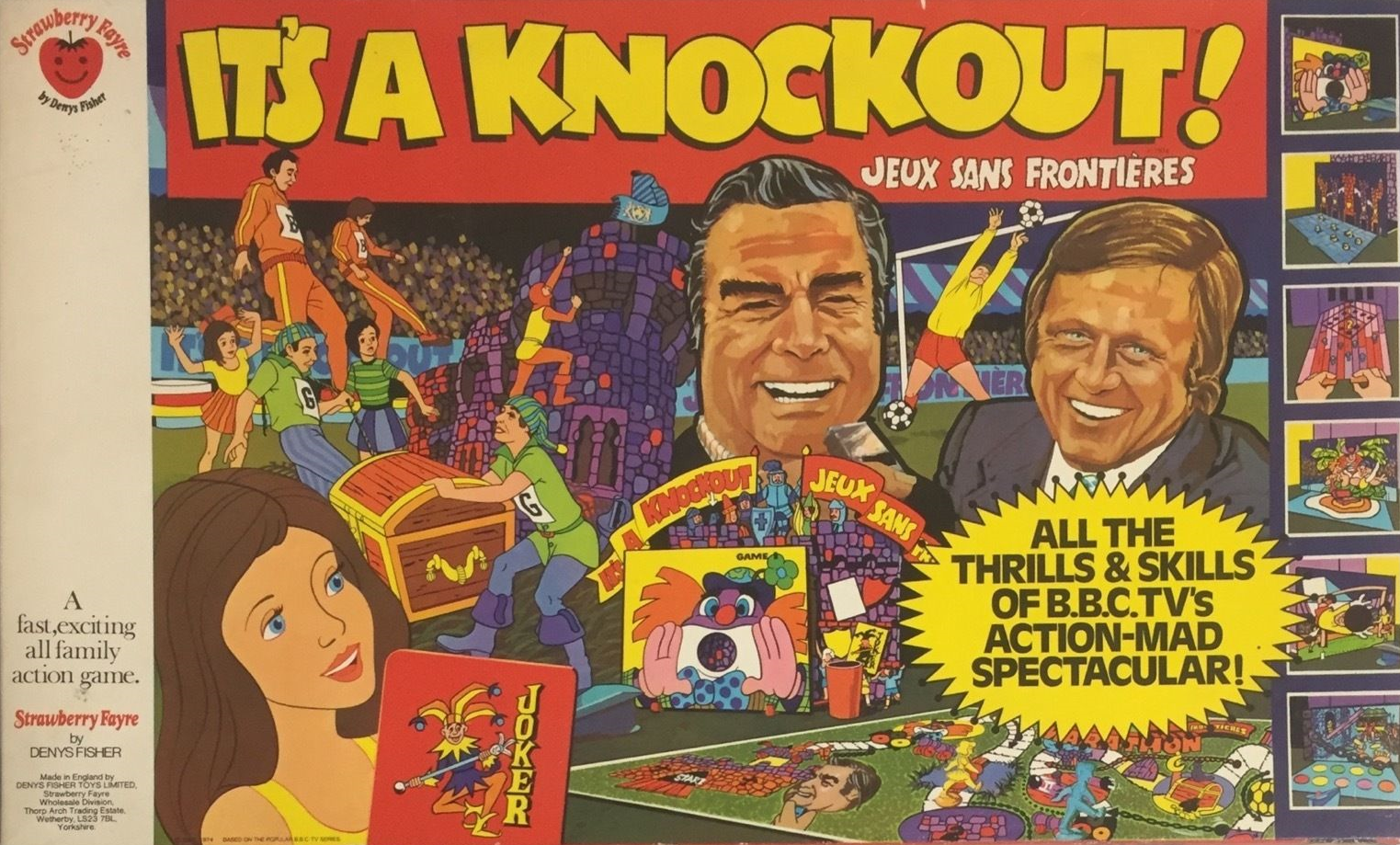
It's A Knockout! (1974)

It's A Knockout!

And if you want potentially troublesome artwork, look no further than the box of this over-complicated affair based on the popular BBC... whatever in the name of sanity it was, prominently featuring a certain disgraced celebrity splashed across a good third of the available space. Requiring substantial pre-game assembly and an assortment of 'mini-boards', the overall effect is a strange attempt at replicating the onscreen madness of people in cow costumes falling into giant paddling pools and audiences who seemed to make as much noise when silent as when roaring with laughter by pitting players against each other in flimsy approximations of such zany and madcap sports as tiddlywinks, target shooting and good old patriotic football, the latter presumably included with the aim of preventing them pesky remoaners from refusing to suck it up like good loosers and sneakily pretending it's actually Jeux Sans Frontieres. All of which is academic, frankly, as the latterday unpleasant associations mean that nobody is likely to be playing it anyway. Not that what came next was really that much better, mind...


Miss World (1974)

Miss World Game

Yes, you too can experience the 'glamour, tension and excitement' of the outmoded beauty contest that people keep trying to inexplicably revive, as creepy-looking cheap plastic dolls make their way on a 'World Tour' around a board dotted with glamour, travel, money and men who 'know what to do', hoping to beat all the others to the 'Golden Spotlight' stage. In the nearest thing that can be found to fairness it is at least an ambitious and unusual three-dimensional gameplay gambit, and did include a black doll at a time when such a move would probably have provoked the average adherent of the Miss World contest to smash their head against a piece of paper until the blood spelt out a letter to the Daily Mail demanding that someone hurry up and invent Nigel Farage, but there's no getting away from the fact that everything about it is built on a solid foundation of wrong, and doubtless there were many ugly scenes that Christmas Day as inattentive relatives bought a copy for someone with a distinctly unimpressed mother. Possibly mindful of this, the following year's Miss UK variant scaled it back into a basic board and card game with even the slightest hint of strategy and intelligence involved, but at the end of the day we're still with the protesters flourbombing Bob Hope. If only there was an environmentally-aware peace-promoting cyborg with a roll-back arm around when we needed one.


The Six Million Dollar Man (1975)

The Six Million Dollar Man

Bostin' Steve Austin has his telescopically-eyed work cut out for him as there are three exact replicas of him on the Bionic loose, and the only way to prove that he's the real deal is by completing a set of Ludo-esque 'missions' on a game board. It's spinners, cards and Miss A Turn squares all the way without acheiving or including anything even halfway rivalling Denys Fisher's still-impressive range of Six Million Dollar Man action figures, but having the players genuinely not knowing which of them is the genuine article is a novel twist, and it was sufficiently successful to be followed later in the year by Bionic Crisis, a quasi-electronic effort that saw players attempting to revive a kaput Steve Austin by deciphering his circuitry without accidentally blowing a fuse. All in all, an admirable attempt to match the imagination and innovation of a forward-thinking TV smash, but even these two were essentially just a warm-up for the next Denys Fisher offering.


War Of The Daleks (1975)
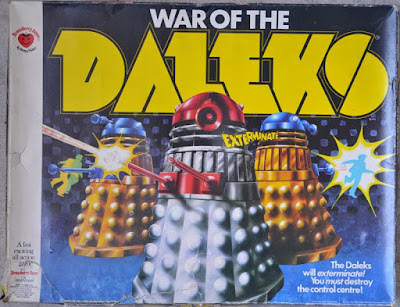
War Of The Daleks

Released just as Davros made his inaugural trundle across the screen, the 'second wave' of Dalekmania gave rise to this mighty effort, which was better than anything released during original 'Dalekmania' and possibly even better than any other board game ever. On top of a dazzlingly-illustrated sprung dancefloor-esque board of wedding cake thickness, comic strip 'rebels' make their way towards a Dalek Command Centre in the hope of destroying it, while eight excellently rendered chunky plastic Daleks (complete with utterly pointless and function-free revolvable head sections) rotate around exterminating any player that gets in their path. Even at the end there's one last twist, as when the infiltrated Command Centre literally collapses, there's a rogue component that could result in you blowing yourself up as part of the heroic quest and technically not really winning. Although Terry Nation would usually let any old bollocks go by in the name of squeezing a bit more money out of his creations, this was an of an unusually high standard for early Doctor Who merchandise, so we can only guess at how exciting an actual Doctor Who game based on Doctor Who itself would have been.


Doctor Who (1975)

Doctor Who

Tom Baker counters! A blue plastic Tardis! Alien planets featuring dinosaur things biting chunks out of spaceships! 'Computer Printout' cards! A thrill-a-move race through time and space! All of which can only go so far towards disguising the fact that this is really just yet another Ludo variant, albeit with the Tardis allowing you to move - gasp - two spaces at once. One of the finest-looking items of seventies Doctor Who merchandise - and, lest we forget, available in two different box designs - but also one of the least satisfying to actually use for its intended purpose. Still more fun than Battle For The Universe, though.


The Guinness Game Of World Records (1975)

The Guinness Game Of World Records

What would any self-respecting child want even less than a gigantic ton-weighing book crammed full of facts and figures about the world's biggest leaf? That's right, a board game that attempted to reflect its McWhirter-recorded contents by requiring them to answer arcane statistical questions about the best/worst/longest immersed and complete a series of Waddington's Games Compendium-esque sub-tiddlywink plastic 'challenges', as demonstrated on the box by a misleadingly awestruck Bristow-alike. Tailor made for parents who enjoyed shouting at you for 'not trying hard enough', this was less a game than an 'outward bound activity day' in your very own home in a handy cardboard box.


Are You Being Served? (1975)

Are You Being Served?

Displaying more attention to the logistical realities of retail than the actual sitcom did, this gaudily realised suspiciously Cluedo-esque effort requires players to pick a character - yes, you can even be Young Mr. Grace - and thriftily stock up on clobber to flog in Grace Bros. This relatively sober gameplay design may not have been especially evident from the box, which featured Mrs Slocombe looking disapprovingly, Miss Brahms looking appreciatively, Mr Lucas looking lecherously, Mr Grainger looking analytically, Captain Peacock looking stoically, Mr Humphries looking alarmedly and Mr Rumbold looking lord-alone-knows-whattishly at a pair of ladies' pants.


Bruce Forsyth's Generation Game (1975)

Bruce Forsyth's Generation Game

His face may take up the lion's share of the box design - and there were two of them too - but there's no indication whatsoever that Bruce actually wants to play this game with you. Instead there's a model of the set complete with sliding doors, an oversized countdown clock and a series of fun-for-all-the-family challenges involving some flimsy plastic props, and not even a single plastic Brucie in 'thinker' pose to go with them. So, relatively faithful to the format of the show, but not really anything more significant than you could have made up when trying to 'play' The Generation Game at home on a wet Saturday afternoon. Or, as the host might have had it, "I'll just make a note of that... rip-off!". But at least you can still play it in polite society...


Jimmy Savile's Pop Twenty (1975)

Jimmy Savile's Pop Twenty

Well, there's no getting away from this "great new game that captures all the excitement of today's pop scene", despite it involving little more than moving boringly around a board filled with Roy Wood-esque 'rockers', embarrassingly unrealistic 'fans' and cigar-chomping 'manager' figures in pursuit of 'gold discs', complete with a patronisingly excitement-free 'turntable' in the middle, and all of it suspiciously redolent of the perspective of someone who was determined to use 'the pop scene' to their personal advantage whilst neither knowing nor caring what it actually involved. So little surprise about their choice of celebrity endorsement, then. "Join in the chart-topping race and head for the Number 1 spot with Pop Twenty!", lies 'Yours Groovily' on the box. It's pleasing to surmise that few would have done even at the time.


James Hunt's Grand Prix Racing Game (1976)

James Hunt's Grand Prix Racing Game

The bad boy of Formula One gets his 1976 World Championship victory commemorated with his very own board game, involving natty plastic cars guided around a deceptively simple-looking racetrack via a complicated system of cards to determine speed, acceleration, petrol et al, with the winner being the first to complete the democratically nominated amount of laps. An accurate reflection of his celebrated skill and judgement on the circuit, all told, though sadly there were no cards to represent being booted out of £3,000,000 'lovenests'.


The George V. Mildred Dice Game (1976)

The George V. Mildred Dice Game

Quite what possessed someone to put TV's top dysfunctional sitcom couple on the box of a barely modified adaptation of enduring dice game Duell will have to remain a mystery. But that's exactly what this is, and nothing more. You'll search in vain for a 'FEED TRUFFLES MISS A TURN' square or a plastic model of Tristram's tyre-fashioned 'Space Station'. And this wasn't even the most inexplicable celebrity comedy tie-in released by Denys Fisher...


The Morecambe & Wise Game (1976)

The Morecambe & Wise Game

For no readily obvious, sane or logical reason, Etic And Ern saw fit to lend their names and images to this perplexing variant on the Connect 4 formula which somehow involved flipping around Andy Warhol-esque images of their sunshine-requesting faces. Not exactly a popular feature of their BBC shows, it has to be admitted, although rumours persist that it may have been a weekly occurrence when they went to Thames at the end. Anyway, you can hear lots more about this game in this edition of Looks Unfamiliar.


Rod Hull's Emu Game (1976)

Rod Hull's Emu Game

A fully operational glittery blue bird-skewed variant of the widely-bastardised proto Pac-Man Mr Mouth game, involving flipping counters into the rotating mechanical beak of TV's top Parky-twatter, replete with authentically luxurious fur. Sadly, despite the implications of the title and indeed his appearance on the box, Rod appears to have been otherwise engaged, doubtless lured away by the suggestion of green jelly. Either that or he'd been promised that there was another Rod Hull And Emu Game in the pipeline.


The Bionic Woman (1976)

The Bionic Woman

Although spun off from The Six Million Dollar Man, The Bionic Woman wasn't just a direct airlift only with hydraulic knockers or something, but a hugely successful series in its own right, with its own cast of characters, thematic obsessions, moral perspective and strictly observed limitations on bionic capabilities. This game on the other hand wasn't THAT far removed from the Six Million Dollar Man one, but it did at least kit out Jaime with a more complicated board, a more complicated set of interlocking assignments, and the unpredictable random appearance of Steve Austin, not always in a directly useful capacity. Sadly, The Bionic Dog does not show up demanding Bonio.


Bat-Man (1977)

Bat-Man

Holy Rare Internationally Licensed Variants Of Top-Selling Board Games! Now almost impossible to find in a half-complete state for less than seventeen million pounds, this appears to have been a 'darker' rejigging of an existing American board game based on the Caped Crusader, with a standard board replaced by an overhead view of Gotham City, a handful of thoroughly expected 'constantly moving' villains on the run, and boring plastic pegs replaced with stand-up Batman and Robin counters which - excitingly - could be role-reversed by players as and when their individual skillsets were called on. Sadly, however, this was just pre-the Filmation series, so we don't get Bat-Mite popping up offering to help. Completists may also wish to seek out the All-Star Comic Action Heroes Game, which roped in several of their DC Comics pals to help but was otherwise more or less exactly the same.


The New Avengers (1977)

The New Avengers Board Game

Gentlemen - we can reissue the The Six Million Dollar Man board game with the artwork changed... we have the technology! Yes, it's more or less the exact same 'mission'-skewed setup as before, only reconfigured to feature Steed, Purdey and Gambit taking on The Cybernauts alongside entirely canonical villains The Mad Major and The Scarlet Skull. Also apparently includes a 'unique' umbrella and hat-themed spinner. Yes, whatever you say, Denys. Not strictly a board game, but it's worth pointing out that this did come accompanied by The New Avengers Shooting Game, which is now worth a small fortune but was not exactly in keeping with the spirit of the series. And which, surprisingly, was not reissued to cash in on The Professionals instead. In fact, astonishingly, that doesn't seem to have inspired any board games at all. Presumably Bodie thought dice were 'namby pamby'.


Multi-Coloured Swap Shop (1978)

Multi-Coloured Swap Shop

Despite the regulation cover-dominating photo of Noel, and despite the repeated artwork appearance of Posh Paws, this ambitious 'computer'-aping semi-mechanised affair audaciously concerned itself with the actual basic phone-in toy exchange framework of Swap Shop, rather than any acknowledgement of the pop groups, the interruptions from The Odd Ball Couple and Skip And Fuffy, or John Craven exhorting us all to take a look at some of Britain's disappearing wildlife. Thus it was that one of the very few tangible reminders of a genuinely revolutionary Saturday Morning show came to embody the very detail that the fewest people remember about it. Meanwhile, if you don't want your mind to liquify, try not to concentrate on the fact that most of the actual real life 'swaps' probably included all of the above games.

Playing pieces from the Miss World Game.


If you want to hear me on the radio talking about Denys Fisher board games, including an amusing story about the Miss World game, then you can find that here.

You can find an expanded version of this piece, with more on the board games and the story behind Denys Fisher Toys, in Can't Help Thinking About Christmas, available in paperback here or from the Kindle Store here.


You can find lots more about old TV shows and ridiculous tie-in merchandise in Well At Least It's Free, available in paperback here or from the Amazon Kindle Store here.

Let's Have A Look At What You Could Have Watched...


There seems to be a bit of a downer on big brash Light Entertainment stylings these days. It's a shame, but it's probably down to a number of insurmountable factors; swanky new computerised show-off technology doing away with ropey animation and schmaltzy sub-Hazlehurst brass, the fact that all mainstream presenters these days seem to have gone to some sort of 'Presenting School' where they learn everything about cue lines and camera angles and how to hit your 'mark' but have every last shred of personality drilled out of them (that's if they ever had a personality in the first place, which in most cases is debatable), the need for talent shows with a huge amount of spin-off merchandise riding on them to make themselves appear bombastic and Earth-stopping rather than a bit of frivolous fun, and above all those legions of killjoy miseryguts that appear to think that anything that isn't worthy or educative or deeply politicised is somehow inherently A Bad Thing, as though the only way to combat the unstoppable globalist expansion of Simon Cowell (a process that is probably as literal as it is metaphorical) is by being a miserable bastard who, if they had their own way, would replace all Saturday night television with a repeat of Threads introduced by Thom Yorke and Tortoise from Pipkins. See, this is what happens when everyone decides buying a twenty year old single with swearing in it - rather than, say, something inoffensive but brand new - is an effective form of protest against, erm, what the majority of other people like whether you like it or not. Still, I'm sure Zack De La Rocha was heartened to know he'd made his point about institutionalised police racism in Hispanic neighbourhoods so effectively.

Anyway, the fact of the matter is that there wasn't actually anything wrong with big brash Light Entertainment stylings in the first place, and time was when they were just part of the televisual furniture. Everyone accepted them and nobody - apart from a few broadsheet columnists ironically angling for their own slot on Did You See? - really much minded them. You had your Tumbledown, your Edge Of Darkness and your The All-New Alternative Comedy Barstard Show (Tune In, Maggie!) exactly where they should have been, while earlier in the evening you had Paul Daniels gamely trying to pass off vacant-looking contestants standing in silence whilst a descending timer bleeped obliviously away as something approaching coherency, all of it smothered in big glittery sets, tacky gold lettering and silly trumpet flourish theme tunes - and we've not even started on the equally gaudy and jaunty trailers for the evening's viewing showcasing those exact same more serious offerings only with inappropriate music and a chummy voiceover - and nobody exactly started calling for the dismantling of state apparatus. Even world-class moaner Michael Parkinson seemingly wouldn't be without his comfy sofas and ridiculous theme tunes.

Whether the end result involved Peter Egan making his weekly appearance on Wogan, Colin Baker attempting to plug Doctor Who via a bit of comic chicanery with Roland Rat, or that ridiculous continuity slide for The Bill featuring Bob Cryer in front of rolling clouds, the world was a slightly jollier place when television was treated as a big showbiz party that you had to wade through in order to get to your worthier stuff; nowadays that's basically all been condensed into John Barrowman, and it's not as if there's some thing with James Burke frowning at a suspension bridge waiting on the other side of him. Anyway, before this starts to look uncomfortably like a major league sulk about the 'golden age' of television - which it isn't, and anyway, my own personal belief that the 'golden age' was the late eighties and involved anything but 'quality' programming would cause most archive TV bores to head for a desert island on a raft made of box sets - let's have a bit of a celebration of the days when you'd invariably switch on the set to be confronted with a ludicrous low-concept game show with opening titles made for about three pence (which, in some cases, still cost slightly more than some of the prizes) and accompanied by what sounded like outtakes from High Havoc by Corduroy. Yes, it's The Five Greatest Game Show Intros Of All Time...!


Winner Takes All


As the dullard who's uploaded the only version of the 'proper' Telly Addicts opening titles currently on YouTube has disabled embedding, and there's no sign of the demented Ask The Family one with the zoinging sitars and 'alternative therapy' playing card things (well, apart from at the start of the Not The Nine O'Clock News parody), it's straight on to this Tarbuck-fronted Tote-riffing Friday evening mainstay, featuring a procession of flying abrupt one-word questions running the full gamut of none-more-seventies fonts, before giving way to what appears to be Tarby alternately undergoing the rigours of a 'trip' in a mid-sixties movie and auditioning for the opening titles of Doctor Who via the medium of the weird-out bits from Jamie And The Magic Torch. Mind you, that shuffling Samba-tinged backing-from-an-unfinished-Middle-Of-The-Road-single politeness isn't a patch on the later electroed-up session singers chirruping 'Winner! Takes! All'.


Odd One Out


Starts with some desperately unconvincing 'computer' effects and 'radiation' klaxon-esque blippering which is about the most un-Hazlehurst thing unimaginable, but what we're really wanting is the overliteral nonsense that follows, in which - courtesy of some publicity stills hacked out with a blunt pair of scissors - we're shown Paul Daniels looking utterly befuddled, then halfway there, then finally spotting the odd one out, all of it cut to the rhythm of one of Ronnie H's classic 'you can sing the title of the show to it' gambits, complete with trademark mental overstuffed cadence at the end.


Play Your Cards Right


A strobing card-derived high-speed countdown that probably wouldn't be allowed under Health & Safety regulations now, followed by what appear to be spinning plates of those old-skool varieties of Jacob's Club where nobody can remember what the flavour was, all of it accompanied by music so banal, repetitive and minimal that it almost comes right the way back out the other side again into Krautrockland. And surely oversized playing cards are more at home in the opening titles of a supernatural anthology series? Note also how Brucie is too preoccupied with 'skirt' to strike his trademark pose.


Gambit


Chunky bullion-evoking gold lettering, a load of stray casino-themed close-up film trims from a long-forgotten attempt at jumping on the James Bond bandwagon, and Radio 2 circa 1972's idea of a funked-out dancefloor smash. Sadly cuts off before we get to see Fred Dinenage being spectacularly rude to the contestants.


Bob's Full House


Flying numbers, spinning cylindrical electronic bingo card on a spangly blue backdrop, five identical passport photos of Yer Monkhouse, and a belting edge-of-the-seat theme tune adhering strictly to that oh-so-eighties rule of the strings taking over the melody from the brass – what more fitting a way could there be to introduce the greatest game show ever? Well, apart from Telly Addicts, that is.


If you've enjoyed this article, you may enjoy Not On Your Telly, which is available in paperback here or from the Kindle Store here.