Showing posts with label noel edmonds. Show all posts

A Fast Exciting All Action Game

War Of The Daleks

Entrepreneur, engineer and inventor of the Spirograph, Denys Fisher was the creative driving force behind an enduring and very very 'British' toys and games company. No, seriously. You really don't have any idea of just how idiosyncratically regionally niche-targeted their output was. Despite being at least partly bankrolled by the vastly more internationally aware Palitoy - which in turn was at least partly bankrolled by American-as-they-come toy and game conglomerate Hasbro - Denys Fisher Toys specialised in securing the rights to what were in the main the most localised and parochial of cultural phenomena imaginable and creating toys and games around them. Famously this included the first ever range of Doctor Who action figures, less famously the official Roger De Courcey's Nookie Bear Ventriloquist Doll, and a staggering quantity of board games.

From sportsmen to disc jockeys, from disruptive puppets to inevitable gift books from well-meaning relatives, if a single child so much as recognised it in passing then Denys Fisher would rush out a board game based on it, and the less chance that the concept had of inspiring international licensing deals the better. Some of these, it has to be said, were of remarkably high quality and equally high concept. Others were very much not. Here then are some of the good, the bad, and the based around a scrawny old bastard...


On The Buses (1973)

On The Buses

It's easy to forget just how popular On The Buses really was in its day. Mainly because of its wince-inducing attitude towards women and minorities and the fact that it appeared to have left all of its jokes back at the depot, but even so, it's worth pointing out that it inspired no less than three hit feature films and - more importantly - a board game. Which, to be honest, is actually quite fun, involving little more than successfully collecting and dropping off three passengers without being interrupted by Blakey by means of dice, cards, a zany road map, and chunky plastic buses and punters. Denys Fisher specialised in making simple gameplay concepts into visually and often mechanically elaborate affairs, and you'd be hard pushed to find a better example of the phenomenon than this. Yes, that was me being nice about On The Buses. I 'ate you, Butler.


Harvey Smith's Show Jumping (1974)

Harvey Smith's Show Jumping

1972 Olympic Equestrian Hero and tabloid-infuriating flicker-of-'V's'-at-judges lends his name to this curious gameplay mish-mash involving dice, cards and good old fashioned chucking plastic horses around a board in an attempt to attain the perfect Descending Oxer. "You can't get nearer to the real thing without taking part", says Harvey, which as non-committal aversions of endorsement go is right up there with "With Richard Hurndall you got a complete character".


Dad's Army (1974)

Dad's Army

Cartoonish counters depicting the entire regular cast make their way across a military map of Walmington-On-Sea, upending Nazi insignias and replacing them with the good old British Union Flag. Yes, you did read that right, and owing to this uneasy combination of cuddly bumbling loveableness and blood-chilling verboten symbolism it's now almost impossible to buy or sell a copy of this game on leading auction sites. Honestly, it's almost as though someone was erring on the side of caution when it came to facilitating the dissemination of potentially and widely-acceptedly offensive and upsetting material and wanted to make sure they were doing the right thing by the overwhelming majority of their customers. What will Plastic Bertrand and those Eurocrats in Brussels think of next?!


It's A Knockout! (1974)
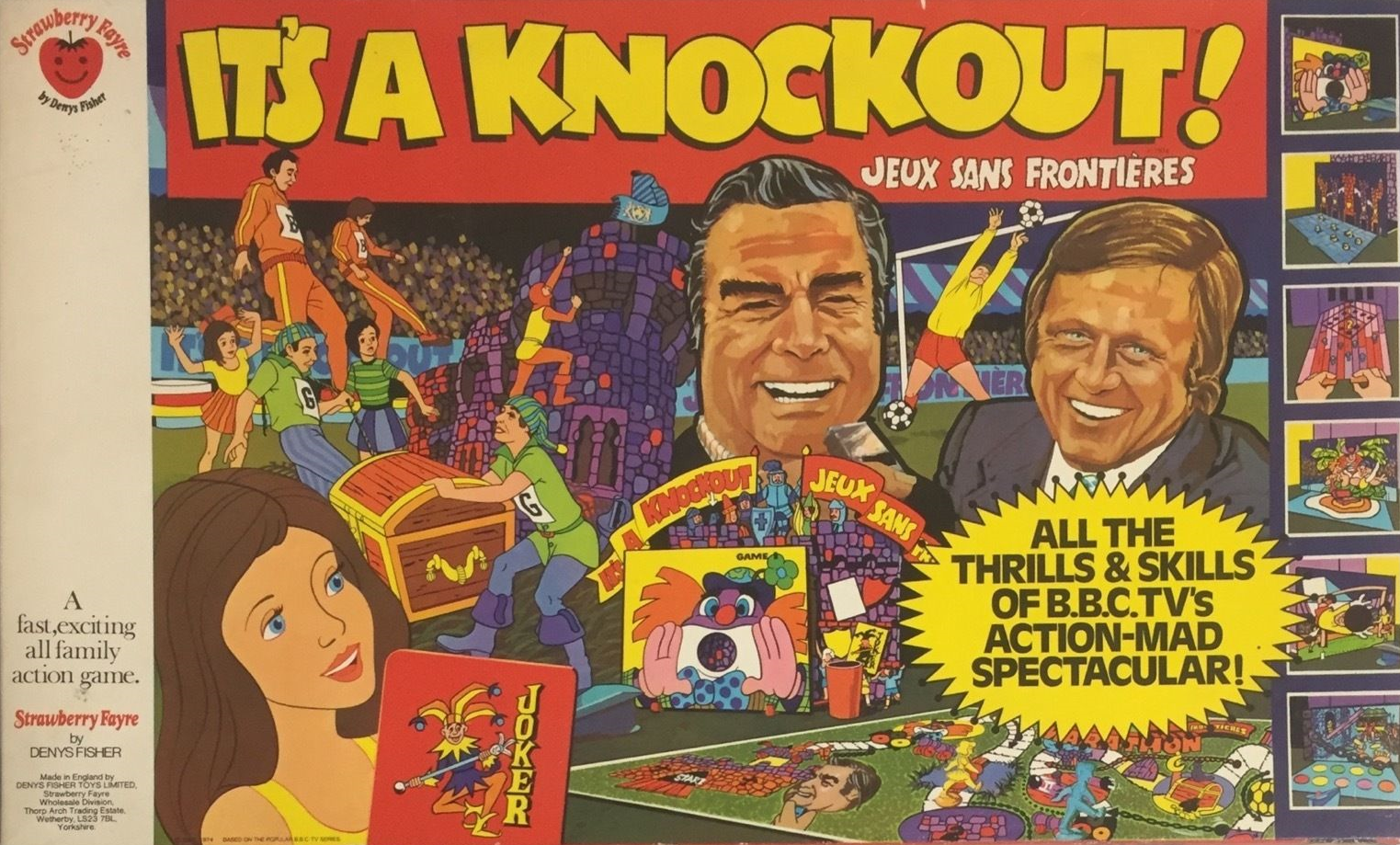
It's A Knockout!

And if you want potentially troublesome artwork, look no further than the box of this over-complicated affair based on the popular BBC... whatever in the name of sanity it was, prominently featuring a certain disgraced celebrity splashed across a good third of the available space. Requiring substantial pre-game assembly and an assortment of 'mini-boards', the overall effect is a strange attempt at replicating the onscreen madness of people in cow costumes falling into giant paddling pools and audiences who seemed to make as much noise when silent as when roaring with laughter by pitting players against each other in flimsy approximations of such zany and madcap sports as tiddlywinks, target shooting and good old patriotic football, the latter presumably included with the aim of preventing them pesky remoaners from refusing to suck it up like good loosers and sneakily pretending it's actually Jeux Sans Frontieres. All of which is academic, frankly, as the latterday unpleasant associations mean that nobody is likely to be playing it anyway. Not that what came next was really that much better, mind...


Miss World (1974)

Miss World Game

Yes, you too can experience the 'glamour, tension and excitement' of the outmoded beauty contest that people keep trying to inexplicably revive, as creepy-looking cheap plastic dolls make their way on a 'World Tour' around a board dotted with glamour, travel, money and men who 'know what to do', hoping to beat all the others to the 'Golden Spotlight' stage. In the nearest thing that can be found to fairness it is at least an ambitious and unusual three-dimensional gameplay gambit, and did include a black doll at a time when such a move would probably have provoked the average adherent of the Miss World contest to smash their head against a piece of paper until the blood spelt out a letter to the Daily Mail demanding that someone hurry up and invent Nigel Farage, but there's no getting away from the fact that everything about it is built on a solid foundation of wrong, and doubtless there were many ugly scenes that Christmas Day as inattentive relatives bought a copy for someone with a distinctly unimpressed mother. Possibly mindful of this, the following year's Miss UK variant scaled it back into a basic board and card game with even the slightest hint of strategy and intelligence involved, but at the end of the day we're still with the protesters flourbombing Bob Hope. If only there was an environmentally-aware peace-promoting cyborg with a roll-back arm around when we needed one.


The Six Million Dollar Man (1975)

The Six Million Dollar Man

Bostin' Steve Austin has his telescopically-eyed work cut out for him as there are three exact replicas of him on the Bionic loose, and the only way to prove that he's the real deal is by completing a set of Ludo-esque 'missions' on a game board. It's spinners, cards and Miss A Turn squares all the way without acheiving or including anything even halfway rivalling Denys Fisher's still-impressive range of Six Million Dollar Man action figures, but having the players genuinely not knowing which of them is the genuine article is a novel twist, and it was sufficiently successful to be followed later in the year by Bionic Crisis, a quasi-electronic effort that saw players attempting to revive a kaput Steve Austin by deciphering his circuitry without accidentally blowing a fuse. All in all, an admirable attempt to match the imagination and innovation of a forward-thinking TV smash, but even these two were essentially just a warm-up for the next Denys Fisher offering.


War Of The Daleks (1975)

War Of The Daleks

Released just as Davros made his inaugural trundle across the screen, the 'second wave' of Dalekmania gave rise to this mighty effort, which was better than anything released during original 'Dalekmania' and possibly even better than any other board game ever. On top of a dazzlingly-illustrated sprung dancefloor-esque board of wedding cake thickness, comic strip 'rebels' make their way towards a Dalek Command Centre in the hope of destroying it, while eight excellently rendered chunky plastic Daleks (complete with utterly pointless and function-free revolvable head sections) rotate around exterminating any player that gets in their path. Even at the end there's one last twist, as when the infiltrated Command Centre literally collapses, there's a rogue component that could result in you blowing yourself up as part of the heroic quest and technically not really winning. Although Terry Nation would usually let any old bollocks go by in the name of squeezing a bit more money out of his creations, this was an of an unusually high standard for early Doctor Who merchandise, so we can only guess at how exciting an actual Doctor Who game based on Doctor Who itself would have been.


Doctor Who (1975)

Doctor Who

Tom Baker counters! A blue plastic Tardis! Alien planets featuring dinosaur things biting chunks out of spaceships! 'Computer Printout' cards! A thrill-a-move race through time and space! All of which can only go so far towards disguising the fact that this is really just yet another Ludo variant, albeit with the Tardis allowing you to move - gasp - two spaces at once. One of the finest-looking items of seventies Doctor Who merchandise - and, lest we forget, available in two different box designs - but also one of the least satisfying to actually use for its intended purpose. Still more fun than Battle For The Universe, though.


The Guinness Game Of World Records (1975)

The Guinness Game Of World Records

What would any self-respecting child want even less than a gigantic ton-weighing book crammed full of facts and figures about the world's biggest leaf? That's right, a board game that attempted to reflect its McWhirter-recorded contents by requiring them to answer arcane statistical questions about the best/worst/longest immersed and complete a series of Waddington's Games Compendium-esque sub-tiddlywink plastic 'challenges', as demonstrated on the box by a misleadingly awestruck Bristow-alike. Tailor made for parents who enjoyed shouting at you for 'not trying hard enough', this was less a game than an 'outward bound activity day' in your very own home in a handy cardboard box.


Are You Being Served? (1975)

Are You Being Served?

Displaying more attention to the logistical realities of retail than the actual sitcom did, this gaudily realised suspiciously Cluedo-esque effort requires players to pick a character - yes, you can even be Young Mr. Grace - and thriftily stock up on clobber to flog in Grace Bros. This relatively sober gameplay design may not have been especially evident from the box, which featured Mrs Slocombe looking disapprovingly, Miss Brahms looking appreciatively, Mr Lucas looking lecherously, Mr Grainger looking analytically, Captain Peacock looking stoically, Mr Humphries looking alarmedly and Mr Rumbold looking lord-alone-knows-whattishly at a pair of ladies' pants.


Bruce Forsyth's Generation Game (1975)

Bruce Forsyth's Generation Game

His face may take up the lion's share of the box design - and there were two of them too - but there's no indication whatsoever that Bruce actually wants to play this game with you. Instead there's a model of the set complete with sliding doors, an oversized countdown clock and a series of fun-for-all-the-family challenges involving some flimsy plastic props, and not even a single plastic Brucie in 'thinker' pose to go with them. So, relatively faithful to the format of the show, but not really anything more significant than you could have made up when trying to 'play' The Generation Game at home on a wet Saturday afternoon. Or, as the host might have had it, "I'll just make a note of that... rip-off!". But at least you can still play it in polite society...


Jimmy Savile's Pop Twenty (1975)

Jimmy Savile's Pop Twenty

Well, there's no getting away from this "great new game that captures all the excitement of today's pop scene", despite it involving little more than moving boringly around a board filled with Roy Wood-esque 'rockers', embarrassingly unrealistic 'fans' and cigar-chomping 'manager' figures in pursuit of 'gold discs', complete with a patronisingly excitement-free 'turntable' in the middle, and all of it suspiciously redolent of the perspective of someone who was determined to use 'the pop scene' to their personal advantage whilst neither knowing nor caring what it actually involved. So little surprise about their choice of celebrity endorsement, then. "Join in the chart-topping race and head for the Number 1 spot with Pop Twenty!", lies 'Yours Groovily' on the box. It's pleasing to surmise that few would have done even at the time.


James Hunt's Grand Prix Racing Game (1976)

James Hunt's Grand Prix Racing Game

The bad boy of Formula One gets his 1976 World Championship victory commemorated with his very own board game, involving natty plastic cars guided around a deceptively simple-looking racetrack via a complicated system of cards to determine speed, acceleration, petrol et al, with the winner being the first to complete the democratically nominated amount of laps. An accurate reflection of his celebrated skill and judgement on the circuit, all told, though sadly there were no cards to represent being booted out of £3,000,000 'lovenests'.


The George V. Mildred Dice Game (1976)

The George V. Mildred Dice Game

Quite what possessed someone to put TV's top dysfunctional sitcom couple on the box of a barely modified adaptation of enduring dice game Duell will have to remain a mystery. But that's exactly what this is, and nothing more. You'll search in vain for a 'FEED TRUFFLES MISS A TURN' square or a plastic model of Tristram's tyre-fashioned 'Space Station'. And this wasn't even the most inexplicable celebrity comedy tie-in released by Denys Fisher...


The Morecambe & Wise Game (1976)

The Morecambe & Wise Game

For no readily obvious, sane or logical reason, Etic And Ern saw fit to lend their names and images to this perplexing variant on the Connect 4 formula which somehow involved flipping around Andy Warhol-esque images of their sunshine-requesting faces. Not exactly a popular feature of their BBC shows, it has to be admitted, although rumours persist that it may have been a weekly occurrence when they went to Thames at the end. Anyway, you can hear lots more about this game in this edition of Looks Unfamiliar.


Rod Hull's Emu Game (1976)

Rod Hull's Emu Game

A fully operational glittery blue bird-skewed variant of the widely-bastardised proto Pac-Man Mr Mouth game, involving flipping counters into the rotating mechanical beak of TV's top Parky-twatter, replete with authentically luxurious fur. Sadly, despite the implications of the title and indeed his appearance on the box, Rod appears to have been otherwise engaged, doubtless lured away by the suggestion of green jelly. Either that or he'd been promised that there was another Rod Hull And Emu Game in the pipeline.


The Bionic Woman (1976)

The Bionic Woman

Although spun off from The Six Million Dollar Man, The Bionic Woman wasn't just a direct airlift only with hydraulic knockers or something, but a hugely successful series in its own right, with its own cast of characters, thematic obsessions, moral perspective and strictly observed limitations on bionic capabilities. This game on the other hand wasn't THAT far removed from the Six Million Dollar Man one, but it did at least kit out Jaime with a more complicated board, a more complicated set of interlocking assignments, and the unpredictable random appearance of Steve Austin, not always in a directly useful capacity. Sadly, The Bionic Dog does not show up demanding Bonio.


Bat-Man (1977)

Bat-Man

Holy Rare Internationally Licensed Variants Of Top-Selling Board Games! Now almost impossible to find in a half-complete state for less than seventeen million pounds, this appears to have been a 'darker' rejigging of an existing American board game based on the Caped Crusader, with a standard board replaced by an overhead view of Gotham City, a handful of thoroughly expected 'constantly moving' villains on the run, and boring plastic pegs replaced with stand-up Batman and Robin counters which - excitingly - could be role-reversed by players as and when their individual skillsets were called on. Sadly, however, this was just pre-the Filmation series, so we don't get Bat-Mite popping up offering to help. Completists may also wish to seek out the All-Star Comic Action Heroes Game, which roped in several of their DC Comics pals to help but was otherwise more or less exactly the same.


The New Avengers (1977)

The New Avengers Board Game

Gentlemen - we can reissue the The Six Million Dollar Man board game with the artwork changed... we have the technology! Yes, it's more or less the exact same 'mission'-skewed setup as before, only reconfigured to feature Steed, Purdey and Gambit taking on The Cybernauts alongside entirely canonical villains The Mad Major and The Scarlet Skull. Also apparently includes a 'unique' umbrella and hat-themed spinner. Yes, whatever you say, Denys. Not strictly a board game, but it's worth pointing out that this did come accompanied by The New Avengers Shooting Game, which is now worth a small fortune but was not exactly in keeping with the spirit of the series. And which, surprisingly, was not reissued to cash in on The Professionals instead. In fact, astonishingly, that doesn't seem to have inspired any board games at all. Presumably Bodie thought dice were 'namby pamby'.


Multi-Coloured Swap Shop (1978)

Multi-Coloured Swap Shop

Despite the regulation cover-dominating photo of Noel, and despite the repeated artwork appearance of Posh Paws, this ambitious 'computer'-aping semi-mechanised affair audaciously concerned itself with the actual basic phone-in toy exchange framework of Swap Shop, rather than any acknowledgement of the pop groups, the interruptions from The Odd Ball Couple and Skip And Fuffy, or John Craven exhorting us all to take a look at some of Britain's disappearing wildlife. Thus it was that one of the very few tangible reminders of a genuinely revolutionary Saturday Morning show came to embody the very detail that the fewest people remember about it. Meanwhile, if you don't want your mind to liquify, try not to concentrate on the fact that most of the actual real life 'swaps' probably included all of the above games.

Playing pieces from the Miss World Game.


If you want to hear me on the radio talking about Denys Fisher board games, including an amusing story about the Miss World game, then you can find that here.

You can find an expanded version of this piece, with more on the board games and the story behind Denys Fisher Toys, in Can't Help Thinking About Christmas, available in paperback here or from the Kindle Store here.


You can find lots more about old TV shows and ridiculous tie-in merchandise in Well At Least It's Free, available in paperback here or from the Amazon Kindle Store here.

The Essential Saturday-Before-Christmas Survival Guide (In Eight Easy Steps!)


Round about now, you’ll start seeing newspaper columnists offering their own personal ‘tips’ for ‘surviving’ the Festive Season. Usually these will involve ingesting specific herbal remedies and particular blends of tea or coffee, turning off your router to get ‘headspace’, recommendations of some heavyweight thing on Netflix and what have you… and really, seriously, what use are any of these to any of us? When you’re haring around Primark on the last Saturday before Christmas trying to find that last elusive present for that difficult-to-buy-for relative, do you really want the organisationally precarious pointers of some iPad-toting metropolitan type reverberating round your head as your last hope for inner peace and quiet?

Of course you don’t. You need an alternative. So join us as we go back in time. Not half-heartedly back in time like those trendy berks who pretend that they think VHS is a ‘superior format’, but way back, properly back. Back to a time when Christmas seemed less frantic, even though it probably wasn’t. And how do you get into this tranquil yet lazily uncritically nostalgic thoughtzone? Easy – by following these eight simple steps!


1. PUT UP SOME OLD-SKOOL DECORATIONS


Forget those enormous mazes of sequenced flashing lights that provoke constant baffling questions from elderly relatives. Ignore that battery-operated poinsettia that rotates and glitters while playing O Come All Ye Faithful. And whatever you do, don’t stick any of those signs outside your house saying “SANTA – PLEASE STOP HERE”, “WORLD’S BEST CHRISTMAS DAD 2000 XTREEM” or “MY OTHER SEASONAL OBSESSION IS TAKING MY COUCH OUT ON THE PAVEMENT AT THE FIRST SIGN OF SUMMER LIKE I’M SOMEONE OUT OF THE WIRE”. It’s costly, it’s unnecessary, and it’ll get you into an arms race-esque battle with the van driving geezer across the road and his inexhaustible supply of eight foot inflatable Rudolphs.

Nope, if you want to show everyone how much you like Christmas, you’ve got to go seriously old-skool. If you’re about to start decking the halls, get yourself a load of multi-coloured gummed paper  and cover every room in the sort of lo-fi decorations that children used to carry home from school at odd angles on the last day before Christmas, which parents would then have to put up out of politeness while that expensive moulded glittery gold relief they got from John Lewis sat unused in a drawer telepathically reminding them of its disproportionate price tag.


2. REMAIN UNMOVED BY HI-TECH CHRISTMAS TREES


Never mind the debate about ‘real’ vs ‘artificial’ trees - your position on that really does depend on your capacity for coping with excessive vaccuming and visits to the vets as your cat/dog/toddler inevitably gets all pine-needles in their feet. The retailers want to push you though; what’s left of Habitat have something that looks like a party hat, and it glows and everything, AND it fits on your desk. Maybe you want one that looks like a marble-run, or a catheter tube with lights in it. Perhaps one that stands in something resembling a French urinal, while it plays music and actual snow falls around it. It probably spins as well. That’s what they tell you that you should get.

No. Make Christmas magical again. Dig out the PROPER tree. Yes, it’s artificial. Some of the fake needles have fallen off again, and the branches are increasingly brittle. That stand is still a nightmare to put together. And it’s wonky once assembled. Doesn’t matter. Just make sure that it’s a pre-lit one, where the LED lights are tastefully wrapped around the branches for you. You don’t want to fall into a lazy comedy trope, after all.


3. RESIST THE FESTIVE LATTE


It’s an unending risk for the modern Christmas Shopper – every last coffee chain, sandwich shop and whatever you generically call those places where they do pasties and stuff is forever trying to lure you in to sample their festive wares to a soundtrack of jazzy reworkings of something that sounds almost but not quite like Once In Royal David’s City. Usually starting from the second week of October if we’re being honest about it. Angularly-syruped lattes! Caramel and Sticky Toffee ‘Christmas Slices’! Turkey, cranberry, bacon, bread sauce and stuffing slip hazards in waiting! Some would doubtless have you believe that such fripperies are the very fuel on which the harassed Christmas Shopper runs. But not us.

Save yourself at least some of that three pounds twenty and make some instant coffee at home, taking care to ensure it’s weak, badly stirred, and overall the sort of quality you’d expect from a vending machine that has been meticulously programmed to poorly replicate the coffee-making facilities of another vending machine. Take it with you in a flask, then pour it into a cheap styrofoam cup as if purchased from a stall run by a bloke in a football hat. Add a Kit-Kat or some other equally no-frills chocolate bar purchased from whatever they have instead of station kiosks now, and you have the perfect culinary accompaniment to wondering how everyone’s going to fit on the next train, and where in the name of Railwatch it is anyway.


4. BUY ONE OF ‘THIS YEAR’S TOP TOYS’ FROM ANOTHER YEAR


The humble ‘Christmas List’ has come a long way from the days when kids would just write ‘LEGO’ on a piece of paper and leave it lying around somewhere they thought constituted subtle. The rise of online retailers and Wish Lists have left us in no doubt as to what anyone from six to sixty wants for Christmas. And yes, probably even Mariah Carey’s got one too. But should you give in and pre-order them that Limited Edition Steelbook of The Unbreakable Kimmy Schmidt and the twelve pack of interactive coffee pods or whatever it is?

No. They’ll get Boglins and they’ll like it. Admittedly you’ll often have to fork out a fair whack eBay for one of the REAL Top Toys of years gone by these days, but if you opt for something that was highly touted but never caught on, you’re pretty much quids in. Rock Lords, B.A.R.T., Wrinkles, Rubik’s Magic and so many other second division “oh… thanks” Christmas Morning Pillowcase mainstays of yesteryear make an ideal present for that easy-to-buy-for relative who needs reminding that a bit more gratitude every now and then might be a nice thing. Especially at Christmas.


5. SCOFF A RETRO SELECTION BOX


Celebrations. Miniature Heroes. Those Expensive Biscuits Where Everyone Takes The Foil-Wrapped Ones First. They’ve all long since come to dominate autopilot cursory Christmas Gift ubiquity to such an extent that they’ve even started to make Ferrero Rocher look like an infrequently-sighted and impossibly-exotic relic of better days. And does anyone even remember poor old Neapolitans now?

Doubtless you’ll have already acquired an EU Butter Mountain-rivalling stack of them from work – and that’s even before the extended family have chimed in – so take your mind off the endless repetitive choc-scoffage ahead by fashioning a close approximation of one of those old-style branded Selection Boxes that Mars, Cadbury and Rowntree Macintosh used to do. To do this you’ll need, say, a Mars, a Bounty and a Milky Way, plus Snickers and Starburst with replacement Marathon and Opal Fruit labels printed off from Google Images and glued over the top. You’ll just have to use your memory for Spangles, though. Then stick them in an only slightly bigger rectangular box, draw some thickly-lined snow and spiral-eyed reindeer on the front, and a rubbish game about helping Santa get to the Robin or something on the back, and, well, stuff your face before your siblings can get hold of it.


6. CIRCLE YOUR HIGHLIGHTS IN A VINTAGE TV LISTING


We’re not going to snipe at how technology has enhanced the modern viewing planning experience as, well, it’s actually quite a good thing.

Like us, though, you probably still miss the thrill of getting the actual physical double Radio Times and TV Times before the listings had been published anywhere else, having to wait impatiently for your ‘turn’ to look at it, then haphazardly circling anything you might have even the most microscopically remote interest in watching, blithely marking all kinds of non-festive Channel 4 documentaries and Radio 2 salutes to ‘the hits of the seventies’ as you went. There’s loads of scanned pages on the web now, so why not print one off and, in amongst the Coronation Streets and Bergeracs and Etics And Erns, see if you can find something where you’ll have no idea why you scribbled around it two weeks later.


7. DIG OUT NOW - THE CHRISTMAS ALBUM


Nothing says Christmas more than finally sitting down after you’ve done all your shopping, and realising that you have to wrap the presents now, and you really aren’t in the mood. There’s only one thing for it, chucking on the ultimate in mood-setting moneyspinning compilation albums that inexplicably get re-released with slightly different track orders every single year despite the fact that all of the good Christmas songs that people buy these for were released prior to 1990. You sit there trying to find the end of the sellotape while Noddy Holder vies with Roy Wood in the argument for the best of the party songs, but there’s more presents to wrap and it’s only a seventy minute CD. You’ll never get finished in time. Then a decision has to be made; it’s a double-CD album. Have you got one of the older ones full of old-standards? Bing without Bowie, Nat King Cole and Elvis with depressing ballads? Or is it one of the newer releases, all Robbie Williams singing Angels, and something by a fly-by night group hastily assembled on an ITV talent show two years ago. An earnest cover version from a John Lewis advert.

There’s only one sensible decision when faced with that choice. Stick on the original Now - The Christmas Album from 1985 again. Nobody wants to listen to Americans getting Christmas songs wrong, and you won't find Abba on there singing about having a Happy New Year. And don’t skip Another Rock And Roll Christmas by you know who.


8. JOIN THE TEAMS FOR ANOTHER ROUND... OF TELLY ADDICTS!


Given Noel usually turned up on Christmas Day most years, and the House Party famously saw off The Darling Buds of May on Boxing Day 1992, it's perhaps surprising that perhaps the Edmonds series we most associate with the festive season is Telly Addicts, but for some reason it's always been intertwined. Maybe this is because its presence in the schedules every September was the first marker on the long road to 25th December, knowing that it would run right up until Christmas. Which sadly doesn't happen any more, but Noel's ever hawk-like eye for the tie-in cash-in potential saw to it that you can recreate that thrill easily enough.

There were, we believe, two Telly Addicts games. The later one, a conventional board game going under the banner of Family Telly Addicts, we don't intend to dwell on (because we never had it), but the first was particularly exciting as it came with its own Hoofer Doofer! Alright, so it was basically a glorified calculator where you inputted the code number of the question and it gave you the numeric answer, then at the end calculated the score, but it seemed terrifically exciting thirty years ago, so much so that it didn't even need a board. The only other accompaniment was a series of books of questions covering all the rounds, including the Props round (not that exciting, you just read them out). But given you could supply your own sofas, this was probably the most accurate facsimile of a TV game show of them all. Those were halcyon days for Telly Addicts, before the show went shit and was axed, but then in 2003 came the Telly Addicts DVD Game! Recorded during Noel's lost weekend that lasted about five years at the turn of the century, we were delighted Noel introduced it by saying "We're back!", very much like ALF returning in pog form. This time we could actually see the clips, although the limited number and less-then-random sequencing rendered it a bit of a farce, and the only way you could stop the game was to physically eject it from the player as it overrode the stop button. Still, at least it served as a better ending that that awful running around revamp, so we all got a bit of closure.


The Essential Saturday-Before-Christmas Survival Guide (In Eight Easy Steps) written by Tim Worthington, Dan Thornton and Steve Williams. Models: Ruby Cunliffe, Garreth F. Hirons, Vikki Gregorich, Some Tinsel. And is Paul McCartney the real Santa Christmas?

Great Lost Synth Sounds Of The Eighties


Whenever people start getting misty-eyed about vintage pre-digital synthesiser sounds, it's always 8-Bit this and monophonic that and someone that sounded a bit like a cut price Top Of The Pops album version of a Factory Records-inspired outfit who couldn't even get signed to Cherry Red the other. Nobody ever seems to wax similarly lyrical, however, about the next evolutionary step - that Roland/Korg-fuelled Whole Band In A Box sound, or rather infinite(ish) permuation of sounds, that dominated most of the eighties and made Go West records sound like, well, Go West records.

And, as you might have guessed, it's high time that somebody actually did. Here are five of the greatest synth sounds that you once couldn't turn on the radio without hearing, but which now everybody tries to pretend never happened...


1. The 'Squiggly Synth'
As heard in... Mama Used To Say by Junior


Weaponised sine wave doodle initially much beloved of the Pigeon Street Soul brigade (see here if you have no idea of who or what they might actually have been), but which later became a staple fixture of early to mid eighties primetime TV themes, most notoriously deployed for Nigel Havers-centric divorcecom Don't Wait Up and long forgotten post-Whirly Wheelgate Noel Edmonds 'soft launch' reboot Whatever Next?, which was a corker, especially in conjunction with the 'teleporting Edmonds' visuals.


2. The 'Flattened Trumpet'
As heard in... Love And Pride by King


Weedy yet widely adopted analogue approximation of a vaguely 'trumpety' sound, which gained huge popularity on account of the relative cheapness of getting the Barry Andrews-haired 2000AD-jacketed Synth Wizard every early eighties band had by law to provide the illusion of a brass backing rather than hiring a small army of real live session musicians. Most infamously used for the instrumental break in Nikita by Elton John, which still finds its way into the minds of office workers on a loop at 11am precisely to this day.


3. The 'Tin Can Orchestral Sweep'
As heard in... Feel So Real by Steve Arrington


Less aesthetically successful variant on the above, attempting to mock up the sonic experience of a full orchestra with some ham-fisted ADSR-fiddling that sounded more like someone scrunching up some inadvertently tonal tinfoil backed up by a malfunctioning washing machine calling you on an old-school telephone where the magnet's gone in the earpiece. A surprisingly enduring example which lasted to the end of the decade, last sighted hidden somewhere behind Big Fun's cover of Blame It On The Boogie.


4. The 'Kamizake Portamento'
As heard in... Yellow Pearl by Phil Lynott


'Future Is Now!'-heralding plummet down the musical scale, possibly intended as a call-to-arms for robots, New Romantics and people drinking Quatro, but ending up more as something that the most annoying kid in your year in school would be able to provide a note-perfect emulation of without anyone ever asking them to. One of the most short-lived examples on this list, spending a short time as a go-to effect for everything from Heartache Avenue to Say Say Say, but ditched in favour of the 'orchestra hit' even before The Tripods began striding across our screens.


5. The 'Existential Flute'
As heard in... Does Caroline Know? by Talk Talk


Introspective Blue Jam-friendly soft-toned World Music-esque woodwind pretence usually reserved for when they were trying to get a bit 'soundscape', doubtless intended to convey a sense of zenned-out globally aware musical mindfulness but invariably ending up with nobody listening to the lyrics and just whacking it alongside Anita Baker and Oran 'Juice' Jones (who had his own neglected synth tones, but that's another story...) in the average local radio 'Love Zone'. Peter Gabriel was not available for comment.


6. The 'Entirety Of The Blockbusters Theme'
As heard in... The Entirety Of The Blockbusters Theme 


Requires no explanation.


Let's Have A Look At What You Could Have Watched...


There seems to be a bit of a downer on big brash Light Entertainment stylings these days. It's a shame, but it's probably down to a number of insurmountable factors; swanky new computerised show-off technology doing away with ropey animation and schmaltzy sub-Hazlehurst brass, the fact that all mainstream presenters these days seem to have gone to some sort of 'Presenting School' where they learn everything about cue lines and camera angles and how to hit your 'mark' but have every last shred of personality drilled out of them (that's if they ever had a personality in the first place, which in most cases is debatable), the need for talent shows with a huge amount of spin-off merchandise riding on them to make themselves appear bombastic and Earth-stopping rather than a bit of frivolous fun, and above all those legions of killjoy miseryguts that appear to think that anything that isn't worthy or educative or deeply politicised is somehow inherently A Bad Thing, as though the only way to combat the unstoppable globalist expansion of Simon Cowell (a process that is probably as literal as it is metaphorical) is by being a miserable bastard who, if they had their own way, would replace all Saturday night television with a repeat of Threads introduced by Thom Yorke and Tortoise from Pipkins. See, this is what happens when everyone decides buying a twenty year old single with swearing in it - rather than, say, something inoffensive but brand new - is an effective form of protest against, erm, what the majority of other people like whether you like it or not. Still, I'm sure Zack De La Rocha was heartened to know he'd made his point about institutionalised police racism in Hispanic neighbourhoods so effectively.

Anyway, the fact of the matter is that there wasn't actually anything wrong with big brash Light Entertainment stylings in the first place, and time was when they were just part of the televisual furniture. Everyone accepted them and nobody - apart from a few broadsheet columnists ironically angling for their own slot on Did You See? - really much minded them. You had your Tumbledown, your Edge Of Darkness and your The All-New Alternative Comedy Barstard Show (Tune In, Maggie!) exactly where they should have been, while earlier in the evening you had Paul Daniels gamely trying to pass off vacant-looking contestants standing in silence whilst a descending timer bleeped obliviously away as something approaching coherency, all of it smothered in big glittery sets, tacky gold lettering and silly trumpet flourish theme tunes - and we've not even started on the equally gaudy and jaunty trailers for the evening's viewing showcasing those exact same more serious offerings only with inappropriate music and a chummy voiceover - and nobody exactly started calling for the dismantling of state apparatus. Even world-class moaner Michael Parkinson seemingly wouldn't be without his comfy sofas and ridiculous theme tunes.

Whether the end result involved Peter Egan making his weekly appearance on Wogan, Colin Baker attempting to plug Doctor Who via a bit of comic chicanery with Roland Rat, or that ridiculous continuity slide for The Bill featuring Bob Cryer in front of rolling clouds, the world was a slightly jollier place when television was treated as a big showbiz party that you had to wade through in order to get to your worthier stuff; nowadays that's basically all been condensed into John Barrowman, and it's not as if there's some thing with James Burke frowning at a suspension bridge waiting on the other side of him. Anyway, before this starts to look uncomfortably like a major league sulk about the 'golden age' of television - which it isn't, and anyway, my own personal belief that the 'golden age' was the late eighties and involved anything but 'quality' programming would cause most archive TV bores to head for a desert island on a raft made of box sets - let's have a bit of a celebration of the days when you'd invariably switch on the set to be confronted with a ludicrous low-concept game show with opening titles made for about three pence (which, in some cases, still cost slightly more than some of the prizes) and accompanied by what sounded like outtakes from High Havoc by Corduroy. Yes, it's The Five Greatest Game Show Intros Of All Time...!


Winner Takes All


As the dullard who's uploaded the only version of the 'proper' Telly Addicts opening titles currently on YouTube has disabled embedding, and there's no sign of the demented Ask The Family one with the zoinging sitars and 'alternative therapy' playing card things (well, apart from at the start of the Not The Nine O'Clock News parody), it's straight on to this Tarbuck-fronted Tote-riffing Friday evening mainstay, featuring a procession of flying abrupt one-word questions running the full gamut of none-more-seventies fonts, before giving way to what appears to be Tarby alternately undergoing the rigours of a 'trip' in a mid-sixties movie and auditioning for the opening titles of Doctor Who via the medium of the weird-out bits from Jamie And The Magic Torch. Mind you, that shuffling Samba-tinged backing-from-an-unfinished-Middle-Of-The-Road-single politeness isn't a patch on the later electroed-up session singers chirruping 'Winner! Takes! All'.


Odd One Out


Starts with some desperately unconvincing 'computer' effects and 'radiation' klaxon-esque blippering which is about the most un-Hazlehurst thing unimaginable, but what we're really wanting is the overliteral nonsense that follows, in which - courtesy of some publicity stills hacked out with a blunt pair of scissors - we're shown Paul Daniels looking utterly befuddled, then halfway there, then finally spotting the odd one out, all of it cut to the rhythm of one of Ronnie H's classic 'you can sing the title of the show to it' gambits, complete with trademark mental overstuffed cadence at the end.


Play Your Cards Right


A strobing card-derived high-speed countdown that probably wouldn't be allowed under Health & Safety regulations now, followed by what appear to be spinning plates of those old-skool varieties of Jacob's Club where nobody can remember what the flavour was, all of it accompanied by music so banal, repetitive and minimal that it almost comes right the way back out the other side again into Krautrockland. And surely oversized playing cards are more at home in the opening titles of a supernatural anthology series? Note also how Brucie is too preoccupied with 'skirt' to strike his trademark pose.


Gambit


Chunky bullion-evoking gold lettering, a load of stray casino-themed close-up film trims from a long-forgotten attempt at jumping on the James Bond bandwagon, and Radio 2 circa 1972's idea of a funked-out dancefloor smash. Sadly cuts off before we get to see Fred Dinenage being spectacularly rude to the contestants.


Bob's Full House


Flying numbers, spinning cylindrical electronic bingo card on a spangly blue backdrop, five identical passport photos of Yer Monkhouse, and a belting edge-of-the-seat theme tune adhering strictly to that oh-so-eighties rule of the strings taking over the melody from the brass – what more fitting a way could there be to introduce the greatest game show ever? Well, apart from Telly Addicts, that is.


If you've enjoyed this article, you may enjoy Not On Your Telly, which is available in paperback here or from the Kindle Store here.

The Ninety Seventh Annual Academy Salute To Two Hundred And Fifty Three Million Years Of The BBC: Christmas Special!

Earlier this year, we ran a quite popular series of articles that celebrated ninety years of the BBC by, basically, making fun of their old continuity. This was primarily inspired by the fact that the BBC - despite what rentaquote hot air-blatherers like Anne Widdecombe might have to say on the subject - have never really been that good at blowing their own trumpet, choosing instead to mark such momentous milestones by, say, commissioning Damon Albarn to play Beagle 2 on one of those roll-out squeaker things you get in Christmas crackers.

Since then, however it's become obvious that all this was a huge double-bluff and they had something up their sleeve all along, and are celebrating their near-century of existence in fine style by dismantling themselves from the inside out, with a side order of pointlessly butchering an entirely independent and non-BBC funded DVD release of a nigh-on-twenty year old sketch show to boot. Party on, dudes!

Still, while we're all busy sleepwalking into Cameron and Murdoch's wank fantasy, let's take a moment to remember that no matter how many mistakes it makes, no matter how easily it capitulates to pressure from the right-wing press, no matter how much certain of its 'creatives' seem to put petty personal point-scoring over the good of the corporation itself, and yes, no matter how many sketches they may pointlessly yet let's face it inconsequentially insist on removing from ancient minority interest cult comedy shows, the BBC really is something to be proud of and to fight to defend against the attentions of self-interested parties at all costs, with your bare hands if necessary, and it has produced and will continue to produce works of art, works of entertainment, and works of screeching puppet rats calling everyone 'sassenachs' that will be remembered and appreciated long after here-today-gone-tomorrow politicians and power-obsessed media moguls have fucked off unmourned.

Anyway, we're here to celebrate Christmas and the BBC, and celebrate Christmas and the BBC we shall, in the only way we know how... by taking a look at some of their frankly baffling Yuletide replacements for the globe over the years. So sit yourself down, grab some Baileys and Matchmakers, pretend The Paul Daniels Christmas Magic Show is on in a minute (or, if raining, Newman And Baddiel Christmas In Pieces), and away we go...!


Our first port of call - mainly because nothing much really seems to exist from before then - is 1974, and on BBC1, the globe doesn't seem to have so much been 'replaced' for Christmas as it has been slapped in front of an untidy collage of walloped-together spray-painted cogs left over from a 'machinery' prop in an episode of The Goodies, and indeed atop some Christmas Card lettering thoughtfully rendered in a lighter frost-evoking shade of Sam Tyler Blue. It's interesting, and it's evocative, but there's not really much there that you can get humorous capital out of. Ho hum, this is clearly going to end up as something of a dry and descriptive affair...


Or perhaps not. For while BBC2 opted for a similar approach in 1974, they did it a lot more cheaply and ludicrously, embellishing a slightly-less-than-sturdy-looking variant of their standard globe-counterparting rotating colour-phasing cubic '2' with a silver bauble forcefully spewing tinselly glitter stars of ascending size into the infinite vacuum of continuity space, which vibrated alarmingly on air due to the overstuffed contraption not really having sufficient room to rotate properly in.


Meanwhile, this 1975 offering from BBC1 is... well, it's hardly any different at all, is it? You're not going to fool us with gold lettering, a nominally festively-coloured BBC1 strap, and a very slightly higher positioned globe. Honestly, this is just like they've wrapped up the tinsel-backed globe you gave them last year and given it back to you as a 'new' present.


Hang on a minute... Parky? What's he doing here?! Don't start adjusting your set just yet - unfortunately, despite extensive research, it's proved impossible to locate any visual evidence of what BBC2 may or may not have done to mark Christmas in inter-programme linking devices in 1975, nor indeed any kind of a description of what form the long-lost rotating '2' replacement may have taken, so Mr. Parkinson has generously agreed to appear as an illustration in its place. Anyway, that's the last we'll be seeing of him.


It's 1976, and BBC1 have deceptively given a cunning lick of festively red paint (well, whatever the electronic colour generation equivalent of 'paint' is) to both the lettering and the 'cogs', but nonetheless spared themselves a spate of television kicking-in tributes to that bloke from Manchester who got offended by The Sex Pistols swearing in the London region only, by temporarily replacing the globe with a gleaming - and rather finger-endangering looking - rotating snowflake. Come on, it's progress. Ish.


That said, by this time, BBC2 had swapped the rotating chameleonic '2' for a larger static one formed by lots of spinning discs slamming together from opposing sides. Normally this was rendered in light blue and slightly less blue on even slightlier less blue background in a gigantic clash of ocular irritation, and as everybody knows there's only one way to 'Christmas' this arrangement up - by swapping the background for a standard issue black one and then dousing the '2' in a nightmarish shimmering multicoloured light show borrowed directly from one of those sequences with an unconvincing psychedelic beat combo 'playing' at a club in a mid-sixties Swinging London-based thriller. And there we were thinking that punk had got rid of all the hippies.


1977 may have been ‘the year punk broke’ if you believe the 100% Official And Authorised American version of cultural history, but more importantly, it was the year in which the BBC started investing more care, attention and indeed money in their Christmas continuity. For this was the year in which the regular BBC1 globe was first sent on Christmas holiday, replaced on this occasion by a revolving pudding, complete with concave refractive brandy butter. Though subsequently scoffed on screen by Rod Hull & Emu, the actual pudding prop was later given away as a competition prize on Noel Edmonds’ Multicoloured Swap Shop, presumably won by some eager young continuity enthusiast who used it to – shudder – stage their own live action ‘mocks’.


Meanwhile, BBC2 temporarily ditched the cylinder-formed '2' - and the psychotropic colours they had seen fit to drench it in the previous year (after all, the 'punks' had by now put paid to all that leftover hippy trippy nonsense, and the poor old Waltham Green East Wapping Carpet Cleaning Rodent And Boggit Extermination Association had probably given up all hope of ever having another hit) - and replaced it with a classy-looking arrangement of quadruplexed pale red rotating '2' positioned around a rather cheap-looking green 'precious stone', and some lettering that can surely only have been employed as a means of extending seasonal inclusivity to the UK's sizeable 'robot' community.


We're concentrating mainly on the stand-in 'globes' here, as frankly a lot of the accompanying seasonal continuity involved little more than snow-topped 'Festive wishes to all your roast dinners' type lettering with the odd smattering of ye olde twee animated children, but sometimes they'd do something that just defied all explanation. Take this 1977 one, for example, where That Gold Key They Never Explained About From Heroes opens a jack-in-the-box thingy to propel a bastard terrifying puppet santa screenwards. Well, it probably would have made Sylar think twice.


And if you're not scared enough yet, here's a late seventies bit of Test Card-embellishing whimsy from the 'backroom boys', with 'Clown' surveying your pathetic 'gifts' with mocking disdain, and 'Girl'... well, where the fuck is she?!? Making a list, and checking it twice, no doubt...


Meanwhile, back in Globe-land, and continuing the seasonal-spherical theme, 1978 saw BBC1 opting for a frankly terrifying revolving Santa Head, suspiciously bearing more than a passing resemblance to latterday permanent Christmas Day resident Buster Merryfield. We all know they liked to go overboard with the promotion for Only Fools And Horses, but this is ridiculous. Not least because it was four years before the show actually started.


BBC2, on the other hand, opted for a quartet of rotating trumpeters heralding the soon-to-be-launched brand spanking new '==2==' logo, but unfortunately we can't really see what they looked like as there's no known recording of their antics in existence. All we have, courtesy of the great TV Ark, is this latterday 'Telesnap', apparently developed on Ryvita rather than photographic paper. Still, at least it stops Parky from making another appearance.


The merrie minstrels did also appear in continuity-derived animated form, however - musically bolstered by a couple of rock-posing lute strummers and a bloke playing a huge chocolate coin - so we do have a marginally-slightly-less-vague idea of what they were all about. And what they were all about was the never quite explained 'olde worlde Christmas' thing that was about to consume BBC Christmas continuity for the next couple of years...


As you might have already surmised, this emergent theme was expanded on by BBC1 in 1979, who whizzed forward a couple of centuries from the archive-averting minstrels to add a 'bawdy Victorian' slant (i.e. comically skewiff top hats to represent 'merrymaking') for a troupe of rotating lamplit carol singers accompanied by the world's longest dalmatian.


And here's those selfsame wassailers making a 'real boy' excursion into live action as part of BBC1's Christmas Trailer gambit, apparently played by leftover members of cash-strapped prog rock bands who had been financially done for by those 'punks'. Not that any of this seems to bother their 'comedy one', who gets up to all kind of instrument-based hi-jinks for the benefit of the camera. It's no wonder Thatcher got in.


The legendary stripey '2' first came to BBC2 in 1979 - if you don't count its aforementioned archivally-challenged flag-mounted cameo alongside those pesky buglers, that is - and what better way to celebrate its first Christmas on air than with a chunkly clear perspex revolving snowflake that periodically catches the light and refracts on the camera like Maggie Moone's sequinned dresses did on Name That Tune? Whereas the parent channel was still keen to denote Christmas by revelling in ye olde nostalgic imagery of days gone by, the artier offshoot was, true to form, pursuing a more arty and modernist bent. Roll on Stars Of The Roller State Disco!


1980 saw BBC1 up the Scary Rotating Victorians ante to truly alarming levels with the genuinely terrifying skaters, who spent an entire Red Hand Gang-heralding festive season whizzing repetitively around a dilapidated-looking snowman. The four errant members of Early Torchwood were later given away as competition prizes on Noel Edmonds’ Multicoloured Swap Shop, presumably won by some eager young continuity enthusiasts who used them to – shudder – create their own army of miniature ident-faithful evil Victoriana micro-bots.

  
That selfsame better-days-seeing snowman would continue the established theme of weird zigzagging between reality and hyperreality by appearing in animated form in BBC1's Christmas trailers, seen variously chewing the festive fat with his old pal 'moon', posing atop the studio set from Doctor Who And The Dragonfire, enjoying some varisized cups of tea with assorted Snowpals, and walking a high wire for no very readily obvious reason at all. The One They Called The Bishop from Play Chess was not available for comment.


Meanwhile, defiantly and doggedly pursuing their own abstractive futurist slant, that bunch of cheapskates at BBC2 simply bathed the previous year's snowflake in a sort of faintly purplish glow. Saving all their money for buying in award-winning Czhechoslovakian animations, no doubt.


Here's Ceefax making with the Festive MODE 2 witticisms back in 1981. But we've already covered that in a previous instalment, and you can read more bewilderment at Ceefax's never-explicable Yuletide antics here.


1981, and BBC1 finally gets with the times and dispenses with all that wassail wassail all over the town business in favour of a few tentative footsteps along BBC2's chosen path, not quite getting all Tate Modern on an unsuspecting audience just yet, but definitely gravitating in that general direction with this choice of a quintet of rotating vari-hued Globe-themed baubles, suspended above a possibly unwittingly Rastafari-evoking colour scheme. You don't really get your right-wing ident fanatics mentioning that, do you?


Not about to be beaten at their own game, BBC2 reached straight for some translucent holly and candles, resembling the sort of useless ‘arty but modern’ ornament you pause by for about twenty seconds in an upmarket department store while trying to find something suitably expensive-looking for that relative that’s impossible to buy for before deciding to get them a couple of books instead.


By now, there's a full-on gallery-scorching 'but is it art?' war in progress, and 1982 sees BBC1 close in on BBC2 with this squint-inducing spidery mechanical snowflake bedecked with steely stentorian glints like something out of an early eighties dystopian sci-fi thriller. Probably the only person who would consider this 'jolly' would be Alan Moore. Not for nothing did Breakfast Time run a feature on how the snowflake worked, no doubt with the same aims as those behind-the-scenes features that showed how Doctor Who monsters were just people in costumes for the benefit of easily-spooked youngsters.


Time, then, for BBC2 to move the goalposts like some sort of The Adventure Game-transmitting Young British Artist, deftly executing a cunning sideways step and aligning their arty leanings with the sort of sleek-yet-sleazy soft-edged colourful designs ushered in by the age of home video. Hence these Christmas trees in outline, looking for all the world like a robot had tried to copy ‘Christmas’ and got it wrong. Anyone hoping to see Electric Blue 007 on their televisions over the Festive season, however, would be going away, erm, empty-handed.


Possibly as some sort of ironic comment on Thatcherist economics, 1983 saw both channels' mechanical mince pie-accompaniments remain more or less the same. All BBC1 did, for example, was bend a couple of spokes of the snowflake and redeploy those Michael Caine-brainwashing lights from the 1976 BBC2 effort. Humbug indeed...


...while BBC2 just threw more light on last year's Christmas Trees from another angle and made them sort of holographic and three-dimensional. Honestly, anyone would think the BBC were trying to save money to fund the launch of a daytime service and were about to launch a series of cost-cutting measures that would include cancelling Doctor Who or something.


Yes indeed, the era of Michael Grade is now upon us, and change is very much afoot as he takes time out from cancelling Doctor Who to encourage the BBC as a whole to adopt a slicker and more unified and designer-aping approach to its visual presentation. Hence this flashily-realised trio of rotating cracker-pulling snowmen atop a gaggle of Christmas presents, which he personally approved but only after suggesting that perhaps one of them should be female. This, according to too many people who are allowed too much access to the internet and to words in general, in some way represents the worst excesses of 'the pc brigade : ('.


Those curmudgeonly gits at BBC2 are, however, grumpily refusing to do much in the way of moving with the times, and could only come up with this sorry-looking bauble surrounded by a ribbon that may be saying 'Vision On' before it turns into half of a grasshopper thing but nobody's really quite sure. But as Bob Dylan once sang, The Times They Are A-Changing. Then he went 'DOOOOO-ooo-OOOOOO'. You know, like the Test Card tone, only in a Bob Dylan voice. Oh... please yourselves.


BBC1, on the other hand, were really getting the hang of this robotics lark by 1985, and dazzled mid-decade Yule-seekering viewers with this brace of scarf-sporting animatronic robins, who fluttered and twittered in alarmingly realistic style as they rotated around gazing with awe and wonder upon the brand new BBC1 logo. Just like TV 'Kamelion' (Doctor Who) [SATIRE].


By now even BBC2 were waking up to the post-Live Aid shock-of-the-new possibilities of silicon chip-controlled visual chicanery, coming up with this 'sophisticated booze' label-esque combination of neon pink '2' and blue-and-ice-white revolving folding-in-on-itself carousel-like snowscape elaborateness. It is entirely possible that the emenating glow was capable of lighting your front room on its own.


In 1986, BBC1 went one better, and did away with all the traditional mechanical creakiness in favour of a full-on looping animated sequence, depicting some marching holly encircling a clearly delighted looking Christmas Tree/star combo, setting the tone for just about every Christmas since and paving the way for 2012's 'Matt Smith Looking Through A Circle And Trying To Get People To Remember That He Was Actually In The All-New Amy Pond Show'. And with the exciting new world of computer-assisted animation looming so close on the horizon, you can bet BBC2 - that traditional supporter of all things visual and cutting edge - will be taking full advantage of the fresh possibilities and coming up with something that will change the way we view television as an art form forever...


Oh fuck off.


And as Noel prepares to blast the Robins into 1978 Bugler Oblivion, that's the end of our not particularly brief look back at the festive inter-programming silliness of yore. There's just enough space left to admit that the Matt Smith thing was one of those 'jokes' that they have now, unless it wasn't, so instead, let's sign off by giving the first ever public unveiling for this year's actual genuine bona fide BBC1 Christmas 'Globe'...