Showing posts with label paul mccartney. Show all posts

There's So Much More In TV Times Part 12: The Changing Face Of Cyril Shaps


From the very earliest days of Gala Night At The Mayfair and Inaugural Speeches By The Lord Mayor, The Postmaster General And The Chairman Of The Independent Television Authority Sir Kenneth Clark, if there was one thing that ITV's top television stars could count on, it was full page photo ahoy cover to cover coverage in TV Times. Whether it was soap stars 'opening up' about their 'personal struggle', newsreaders hilariously trying their hand at an 'ordinary' job for a day, or Brucie making something out of 'leftovers' in an oversized comedy chef's hat, each issue was crammed with page after page after page of features on commercial television's all too often here-today-gone-tomorrow headliners - seriously, you won't believe how many people who warranted a three page interview in the average fifties or sixties edition are almost impossible to find out anything about now - and everyone was happy.

If there was anything else that they could count on, though, it was that TV Times would not allow them to self-promote in any way that at all afforded scope for the retention of a sub-atomic amount of self respect. Or that they would make any effort to avoid printing letters from viewers saying you were rubbish and should be thrown off television and into a skip with immediate effect. Here, then, are just a handful of the series-promoting profiles that probably nobody in their right mind will ever be allowing anywhere near any DVD extras...


If there was one programme that dominated TV Times more or less throughout the sixties, it was The Avengers; indeed, they were right behind it right from the outset, as you can see from this interview with original 'Avengers Girl' Ingrid Hafner in which she is charmingly asked about virtually nothing apart from her two male co-stars. We've seen plenty of examples of the barely disguised perving over her more catsuit-inclined successors in previous instalments of this series, so this time let's turn our attention instead to Patrick Macnee, whose sporting of a bowler hat on television apparently qualified him as a somewhat baffled and reluctant expert on any and every matter related to 'style' and fine gentlemanly living. Here, for example, is an interview in which he's keen to play down any resemblance between himself and John Steed, followed by his struggling to get a word in edgeways in the thick of someone else's breathless opinions on wine and when he does get to spear appears to try and steer the conversation towards whiskey instead, a plaintive 'they're not my real clothes, you know' conversation about his on-screen attire, and finally a frank admission that he knows absolutely nothing about the Football Pools and that if you see fit to adopt his gleefully randomly and panic-strickenly chosen tips then more fool you. With this sort of nonsense going on, you can understand why actors worry about being typecast. Mind you, he was not without his fans, as evidenced by this clear, concise and doubtless warmly received praise from schoolteacher Miss Margaret Tully, and a bewildering missive from (Miss) Jean Higson, which elicits a para-intelligible response that can only be described as purest refined goobledygook. So much so that it's a wonder that they didn't ask Patrick Macnee for his opinion on it.


Not all stars of the brand spanking new commercial channel enjoyed quite so enthusiastic a level of support, though. TV Times initially got right behind Tony Hancock when he pioneered the invariably disastrous 'Going To ITV' manoeuvre, but as soon as his ratings slumped in true When They Went To Thames At The End fashion, suddenly they became a touch more wary and each new series came and went with a simple 'oh and apparently there's been some sort of summit this week as well'-hued throwaway feature, such as a the alarmingly negative and accusatory one seen above. He still had his fans, though, and one took the trouble to write in fuming that even if you didn't like his new material, you should just say you did because reasons. Yes, that usually works out just fine.


Needless to say, widespread viewer bafflement and hastily shifted timeslot antics caused TV Times to more or less turn its back on Anthony Newley's short-lived deconstructionist sitcom The Strange World Of Gurney Slade while it was still on air. Nowadays of course we're all familiar with it as an ahead-of-its-time lost masterpiece rediscovered after half a century of neglect, but back then it had few supporters apart from the young David Bowie. Mind you, Miss V. J. Johnson was sufficiently aggrieved by the mass chorus of 'if it's too hard, I can't understand it' to write in and point out that it actually made perfect sense and was jolly amusing and what in the name of Moogies Bloogies are you all on about etc etc. Her opinion was clearly shared by an undaunted Anthony Newley, who responded to the critics with this fascinating article about how television was a new and exciting artform and should be treated as such, and for that reason The Strange World of Gurney Slade was a mistake worth making. It's that kind of thinking that got us The Prisoner. And Zokko!.


Sometimes, though, you just couldn't win against the viewers. Flirty, zany and not averse to singing filthy songs on the b-sides of her singles, satire's leading redhead Millicent Martin was almost literally everywhere in the early sixties, and you could scarcely move for articles like the one above featuring TV Times columnist Dave Lanning practically slobbering over her. But familiarity breeds contempt, and overexposure breeds people writing letters to a listings magazine demanding to see less of you as if that was in some way an achievable objective and the indeed direct responsibility of the hapless layout editors pasting up regional variations for Television Wales And West. Noele Gordon and Troy Tempest must have been thrilled with the idea that Millie was on every time viewers switch the TV on, though.


Anyway, back to the BBC-to-ITV ship-jumpers, and the cautionary tale of Carole Ann Ford, who left Doctor Who at the absolute height of 'Dalekmania', bringing the never-bettered original Tardis crew to an all-too-hasty conclusion, as she wanted to avoid typecasting. Hence this prominent feature on 'The Back To Earth Girl' to promote her appearance in gritty down-at-heel detective series Public Eye as what TV Times cautiously described as a 'vice girl'. As she herself has wryly reflected, this resulted in angry letters from mothers who had allowed their youngsters to stay up to see the new thing with 'Susan' in, little anticipating the exceptionally mild filth therein. By the end of the year they were still sufficiently taken with their new star to include her in resident astrologer Maurice Woodruff's 'Gemini Prediction Party', but the dazzling lights of fame soon fell elsewhere, leading her to embark on a lower-key career that if Doctor Who fan writers are to be believed consisted entirely of an endless procession of 'comebacks'. Apparently her stars suggested that in 1965, she'd be falling in the sea fully clothed for a film or TV part. That must have been quite a comeback.


Quite what fixation Maurice Woodruff had with 'Geminis' will have to remain a mystery, but here he is taking a fraudulent sham punt at what 1967 might hold for 'Dinners'. Even aside from saying he will put his money in 'building' rather than a big brown bag inside a zoo, it doesn't mention Carnival Of Light once!


Of course, Carole Ann's screen grandfather William Hartnell was a star on ITV long before Doctor Who, thanks to his appearances as the aptly named Sergeant Major Bullimore in National Service jape-wrangling sitcom The Army Game. However, TV Times apparently only ever owned one photograph of him. Here we see it called up to accompany some trademark grumbling about The Army Game not being 'legitimate' acting and how he was sick of authority figure roles and would rather be playing Polonius than policemen, despite revealing right at the end that he was literally just that minute off to make Brighton Rock, followed by a baffling piece about how he gets recognised in the street but something or other about wanting to wear 'civvies' on screen. No, us neither.


Character Actor Cyril Shaps, as it is apparently a legal requirement to refer to him as, had to wait until Patrick Troughton had taken over to get his first of many roles in Doctor Who - nearly all of them playing 'characters' funnily enough - but he was a regular sight in co-conspirator type roles in ITV series for years before that. In an early incarnation of the time-honoured 'you'll know the face, but you might not know the name' article that still thrives to this day, TV Times presents a profile of Cyril and his 'changing face'. Which you have to admit looks practically identical in all of the examples they've chosen.


Far more successful in the 'changing face' stakes was Bob Monkhouse, seen here in the little-remembered flop original live action version of Mr. Benn.


We've seen quite a few examples of the much-favoured TV Times gambit of getting telly stars to do something zanily unlikely and different for a the sake of filling a couple of column inches, but few can have provoked as much bafflement as this surely spurious filler item about Arthur Lowe, then starring as Leonard Swindley in Coronation Street spin-off Pardon The Expression, taking up judo. Answers on a postcard if you've got any idea of how they posed that photo.


And finally, here's Brucie, sans comedy oversized chef's hat, managing to get a full-page comic-pose-ahoy feature out of the fact that he's just had his tonsils out. A procedure that they're keen to point out will not affect his weekly presentational schedule in any way whatsoever. But then again, that's the typical ITV star for you - cheerful, professional, enthusiastic, able to put a positive spin on just about anything, and with bags of the right kind of talent for their chosen mass audience-pleasing niche. Good clean family fun, and with absolutely no reason to suspect they might have been up to no good.


Oh right. Yes. Still, THEY ALL KNEW at the BBC, eh?
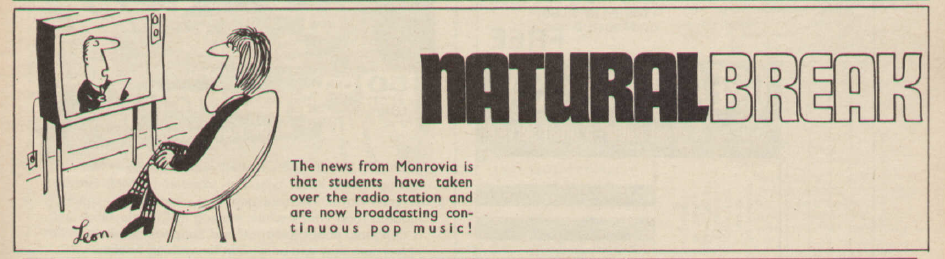

If you can work out what the joke is here, or how and why it involved Peter Cook, you're doing better than us. Anyway, join us again next time, when we'll be looking at some of the many occasions on which TV Times printed something that made absolutely no sense whatsoever...


If you've enjoyed this article, you can find lots more slightly more serious writing about fifties and sixties television in Not On Your Telly, which is available in paperback here or from the Kindle Store here.

Can We Hear It Back Now?


Carnival Of Light is probably the most obscure track The Beatles ever recorded. Specifically created for a live art installation, it was heard twice in public and has never resurfaced. Not even on the newly-released Sergeant Pepper's Lonely Hearts Club Band 'Sessions' box set, despite that being precisely where and when it was put down on tape. You could be forgiven for assuming that it's just an unimportant studio offcut and that if it was of any point or value whatsoever we'd have heard it by now. You'd be wrong, though, as it's also the subject of one of the most interesting stories in the Beatles' entire history. If you're interested in the mid-sixties counterculture and its associated artistic innovations rather than sex, drugs and indeed literally rock'n'roll, that is.

Carnival Of Light was The Beatles' contribution to an event called The Million Volt Light And Sound Rave, held at The Roundhouse in Chalk Farm on 28th January and 4th February 1967, and it's the chain of events behind that hazardously-named 'happening' that explain just why it is a little-explored corner of their work that deserves more exploration. It's depressingly common for articles about The Beatles to discuss them as if they were acting in complete isolation from anything else that was going on in 'the sixties', rather than the fulcrum around which hundreds of musical and artistic endeavours pivoted and vice versa, and that their mid-sixties experimentalism had absolutely no connection to their earlier cleaner-cut incarnation. How many reviews of the new box set, for example, will talk of the album as though it appeared as if by magic and not even touch on such fascinating details as the fact that "it's getting better all the time" was the catchphrase of short-stay Beatle Jimmie Nicol, who replaced an incapacitated Ringo on one of the Australian tours and who also later performed similar deputising duties for The Dave Clark 5 - it's a wonder they didn't keep him frankly; or that George Martin very deliberately lifted the audience sounds for the album from his hit recording of the Peter Cook/Dudley Moore/Alan Bennett/Jonathan Miller satirical stage revue Beyond The Fringe as he wanted to have a specific 'kind' of audience reacting; or the stray chortle that appears partway through the title track, which McCartney asked for because he remembered always being fascinated by radio comedy audiences laughing at things that listeners at home couldn't see; or the band specifically getting their old Hamburg mates Sounds Incorporated - a now largely forgotten instrumental outfit with a full brass section who had minor success throughout the sixties with alarming takes on the likes of the William Tell Overture and Hall Of The Mountain King - in to do suitably vulgar and blaring brass on Good Morning Good Morning rather than reaching for the nearest in-house session musicians? Probably about as many as will comment on the absence of Carnival Of Light, if we're being honest about it. It came about as the direct result of their association with a wider artistic scene, though, and there's a strong case for arguing that it had an important and immediate effect on the album that they were about to make.

Throughout 1966, London's experimental art community - the word 'psychedelic' would not come to be commonly used until late in the year - had started to converge on a number of venues; firstly the Spontaneous Underground events held at The Marquee on Sunday afternoons, closely followed by the UFO club on Tottenham Court Road, and The Roundhouse in Chalk Farm. A number of bands quickly found favour on this circuit, including the likes of Pink Floyd, Soft Machine, The Move, The Jimi Hendrix Experience and The Crazy World Of Arthur Brown, alongside the less well known likes of The Smoke, The Purple Gang, The Flies, The Riot Squad, Tomorrow and any given combination of Liverpool Poets Adrian Henri, Brian Patten, Roger McGough and their guitar-playing associate Andy Roberts. Many of these bands were given to indulging in extended free-form instrumentals, often with electronic effects, while the lab-coated free-jazz outfit AMM went even further and dispensed with any notions of actual song structure, concentrating on creating soundscapes with a combination of amplified instruments and transistor radios. However, these were never simply musical events, and usually involved elements of multimedia, stage theatrics and performance art, the latter often provided by a certain Yoko Ono. With his then-significant other Jane Asher, Paul McCartney was a regular at such venues and events, particularly Spontaneous Underground, and was no doubt left feeling sufficiently inspired to want to join in. That opportunity would come about through the unlikely route of buying a piano.


The main driving force behind The Million Volt Light And Sound Rave was David Vaughan, who with Doug Binder and Dudley Edwards made up BEV, a Swinging London-based design group who specialised in psychedelic murals with a pronounced and distinctive pop-art influence. Amongst those who employed BEV's services were The Kinks, Carnaby Street boutique Lord John, and infamous socialite Tara Browne, who would later provide the unfortunate inspiration for the opening verse of A Day In The Life. Late in 1966, Paul McCartney engaged BEV to decorate a piano for him, and when they delivered the alarmingly-hued finished article, Vaughan took the chance to ask if he or The Beatles would be interested in contributing something towards an electronic light and sound showcase they were planning. To his surprise, McCartney agreed enthusiastically, and on 5th January 1967, at the end of a session dedicated to overdubbing vocals onto the forthcoming single Penny Lane, The Beatles set to work in Abbey Road Studio 2.

Cobbled together from descriptions given by various individuals who have actually heard it - notably Beatles historian Mark Lewisohn and McCartney's friend and biographer (and, at the time, owner of focal point of the 'Underground' scene The Indica Gallery and Bookshop, and organiser of several similar events himself) Barry Miles - it appears that Carnival Of Light runs more or less along the following lines. Over a backing of organ and drums, recorded at a high speed to give an unnatural lower pitch and time distortion effect when played back, and overdubbed with church organ, frenetic tambourine and distorted electric guitar, McCartney and Lennon engage in seemingly random outbursts of echo-drenched proclamations, while various taped sound effects are cued in with equal spontaneity. The latter reportedly included gurgling water, pub piano, cinema organ and feedback, while the former include such meaningful interjections as "are you alright?" and "Barcelona!", in amongst a cacophony of whistling, chanting and random fragments of studio chatter, including at least one quite understandable coughing fit, and ending with an echo-saturated McCartney asking "can we hear it back now?". According to Miles, who was very much in tune with this style of making music, there is no conventional structure, and it simply moves between different tempos and hints of melody on a whim; it's clear that he actually considers this to be a good thing, incidentally. Some sources including Dudley Edwards have also claimed that it included a brief performance of Fixing A Hole; while it seems odd that Lewisohn would not have noted this detail, it is also entirely possible that McCartney may have appended a home demo of the song to the tape that was actually used at the event (recording of Fixing A Hole itself did not actually begin until 9th February). Incidentally, it's worth pondering on whether Berserk, a truly alarming early Blur b-side, might have been at least partially based on the description of Carnival Of Light given in Lewisohn's The Complete Beatles Recording Sessions.

Recorded in one take and running to thirteen minutes and forty eight seconds, the resultant mono mixdown (though Miles maintains there was also a stereo mix) reportedly failed to impress George Martin. It also, more surprisingly, proved underwhelming to David Vaughan, who had apparently been hoping for something more in line with Tomorrow Never Knows and which would have inspired a more spectacular light effect sequence. Nonetheless, Carnival Of Light was duly played in full as part of The Million Volt Light And Sound Rave, alongside a performance by Unit Delta Plus.


Formed in very late 1965, Unit Delta Plus was a collective composed primarily of Peter Zinovieff, developer of the prog rock-favoured VCS3 synthesiser, and Delia Derbyshire and Brian Hodgson of the BBC Radiophonic Workshop, with the stated aim of introducing a live performance element into electronic and taped music. Given how the Workshop are often depicted - not least in Doctor Who folklore - as eccentric tech-minded squares, many may be surprised to see Derbyshire and Hodgson's names mentioned in this context, but the fact of the matter is that they were young cutting-edge musicians very much involved in London's arts scene, and took part in a number of similar 'happenings' around this time. Indeed, there were numerous multimedia events staged by Unit Delta Plus themselves, after one of which they were introduced to musician David Vorhaus, with whom they would later form the influential electronic rock band White Noise.

Sadly, there is no available indication of what Unit Delta Plus may have performed at the event, nor even who was actually involved; the only clue is that Derbyshire retained a clipping from the Daily Mail about the event in her files, hinting that she may have participated in it. Incidentally, the paper was running their comic strip serialisation of the recently-released Thunderbirds Are Go! on the same page, which has nothing to do with Unit Delta Plus or The Beatles but does at least show what a remarkable time the mid-sixties was for boundary-pushing creative artists. However, other Unit Delta Plus events around the same time are known to have involved Derbyshire's religiously-themed 1964 sound collage for the BBC Third Programme Amor Dei, Zinovieff's montage of rhythmic loops Tarantella, an untitled Hodgson piece based around recordings of street sounds and passing conversations, Derbyshire's celebrated (and at that point unreleased) collaboration with Anthony Newley Moogies Bloogies, which uncannily anticipated the sleazy synth-pop duos of almost twenty years later, and Random Together, in which all three took part in a live unrehearsed mixing of sounds, so it presumably involved some or all of the above in some terrifyingly manipulated capacity.

That's basically as much as we know about the million volt sounds, but what about the lights? It is known that the event involved four sixty foot-high screens and a bank of sixteen projectors, which changed their output in response to changes in sonic signals, while a further five projectors, hand-operated by Binder, Edwards and Vaughan, provided a series of contrasting and interlocking patterns, but beyond that details are frustratingly elusive. So far it's proved impossible to locate a decent review of or feature on either performance (and I really have looked), and there appears to be no available photographic evidence, let alone film footage. However, it's also true to say that there are plenty of photographs - and indeed a small amount of film footage - of similar events held at The Roundhouse, many of them involving giant screens and punters with weird patterns being projected onto them, so it's possible to make an educated guess at what it might have looked like. Anyway, from the sound of it, you'd have been hard pushed to get a decent sense of what it looked, sounded or felt like without actually having been there.


Nobody seems to know what happened to the fully mixed tape used at the event itself, although McCartney has indicated that he has his own copy, and in any case the multi-track master of Carnival Of Light still exists at Abbey Road. So, why hasn't it been more widely heard then? Well, nobody really seems to have an answer to that either. Carnival Of Light apparently came very close to appearing on Anthology 2 in 1996, but was vetoed by someone within the Beatles' inner circle. For once, we can't just point the finger straight at Yoko Ono - who to be honest probably wouldn't have had much of an issue with it on musical terms - as by all accounts the main dissenter was George Harrison, who reputedly 'quipped' "avant garde a clue" in true Principal Skinner You've Been Called The 'Funny One' fashion. Given that his two oft-overlooked late sixties solo albums - not to mention his later contributions to The Beatles - were packed to the rafters with avant-garde sounds, this is putting it mildly a little surprising; additionally, you also could argue that the man who inflicted Ding Dong on the world had a bit of a nerve.

Some of those who have heard it have made comments along the lines of everyone getting excited about something that's not really that exciting, though you do have to wonder just how familiar or comfortable they may or may not be with that form of off-script music making in the first place. It's worth noting that the few insiders who had heard Syd Barrett's long-lost twenty minute free-form instrumental Rhamadan recalled it as somewhat on the tedious side and certainly nothing worth getting worked up about, and fans used to his less inspired studio offcuts didn't really expect that they were missing out on much either; until it was finally released and everyone realised that it was actually rather good after all. Meanwhile, Paul McCartney continues to enthuse about Carnival Of Light and mention how much he'd love to give it a proper release approximately every three minutes, and on balance he is usually worth listening to about his own music.

What is more mysterious, however, is the fact that Carnival Of Light has consistently failed to appear on bootleg. This could normally be explained away as being due to it only existing as a multitrack tape and that there is nothing to surreptitiously copy, but this is The Beatles we're talking about, of whom every single other last extant recorded moment from 'closely guarded' early rehearsal tapes to head-maddeningly fuzzy microphone-to-TV-speaker recordings of them larking about with now discredited celebrities to outtakes from their Christmas fan club records, has not just escaped but been unofficially copied and 'released' millions upon millions of times over. Somebody somewhere at some point must have made a copy of it, so is it possible that Beatle 'superfans' are carefully controlling its distribution amongst a small elite to make sure that they remain 100% Officially Best At Liking Beatles? You're talking to a Doctor Who fan here. Of course that's bloody happened.


Apparently the reason that Carnival Of Light has been left off the new box set is that producer Giles Martin feels that it "wasn't part" of Sergeant Pepper's Lonely Hearts Club Band, to which we could add a snarky comment about it having been recorded in the same session as a song that wasn't part of Sergeant Pepper's Lonely Hearts Club Band either but has somehow found its way onto it now. That said, we could also add a more balanced and pertinent comment about how, regardless of its actual musical worth, it quite possibly had some bearing on Being For The Benefit Of Mr Kite!, Lovely Rita, Good Morning Good Morning and A Day In The Life. Whether or not Carnival Of Light really is 'part' of the album is a matter of conjecture. What it is part of, though, is a much bigger and more fascinating era of open-mindedness and experimentalism in the popular arts that stretched all the way from jazz and radio drama to comedy and supermarket own-brand food packaging. It deserves much better than to be left gathering dust in a tape archive. So, please... can we hear it back now?


If you've enjoyed this, you can find more articles about psychedelia and pop music in my book The Camberwick Green Procrastination Society, available in paperback here, from the Kindle Store here, and as a full-colour eBook here.

There's So Much More In TV Times Part 8: Put Your Shirt On The Beatles!


As everybody in the early sixties knew only too well, there was one group of celebrities whose star status eclipsed all others. Who inspired a 'mania' so huge and all-enveloping that it consigned their contemporaries to pop cultural historical footnote status. Whose vocalisations and distinctive appearance were emulated in playgrounds across the nation and eventually across the world. Whose artistic endeavours changed highbrow and lowbrow culture so fundamentally that their collective name became an actual word in its own right. And who were so popular and successful that they knocked Bruce Forsyth making something out of 'leftovers' into a cocked novelty oversized chef's hat.

But unfortunately for TV Times, The Daleks were on the BBC, and so they had to settle for giving relentless coverage to The Beatles instead. Here are just a few of their spurious attempts to pad out their pages with tenuous excuses for printing a photo of one or more of the Fab Four, to the delight of those who just couldn't get enough of John, 'Dinners', George and Ringo. Even if they had to wade through acres of features on the holiday plans of the cast of Ghost Squad: G.S.5 to get there...


Conveniently for magazine editors, the fact that there were four Beatles allowed them to spin any given feature out across a month's worth of issues, even if this resulted in each 'part' amounting to little more than two gigantic photos and three words. From the confusingly titled Hancock-evoking TV Times series 'Reada Beatla Week', here's the entry on 'Our' Ringo, in which the other three indulge in some trademark surreal dialogue about how he used to play the bins on the drums or something and take delivery of, quote, "a bottle of whisky and a crate of 'coke'". Note also the entirely coincidental and not at all stage-managed interruption from fellow Brian Epstein protege Billy J. Kramer. Anyway, join them again next week for another Fab Four profile and a special 'Beatle Bonus'. Hope it's Carnival Of Light!


Ringo Starr was lucky enough to have a name that lent itself punningly to pretty much every magazine feature imaginable. Here he is making an appearance in - boom boom - TV Times celebrity horoscope box-out 'Star Destiny', in which they correctly and uncannily deduce a dazzling array of facts that everybody on the entire surface of the planet already knew. Even their one attempt at predicting the future wouldn't impress anyone bar gullible buffoons; it was hardly a daring leap of faith to suggest that The Beatles might release a successful new album 'early' the following year. Meanwhile, not a single mention of The Concert For Bangladesh, Ognir Rrats or FROM THE EIGHTY FOURTH OF OCTEMBER, NO MORE AUTOGRAPHS.


Earlier on in their career, The Beatles were often to be found larking around with full-time comedians on television variety shows, and here TV Times' 'slice of life'-friendly 'lighter side of showbiz' reporter Dave Lanning paired them up with hot ITV stars (though they had to go to the BBC to become properly famous) Etic and Ern for a meeting of humorous minds that he presumably hoped would be dripping with rib-tickling comedy gold. Sadly it was nothing of the sort, though it's interesting to see Ernie Wise making an innocent gag that would doubtless turn him into the target of ferocious Twitter outrage if made today. Unless he said it when they went to Thames at the end, of course.


Essentially a Ready Steady Go! that you could take home to meet your parents, weekly family-friendly pop extravaganza Thank Your Lucky Stars was once one of ITV's biggest shows, and considered so pivotal and essential to the average beat combo's chances of pop success that its subsequent forgotten status is little short of bewildering. Certainly The Beatles continually fell over themselves in an apparent attempt to make as many appearances on it as possible. That, however, is an inexcusably flimsy pretext for this competition, in which lucky readers could win their very own Thank Your Lucky Stars t-shirt if they could think up a funny enough caption for this photo of a crazed teenage girl trying to grab the disembodied lower half of a 'Beatle Suit' while George attempts to make his escape by vaulting over a giant shortbread biscuit. Which, you can't help but notice, is even larger than the actual competition itself.


Occasionally, even TV Times would have to run a slightly more substantial feature on The Beatles, and on this occasion we get their long-serving press man Derek Taylor dishing the dirt on why John stole his trousers, explaining why they hate 'mayors', and finally revealing the real reason why Ringo collapsed just before a massive world tour. Probably got asked for too many autographs.


One of THE faces of Swinging London, by the mid-sixties Jane Asher had caused a sensation in The Masque Of Red Death and Alfie, become a major shareholder in Private Eye, and thoroughly immersed herself in the Capital's avant-garde art set, introducing her Beatle paramour to pop-artists, electronic musicians and classical ensembles that would have a profound effect on his songwriting and his band's recordings. To TV Times, however, she was simply 'Paul's Girl'. Not that we should really have expected anything better of them, mind...


As so often happened, the Great Beatle Debate soon spilled over into the TV Times letters page. Above you can see a staunch Beatlesceptic foaming at the mouth and demanding his Light Entertainment 'sovereignty' back, fundamentally misunderstanding the point that the 'Hit Parade' is compiled from statistics based on which records are selling in the largest quantities to the most people in the process. There's also some desperately unfunny satire at the expense of, apparently, electricity. It won't be doing THAT again! Next up is a bewildering pro-Beatle missive from someone who, it seems, was enjoying one of their performances so much that it made her keep knitting. And finally, one of those perplexing 'I'm funny, me!' efforts that you can still find in TV listings magazine letters pages to this day, from someone who assumes that combining reference comedy with a joke that nobody in the universe including them actually understands makes them into a comic genius. You will find absolutely none of that around here, of course. Not before The Grimleys is on, anyway.


And finally, here's a special Beatle Quiz, with twenty five fiendishly difficult questions to test your knowledge of the Fab Four. The answer to number seventeen is 'Warrien'.


Yeah, you can't fool us, Ian Butlin. That hottie with the suspiciously-angled pout won't actually BE at any of your holiday camps, will she? No matter how much your 'free coloured brochure' might try to suggest otherwise. And where in the name of sanity is Mosney? Anyway, join us again next time, when we'll be taking a look at some of the ways in which TV Times attempted to expand its readership by reaching out to our furry friends...


If you've enjoyed this, you can find more articles about sixties pop music and television in my book The Camberwick Green Procrastination Society, available in paperback here, from the Kindle Store here, and as a full-colour eBook here.

The Alternative Anthology

If you ever wanted evidence of just how commercially unassailable The Beatles were in the sixties, look no further than the sheer amount of Fab Four covers that were around at the time. Just about everything the Beatles ever wrote and recorded, from With A Little Help From My Friends all the way to Love Of The Loved, was covered by somebody somewhere several times over in the usually vain hope of a little bit of chart magic rubbing off on them. Often they were little more than cheaply done cash-in efforts that were never going to stand the test of time - who could pick Marmalade's version of Ob-La-Di-Ob-La-Da out of a line-up, for example, and has anyone even ever heard The Overlanders' chart-topping stroll through Michelle? - but the sixties was an exciting time for exotic musical sounds even outside of George Martin's studio trickery, and many of these covers are worth a second listen. Like, for example...


Enoch Light 'Get Back' (Studio2Stereo 1969)

Taken from his legendary (well, with certain genre enthusiasts at least) 'Easy Listening On The Moon' album Spaced Out, this is a rip-roaring loungetastic rampage through one of the band's less exciting (and, it must be said, more ideologically dubious) chart-toppers, with brass and fuzz guitar battling it out at epic length. See, it was useful for something then.


Loose Ends 'Tax Man' (Decca 1966)

Within mere weeks of its release on Revolver, George Harrison's Weller-theft-occasioning moaning about having to cough up Income Tax like any old commoner becomes an organ driven exercise in slow-burning funk, packed with those mental bongo breaks that sample-crazy DJs go mental for nowadays. A big favourite on Pirate Radio, apparently, but seemingly just too wild for mainstream chart success. Wonder if Bradley Wiggins has heard it?


The Gods 'Hey Bulldog' (Columbia 1969)

When Progressive Rock came a-calling (probably over the length of a triple album) at the close of the decade, many early exponents of the genre decided to showcase their instrumental prowess by doing heavied-up takes on Beatles numbers. Most of these were as horrible as you're already imagining, but this hammering cover of an unjustly obscure number (relegated to an album soundtrack, and even then cut out of most of the original release prints because Paul McCartney wanted more 'bloody stupid marching' inserted or something) is pretty good.


The Score 'Please Please Me' (Decca 1966)

Though some would undoubtedly get very angry at the merest suggestion that The Beatles did not invent the wheel, there was a brief period in the mid-sixties when it seemed that many of the bands hanging around London's nascent psychedelic scene had actually leapfrogged ahead of the Fab Four in terms of far-out pop sensibility and general sonic trickery. For a particularly pertinent example, see this delieriously obscure effort drenched in loudspeaker-endangering swathes of feedback and buzzsaw guitars. Bet their light show was a sight worth seeing.


The Young Idea 'With A Little Help From My Friends' (Columbia 1967)

Legend has it that on the evidence of their incredibly rare LP and other singles, this overdressed duo had designs on a more Syd Barrett/Scott Walker kind of territory, but they hit the big time with a fairly respectably done Beatles cover and that was pretty much the end of their career. It's certainly preferable to Joe Cocker's overwrought histrionics, but the laws of irony have seen to it that while his The Wonder Years-introducing tedium is still inescapable to this day, The Young Idea's version probably hasn't been heard anywhere since the 1967 Christmas Top Of The Pops.


The London Jazz Four 'Norwegian Wood' (Polydor 1966)

The hip jazz community were as fond of messing around with sitars and backward tape loops as The Beatles, but the London Jazz Four preferred a more straightforward 'modern jazz' approach, which makes it rather puzzling that they recorded an album's worth of covers of The Beatles at their most intensively experimental. Here, Lennon's tale of being annoyed because a girl wouldn't 'do' him is shorn of all sitar droning and becomes a frug-friendly vibraphone workout of the sort that would sound at home in a 'beat club' scene in a sixties big screen Brit-thriller.


David Bowie 'Penny Lane' (Music For Pleasure 1967)

While The Beatles were living the high life and snorting LSD off Mia Farrow's arse or something, young David Jones, latterly of failed beat combos The Lower Third and The Buzz, was so poor and starving that he had to resort to making ends meet by singing on one of those 'not the original artists' LPs that were common currency at the time. Thus it was that he added voice to undernourished strolls through various Monkees and Beatles numbers, though the story has a happy ending, as by the end of the year he had turned his dire financial straits into a spectacular cautionary tale called The London Boys (and, erm, one about a gnome), secured himself a new deal, and ever so slowly started to evolve into the world's favourite distant and androgynous chameleon of rock who fell to Earth. Except it turns out it wasn't actually Bowie after all. Or it was, depending on who you listen to. He definitely played the sax on Baker Street, though.


Killer Watts 'We Can Work It Out/Hey Jude' (Pye 1972)

Time was when the dreaded synthesiser was considered not just an Exciting Musical Instrument Of The Future but also a selling point in its own right, and record shops were awash with synth-demonstrating LPs back in the early seventies. You will not be surprised to learn that it seems to have been a legal requirement for such albums to include at least one Beatles cover, and some of them even featured nothing but. Mr. Watts' effort is not one of the more inspired ones, it must be said, composed largely of undistinguished trots through Shadows numbers and movie themes, but the better tracks include this lengthy Beatles medley, which binds two unlikely medley-mates together with the aid of a funky rhythm and zapping electronic tones.


Bobby Lamb & The Keymen 'Fool On The Hill' (BBC Records 1971)

Top trombonist Bobby Lamb, along with Tony King, Dave Snell, Norrie Paramor and many other names that will be familiar to anyone who's ever scanned the the list of 'also available' titles on the back of Doctor Who Sound Effects or Sing A Song Of Play School, was one of those characters that used to plug the gaps on Radio 2 caused by the Musicians Union's stringent rules on how many commercially available records could be played per hour. Backed by a crack team of session musicians, there's some deliciously strange covers of recent chart hits on offer here, not least this rendition of the superb song from The Magical Mystery Tour, which starts off all pastoral and wistful before being invaded by what can only be described as a pitched battle between Hammond Organ and flute.


Tomorrow 'Strawberry Fields Forever' (EMI 1967)

Tomorrow - a band made up of no less than future Yes guitarist Steve Howe, Teenage Opera-excerpting solo superstar Keith West, and all-round Festival-hogging anarcho-hippie and general punk before punk existed John 'Twink' Adler - were one of the first proper psychedelic bands on the UK scene and made some fantastic records, not least the Lennon-endorsed My White Bicycle. Unfortunately, when it came to recording the album, they were apparently one song short and resorted to filling up space with this heavied-up Fabs cover with guitars replacing all of the orchestration and sound effects. It probably sounded fantastic through a haze of dry ice at the UFO club, but on record it just sounds a bit tedious. However, the joke was on them, as an angry tour promoter later forced them to do the same with Excerpt From A Teenage Opera on threat of not being paid, of which West later recalled “we did it like Strawberry Fields Forever, and they threw coins at us”.


The Eyes 'Good Day Sunshine' (Mercury 1966)

And the cautionary tales continue. One of a handful of psychedelic acts who were doing the live rounds before The Beatles had even finished recording Revolver, The Eyes caused an immediate splash with their flourescent rugby shirt stage outfits and bonkers single When The Night Falls, based around a heavily distorted gong. Unfortunately this didn't translate into chart success, and after a couple more tries, their record company forced them to record a cover of a Beatles song that wasn't even that good to begin with. The band weren't happy and split soon afterwards. If only they'd been pushed towards She Said She Said...


Lord Sitar 'I Am The Walrus' (Columbia 1968)

Nobody seems sure who Lord Sitar was - though accusatory fingers can surely be pointed at top sixties session sitarist Big Jim Sullivan - but it's a fair bet he wasn't a real nobleman. He did, however, get to record an album of covers of recent chart hits, keenly sought after by people who've heard the demented snarl through I Can See For Miles, and then equally keenly discarded when they discover that much of the rest of it is tepid reditions of the likes of Daydream Believer. However, it's well worth sticking around for this out-psyching the original Beatles cover, liberally doused in fuzz guitar and shrill flutes, and as it doesn't say 'knickers' it's perfectly safe for The Light Programme to play too.


If you've enjoyed this, you can find more articles about psychedelia and pop music in my book The Camberwick Green Procrastination Society, available in paperback here, from the Kindle Store here, and as a full-colour eBook here.