Showing posts with label david bowie. Show all posts

Box Set: Book Reviews


 A collection of some of my recent book reviews...

It looks as though some of you aren't aware that I now have a new website (which you can find here), and are still hanging around here wondering where all the new 'content' is. Well it's over there, obviously. To give you all some idea of where to start, though, I'm adding some new posts here with themed collections of links, and this time it's some of my recent book reviews and a couple of other related bits and pieces...

Ashes To Ashes - The Songs Of David Bowie 1976-2016 by Chris O'Leary

How Does It Feel? - A Life Of Musical Misadventures by Mark Kermode

Psychedelia And Other Colours by Rob Chapman

I'm Not With The Band by Sylvia Patterson

1966 - The Year The Decade Exploded by Jon Savage

The Books I Couldn't Help Thinking About - a look at some of the writers that have had the most significant influence on me, including Richard Herring, Caitlin Moran, Andrew Collins, Nicholas Pegg, Stuart Maconie and more.


You can find more not especially highbrow literary criticism in The Camberwick Green Procrastination Society, available in paperback here, from the Kindle Store here, or as a full-colour eBook here.

Looks Unfamiliar Christmas Extra: “The Meaning Of Christmas Is No Boris Gardiner”

Christmas In Hollis by Run DMC, as discussed by Tim Worthington and writer Stephen O'Brien in Looks Unfamiliar.


Looks Unfamiliar Christmas Extra: “The Meaning Of Christmas Is No Boris Gardiner”

Looks Unfamiliar is a podcast in which writer and occasional broadcaster Tim Worthington talks to a guest about some of the things that they remember that nobody else ever seems to. Joining Tim for a special Christmas edition is writer Stephen O’Brien, who’s brought along some little-heard eighties Christmas Singles including Hokey Cokey by The Snowmen, Jingle Bells Laughing All The Way by The Hysterics, What Are We Gonna Get ‘Er Indoors by Dennis Waterman and George Cole, Oh Blimey It’s Christmas by Frank Sidebottom, Christmas In Hollis by Run DMC, Old Fashioned Christmas by Anne Charleston And Ian Smith, and Do They Know It’s Christmas? by Band Aid II, not to mention Bing Crosby and David Bowie’s stilted stately home natter, Boris Gardiner’s mercifully forgotten third single, and the thorny question of whether Keeping The Dream Alive by Freiheit is a Christmas Single or a load of old twaddle. Along the way we’ll be hearing the World’s Worst Jane Leeves Impression, revealing who wrote and sang the theme tune for The Quatermass Experiment, narrowly avoiding giving the actual official worst Christmas Present possible in the entirety of all history, and finding out how to get accidentally mistaken for an extra in Neighbours.

DOWNLOAD IT HERE - SUBSCRIBE IN ITUNES - RSS


You can hear Stephen's other appearance on Looks Unfamiliar here.

You can find more regular editions of Looks Unfamiliar here.


Looks Unfamiliar - the show about the things you remember that nobody else does

Looks Unfamiliar is hosted by Podnose.


Support Looks Unfamiliar by buying one of Tim's books! Can't Help Thinking About Me is brand new and features loads of brand new material, and you can get it in paperback here or from the Kindle store here.

The Best Of Looks Unfamiliar #4: The Real Bowie Says To The Imagined Bowie


Looks Unfamiliar is a podcast in which writer and occasional broadcaster Tim Worthington talks to a guest about some of the things that they remember that nobody else ever seems to. This is a collection of highlights from shows nineteen to twenty four, featuring Paul Kirkley on The Kids From Fame Again, Garreth F. Hirons on Sweet 75, Darrell Maclaine on The Brennan JB7, James Gent on When The Wind Blows by David Bowie, Ros Ballinger on Microsoft Explorapedia, and Jonny Morris on Jesta Giggle by The Barron Knights. Along the way we’ll be finding out why The Barron Knights should have covered T.V.O.D., where the whistling from Never Let Me Down was ‘borrowed’ from, which CDs you should never trust your car with, and which former member of Nirvana really loves accordions. Plus there’s also something you may not have heard before – Tim on Betamax Video Club talking about Absolute Beginners, and an extra downhill slaloming surprise at the end…

You can get Tim’s new book, Can’t Help Thinking About Me, here.

DOWNLOAD IT HERE - SUBSCRIBE IN ITUNES - RSS


You can also find the full version of each show here...


Looks Unfamiliar is hosted by Podnose.


Support Looks Unfamiliar by buying one of Tim's books! Can't Help Thinking About Me is brand new and features loads of brand new material, including plenty about Camberwick Green, Trumpton and Chigley, and you can get it in paperback here or from the Kindle store here.

Looks Unfamiliar #22: James Gent – A Cross Between The Prisoner And Test Match Special


Looks Unfamiliar 22: James Gent

Looks Unfamiliar is a podcast in which writer and occasional broadcaster Tim Worthington talks to a guest about some of the things that they remember that nobody else ever seems to. Joining Tim this time is writer James Gent, who is stringing together hazy archive recollections of The Golden Oldie Picture Show, When The Wind Blows by David Bowie, Beeb Magazine, T-Rex ‘Greatest Hits’ albums with none of the hits on them, Boxpops, and the Montreux Special of Monty Python’s Flying Circus. Along the way we’ll be finding out what Clive Dunn being Grandad as Grandad looks like, where the whistling from Never Let Me Down was ‘borrowed’ from, and where you can read about Michael Sheard And His Pet Dogs.

DOWNLOAD IT HERE - SUBSCRIBE IN ITUNES - RSS


You can find more editions of Looks Unfamiliar here.


Looks Unfamiliar is hosted by Podnose.


Support Looks Unfamiliar by buying one of Tim's books! There's more about Rubik's Magic in The Camberwick Green Procrastination Society, available in paperback here, from the Kindle Store here, or as a full-colour eBook here. And there's several other books to choose from here...

Russ Conway Day


The only time that I ever queued for annual limited edition vinyl bonanza Record Store Day was for the third event in 2010. I'd participated in, and quite enjoyed, the first two; this had involved nothing more arduous than sauntering along to an independent record shop that I'd been visiting since I was in my mid-teens (and you can find an article about my first encounter with it in Well At Least It's Free) in the mid-morning, picking up a couple of bargains, and generally appreciating the upbeat atmosphere and overall sense of celebration of old-fashioned record shops and their patrons. By the third event, though, Record Store Day was attracting a good deal more media attention, and bemused half-interested reports on the national news were suggesting that 'queues were expected'. As one of the records being released in very small numbers on that day was a brand new single by Blur - their first in almost seven years, and the first to really involve Graham Coxon for even longer - and I was very keen to get hold of a copy, it seemed sensible to err on the side of hype and turn up as early as possible.

When did I arrive early on the Saturday morning, there was indeed a small queue forming, and amongst the line of thirty or so people I noticed one person I knew very well, two others I knew by sight, and many more utterly unfamiliar and steelily determined faces that may as well have had the URL for eBay in front of their eyes. I'd joined the back of the queue and had literally only been waiting for about ten minutes when one of the shop's staff appeared from nowhere and called myself and the other three to one side. In a low voice, he informed us that they hadn't received any Blur, Stone Roses or Rolling Stones singles, and as that's what he had assumed the four of us were variously after, he didn't see any point in making us stand around in the rain for no good reason. We were, after all, regular customers; everyone else he had 'never seen before in my life'. Feeling weirdly relieved, the four of us then went off to have a coffee and, well, a laugh, leaving the mystery shoppers to come to blows over Live At Leeds by Pulled Apart By Horses.


Since then, I've had nothing to do with Record Store Day; not out of any pompous, pious or purist reason, but simply because it doesn't really have very much to do with how I would normally buy records. It's not really aimed at people like me but at a completely different demographic, evidenced by the increasing volume of what I would personally consider rip-offs or money for old rope, but which large numbers of others seem eager and delighted to get hold of; and if they do then good luck to them frankly, as that's what record collecting is all about. Despite what some columnists might have to say on the subject, it's not a case of other people invading 'our' world, but of that world being thrown open to the wider public for a single day, and in many ways that can only be a good thing. I'm aware that I've probably missed out on some quite nice items as a consequence - though not always; there were still copies of the Doctor Who soundtrack EP Sounds From The Inferno and Georgie Fame's R&B At The Ricky Tick easily available even a month later - but also at the same time have managed to steer well clear of shoddy rip-off rubbish. Who in their right mind would fork out a tenner for a coloured vinyl 7" of a Derek And Clive sketch that had already been released several times over, and not even one of the funny ones at that?

This year, of course, there are an unreleased Pink Floyd track and rare early David Bowie outtake on offer, but both of those should have been on recent pricey reissues and weren't so Ian EMI can get to fuck if he's expecting me to queue for two hours and then hand over eighty four million pounds on top of already extravagant purchases. Anyway, if you're a full time record collector on the three hundred and sixty four non-Record Store Day days, then you'll almost certainly have the patience, perseverance and keen observational skills to get hold of anything you wanted a couple of months later for considerably less money.


That's not to say I've been above making the odd sarcastic dig at Record Store Day and its patrons, though. When myself and Ben Baker did an Advent Calendar podcast based on forgotten Christmas Singles recently, one of our choices was Snow Coach by fifties piano-pounder Russ Conway (which, incidentally, you can find on the excellent compilation Saint Etienne Present Songs For A London Winter; and which, equally incidentally, you can find my review of here), the absolute epitome of the clean-cut pre-Beatles pop star whose records all sounded pretty much identical. Russ Conway is something of a recurring obsession of ours, and during the course of our genuinely affectionate discussion of his 'unique' musical stylings, the conversation took the following turn (warning - contains an heroic amount of swearing)...


Needless to say, there wasn't a one-sided Russ Conway exclusive on offer as part of this year's Record Store Day. Even so, as a pointless situationist prank making absolutely no real actual point about anything whatsoever, I thought it would be fun to try and find a Russ Conway record in an adjoining charity shop while everyone else was queueing up in the hope of getting hold of a pink 7" of Barbie Girl by Aqua. And, well, it was harder than you might think.

If you were looking for endless Blaster Bates albums or about seventeen million copies of that Break Through - An Introduction To Studio 2 Stereo thing, then your luck would have been in. In the market for an Elvis Presley compilation with a bizarre cover showing what appeared to be the HMV dog throwing 'shade' at him? Not that difficult to find. Album with Johnny Mathis forcing a terrifying green balloon with a face drawn on it into a youngster's hand? Some sickly-looking effort called Magical Mystery Man - A Children's Musical By Colleen and Charles Segal? That horrendous bulky Karaoke Party CD that everyone had at every party in the early nineties? A shelf of seven or eight Jeremy Clarkson books inexplicably but deservedly turned upside down? A complete collection of Stargate SG-1 on DVD? Then roll right up and you could walk away with the lot for about a quarter of the price of even the cheapest Record Store Day 'exclusive'. But - astonishingly, and indeed frustratingly - nothing by Russ Conway. Apart from a 1976 album featuring 're-recordings' of his hits, for which there is not enough NO in the known universe.


Three thoroughly ransacked charity shops later, I was starting to feel like a slightly less sociopathic Simon Quinlank (although some would probably argue more), but the hobby had to continue and a long player's worth of authentic Conway originals with the proper actual hit version of Side Saddle on it had to be found. Inevitably a number of things had already shown up that I did want, including a compilation by his hit parade contemporaries Steve & Eydie and a live album by space-age popsters Ferrante And Teicher as well as Ray Conniff's Hollywood In Rhythm which was worth picking up for the redhead on the cover alone, but still nothing at all by the China Tea hitmaker himself. Until, that is, I had the idea of rifling through the CD racks instead, and promptly found a Very Best Of featuring all of his hits and more in their authentic original versions. And all of them sounding exactly the same as each other, so much so in fact that twenty four tracks' worth of it started to feel more hallucinogenic through sheer repetitious weight of Pot Black Theme-resembling force than Sergeant Pepper's Lonely Hearts Club Band ever quite managed.

It's probably possible to turn this into some kind of serious point about how it's increasingly easy to get hold of popular and modern music on vinyl whereas the forgotten and the neglected hits and misses of yesteryear can only be found on CD if you're lucky, but really, what would be the point? If you're enjoying the 'Vinyl Revival', then good on you frankly and please keep trying new sounds (especially if they're actually not-so-new sounds) instead of relying on what the broadsheets tell you that you have to buy. And in the meantime, everyone else keep rediscovering everything else. That way we might even get a Boys Wonder CD one day. Probably not for Record Store Day, but in all honestly, I'd probably queue for that.


If you've enjoyed this, you might also enjoy this slightly more charitable piece about Record Store Day.


If you've enjoyed this article, you can find plenty more about the early days of pop music and black and white television in my book Not On Your Telly, available in paperback here or from the Kindle Store here.

All Dead, But Still Alive


We’ve no way of knowing for certain what Gordon Murray was doing on 22nd December 1965, but we can take a fairly good guess. Chances are he was editing Mrs Honeyman And Her Baby, the thirteenth and final episode of Camberwick Green, by hand in his tiny Crouch End studio, delivering it to the BBC only days (or according to some accounts hours) before the first one went out on 3rd January 1966. Over in a slightly more well-appointed studio in Slough, Sylvia Anderson was probably watching a rough cut of the Thunderbirds episode The Cham-Cham, flushed with the excitement of its runaway success and doubtless little realising that men in suits behind desks would later claim all of the credit for her ideas. Meanwhile, in Kent, David Bowie was most likely listening to an advance acetate of Can’t Help Thinking About Me, and wondering if this would be the one that finally made him into a pop star.

David Bowie, Sylvia Anderson and Gordon Murray, of course, all died in 2016. All three are people whose work I have admired with an almost unequalled fervour for pretty much as long as I can remember; and no, that’s not really an exaggeration in Bowie’s case. The first two of them often tackled their thoughts and fears on nuclear conflict in their work; Gordon Murray sure never did, but he did once tell a BBC documentary maker that his creative imperative was to “protect children, while they are children, for as long as possible from this dreadful world that we’re living in”, so it doesn’t take too much imagination to work out what his thoughts on the matter were.


Arthur Lee and Bryan MacLean, the angry, cynical frontmen of the provocative and defiantly mixed race band Love, both left us a long time ago, but they were recording their debut album in December 1965 and their almost plainsong-like plea Mushroom Clouds remains one of the simplest yet most chillingly effective expressions of that same fear. Their labelmate Tim Buckley hadn’t made it into the studio yet, but he was certainly performing his furious analysis of the Cold War’s intangible sense of threat No Man Can Find The War live by that point. And we really could go on and on and on about December 1965 there, but it’s straying from the point a bit. A bit. Suffice it to say that, one way or the other, none of them nor indeed any of their contemporaries would have imagined that we’d still be having the same sense of dread and paranoia over fifty years later.

David Bowie, Sylvia Anderson and Gordon Murray will be missed by many and their work will live on. But they’re not who we’re supposed to remember. They’re artists. Creatives. Producers of material that, at least in 1965, was literally intended to entertain audiences for a couple of months then disappear forever. They are not statesmen or politicians, and even Bowie will struggle to make much of a dent on the history books, let alone a couple of people who pushed a couple of puppets around, and one of them an uppity woman at that. We’re supposed to save our reverence, our remembrance, our memorials for the decision-makers and strategists, regardless of how well they may actually have treated us. Monuments, as the similarly long gone folk singer Jake Thackray once put it, “for the eyes and admiration of the common people who/you never ever in your lifetime ever liked or ever knew”. Given that he was never afraid of having arrogant authority figures reduced to giving rosettes to prize-winning pigs or sexually assaulted by apes, simply telling these ‘Famous People’ that “you are unwise/to imagine you are dear” speaks contemptuous volumes.


I can’t say it really happened with Gordon Murray or Sylvia Anderson, but there were people who openly expressed bewilderment bordering on hostility at the idea that David Bowie’s death should be mourned by anyone in any way at all. Many of these, it has to be said, spent much of 2016 publically crawling up to the very political figures who have got us right back to Love’s nightmarish visions of “little children dying/in an age of hate”. Yet there’s one last thing that all three of them had in common. As did Prince, Victoria Wood, Greg Lake, Leonard Cohen, Terry Wogan, Pete Burns, Caroline Aherne and, on a personal note, Kris Ealey, who was an old friend and one of the people least affected by celebrity ever, who only ever saw acting as his job and was far happier hanging out at record fairs and playing his guitar in tiny bars in his spare time. And in fact any of the celebrities who have died this year and had columnists snorting at the pathetic public and their silly outpourings of sadness. They made people's lives just that tiny bit better. Their names may not be on plaques or on paper, but they and their work are who and what real people will remember, and long may it stay that way.

This Is The Camberwick Green Procrastination Society/Now On The Kindle Store For You To Add To Your Library!


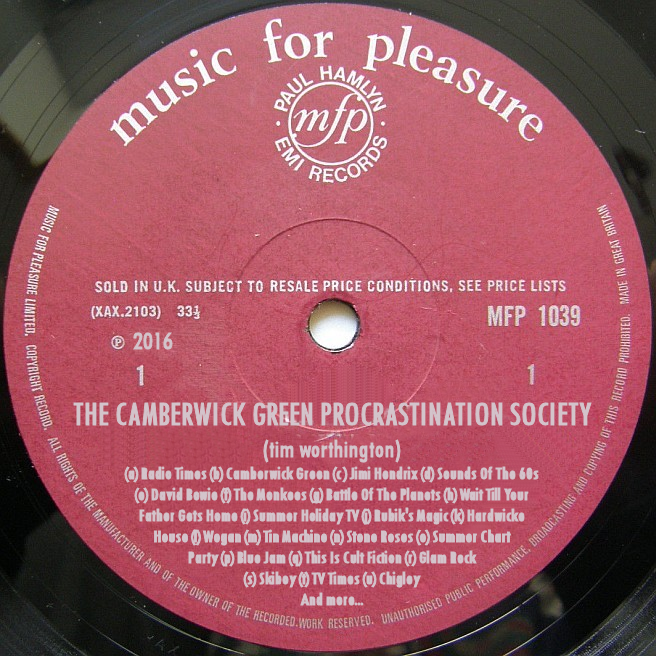
The Camberwick Green Procrastination Society, a book collecting some of the ridiculously lengthy diversions I've gone on about archive TV and pop music when I really should have been working on something more substantial, is now available from the Amazon Kindle Store. Regular readers may be interested to know that it includes exclusive and previously unpublished pieces on Chigley, Wait 'Till Your Father Gets Home and David Bowie's early TV appearances. Elsewhere there are features on Doctor Who, The Monkees, Battle Of The Planets, Tin Machine, Skiboy, The Stone Roses, Glam Rock, Jimi Hendrix, Hardwicke House, Rubik's Magic, Blue Jam and Camberwick Green. There's quite a lot about that, in fact.

You can get The Camberwick Green Procrastination Society from the Kindle Store by clicking here. Or if you'd prefer, you can still get the paperback from here, or the original full-colour eBook from here.


The Camberwick Green Procrastination Society

The Camberwick Green Procrastination Society by Tim Worthington

The Camberwick Green Procrastination Society is a book collecting some of my recent columns and articles, mostly in massively expanded form. And if you've already read them, there are brand new previously unseen features on Chigley and its role in the end of 'the sixties', Wait Till Your Father Gets Home and its role in the end of the hippy dream, and David Bowie's wiped early TV appearances and their role in being wiped. Also, if you get the paperback or eBook version, they're all in appropriate and painstakingly recreated magazine layout pastiches; you can see some examples of these below.

In The Camberwick Green Procrastination Society you can find out what Jimi Hendrix was really watching when he wrote The Wind Cries Mary, why old Glam Rock compilations are an ethical nightmare, and how time stood still in the middle of Summer Holiday mornings on BBC1, alongside in-depth features on Camberwick Green, Battle Of The Planets, Hardwicke House, Doctor Who, Blue Jam, The Monkees, The Stone Roses, Pink Floyd, the aural horror that is Summer Chart Party, and plenty more besides, including more detail than anybody ever wanted or needed about Skiboy. Even Skiboy himself.

You can get The Camberwick Green Procrastination Society as a paperback here, or as a full colour eBook here. Or, if you want it without the pictures but with an additional chapter on Trumpton, it's also available from the Kindle Store. And if all of that doesn't entice you, have a look at some of the pages...

The Camberwick Green Procrastination Society by Tim Worthington
Feature on Jimi Hendrix, Camberwick Green and The Test Card from The Camberwick Green Procrastination Society by Tim Worthington
Feature on David Bowie's lost early TV appearances from The Camberwick Green Procrastination Society by Tim Worthington
Feature on Hardwicke House from The Camberwick Green Procrastination Society by Tim Worthington
Feature on Tin Machine from The Camberwick Green Procrastination Society by Tim Worthington
Feature on Summer Chart Party from The Camberwick Green Procrastination Society by Tim Worthington
Feature on That 70s Show from The Camberwick Green Procrastination Society by Tim Worthington
Feature on Skiboy from The Camberwick Green Procrastination Society by Tim Worthington
Feature on Chigley from The Camberwick Green Procrastination Society by Tim Worthington
Feature on Radio Times, Doctor Who and Play School from The Camberwick Green Procrastination Society by Tim Worthington
Back cover of The Camberwick Green Procrastination Society by Tim Worthington


If you've already got The Camberwick Green Procrastination Society, you can find more books by me here.


The Camberwick Green Procrastination Society is available in paperback here, from the Kindle Store here, or as a full-colour eBook here.

The World Of David Bowie


I've been thinking all day about what to write about David Bowie. Not so much because I'm short of anything to say, but because, well, everyone else is doing deep and serious and the big outpourings of emotion, and in some ways that was never who he was to me. As much as I love the Berlin Trilogy and all the rest of it, my absolute favourite aspects of Bowie's career have always been when he's playing around with the medium and the artform, and generally having a bit of a chuckle at everyone else's expense, not least those who would never stop moaning about why couldn't he do another record like that nice Let's Dance etc etc. The sixties albums, Earthling, Tin Machine, the bewildering acting engagements, those paintings of the back of his head or whatever they were, all of them laudable and amusing attempts to stray from paths that had been marked out for him by the wider audience, and aren't going to go away no matter how hard some people may wish they would.

So I kept on thinking about this, even vainly attempting to enlist the help of Oblique Strategies in a quest for inspiration, when I remembered a time that I'd ended up writing about David Bowie without ever intending to at all. This was when I was dared in the pub one evening to try and write an article about the famously dull sixties Doctor Who story The Space Pirates, and although I started off doing just that, halfway through I realised that I'd started writing about the Space Oddity album instead, which turned it into a very different and much better piece (and one that I'm still very pleased with, and which you can find in my book Not On Your Telly). This started me thinking about just how much David Bowie had worked his way into the background of pretty much every aspect of my everyday existence, and at that point I decided to do a list of ten unexpected examples of him doing just that. It's a little bit ragged and unpolished - a bit like the first Tin Machine album, then - but hopefully it says what I want to say. Thanks for everything, Silly Boy Blue.


Great Pop Things


It's difficult to put into words just how much I used to look forward to Great Pop Things, the skewed and not even remotely accurate history of rock by Colin B. Morton and Chuck Death, that appeared at the foot of every NME letters page between 1987 and 1997. Driven by an almost nihilistic irreverence, and crammed with wilfully arcane in-jokes and pop culture references, it ridiculed the great and good (and Bros) more with thoroughly deflating absurdity than offensiveness. I can still be reduced to helpless laughter just by thinking about how Atlantis by Donovan is "about six minutes of wibbling on about where Atlantis might be, followed by about six seconds of singing about wanting to live in a coral house under the sea", or U2 being instructed by Oblique Strategies to "play as boringly as possible", or NWA rejecting aspirant rappers MC W ("an' I'm here to trouble you!") and MC * ("and I'm... erm... um"), or Can forming in school ("Sir, The Beatles are better than Stockhausen (in German)" - "Do not be stupid boy (also in German)"), or Robert Smith upsetting Siouxsie by turning up to rehearsals with his new 'happy' image, or Morrissey's 'Glum Rock' album ("This Chin Is Big Enough For Both Of Us!") 'Produced by Mick Ronco for A Chinnichap', or Pere Ubu "of whom Talking Heads were a substandard just-far-out-enough-to-say-you'd-been pale shadow" reinventing themselves as "a sub-Talking Heads drippy love song type group", or Tom Baker telling a dumpster full of proto-grungers that "it's OK to come out now, the punks have all gone", or Jimi Hendrix being welcomed to London by Marianne Faithfull, Jeremy Thorpe and Ken Dodd, or PiL singing Where Is Love? ("B'dum! SKREEEE!"), or... well, I could seriously go on all night. But it began with a multi-part history of 'The Chameleon Of Rock', following him from getting in trouble in school for "cutting up library books and using the wrong changing rooms", through inciting beach riots with his incendiary mod anthem The Laughing Gnome, and his controversial late seventies attempt to hail a train whilst dressed as Hitler and singing Helden, all the way to Tin Machine's fractious relationship owing to the others' bewilderment at his constant On The Buses references. And the writers' comic obsession with the essential concept of 'Dave' would spill over into pretty much all of their other strips too, from Syd Barrett's mental deterioration being signposted by his bursting into The Laughing Gnome onstage, to the sidesplittingly Dickensian Sex Pistols story starting with 'tea-leaf' Steve Jones nicking Bowie's equipment in a swag bag, all the way to The Laughing Gnome himself proving a punning nuisance during the invention of the electric guitar. Sadly, although some other performers were known to enjoy it (though not Morrissey), Bowie never really expressed an opinion on Great Pop Things, but it's fairly safe to assume he would have seen the joke. "Give me a pickle, Olive!".


States Of Mind


These days, you'd be hard pushed to find a bigger fan of Satire Boom-launched polymath Jonathan Miller than me, and in particular his UK Psych-inventing film adaptation of Alice In Wonderland, the masterclass in how to make a complex TV series for uncomplicated audiences that is The Body In Question, and his assertion at the start of A Brief History Of Disbelief in 2004 that "I should perhaps warn you that what you are not going to see in this programme is anything that you might be tempted to think of as 'Walking With Atheists'; I will not be seen leaning over a balcony, watching René Descartes nibbling his quill while he struggles with the problem of mind-brain duality, and there will be no blurred, slow motion shots of people making leaps of faith or failing to do so, because I think such dramatisation is somewhat vulgar and inappropriate" ("OMG did that person just say that thing in that programme from thirty years ago!?!?!?" - Pappy's Fun Club, 2015). When I was a lot younger, however, he was simply the presenter of States Of Mind, a rather quite scary show about psychology and mental disorders that came on BBC2 at lunchtime on a Sunday after the family-friendly stuff like Windmill and Taken Obody Sword Forit had finished. States Of Mind was introduced by rotating concentric 'brain'-denoting circles and a creepy piece of electronic music that I later described as "an ominous synthesiser melody that sounds curiously like a toxic rewrite of the theme song from Orm And Cheep". This music would lodge itself in my mind and resurface at inopportune and disturbing moments - especially during exams - so you can imagine my surprise when I eventually bought the CD release of Low and found Art Decade hidden away on Side Two.


Absolute Beginners


Not the song per se, which admittedly is one of the best that Bowie ever wrote, but the film itself, a grand overhyped overlong jumble of a stylistically inconsistent bewilderingly directed Patsy-Kensit-meets-Courtney-Pine-meets-Sade-meets-Smiley-Culture-meets-Lionel-Blair mess, which may be many things but is never, ever boring. On any level. Being something of a sucker for the neglected corners of cinema, especially ill-conceived and under-budgeted British-made attempts to 'sweep the board' at any given awards ceremony (they never do), I'm naturally very fond of Absolute Beginners; it's never been given a fair critical crack of the whip and is a lot better than you've probably been told it is, and in any case, the bizarre story of how it came to be made in the first place, and then bomb so dramatically, is nothing short of a goldmine if you're interested in the relationship between society, culture and popular culture. So intoxicating is this infectious and all-consuming misjudgement of youth culture that it's easy to forget that David Bowie not only sang the theme song but contributed two other numbers and even acted in a key role until you actually watch it. Which, let's be honest, most of you haven't done, have you?


'Ziggy' From Grange Hill


On to a somewhat more popular and longstanding fixture of the viewing habits of eighties youngsters. When crash helmet-haired scouse cheeky chappie Eric Greaves arrived at Grange Hill in 1986 to wreak havoc with Gonch and Hollo's money-making plans, wisecrackingly derail the bullying aspirations of both Trevor Cleaver and Imelda Davies, and generally repeatedly end up with fibreglass down his back for reasons that nobody is really quite sure of, the story behind his given nickname of 'Ziggy' was initially left as a mystery. All would be revealed, however, when he 'rescued' some jumping-up-on-playground-wall-type girls from the world's smallest 'big' spider, confessing that it was his twin admiration for our eight-legged pals and David Bowie that had earned him his popular handle. Two characteristics that, in true Grange Hill fashion, were never remarked upon ever again.


"It's My Lunch, Terry"


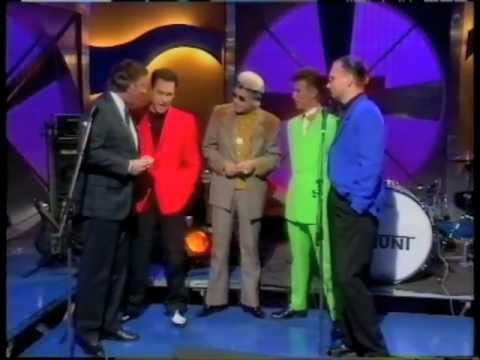
I've written extensively about Tin Machine here, but it's always worth revisiting this. Back in its heyday, almost everyone watched BBC1's early evening chat show Wogan - seriously, just think about how many interviews have become longstanding national reference points - and it was always a pleasure to see a musical act turn up who really ought not to have been there. This was especially true when Tin Machine made a trip to Shepherd's Bush in 1991 to mime to You Belong In Rock'n'Roll and indulge in a spot of post-performance natter with the host. Terry Wogan wasn't always the genial figure we know and love him as - the really quite nasty interview with David Icke is evidence enough of that - and he approached the band with a gallery-playing combination of sneeriness, mocking disdain ("what are you trying to do here?"), and a total lack of interest in the other three members verging on base rudeness. It's hardly surprising, then, that Bowie should have reacted to his banal line of questioning (especially that bollocks about pretending not to realise what that shoebox-shaped guitar was) with interview-sabotaging non-sequiturs. Wogan has since repeatedly tried to paint himself as the victim in all of this, but in all honesty he brought it on himself. If you provoked David Bowie into refusing to play the fame game, you'd really gone wrong somewhere.


"Portable Telephones Could Make You Turn Into A Cow..."


Jump They Say is an exhilarating, danceable and powerfully affecting attempt by a major recording artist to come to terms with his brother's suicide, speculating on the thoughts that might have run through his head in a genuinely heart-wrenching fashion, inspiring you to look out for your fellow human beings and providing an emotional wallop in a way that certain of his peers' mawkish displays of familial mourning (or for Princess Diana for that matter) sure never managed. However, it also served as backing music for Armando Iannucci's short early nineties stint as a Radio 1 DJ, looping endlessly and hilariously in the background as he reviewed the new platform game 'Aled Jones II' and read out nonsense about Robert Robinson On Ice ("featuring scenes from Ask The Family and Call My Bluff"), the new one-sided two pence piece, and Sharon Stone starring as a granary bap in a movie adaptation of Delia Smith's One Is Fun.


The Real Pin-Ups


Unless they had a career as brief and unprolific as Nick Drake (and even he did bloody Tow The Line), it's always a mistake to claim that everything your favourite artist ever produced was on an equal level of brilliance. You'll all have your Bowie album that doesn't work for you, and mine is Pin-Ups, a great idea ruined by stilted and overthought production that just ends up trampling over a terrific set of mid-sixties r'n'b, beat and psych covers. His take on The Kinks' Where Have All The Good Times Gone? just about works; elsewhere his mannered and theatrical vocals struggle with lyrics that are anything but that, and there is all manner of musical horrendousness going on, from the guitar riff on I Wish You Would that makes you want to throw your stereo out of the window, to the truly awful mangling of See Emily Play. Really, honestly, the idea of David Bowie covering Syd Barrett should be a match made in heaven, but all we get here is the rough and ready psychedelic shock of the original replaced by needlessly avant-garde and neo-classical instrumentation, overdone harmonised yelping, and a synthesiser that makes it sound as though Zippy and George are about to join in on backing vocals. It's this more than any other track that makes you wish you were listening to a compilation of the originals instead... and years later, you realise that, well, you can do just that. And it's brilliant. And maybe, just maybe, that's what he wanted all along. Clever sod.


'He Decamped To Berlin With Eno'


Whether it's Chris Morris fans reminding you that he's "a godlike genius"Doctor Who historians and their overuse of the words 'emblazoned' and 'black-clad', or more obscurely the way early seventies sci-fi series Ace Of Wands apparently always "returned for a stylish new series" with "sometimes sinister foes", off-the-peg cliché lexicon stock phrases beloved of writers who can't be bothered to think for themselves are always amusing once you spot them, and there is no more ridiculous an example of this than the mainstream rock press' bizarre insistence on opening any article about the Berlin albums by informing readers that Bowie "decamped to Berlin with Eno". Quite what this means or what it involved nobody's quite sure, but it doesn't half make for a good in-jokey reference point with the other Bowie fans in your life ("I'm just decamping to the bar").


Transmission, Transition (Repeat Until Students' Heads Explode)


With the arrival of cheaper and more compact digital technology, the Pub Jukebox really came into its own in the mid-nineties, with an easily-navigable flipchart of entire albums to choose from. Unfortunately, this meant that people always chose the exact same things, and after you'd heard Wonderwall and Brown-Eyed Girl accompanied by slurry student caterwauling for the fourteen thousandth time that night, you really did want to take action. Action which may have involved all of your party pooling together as much money as they could and putting on TVC15 as many times as that allowed, until the place was noticeably less full of rowdy singalongs and a weary barman went over and reset the jukebox. Direct action!


Bowie Buskers


And finally, you've doubtless all heard buskers take on all of the obvious Bowie candidates, from Space Oddity and The Wild Eyed Boy From Freecloud to Rebel Rebel and China Girl. You might even have witnessed some braver souls strumming their way through Wild Is The Wind, When I Live My Dream or Rock'n'Roll Suicide. But you really have to hand it to the ones who jump right into the back catalogue without a parachute, treating puzzled commuters to acoustic guitar-wrested renditions of the likes of Chant Of The Ever Circling Family and V-2 Schneider; two numbers that I have genuinely heard real-life buskers attempt (and creditably so in both cases). They deserve all the spare change you have, frankly. If you haven't used it to put TVC15 on a jukebox, that is.


And that, ladies and gentlemen, ain't rock'n'roll, it's my attempt at wrestling something positive, amusing and uplifting out of some genuinely horrid news. I hope it did the same for you. And now, I'm 'Avin 'Oops!


This piece is dedicated to Camilla Long and Julia Hartley-Brewer, and to the rich and diverse contribution they have made to art, popular culture, and the improvement of the human experience.