On
the first side of Hits 5, we encountered a bunch of quirky, sophisticated and sometimes angular mainstream pop and rock songs that didn't always quite come off, but between them amply demonstrated just what a strange year for chart music 1986 really was. But hold on to your Mexico '86 spiral paper hats, as we're about to get plunged straight into the dark side of that 1986 sound...
Paul Simon - 'You Can Call Me Al'
If you rejected the Tao of Nick Kamen (or, if you will, Kamenism), and had no desire to align yourself with the murkily-fringed sub-cultural world of the likes of The Smiths and The Jesus & Mary Chain, there was only one big showy look-at-me-I-disagree-with-the-populist-stuff stance left for you to adopt - namely affecting an interest in the burgeoning trend for ‘World Music’. Yes, 1986 saw a sudden increase in attention directed at all things global and groovy, as the broadsheet press and Channel 4 youth shows (not least the Eagle Eye Cherry-fronted
Big World Cafe) were at risk of being submerged beneath a deluge of cake tin hats and people pretending that they’d liked all those African artists that Andy Kershaw played before
you had even heard of them. And – whether those the people with the ‘Only when we have catapulted the last gnu will we realise we cannot eat KP Griddles’ mugs like it or not - the man who did the most to promote this, and indeed more than likely made the most money out of it (from royalties on record sales, before anyone reaches for the nearest lawyer), was quite probably the least expected of all. Well, least expected apart from ‘Belouis’ ‘Some’.
Paul Simon was already into his second decade as a solo artist when a chance hearing of Gumboots by the Boyoyo Boys changed his musical outlook forever. Out went slick post-folk-rock quirky tales of sub-Woody Allen romantic mishaps set to rinky-dink drum patterns, and in came rhythmically dense collaborations with artists from Africa and Latin America, still backing quirky tales of sub-Woody Allen romantic mishaps but cunningly mentioning ‘townships’ every now and then so nobody would ever suspect a thing. Needless to recount,
Graceland – as the resultant album was cleverly titled in a double-barrelled reference to both his musical pilgrimage and a literal pilgrimage to Elvis’ former home (which doubtless added an extra element of too much perspective) - went on to become a multi-multi-multi million seller and was one of the albums responsible for ‘breaking’ the CD format, its massive success presumably contributing in some way towards the miraculous recovery of Mr. Simon’s hairline. Its musical, ethical, political, economic and indeed olfactory rights and wrongs have been widely debated elsewhere, and indeed it is still the subject of some controversy to this day, but at least it had
The Boy In The Bubble on it. And, indeed, the single that eventually found its way onto the start of side two of
Hits 5.
It’s scarcely worth going into any detail about
You Can Call Me Al, nor indeed anything from
Graceland, simply because it’s so well known, but despite the ‘unit-’shifting-related music press excitement and classmate hysteria over the quirky video featuring a lip-synching King Of The Video Rental Shops 1986 Chevy Chase being ‘zany’ that it generated at the time, the harsh reality is that it’s a fairly humdrum song with exceptionally irritating lyrics but one which is lifted no end by the then-unfamiliar instrumental flourishes, not least an arresting bass guitar solo by Bakithi Kumalo that everyone forgets about. More to the point, it’s difficult to stress just how well, in its original context, it fitted the winter-draws-on excitement of furtively scouring the Grattan catalogue for extra items to append to your Christmas list. As such, it’s only fitting that it should adopt such a prominent position on
Hits 5 - though, that said, its positioning at the start of side two does seem to indicate that, having enjoyed an entire opening side’s worth of slightly-left-of-centre pop thrills, we might now be in for eight whole tracks of ‘quality rock’ drivel…
Eurythmics - 'Thorn In My Side'
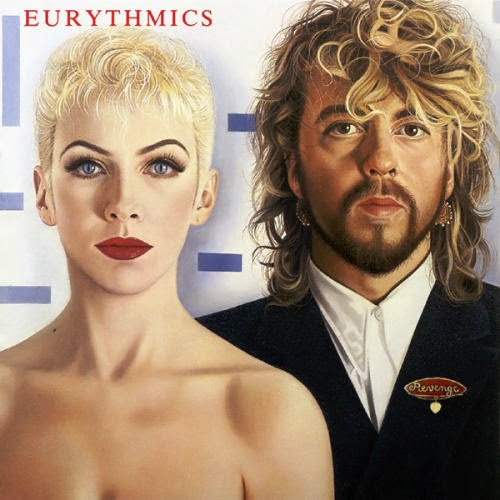
Such was the all-conquering clock-resetting art-pop-decimating power of Live Aid that it was even able to work its ‘magic’ – in the most debatable definition of the word imaginable - on acts that didn’t even perform at the event. Eurythmics had in fact been pencilled in for a slot at Wembley Stadium, but had to pull out at the last minute due to Annie Lennox having a severe attack of vocal chord-related health worries, yet even so the latter half of 1985 would see them being pulled slowly but unstoppably towards the stadium rock end of the musical spectrum. Out went sophisticated if annoyingly arch two-person electropop with performance art leanings, and in came shoutalong choruses, eight million-member rock posturing lineups, and Dave Stewart flamboyantly strumming a guitar that was barely audible on the actual records. And throughout all of this, lest we forget, Dave Lee Travis insisted on telling Radio 1 listeners that he found their name – inspired by early 20th Century progressive theories on pre-school education techniques interpolating strictly-defined usage of rhythm patterns – ‘hilarious’. No, us neither.
It was something of a surprise, then – especially given the media-dominance of the irritatingly ubiquitous (and indeed irritating full stop)
There Must Be An Angel (Playing With My Heart) the previous year – that their 1986 album
Revenge was initially something of an under-performer in the UK, with lead single
When Tomorrow Comes only just scraping into the top forty. However, their new-found theme-from-
LA-
Law-with-distortion-pedals-esque musical direction proved to be just what America was looking for, leading to music press murmurings of their off-radar States-conquering and the album being given a second push, duly propelling the uber-commercial
Thorn In My Side into the UK top ten.
Though it was an obvious choice at the time for side two of
Hits 5, it has to be said that
Thorn In My Side isn’t exactly one of those inclusions on the tracklisting that fills the nostalgic relistener with excitement, and this is borne out by the fact that it’s actually quite pleasant to hear again for about thirty seconds, but after that massively outstays its welcome, especially during the seemingly endless ‘breakdown’ bit in the middle. What’s worse, it marks the first appearance on
Hits 5 of that most hated of mid-eighties musical cliches, the American Saxaphone (of which The Housemartins perceptively observed
“it follows me all the way from the telly to the public house/my fingers are always in my ears but the reed’s always in their mouth”), which immediately loses Dave and Annie any goodwill they may have been begrudgingly granted. Worse still, it bears some subtle but uncanny similarities to another, much better song that will appear later on
Hits 5, and the video is overwrought model-festooned MTV-friendly glossy nothingness of the first order. Happily, some fellow post-punk stragglers are on hand to lift matters a bit…
The Stranglers - 'Always The Sun'
From legwarmers to yo-yos, from Batman t-shirts to those spidery octopus things that rolled down windows, fads famously came and went in the eighties with an alarmingly short average shelf life. The Stranglers, however, just kept on coming back. Every couple of years, they’d seem to fall out of fashion and into ridicule, only to suddenly score yet another hit with yet another strong single and find themselves flavour of the month yet again, with a fresh round of uniformly-adopted ‘The Men In Black Are Back!’ headlines even when they were wearing other colours. What’s more, with the aid of a liberal helping of tenuous adherence to (or, if you prefer, downright disregarding of) the Gregorian Calendar, you could make a reasonable claim that they sort of bookended the eighties with a brace of unlikely but well-recieved cover versions;
Walk On By as the seventies faded, and
96 Tears as the nineties arrived.
Slap bang in the middle of the decade came yet another resurgence in career fortunes with the
Dreamtime album, and its highly popular – if not exactly highly-top-thirty-scaling – attendant singles
Nice In Nice and
Always The Sun. The poor chart showing of these two particular singles – quite at odds with how successful the general public always seem to remember them as having been – is apparently still something of a sensitive point with the band, who even at the time were claiming that their then-record label weren’t responding to single-buying demand levels adequately. In the long term they would seem to have been proved right, not least on account of
Always The Sun being reissued several times, becoming a cornerstone of a great many Greatest Hits collections, and later cropping up regularly in adverts and as backing music in TV shows.
It’s very difficult to be acerbic, sarcastic or surreal when you’re talking about a band that have had to put up with more than their fair share of mostly unwarranted and indeed mostly unfunny jibes over the course of a long career; even more so when it’s in relation to a song that’s never been given as fair a crack of the whip as it clearly deserves. Complicating matters still further,
Always The Sun may not exactly be the most profound of statements on global economic inequality that climax with a cryptic allusion to nuclear war, but compared to most other mid-eighties attempts at doing this via the medium of pop music it’s at least restrained, impassioned and to the point. Even the video can’t really be mined for gag material, as it merely features The Men In, erm, Grey miming in a darkened studio with the occasional flash of ‘eco’-themed stock footage. Which makes it all the more pleasing to hear it on
Hits 5, to be reminded how much of a great song it is, and to have little else to say so here. But will circumstances be quite so favourable for a certain other bunch of leftover New Wave-rs in it for the long haul…?
The Pretenders - 'Don't Get Me Wrong'
Like The Stranglers, The Pretenders are enduring New Wave-era stalwarts who have suffered from a long-term unreasonable image problem, though in their case it’s entirely the opposite kind of unreasonable image problem. Whereas the so-called Men In Black were all too regularly written off as little short of their own tribute act, unable to move on musically and trapped in the persona that had brought them their greatest public and critical adulation (both of which, as outlined in the previous entry, were demonstrably untrue), time has come to pigeonhole The Pretenders as ultra-bland ultra-radio-friendly stadium rock lightweights appealing to listeners who considered
Q Magazine a bit ‘daring’. While Chrissie Hynde’s post-Live Aid ubiquity as featured vocalist on UB40′s rotten cover of
I Got You Babe hardly exactly helped matters, this unfair bracketing does a tremendous disservice to their sharp and assertive early output, their frontwoman’s status as a take-no-prisoners role model for an entire generation of erstwhile teenage girls, and the fact that at this point they were barely two years away from a snarling, blistering song about the tragic fate of their original guitarist James Honeyman-Scott. Meanwhile, UB40 are yet another band that emerged from the post-punk scene and have since found themselves tarnished by an admittedly self-inflicted image problem that has all but wiped their better material from history… but unfortunately for them, they aren’t on
Hits 5.
Sticking to bands who are on
Hits 5, it’s difficult to avoid the fact that The Pretenders who made the album
Get Close in 1986 were in many ways a different band to The Pretenders of the post-punk era. In fact they were almost literally a different band, with Hynde and Honeyman-Scott’s replacement Robbie McIntosh joined by former Haircut 100 drummer Blair Cunningham and perma-Raybanned bassist-for-hire TM Stevens, and a more jaunty and commercial sound replacing the often harsh-edged thrashy jangling of their earlier output. Though in balance, it did also include some ‘guitar synth’ work by Bowie sidekick Carlos Alomar, and a cover of Jimi Hendrix’s
Room Full Of Mirrors, which hardly exactly left it sitting comfortably in the Deacon Blue bracket.
Released in the late summer of 1986, lead single Don’t Get Me Wrong was an unsurprising top ten hit, helped in no small part by a technically impressive-for-the-time video in which Chrissie Hynde was inserted into archive footage from
The Avengers. It’s a bouncy and deceptively lightweight song bolstered by subtle but effective production (not least the unepected dramatic bursts of searing guitar towards the end), though despite what some Citation Needing contributors to Wikipedia may claim, the lyrics don’t really stand up to close scrutiny. In many ways, it’s a song that seemed tailor-made for ‘oldies’ radio even before it was a ‘newie’, and while it’s nice enough to hear again it’s not exactly a track that’s liable to get the listener freebaseing pure uncut 1986 nostalgia. Though sometimes even that can be a good thing. There is, after all, a dark side to
Hits 5…
5 Star - 'Rain Or Shine'
If you’re taking a track-by-track look at a compilation of then-recent pop hits from many years ago, chances are that you will eventually run into something you really can’t stand. Something that you hated so much at the time that you still consider it one of the most irredeemably awful records you have ever had the misfortune to hear. And indeed, something so nauseating and offensive to the ears that the prospect of having to sit through it again in its entirety almost put you off doing this project altogether. That record, in case you haven’t worked it out already (the clue is, quite literally, in the title), is
Rain Or Shine by Five Star.
Since we’ve so far gone to great lengths to challenge the widespread public perception of both The Stranglers and The Pretenders, given the sociopolitical benefit of the doubt to Paul Simon, charted a crash course through Julian Cope’s haphazard eighties output with a couple of jokes thrown in for good measure, and explained just why that bloke from Hollywood Beyond was sitting in that big chair all the time, it’s only fair that we afford an equal amount of proportionally due respect to Five Star. So, in short, they were a family-derived collection of bacofoil-clad Jacksons wannabes with an unreasonably inflated idea of their own musical worth, who specialised in tepid dance-pop only with post-New Romantic lyrical references to technology and the space age to make it more ‘exciting’, and were so inconsequential that they were openly mocked by children on live television. Whether you liked The Smiths, A-ha, Madonna or even ‘Belouis’ ‘Some’, they seemed to be the absolute antithesis of everything you found moving, exciting or fulfilling about pop music, and in this regard were far worse offenders than anyone who was ever produced by the in comparison outrageously unfairly maligned Stock, Aitken & Waterman. And
Rain Or Shine was by some distance the worst of the lot; which, when you have a back catalogue that also includes
If I Say Yes, is no mean feat.
Rain Or Shine, a sickly mid-paced drippy ballad of such overpowering tweeness that it makes Sarah from Belle & Sebastian look like she’s picking a fight with an entire taxi queue, is so unremittingly awful that for the sake of linguistic decency it’s scarcely worth commenting on, other than to chortle at the line
“Robin Hood and Major Tom/all the superheroes rolled into one”. Not only does this hint at a profound misunderstanding of the lyrics of
Space Oddity, and indeed the legend of Robin Hood, it’s also worth pointing out that ‘all the superheroes rolled into one’ is more or less an accurate description of Peter Petrelli from
Heroes, who would certainly have had some angsty difficulty in living up to the romantic promise of the lyrics. And who wrote those lyrics? None other than Pete Sinfield, formerly of King Crimson, and author of the oft-quoted around these parts
21st Century Schizoid Man. Well, we all have our off days. If anyone really cares,
Rain Or Shine came from the album
Silk And Steel, which was also handily namechecked in the lyrics, and it may actually have the worst video of all time. Anyway, you can stop covering your ears now, the next one on
Hits 5‘s quite good…
Dead Or Alive - 'Brand New Lover'
What a difference a year makes. In 1985, Dead Or Alive were scarcely out of the pop charts, and thanks to visually and verbally provocative frontman Pete Burns, barely out of the papers either. Hailing from the same Liverpool-centric post-punk jamboree as Julian Cope - indeed, Burns had previously worked behind the counter of scene-pivotal independent record shop Probe Records - Dead Or Alive had made a couple of murky-yet-tuneful critically-raved-over proto-goth electropop singles for indie labels before they were snapped up by Epic. One moderately successful debut album later, they were teamed up with Stock, Aitken & Waterman – one of the first acts to work with the soon-to-be-dominant pop production team, in fact – in an audacious gamble that paid off handsomely. With their sound refined into a sort of spectral eurodisco, and their knack for a catchy hook emphasised by up-to-the-minute synth-pop production, second album
Youthquake gave rise to no less than four seizeable hit singles, not least two-week chart-topper
You Spin Me Round (Like A Record). And in what was perhaps their most startling achievement of all, Dead Or Alive even seemed to still be attracting public interest post-Live Aid.
Quite what went wrong between then and late 1986 is difficult to say, but despite the absence of any readily discernible reason, the inescapable fact of the matter is that surprisingly few people seemed to have much interest in the return of Dead Or Alive. So few, in fact, that ready-to-roll follow-up album
Mad, Bad & Dangerous To Know, again produced by a by-then-very-much-in-the-ascendant Stock, Aitken & Waterman, ended up being delayed until early 1987 following the poor chart performance of big comeback single
Brand New Lover. It’s probably true to say that it was really more of an ‘album’ as opposed to a straight-up collection of potential hits like Youthquake, and as such probably gave off much less commercial ‘vibes’ from the outset, but even so, you’d think that a few more of their clearly enormous fanbase of only twelve months previously might have been at the very least vaguely interested in what they got up to next.
The compilers of
Hits 5 clearly assumed so too, which is how it ended up being plonked towards the end of the second side, and although some sources point towards a pressing plant error resulting in not enough copies being in the shops to meet first week demand, a quick relisten to
Brand New Lover reveals the uncomfortable truth that it’s a really rather ordinary song by a really rather good band. It’s pleasant enough, but doesn’t really go anywhere, doesn’t really stand out, and the rather muted production – more like something you would have heard on an early Jason Donovan b-side before Mike, Matt and Pete started putting a bit more effort into these things - doesn’t do it any favours either. Put it this way, it’s no
In Too Deep. Perhaps, then, its failure to progress any further than number thirty one isn’t so hard to understand. Then again, a really rather ordinary Dead Or Alive song is still a million times better than some of the codswallop that enjoyed a stronger chart showing in 1986…
Haywoode - 'Roses'
With every double-album recent hits collection like
Hits 5 – so that will be the other
Hits albums, the
Now That’s What I Call Music!s, the
Out Nows the
Smash Hits Partys and that
Raiders Of The Pop Charts thing – there was always one track that you’d just end up skipping altogether, sometimes even from the very first listen. Quite often the precise identity of this track would vary from listener to listener – opinion must have been divided on the likes of, say, Big Country, Jan Hammer and Jaki Graham to name but a few - but sometimes there turned out to be one song that almost everyone agreed on in their needle-lifting/fast-forward-hitting millions. Not because it was particularly bad, or particularly angular, or particularly by ‘Belouis’ ‘Some’, but just because it was, well, a bit on the dull side.
‘Sid’ Haywoode – for that was apparently her full name – had been making largely unsuccessful dance records since the early eighties, and it wasn’t until 1986 and a teaming up with Stock, Aitken & Waterman sideman turned part-time producer Phil Harding that she scored a hit with
Roses. And the choice of Phil Harding was an apposite one, as everything about
Roses – from the melody to the arrangement to the lyrics to even Haywoode’s actual adopted image for the video and tie-in appearances – smacked of little more than a transparent attempt to jump the pink-streaked bandwagon started by Mike, Matt and Pete’s big breakthrough act of the year before, Princess. The main difference, however, was that Princess had stronger songs, sharper melodies, denser production and, if we’re being pedantic about it, a better hat.
Roses, with its ‘sassy’ lyrics masking a rather gender-politically dubious message and aesthetic-numbing
Grandstand theme-aping squealy session guitar, was simply the right record at the right time. Everything else about it is just plain wrong.
What’s more mystifying is the question of what exactly it was doing on
Hits 5.
Roses had been a hit – actually stalling just outside the top ten – back in June 1986, and although as we shall see it wasn’t actually the oldest inclusion on the album, it was certainly long enough past its shelf life to strike any pop-obsessed youngster perusing the tracklisting as a chronological fish out of water. Haywoode clearly still has her followers, as there are plenty of online profiles out there that make ridiculously great play of her non-
Roses achievements, coming across like some weird eighties pop counterpart to that article where Lester Bangs invented a parallel dimension decade-straddling career for sixties one-hit garage-psychers The Count Five, while
Roses-sporting album
Arrival has been reissued in a jaw-droppingly lavish Deluxe Edition. It’s not likely, however, that their ranks will be swelled by anyone taking a retrospective relisten to
Hits 5. Still, at least people actually
remember her one hit…
The Real Thing - 'Straight From The Heart'
For better or for worse, 1986 was the year when The Opportunistic Cash-In Re-release really came into its own. From jeans ad-soundtracking Kamen-endorsed Motown oldies, to anniversary-contorting punk hoedowns, to an unlikely rock’n'roll relic catapulted chartwards by an ideologically dubious claymation caricature, record companies were suddenly rifling through their back catalogues with a renewed vigour. The Real Thing’s seventies chart-topping disco favourite
You To Me Are Everything hadn’t been used in an advert or film, nor was it – despite being subtitled ‘The Anniversary Remix’ – tied in with any tangible actual anniversary, nor was it even particularly favoured by the emergent ‘Rare Groove’ scene. In truth, it was really only promoting a standard-issue Greatest Hits album, and yet ironically it proved to be the most successful revival of the lot, only narrowly missing out on repeating its chart-topping antics and leading to two further Real Thing oldies – again in handy ‘Anniversary Remix’ makeovers – climbing almost as high again in the charts. And then, inevitably, they had to have a go with a ‘new’ song.
In fairness, The Real Thing had never really been away at all. They’d carried on scoring minor hits into the eighties, and once they hit a temporary brick wall chartwise, still managed to carve out a successful career in TV variety shows and backing old pals like David Essex. The second-time-around hits were in some ways little more than a welcome bonus for a band that were still a going concern and still doing very nicely thank you, and nobody could really blame them for trying to get their new material some exposure on the back of the reissue-mania. The problem, though, was exactly the same one that they’d faced the first time around – that despite their success in the field of
Hill Street Blues theme-soundalike mid-paced balladeering, The Real Thing were actually a pretty serious band, heavily into their deep funk sounds and keen writers of socially aware material, including a startling late seventies song trilogy that more or less predicted the urban unrest that would break out in the UK in the early eighties, but whenever they headed in that direction, for some strange reason the public just didn’t want to know.
Straight To The Heart, the ill-fated ‘new’ single released at the tail-end of 1986, sat somewhere between their musical extremes, and – yes, you guessed it – once again the public just didn’t want to know. It only just scraped into the top seventy five, and thereafter disappeared from view completely, to the extent that it’s not even been uploaded to YouTube in any form. It is, however, preserved for posterity at the end of side two of
Hits 5, and it’s a creditable effort with some neat jazz-funk touches in the backing and an interesting free-form approach to the verses. And, well, that’s it for side two, and ahead lies what you’ve all been dreading – the inevitable ‘ballads side’…


