Showing posts with label eighties. Show all posts

Looks Unfamiliar #15: Steve Berry – I Survived The Great Nostalgia Wars Of 1989


Looks Unfamiliar 15 – Steve Berry

Looks Unfamiliar is a podcast in which writer and occasional broadcaster Tim Worthington talks to a guest about some of the things that they remember that nobody else ever seems to. Joining Tim this time is writer, broadcaster and TV Crisp Expert Steve Berry, who’s keen to scratch a nostalgic itch for Single Versions Of Pop Songs That Never Get Played Any More, Elastoplast Heroes, late night Channel 4 show United States Of Television, Skoal Bandits, the Starblazer Electronic Space Command Belt, and school assembly songbook Morning Has Broken. Along the way – when we’re not stalking Richard Herring – we’ll be musing on the hard-hitting storylines Grange Hill missed, discovering the identity of ‘Ant Marco’, and working out just how far you can balance a hymn book on the edge of a church balcony. And there’s ten million points if you can work out which comedian is noisily drinking coffee in the background…

DOWNLOAD IT HERE - SUBSCRIBE IN ITUNES - RSS


You can find more editions of Looks Unfamiliar here.


Looks Unfamiliar is hosted by Podnose.


Support Looks Unfamiliar by buying one of Tim's books! Fun At One - The Story Of Comedy At BBC Radio 1 is available in paperback here or from the Kindle Store here. And there's several other books to choose from here...

There's So Much More In TV Times Part 14: Parky's Perfect Dinner Party


Imagine, if you will, a time when Peter Davison was a widely-loved television star who, in spite of the occasional bit of wishy-washy fence sitting that even in its full context hardly adopts an actual tangible position, was generally seen as being on the right side of right-on and an overall likeable and decent person.

Well, that was approximately four days ago. Cast your mind back, though, to a time before people who don't even sodding watch Doctor Who decided to take a tabloid's word over his, and him out of The Terror Of The Vervoids tried to score a few cheap points and somehow still managed to come off worse. Yes, it's time to travel forwards to the late eighties, a time of huge change for TV Times. There was now an extra commercial channel, outraging the tabloids with Keith Allen swearing at a polish cartoon or something. Home video was luring viewers away from good clean World In Action and The Fear, except for when it wasn't and something about Video Nasties. And throughout it all, Brucie kept on putting on that comedy oversized chef's hat and making something out of 'leftovers', only on slightly better quality paper.


Something that had most definitely not improved with the passage of time was the quality of readers' letters. Here we can see a thoroughly pointless missive from someone who felt sufficiently impressed by a character from The Bill behaving like a character from The Bill to write in to TV Times to congratulate the programme makers on this bold artistic decision. And that's not the last we'll be hearing from Sun Hill's finest, but moving on...


Full-paged posed photos doubling up as putative 'posters' for the terminally barking mad with no discernible sense of design aesthetic were all the rage around TV Times Towers in the eighties, it seems. In the ludicrously small boxout bit that nobody ever read, Gary Wilmot - who, it's staggering to recall, was all over ITV at the time - reveals that he took time out from impersonating whoever it was he did impersonations of to indulge in a spot of proto-green Save The Trees rabble-rousing; something that, much like Timmy Mallett's denunciation of Apartheid for the benefit of Wide Awake Club viewers, suspiciously never seems to get mentioned whenever the ha ha you big rubbish what were we thinking sneering boots up again. He also seems to be wary of the imminent arrival of Ben Kingsley, Clown Union. This is followed by Matthew Kelly making with the ha ha ha hee hee hee's and 'Gnome - For A Laugh!' puns as he introduces us to his good friend Grimble Grumble. There's probably a perfectly sane and rational explanation. If there is, though, it isn't in the boxout.


TV-am's top 'Girls Who Get Britain Up In The Morning' as the tabloids always had it Ulrika Jonsson and Lorraine Kelly kick off the 1990 FIFA World Cup with a bit of posed punch-up hilarity - hardly the most appropriate of analogies at a time when football was desperately trying to restore its yob-tarnished image - in honour of their home nations' imminent Group C clash, in an issue of TV Times that mysteriously 'disappeared' into a million teenage boys' bedrooms the second that that week's Friday Night viewing was over.


Big smash blockbuster miniseries came and went in the eighties, but every Sunday evening on ITV you could find Harry Secombe strolling religiously from region to region and singing about how God made the clouds while standing in the grassy bit in the middle of a dual carriageway. Yes, bizarrely compelling surrealist masterpiece Highway was putting together an album, and they needed your inexplicably typewritten help! Just write to Harry telling him which hymns you would like to see and indeed hear on there, and when he's finished sending his Christmas Cards he'll draw up a tracklisting. Sadly, how many wags voted for He Made This Lovely Anorak is not on record.


Sometimes, on the almost unthinkably rare occasions on which Brucie was not available (or, more likely, they'd simply run out of 'leftovers'), you just had to get someone else in the kitchen to do 'wacky' poses at the top of a recipe you can't help but suspect they'd never actually been within fifteen feet of. Here for example we can see Kenny Everett refuting all accusations of 'wackiness' whilst throwing a zany look at an industrial-strength quantity of spaghetti, followed by Hale And Pace in character as 'Ron' and 'Ron', offering up a Cloret-inviting menu of basic food procedures kitted out with good honest thumping-skewed pun variants on their names, which was presumably food wot you would like otherwise 'Ron' will arrange for you to have some food wot you would not like even more if you get our meaning ur hur hur 'Ron'.


Hang on a minute... Parky? What's he doing here?! Telling us who his ideal dinner party guests would be, that's what. And it will surprise precisely nobody to learn that Billy Connolly is top of the VIP RSVP list, followed only slightly less predictably by the 'anecdote' barrage of Michael Caine, Jonathan Miller, Alistair Cooke, Anthony Burgess, Peter Ustinov, and token 'there are no women allowed on the dock of the bay' exception Shirley Maclaine. Apart from displaying a strange obsession with getting them all to gather round the piano for a sing song, he also pretty much maps out who will talk on what topic and when, and states his intention to treat them all to caviar, Dover sole and fancy ice cream washed down with coffee, cognac, port and a premier cru Chablis, all of which will take place in the Gilbert And Sullivan rooms at the Savoy. "Beat that!", boasts Parky. OK mate, fix me up with Karen Gillan and her off The Unbreakable Kimmy Schmidt at a Pizza Express and I fucking well will.


One regular feature of TV Times in the eighties was the confusingly titled 'My Top Ten Top Tens', in which stars of the network were asked to list their favourite examples of several 'quirky' genres, resulting in enough text to pad out to a three page spread being crammed into a single page. In this example we see Kevin Kennedy, TV 'Curly' (Coronation Street), expressing his enthusiasm for decidedly unadventurous music, movies, cuisine and lust icons, though he does sneak the somewhat less than predictable Tutti Frutti and Hank Wangford's A-Z Of Country Music into his list of 'TV Gems', which at least wins him some points. Note also how he crowbars a couple of his Corrie mates in where he can, notably Bill Tarmey above John Wayne in 'Greatest Actors'. No mention of Don't Forget The Old Folks At Christmas by Bill Waddington, though.


What I Watch was a regular feature in TV Times throughout the eighties, in which a procession of second-tier celebrites - or in some cases just anyone who actually answered the phone - namechecked a couple of currently popular television shows, primarily with a hefty ITV slant, and revealed absolutely nothing about anything whatsoever. Here, for example, is Kevin Lloyd, street-hardened DC Tosh Lines from The Bill, pretty much listing all of the then-operational ITV detective shows, followed by a plug for the now entirely forgotten massive-in-their-day sitcoms About Face and Surgical Spirit, and a suspiciously sizeable thumbs-up for ITN. It doesn't take Ted Roach to figure out what his 'snouts' had tipped him. This is followed by Brookside head honcho Phil Redmond taking time out from appearing on the front page of the Liverpool Echo holding his fringe back with a 'defeated' look and asking why the 1957 Venezuelan National Games can't be in Liverpool to bore everyone senseless about 'realism' and 'value' before going on about films and some programmes he created himself. And finally, Ian and 'Wee Jimmy' essentially run through an entire day's schedule on ITV from Chain Letters to Taggart, pausing only to admonish sitcoms for being too middle class and not reflecting real life - presumably they needed more 'naughty' schoolboys in outmoded school uniforms getting up to all manner of Forties DC Thompson-style hi-jinks (and, of course, chalking rude words on next door's garden gate) - and, worryingly, confirm that "we liked the Shoot To Kill programme". You'd never have expected that of The Krankies and their strict adherence to wholesome family fun.


Oh for fuck's sake. Still, this will only be a rare lapse on the part of good clean ITV. After, all, it was the boo hiss BBC that 'all knew', and ITV never employed any of that shower at any point ever.


Moving rapidly on...


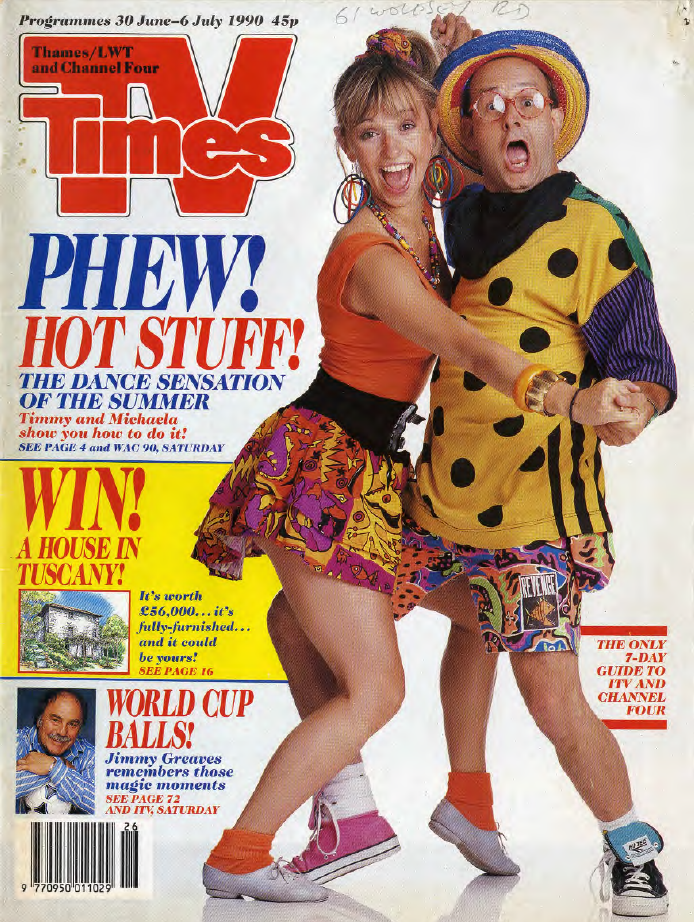
Time to dance your cares away with Timmy Mallett and Michaela Strachan, and their tried and tested formula of just copying something in the public eye and putting 'Wac' in front of it so nobody would ever suspect a thing, as they teach us how to do the purported 'dance sensation of the summer', The 'Wacbada'. Sadly the issue in which they explained how to bust a move to Pump Up The Jam by Wacnotronic Feat. Jelly was not available. Nor was the Halloween/Bonfire Night issue of Family Circle with Timmy Mallett on the cover. Slightly less sadly.


Grr grr, remember when Ryan Paris and those Eurocrats in Brussells made us change the name of all of our best chocolate and chew bars and there was that hilarious comedy advert with a 'French' woman refusing to buy a Marathon, except it was actually a change enacted to allow more seamless integration with American branding, advertising and manufacture so don't go losing your temper and ramming some chlorinated chicken down Liam Fox's throat or anything etc etc? Well, it wasn't the only thing changing around then, and in 1991 - signposted with a bizarre full-page advert saying 'What's Bob Cryer Doing On The BBC?' - TV Times and Radio Times were finally allowed to run each other's schedules and, well, a little bit of character went out of each. So it's at this point that we leave our collective bafflement at TV Times' eccentricities for now, but there's still the seventies to get through. And more eighties. And there might even be the odd thing or two in Radio Times worth looking at. In fact, you could almost say there was so much more still in it. Sorry.


If you've enjoyed this article, you can find lots more slightly more serious writing about fifties and sixties television in Not On Your Telly, which is available in paperback here or from the Kindle Store here.

ITV 59 - All Your ITV Favourites (And Mike & Angelo) Part Nine: TV-am AND Channel 4!


Baaaa! Baaaa! B'baaaaa (DUM DUM DUM)! Well, Independent Television Fans, it seems that this archive-scouring expedition through the electronically generated polystyrene chips that used to be wedged between your average day's worth of ITV programming is attracting less than a quarter of the audience that the earlier and self-edivdently far more successful jaunt through the BBC's equivalent iconographic history did, and quite obviously this is down to the fact that TEHER ARE FAR TOO MANYT IDEANTS IDENATS

Sorry, not sure why that keeps happening. What we were trying to say up there was that quite obviously this is down to the fact that ITV really always just had a 'nyahhh... that'll do' carboard-and-Letraset attitude towards its own inter-programming corporate brandery, and as such the end result was both much less interesting and indeed much less just plain weird than that of the BBC. You may even have noticed this being ever so slightly reflected by last couple of entries not really featuring that much in the way of anything worth commenting on. In the hope of making up for this, we've kind of expanded the remit for this particular entry to allow for closer examination of two somewhat more interesting offshoots of the Independent Television expanded universe - Channel 4 in a little while later on, but firstly, TV-am!


Once an all-too-familiar sight to youngsters who had got up before TV 'started', and with all the artistic flair of a crudely felt-tipped drawing cut out with safety scissors and clumpily pasted onto dull-hued skin-irritating 'soft card' for a school project, this makeshift 'GET BACK TO BED' notice would sit blearily between the end of the overnight shutdown and transmssion tests and the actual commencement of TV-am, with Good Morning Britain's uneasy lurch from beshirted break of day 'hard news' to sofa-bound tabloidy celebrity-endorsed campaigns against whatever people were against that week famously introduced by...


Backed by THAT Jeff Wayne-penned the-chances-of-anything-coming-from-Teddington-Lock ambient synth fanfare, Good Morning Britain would blare its way onto the airwaves with a celebrated opening sequence featuring the individual words of the show title picked out firstly by - gasp - derring-do-representing 'Red Devils'-esque skydivers holding aloft a banner for the benefit of all the square-jawed youngsters who were constantly being told 'YER LIKE THIS' about quasi-military 'adventure sport' stuff, then by some flowers blooming aboard whatever it was that had latterly replaced the Ark Royal (the square-jawed youngsters neither knew nor cared and were only watching to see Super Chicken anyway), then by some 'seed'-thirsty pigeons descending on Trafalgar Square en masse in a strict lexicographical formation, and finally by some hapless members of the general public standing in a predefined arrangement to bodily spell out the full title, famously diverging in a bizarre 'melting letters' gambit at the start of certain ad breaks. And speaking of TV-am's ad breaks, you know what the best one they had was?


Hang on a minute... Parky? What's he doing here?! Don't start adjusting your set just yet - unfortunately, despite extensive research, it's proved impossible to locate any of those ad break slides wherein a crudely cut out Roland Rat mounted on a stick was pushed in at 'zany' angles in front of a still photo of a nonplussed-looking Kevin The Gerbil, so Mr. Parkinson has generously agreed to appear as an illustration in its place. Anyway, that's the last we'll be seeing of him.


The present-day availability of cheapo cricket bat-stricken Rat mock-animated examples notwithstanding, TV-am's ad break slides really did have to be seen to be believed, walking a daredevil technological tightrope by cramming in pretty much everything bar the kitchen sink. And, if the ad break was during one of Rustie Lee's cookery slots, the kitchen sink as well. This one here manages to combine a functioning superimposed clock, a cheery picture-in-picture salutation from the resident newsreader, and impenetrably cryptic hints at upcoming features (Between Stairs??). All very impressive, though do bear in mind that you're not supposed to praise TV-am these days due to their Thatcher-impressing strike-busting anti-union antics, irrespective of the fact that their bizarre attempts to keep the station running by using tea ladies to operate cameras and running episodes of Flipper backwards (not actually an exaggeration for comic effect this time) provoked mirth rather than pride. You may as well just read the Daily Mail and be done with it. So it's definitely time to move on... to another ITV semi-affiliate that nobody upon nobody could accuse of ever displaying hostility towards right-on-ness. Well, up until about 1998 anyway.


Yes, it's those famous tumbling primary-coloured blocks assembling themselves into a warning of lefty performance art/sweary drama/feminist documentary/ethnic sitcom/agit-prop poetry/Keith Allen in general to come, Channel 4 The Big Bore! Created by original-lunch-scoffer Martin Lambie-Nairn using months of painstaking transatlantic computer technology that you could probably do in a couple of minutes on your phone now, the deceptive genius of the self-constructing approach was that - as would be endlessly demonstrated over the years - it could be easily broken down and reassembled into another suitable shape to accompany such landmark televisual events as Puffin Night, Kia-Ora Night and Mr. Pastry Night. Or even into a '5' for an actually rather amusing advert featuring what was, to all intents and purposes, an unlabelled 'mock'.


One of the more sane and rational rearrangements of the three-dimensional fragments was into this natty Swatch-evoking clock face, which it has to be said was seen on screen a lot more than any corresponding ITV clock ever was. And the reason for this curious disparity is about to be made very obvious indeed...


In a classic bout of you-couldn't-make-it-up-ness, Channel 4's early years fell victim to the very same sort of industrial relations that they insisted on showing fifteen thousand hard-hitting documentaries about every evening, and as such they were only allowed to sell a limited amount of advertising space per day. As a consequence, ad break insulation foam captions like the one seen above were common currency, albeit thankfully without some bloke with a buzzing microphone spluttering at a speaker-rattling volume over the top. If they'd shown more Murun Buchstansangur this would never have happened.


Anyway, back to those bizarre situationist reimaginings of the constituent parts of the '4'. One of Channel 4's favourite early cost-conscious space-filling gambits was the bulk-buying of televised minority sports from around the world, which unexpectedly paid off when the nation's schoolboys (and, erm, Bernard Levin) briefly became caught up in the Madden-commentated thrills and spills of American Football. While William 'The Refrigerator' Perry's spell of being known over here as anything other than a ridiculous name would prove to be all too brief, Channel 4 certainly did their utmost to capitalise when it was still a 'thing', hence the teetering 4-derived linebacker shown above. Saltwater Taffy all round, y'all!


No primary colours here, pals. As anyone of a certain age knows, night-time on Channel 4 was where European ladies took their tops off and shouted "REHHHHHH POLITICA!!!", alternative comedians joked about what would happen if Thatcher was a bus driver, award-winning animations blurted out sub-Morph gibberish about Enver Hoxha, Jonathan Ross did 'postmodernism' and went on about old toy rockets and bizarre films, and TV's The Joeys appeared in The Corner House. Except, of course, for when you were watching, when it was only ever endless hard-hitting documentaries about restrictive practices. Unless, of course, there was a certain symbol in the top left of the screen...


Woah yes. The lights are out, the family filters are off, the film stock has been rendered suitably sandpapery, and it's time to unwind with a controversial banned movie from the more uncompromising corners of the globe, so strap yourself in for a generous helping of allegorical nude ladies, allegorical laughably rendered cannibalism, allegorical frank talk about sexually transmitted diseases and allegorical babbling in invented nonsense languages with the likes of Pastoral Hide And Seek, Throw Out Your Books Go Into The Street, Out Of The Blue, Identification Of A Woman and The Clinic. Or, when you were watching, hard-hitting documentaries about restrictive practices, only in Brazil or something.


And to round things off, here's the special variant they produced to celebrate Channel 4's fifth birthday in 1987, an occasion that they marked with repeats of Ace Of Wands, The Tomorrow People and Randall And Hopkirk (Deceased). A joke that will be lost on all bar about three percent of the readership. Oh well, join us again next time for the bit you've all been waiting for...


If you've enjoyed this article, you can find lots more about stuff you just don't see on television any more in Not On Your Telly, which is available in paperback here or from the Kindle Store here.

Could It Be Magic? (A: No)


Relax had Two Tribes. The Secret Diary Of Adrian Mole Aged 13 3/4 had The Growing Pains Of Adrian Mole. Rockliffe's Babies had Rockliffe's Folly. Even C.A.B. had C.A.B. 2.

But the Rubik's Cube? Well, that's one unexpected runaway eighties success story that never actually inspired a sequel. Or so you'd think, given how it's now pretty much uniformly used as a textbook example of a one-off here-today-gone-tomorrow short-lived global sensation to rank with The Dirtwater Dynasty and It Bites. Which is a very strange way of looking at it, as not only does that version of events imply that precisely none of the millions upon millions upon millions addicted to attempting to master the art of flipping edges and twirling corners before flinging it at the wall in frustration with a copy of a You Can Do The Cube by Patrick Bossert in hot pursuit - in numbers and with an intensity that made Flappy Birds look like Atlantis Is Calling (S.O.S. For Love) by Modern Talking - would ever have been salivating at the prospect of a brand new follow-up puzzle from the same team, it also fails to entertain the likelihood that Professor Erno Rubik would have wanted to further capitalise on the phenomenal worldwide popularity of his maths homework that got out of hand.

The non-clip-show-friendly fact of the matter is that once the original plastic mind-and-wrist-hurter had caught on, a legion of cube-infringing imitators soon sprang up like third division Britpop bands singing about eating some loverley fish and chips, hoping to cash in on the purported puzzle craze by convincing punters to fork out for market stall-proferred Rubik-alikes in all sizes and shapes from barrel to tennis ball. And like a first division Britpop band, Professor Rubik responded to this poorly catered-for demand by changing direction entirely, promptly developing Rubik's Snake, a twisty turny angular shape-making whatnot that was pretty much that thing from the episode of The Monkees set in a toy factory made reality. Actually, Oasis make a bit of a mess of that analogy, but the point that hasn't actually been made yet still stands - namely that underneath all the branding and promotional fanfare the Snake was really just a fun novelty, and what everyone really wanted from the house of Rubik was another fully certified brainteaser and mindbender. And, bowing to public demand, a fully certified brainteaser and mindbender from the house of Rubik was exactly what they got in that year of pan-cultural transcendental symbiosis, 1986.

Rubik's Magic, as it was rather grandly dubbed, consisted of a set of eight elaborately-hinged plastic squares, each bearing a portion of two of three Olympic-esque multicoloured rings. Initially discrete, the point of the puzzle was to jumble the circular sections up and then reassemble them in one of many interlocked forms of ascending difficulty. It was, the global populace were breathlessly informed, the brand new trailblazing puzzle sensation with more than a hint of mid-eighties sophistication; literally the next Rubik's Cube. And so it was that on Christmas Day 1986, shortly after flicking through their copies of Cool's Out and scoffing their Citrus Spring selection boxes, an entire generation of youngsters attempted to get to grips with the foldy-flipboard-interlinked-circles thing. And attempted. And attempted. And... gave up.


Much like the Sinclair QL was to the ZX Spectrum, or if you prefer like Dramarama: The Young Person's Guide To Going Backwards In The World was to Dramarama: The Young Person's Guide To Getting Their Ball Back, this wasn't even so much an attempt to reinvent the wheel as it was to reinvent an individual spoke. Nobody could accuse Rubik's Magic of skimping on the need for dexterity, logic or flashy displays of lateral thinking, but the important element it left out of the equation was fun. It didn't look as appealing as the Cube, it lacked the vital fiddlability factor (in fact, fiddle too idly with Rubik's Magic and you ran the risk of twisting one of the interconnecting wires unusably in the wrong direction), and played straight into the hands - literally and metaphorically - of people who would solve it and then go 'ahhhhhhhhhhhh!'. If anyone did try to dazzle you with their Magic-solving skills, it was about as impressive as the 'David Copperfield Unplugged' tricks from Chris Morris' Radio 1 show. Where the Rubik's Cube had inspired still-bewildering Ruby Spears animated hijinks Rubik, The Amazing Cube, Rubik's Magic could barely even scrape a mention on BBC2's 'popular science' shows. Patrick Bossert's You Can Do The Magic would sadly never see print. He may as well have invented Rubik's Shark and jumped over it.

Within a couple of years, Rubik's Magic was a regular trestle table sight at church bazaars. And yet, for all its shortfalling in terms of hands-on puzzling thrills, it at least had and indeed retains a charming air of mid-eighties highbrow high-concept folly, and we can only guess at what might be found on a Fantastic Eighties! compilation with the Magic rather than the Cube on the front (though the smart money's on Atlantis Is Calling (S.O.S For Love) by Modern Talking). There was an attempt at making amends with Rubik's Clock in 1988, which presented the hapless puzzle-solver with nine chronologically-skewed clockfaces in the style of one of Peter Petrelli's hallucinations, and challenged them to reset the mechanically-interlocking dials to all show the same time. However, this wasn't actually created by Professor Rubik, who simply bought the rights to market it, and so it doesn't really count. Outwardly impressive, but lacking the true credentials, it was, in so many ways, the Beautiful South to his earlier creations' Housemartins.

Don't Take A Look At Him Then


Every so often, you'll find a newspaper or magazine feature charting the Mojo-approved Official History Of The Pop VideoTM. With a bit of variance to allow for frowning over the record sales of whoever's proving quite popular at the moment, it normally runs somewhere along these lines: the pop video was invented by The Beatles when they started doing music that was too complicated to perform live, and then invented again by Queen in 1974, and then it took off but also declined with the arrival of MTV. With the exception of one wildcard entry by an 'influential' indie band, the accompanying lists of Best Ever Pop Videos are essentially always more or less the same, although none of the corresponding lists of Worst Ever Pop Videos ever point out that the actual literal worst pop video of all time is November Rain by Guns'n'Roses, a parade of pomposity, pretentiousness and heavy-handed 'symbolism' so mind-numbingly interminable that Slash actually GOES FOR A WALK in the middle of it, and which ends with Axl Rose springing back and forth in what can only be a tribute to that animated rabbit trying to pull a carrot out of the ground in Rainbow.

One thing that they can all agree on, however, is that the eighties was the evolutionary high watermark of the pop video, when everyone blew vast amounts of money on exhiliarating big budget high concept mini-movies that epitomised the perfection of mid-eighties pop except that they also epitomised the imperfection of mid-eighties pop, and that The Smiths reacted against this by refusing to make any pop videos ever apart from all the ones that they actually did. And once they get onto that subject, the same old examples get trotted out again and again and again. There's The Wild Boys, Duran Duran's homage to Channel 4's Ghosts In The Machine, in which a robot head of Lloyd from Byker Grove headbutts a computer or something while Simon Le Bon goes round on a big water wheel. There's Peter Gabriel's Sledgehammer, a song-ruining parade of animated click-ting stamps literalism tailor made for clip show representation of a year that everyone knows should only be signposted by Phil Cool drinking Citrus Spring. There's Reet Petite, the Claymated springboard for an unexpected three-hit Jackie Wilson mini-revival, which causes clip show talking heads to perform an elaborate retronostalgic variation on the Charleston when they chuckle that they found it funny, then frown that they also found it offensively caricatured, then chuckle that they found it funny again, all the while utterly oblivious that it was first made as an interstitial for the BBC arts show Arena. And then there's Thriller, in which Michael Jackson effects a terrifying transformation into Barry Grant from Brookside.

What you will never find in any of these articles, however, is the cold harsh truth that the most hilariously awful videos of the eighties were a combination of attempts by visually unarresting mainstream artists to look 'stylish', and clip-interpolating rock ballad big budget film themes. And the most hilariously awful of all were those that were a literal combination of the two. If you want evidence of this, look no futher than Phil Collins' Against All Odds (Take A Look At Me Now).


Like all big hit movie themes of the eighties, Against All Odds (Take A Look At Me Now) was the credit-propping pop ditty from a film that nobody seems to have seen despite latterday ubiquity in the hallowed everyone-else-in-school-was-allowed-to-stay-up-but-you timeslot. As far as anyone can make out it's got something to do with a love triangle and Jeff Bridges being framed for a crime he didn't commit except he did or whatever it is; frankly, as it was a contemporary of Spies Like Us, nobody should even be in the least bit interested.

As you can imagine, the accompanying video features an endless parade of clips from the overlong popcorn-challenger, most of them seeming to involve little more than people turning their heads slowly sideways. As you can also imagine, these are interspersed with Phil Collins doing some piano-free power ballad miming to camera. What elevates this above the competition, though - and even above Peter Cetera looking askance at some clips from The Karate Kid Part II through sliding doors, which takes some elevating above - is how they introduce the nation's favourite Mel Smith/Eddy Shah/Bob Hoskins-alike into proceedings; the camera zooms in on some sort of Aztec mask featured in the movie, which promptly starts miming his part. No, really.

We then get a dissolve into his face as he stands in front of a luminescent waterfall, which gradually changes colour from red to green to blue, presumably as some sort of love triangle-evoking symbolism, and leaving him looking like Max Headroom as reimagined by whoever designed the wrapper for Terry's Bitz. The mask sporadically recurs but fails to do any more miming - so you could be forgiven for thinking you'd imagined it - Phil slides in and out of frame like a 'comedy' Roland Rat-plugging TV-am ad break card, and a procession of thuds and wallops from the film accompany the inter-verse drum thudding.

But that's not all. For the finally overwrought chorus repetition, Phil changes location to what appears to be the actual literal studio floor from BBC Daytime quiz show Turnabout, which then in turn appears to threaten to turn into the opening titles of The Tripods. All you really need is a cameo from 'Belouis' 'Some' and that'd be the entire eighties right there.


What any of this has to do with any of the film is something of a mystery, and judging from the look of the clips included here, a mystery it can frankly remain. What it does tell us, though, is that if you want a real flavour of an art form, even something as trivial and ephemeral as the pop video, you have to look slightly further afield than the usual accepted facts and figures. You'll find the most ludicrous of stuff in the most unlikely of places, like in bafflingly thrown-together film advertising thinly disguised as chart fodder, and we haven't even started on movie-plugging promo antics by Starship, Chesney Hawkes or 'Dinners' yet.

And anyway, this is the best pop video ever made...

Great Lost Synth Sounds Of The Eighties


Whenever people start getting misty-eyed about vintage pre-digital synthesiser sounds, it's always 8-Bit this and monophonic that and someone that sounded a bit like a cut price Top Of The Pops album version of a Factory Records-inspired outfit who couldn't even get signed to Cherry Red the other. Nobody ever seems to wax similarly lyrical, however, about the next evolutionary step - that Roland/Korg-fuelled Whole Band In A Box sound, or rather infinite(ish) permuation of sounds, that dominated most of the eighties and made Go West records sound like, well, Go West records.

And, as you might have guessed, it's high time that somebody actually did. Here are five of the greatest synth sounds that you once couldn't turn on the radio without hearing, but which now everybody tries to pretend never happened...


1. The 'Squiggly Synth'
As heard in... Mama Used To Say by Junior


Weaponised sine wave doodle initially much beloved of the Pigeon Street Soul brigade (see here if you have no idea of who or what they might actually have been), but which later became a staple fixture of early to mid eighties primetime TV themes, most notoriously deployed for Nigel Havers-centric divorcecom Don't Wait Up and long forgotten post-Whirly Wheelgate Noel Edmonds 'soft launch' reboot Whatever Next?, which was a corker, especially in conjunction with the 'teleporting Edmonds' visuals.


2. The 'Flattened Trumpet'
As heard in... Love And Pride by King


Weedy yet widely adopted analogue approximation of a vaguely 'trumpety' sound, which gained huge popularity on account of the relative cheapness of getting the Barry Andrews-haired 2000AD-jacketed Synth Wizard every early eighties band had by law to provide the illusion of a brass backing rather than hiring a small army of real live session musicians. Most infamously used for the instrumental break in Nikita by Elton John, which still finds its way into the minds of office workers on a loop at 11am precisely to this day.


3. The 'Tin Can Orchestral Sweep'
As heard in... Feel So Real by Steve Arrington


Less aesthetically successful variant on the above, attempting to mock up the sonic experience of a full orchestra with some ham-fisted ADSR-fiddling that sounded more like someone scrunching up some inadvertently tonal tinfoil backed up by a malfunctioning washing machine calling you on an old-school telephone where the magnet's gone in the earpiece. A surprisingly enduring example which lasted to the end of the decade, last sighted hidden somewhere behind Big Fun's cover of Blame It On The Boogie.


4. The 'Kamizake Portamento'
As heard in... Yellow Pearl by Phil Lynott


'Future Is Now!'-heralding plummet down the musical scale, possibly intended as a call-to-arms for robots, New Romantics and people drinking Quatro, but ending up more as something that the most annoying kid in your year in school would be able to provide a note-perfect emulation of without anyone ever asking them to. One of the most short-lived examples on this list, spending a short time as a go-to effect for everything from Heartache Avenue to Say Say Say, but ditched in favour of the 'orchestra hit' even before The Tripods began striding across our screens.


5. The 'Existential Flute'
As heard in... Does Caroline Know? by Talk Talk


Introspective Blue Jam-friendly soft-toned World Music-esque woodwind pretence usually reserved for when they were trying to get a bit 'soundscape', doubtless intended to convey a sense of zenned-out globally aware musical mindfulness but invariably ending up with nobody listening to the lyrics and just whacking it alongside Anita Baker and Oran 'Juice' Jones (who had his own neglected synth tones, but that's another story...) in the average local radio 'Love Zone'. Peter Gabriel was not available for comment.


6. The 'Entirety Of The Blockbusters Theme'
As heard in... The Entirety Of The Blockbusters Theme 


Requires no explanation.


Strikes! Silver Jubilees! Barnaby!

This bit of pop-cultural political posturing from back in 2007 got one of the angriest responses to anything I've ever written, leading to me quickly pulling the post and deciding there and then that I was going to pursue a less GRR GRR-friendly creative path in future ("What are they on about? You like Ugly Betty, for fuck's sake" - Ben Baker). It's sort of worked, though I do still sometimes find my name mentioned in connection with some pointless campaign to bring back 1976-standard ad break lengths while I'm walking into Starbucks listening to the Glee soundtrack. Not everyone's behind your campaigns just because they like old stuff, people. Anyway, here it is again, hopefully appearing to a more positive reception this time around...


Spangles. Bagpuss. Spacehoppers. Slade. Rainbow. That episode of Grange Hill where Tucker did something. All of these things, and so much more more besides, once seemed so nostalgically evocative, even as early as the mid-eighties (when 'nostalgia' supposedly began and ended with Jonathan Ross saying "cor them toy space rockets eh?"), but more recently have become like popular cultural Kryptonite.

On the one hand, there was the endless parade of clip show talking heads who thought that simply 'remembering' such things was enough to provoke a proustian rush of nostalgia for the days of Sam Tyler arguing with the BBC Schools Diamond, and those ringtone-toting Abba-endorsing ha-ha-Zippy-was-on-teh-drugs retrololz jerks who insist on turning everything into an unfunny 'lewd' observational joke, which was enough to make even the most tolerant and good-humoured enthusiast for all things vaguely Phantom Flan-Flinger-tinged start to think that Noddy Holder was becoming ever so slightly tedious a reference point.

But on the other hand, when some of said enthusiasts started to wave a healthily tongue-in-cheek two fingers in the direction of Space Dust and its ilk, some others took the George Best-autographed ball and ran with it, adopting a militant stance that basically dictated that nobody was allowed to show affection for anything from the past unless they had obtained written permission and had refused to watch a South Bank Show on two people that they weren't interested in discussing a subject that they didn't understand but still got angry about it anyway.

And so everything fell into a kind of limbo, with poor old Bungle going undiscussed for fear of sparking off a wave of stupidity in both directions... and it's time that we took them back. Reject those false prophets, and reject those false blokes-with-big-sunglasses-on-office-nights-out - let's put lazy uncritical nostalgia back in centre stage, and indeed 'Denim', where it belongs. Starting today, Out On Blue Six officially launches The Humphrey Cushion 'Remember Supermousse' Campaign For Being Allowed To Talk About Spangles Again - watch this space for further developments, and for celebrity endorsements by the likes of Bawrence, Darren Grimley and TV Andrew Collins!